By Daniel Brouse | November 2026
Simplified Overview
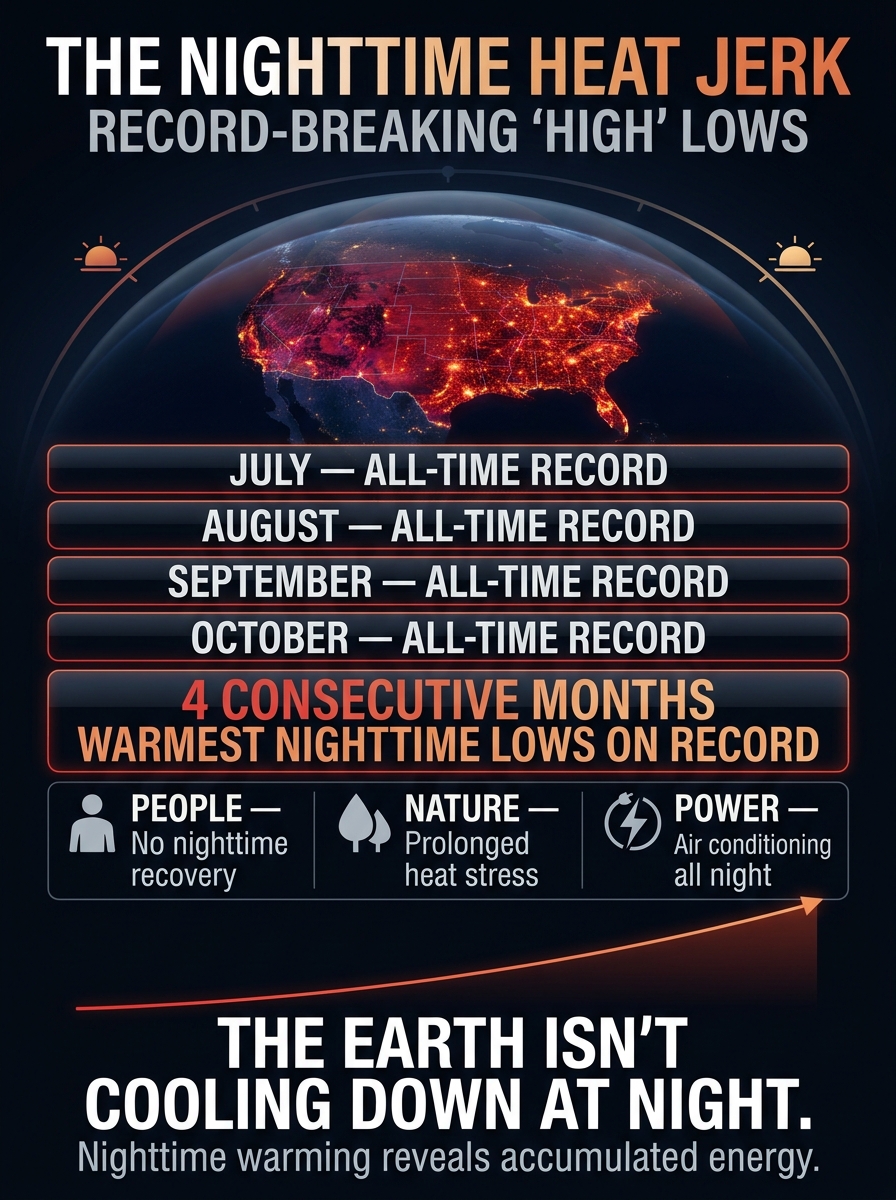
🌡️ FOUR CONSECUTIVE MONTHS. FOUR NIGHTTIME TEMPERATURE RECORDS. ONE ACCELERATING CLIMATE CRISIS.
From July through October 2026, the contiguous United States broke its all-time monthly records for average nighttime minimum temperatures in four consecutive months.
July: All-time record
August: All-time record
September: All-time record
October: All-time record
These aren’t just hot days. They’re increasingly hot nights.
Why does this matter?
🌎 The Earth retains more accumulated heat overnight.
❤️ People, livestock, and ecosystems lose their opportunity to recover from daytime heat.
⚡ Air conditioning demand remains elevated, increasing electricity consumption and grid stress.
📈 Nighttime warming provides another important indicator of accelerating climate change.
This is precisely why our Climate Jerk research examines not just rising temperatures, but the changing rate of warming and the acceleration of climate extremes.
The climate crisis doesn’t stop when the sun goes down.
Read the research:
A New Record in Nighttime Climate Extremes
From July through October 2026, the contiguous United States (CONUS) recorded its warmest average nighttime minimum temperatures for four consecutive months. This unprecedented sequence broke monthly records dating back to 1895, according to the National Centers for Environmental Information (NCEI), part of the National Oceanic and Atmospheric Administration (NOAA).
The significance extends beyond four consecutive temperature records. Nighttime temperatures reveal an increasingly important dimension of climate change: the loss of the Earth’s ability to release accumulated heat after sunset.
While daytime temperatures measure how intensely the surface heats, nighttime minimum temperatures reveal how much heat remains trapped within the atmosphere and surface environment. When nights remain unusually warm, the normal cooling period becomes less effective, creating a higher thermal baseline for the following day.
This is an important component of what we describe as Climate Jerk: not simply rising temperatures, but an accelerating rate of change in the climate system.
Month-by-Month Record Breakdown
July 2026 — A Record-Breaking Start
Average overnight minimum temperature reached 64.2°F, or 3.7°F above the 20th-century average. This exceeded the previous July record, set in 2022, by 0.7°F. July also became the hottest month overall in the 132-year CONUS temperature record.
August 2026 — The Record Continues
Nighttime minimum temperatures established another monthly record. August also completed the hottest meteorological summer (June–August) in the 132-year CONUS record. The summer’s average nighttime minimum reached 61.71°F, the highest in the 1895–2026 dataset.
September 2026 — Extreme Warmth Persists
Average overnight minimum temperatures established another monthly record, exceeding the previous September record by more than 1.2°F. The persistent nighttime warmth extended the extraordinary summer conditions into autumn.
October 2026 — Four Consecutive Monthly Records
Average nighttime minimum temperature reached 46.3°F, 4.9°F above the 20th-century average. This surpassed the previous October record, set in 1947, by 0.1°F. Five states—Colorado, Kansas, New Mexico, Oklahoma and Texas—also recorded their warmest October nighttime minimum temperatures.
The sequence is particularly significant because these records occurred across four consecutive months, spanning the height of summer and extending into autumn. This is not simply a collection of isolated hot days. It is evidence of persistent nighttime warmth across an extended period.
Why Record-Breaking Warm Nights Matter
The significance of nighttime warming goes well beyond temperature records. Nighttime cooling is an essential part of the Earth’s daily energy cycle. It allows people, animals, vegetation, buildings, soils and other components of the environment to release heat accumulated during daylight hours.
When nighttime temperatures remain unusually high, that recovery period becomes less effective.
1. Human Health and Physiological Stress
Elevated overnight temperatures prevent the human body from recovering fully from daytime heat exposure. Core body temperatures remain elevated, cardiovascular strain persists, sleep quality deteriorates, and cumulative heat stress increases.
A heatwave that continues through the night is fundamentally more dangerous than one followed by substantial overnight cooling. The human body loses an important opportunity to recover between successive days of extreme heat.
2. Agriculture and Ecosystem Stress
Plants, livestock and agricultural systems also depend on nighttime temperature reductions.
Persistently warm nights increase plant respiration, interfere with recovery from daytime heat stress and contribute to cumulative physiological strain. Livestock experience prolonged heat stress, while crops face additional challenges to productivity and resilience.
Nighttime warming therefore extends the damaging effects of extreme heat beyond daylight hours.
3. Electricity Demand and Infrastructure
Warm nights keep air-conditioning systems running long after sunset. This increases electricity consumption, extends peak-demand periods and places additional pressure on power generation and transmission infrastructure.
Instead of experiencing the normal overnight reduction in electricity demand, utilities face sustained cooling requirements.
This creates another reinforcing climate feedback:
More heat → more air conditioning → greater electricity demand → additional energy consumption and emissions → more warming.
The effects extend beyond electricity costs to infrastructure reliability, water requirements and household energy expenses.
These mechanisms are examined in greater detail in our research on nighttime heat extremes.
The Nighttime Heat Jerk: Beyond Linear Warming
The four-month record-breaking sequence is particularly important when examined through the Climate Jerk framework.
Traditional climate analysis frequently emphasizes average temperatures and long-term linear warming trends. However, those averages can conceal significant changes in extreme-temperature behavior, persistence and the rate of acceleration.
The important distinction is between three different measurements:
- Velocity: How quickly temperatures are changing.
- Acceleration: How quickly the rate of temperature change is increasing or decreasing.
- Jerk: How quickly that acceleration itself is changing.
Mathematically:
Velocity = dT/dt
Acceleration = d²T/dt²
Jerk = d³T/dt³
Our analysis of NOAA’s 1895–2026 summer nighttime minimum-temperature dataset identifies a significant change in the rate of warming.
The CONUS summer average nighttime minimum temperature reached 61.71°F in 2026, the highest in the historical dataset.
Our regression analysis identifies the following progression:
Period | Nighttime warming velocity
1990–2010 | +0.5774°F/decade
2010–2020 | −0.0345°F/decade
2020–2026 | +0.6893°F/decade
The resulting finite-difference estimate of nighttime temperature jerk is approximately +1.14°F/decade³.
This is not a measurement of an instantaneous temperature increase. It describes the changing rate of acceleration across the analyzed periods.
The four consecutive monthly nighttime records provide additional observational context for this analysis. They demonstrate that extreme nighttime warmth is not confined to one isolated season or a single exceptional month.
The broader evidence is consistent with our central argument: Climate change must be evaluated not only by how much temperatures are rising, but also by how rapidly the behavior of extreme temperatures is changing.
The Broader 2026 Climate Picture
The July–October nighttime records occurred alongside an extraordinary period of overall U.S. warming.
According to NOAA/NCEI:
- July 2026 was the hottest month overall in the contiguous U.S. historical record.
- August 2026 completed the hottest meteorological summer on record.
- September 2026 established a new record for September temperatures.
- October 2026 was the fourth-warmest October overall.
- January–October 2026 became the warmest year-to-date period in the CONUS historical record.
- October marked the 21st consecutive month with above-average CONUS temperatures, extending a streak that began in February 2025.
The January–October record is particularly significant because it demonstrates that the extraordinary warmth was not simply a seasonal anomaly.
The nighttime records add another dimension: the warming persisted through the hours when the environment would normally release accumulated heat.
Conclusion: The Loss of Nighttime Cooling Is a Major Climate Warning
Four consecutive months of record-breaking nighttime minimum temperatures represent an important climate signal.
The significance is not simply that summer nights are becoming warmer. It is that the normal daily cooling cycle is becoming less effective, extending the duration of heat exposure and increasing cumulative stress across human, ecological and economic systems.
Nighttime temperatures deserve far more attention in climate monitoring because daytime highs alone do not adequately describe the energy burden experienced by the environment.
The 2026 records reinforce the importance of examining temperature extremes, their persistence and their changing rates of acceleration.
The climate system is not simply getting warmer. The rate of change is changing, and nighttime warming is one of the clearest places to observe it.
Related Research and References
- Climate Energy and Nighttime Jerk:
https://www.kingarthur.com/global_warming/Climate-Energy-Nighttime-Jerk.html - Extreme Heat Jerk:
https://www.kingarthur.com/global_warming/Extreme-Heat-Jerk.html - Nighttime Heat Extremes:
https://www.kingarthur.com/global_warming/Nighttime-Heat-Extremes.html - NOAA/NCEI — July 2026 U.S. Climate Report:
https://www.ncei.noaa.gov/news/national-climate-202607 - NOAA/NCEI — August 2026 U.S. Climate Report:
https://www.ncei.noaa.gov/news/national-climate-202608 - NOAA/NCEI — September 2026 U.S. Climate Report:
https://www.ncei.noaa.gov/news/national-climate-202609 - NOAA/NCEI — October 2026 U.S. Climate Report:
https://www.ncei.noaa.gov/news/national-climate-202610