Economic forecasting has always carried uncertainty, but under Trump’s current fiscal and trade agenda, that uncertainty has exploded to levels not seen in a century. Policies that economists—left, right, and center—have avoided for 100 years are suddenly being deployed at massive scale. Chief among them: unprecedented import taxation and the largest tariff regime in modern U.S. history.
These policies are not just economically risky—they’re actively destabilizing the tools we rely on to understand the economy. Even the Atlanta Fed’s GDPNow model, one of the most respected real-time forecasting systems, has struggled to capture the resulting volatility.
The First Shockwave: GDP Collapses in Early 2025
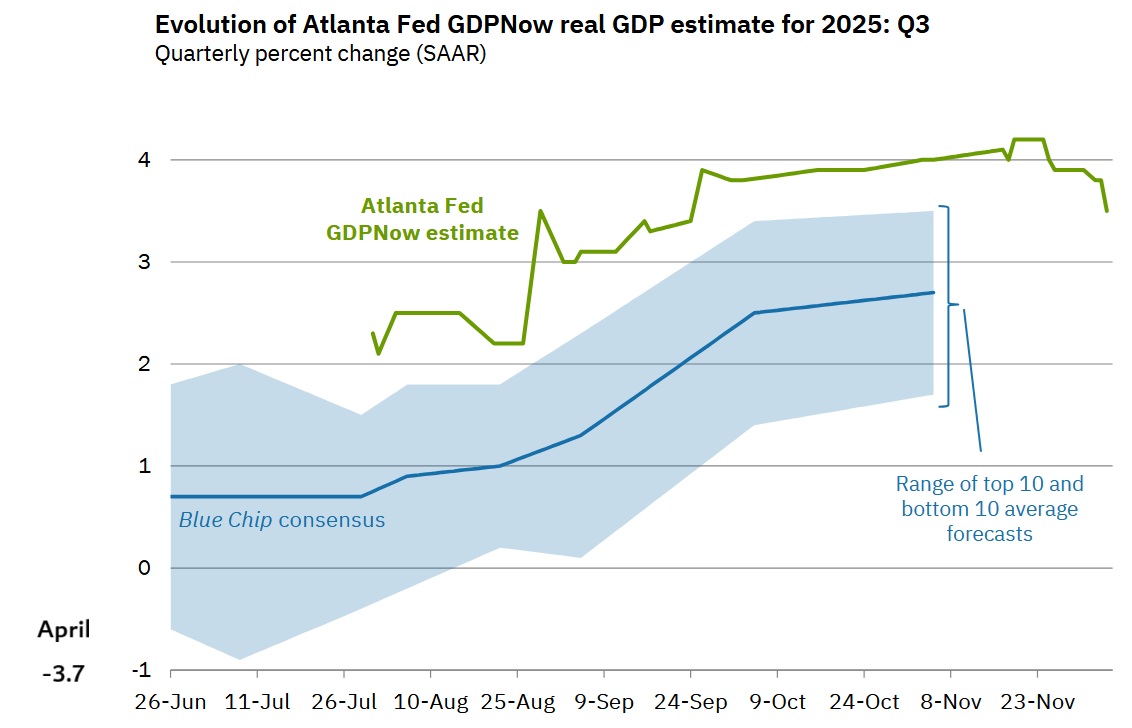
During the first quarter of 2025, the GDPNow model projected real GDP growth (seasonally adjusted annual rate) at –3.7%. The contraction was so sharp that it fell off the scale of standard graph displays.
Crucially, this collapse wasn’t caused by consumer demand or business investment falling apart—it was almost entirely due to the way imports and exports are measured in GDP accounting. With Trump’s tariff schedule looming, businesses launched a massive, front-loaded rush to import goods before the tax hikes hit, causing an artificial spike in imports that mechanically pushed GDP downward.
This is not normal economic behavior. It’s panic behavior—created by policy.
The Tariff Whiplash Effect: Forecasts Go Wild
Once the early-year import surge ended, import levels cratered. Because imports are subtracted in GDP calculations, this plunge created the opposite effect: a predicted surge in GDP growth for late 2025.
Initial projections showed GDPNow spiking to around 5% in Q3 and Q4.
But those optimistic spikes never fully materialized.
The tariffs had a far more damaging, persistent effect on supply chains than anticipated. Import volumes fell harder and for longer than models historically assume possible.
As a result, GDP appears to have briefly peaked at about 4% in November 2025, followed by a rapid decline.
Where the Economy Is Heading Now
Current forecasts show GDP falling sharply again, with projections targeting near 0% growth in the first two quarters of 2026.
And this time, the uncertainty is extreme. Economists describe today’s forecast bands as “cone-of-uncertainty levels wider than during COVID,” because:
- Tariff effects are non-linear and historically unprecedented
- Supply chains are behaving unpredictably
- Consumer prices are destabilizing
- Business investment is freezing due to policy confusion
In short: upside potential is tiny, but downside risk is enormous.
The Supreme Court Wildcard
One of the biggest unknowns is the upcoming Supreme Court ruling on whether Trump’s “retaliatory tariffs” are even legal.
If the Court invalidates them abruptly:
- Imports could surge again
- Supply chains would be thrown into chaos
- Businesses would need to reprice and reorder instantly
- GDP models would again be blindsided
If the Court upholds them, the U.S. remains locked into a historically high-tariff regime that suppresses imports, raises prices, and slows growth.
Either outcome carries major economic shock potential.
Additional Policy Risks on the Horizon
Forecasting also remains clouded by several other Trump-era policy disruptions, each of which could individually affect GDP growth but collectively pose massive systemic risk:
- Immigration restrictions, which could worsen labor shortages and reduce potential GDP
- Healthcare policy uncertainty, especially around ACA destabilization
- Expansion of fossil fuel subsidies, which distort investment flows and long-term energy costs
- Budgetary unpredictability due to inconsistent fiscal priorities
All of these factors compound the difficulty of projecting the next 12–18 months.
Conclusion: The U.S. Is Entering an Economically Uncharted Era
The combination of unprecedented tariffs, volatile trade behavior, unstable supply chains, and sweeping policy changes has pushed the U.S. economy into a state where traditional forecasting tools are struggling to keep up.
This is not just “normal economic noise.”
This is a result of anti-economic policy design, implemented at a scale large enough to break the models themselves.
Until the policy environment stabilizes—and until the Supreme Court resolves key legal uncertainties—the U.S. economy is likely to remain on a knife’s edge, with enormous downside risk and extremely limited upside potential.