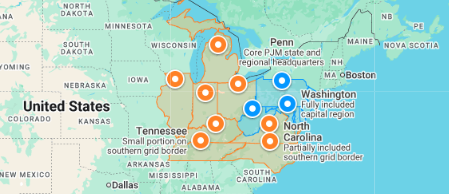
The current heatwave across the PJM region is unfolding within the broader context of ongoing global warming, where rising average temperatures are increasing both the frequency and severity of extreme heat events.
As the climate warms, baseline temperatures shift upward, making extreme heat more likely and more persistent. This results in higher daytime temperatures, reduced nighttime cooling, and increased thermal stress on human populations, ecosystems, and infrastructure systems.
These conditions also place significant strain on the electric grid. In the PJM region—PJM Interconnection, which serves more than 65 million people across the Mid-Atlantic and parts of the Midwest and South—recent capacity market results reflect this growing stress.
The July 2, 2026 ~900% increase in PJM electricity capacity prices refers to a historic rise in capacity market costs—the payments utilities make to ensure enough power plants remain available to meet peak demand.
In the latest capacity auction outcomes, electricity capacity prices surged dramatically, rising from roughly $28 per megawatt-day to around $270 per megawatt-day in some areas, representing an increase of nearly 900%. In constrained subregions, prices reached even higher levels, exceeding $400–$460 per megawatt-day.
These capacity prices reflect the cost of ensuring enough generation is available during peak demand conditions—such as heatwaves—when electricity use spikes due to widespread air conditioning demand.
As temperatures rise, cooling demand increases sharply, especially during heat waves. This creates a cascading set of stresses across the power system:
- higher electricity demand during peak heat events
- increased strain on generation and transmission infrastructure
- increased water demand in some regions for cooling and thermal generation
- higher emissions during peak periods in grids that still rely heavily on fossil fuels
This produces a reinforcing sequence:
more heat → more cooling demand → higher electricity demand → increased emissions (in fossil-reliant systems) → further warming → more heat
In practice, what emerges is not a single isolated feedback loop, but a coupled network of reinforcing systems. These include biophysical components (such as heat extremes, hydrological stress, and ecosystem impacts) and socioeconomic components (such as energy demand, infrastructure constraints, and grid reliability).
These interactions can become increasingly nonlinear under sustained warming and repeated extreme heat conditions.
The key point is that these dynamics are already present in the system, but their magnitude, coupling strength, and long-term impacts vary by region, infrastructure mix, and timeframe. Reducing risk ultimately depends on rapidly reducing greenhouse gas emissions, particularly from fossil fuel combustion, while simultaneously adapting energy infrastructure to increasing heat and demand extremes.