by Daniel Brouse
The One-Two Punch of Doubling Feedbacks
Climate feedbacks are processes in which an initial change in Earth’s climate system triggers additional changes that amplify or dampen the original change. Positive feedbacks amplify the initial warming caused by greenhouse-gas emissions, accelerating climate change beyond what the initial forcing alone would produce.
As Earth’s climate system warms and destabilizes, millions of emerging feedback interactions are becoming active across the atmosphere, oceans, cryosphere, land, and living systems. Many of these interactions are now being observed for the first time in human history. As individual feedbacks activate, strengthen, and interact with one another, they create new pathways for amplifying climate change and accelerating Earth-system change.
Two important climate-system responses illustrate this one-two punch: water-vapor amplification and ocean thermal expansion.
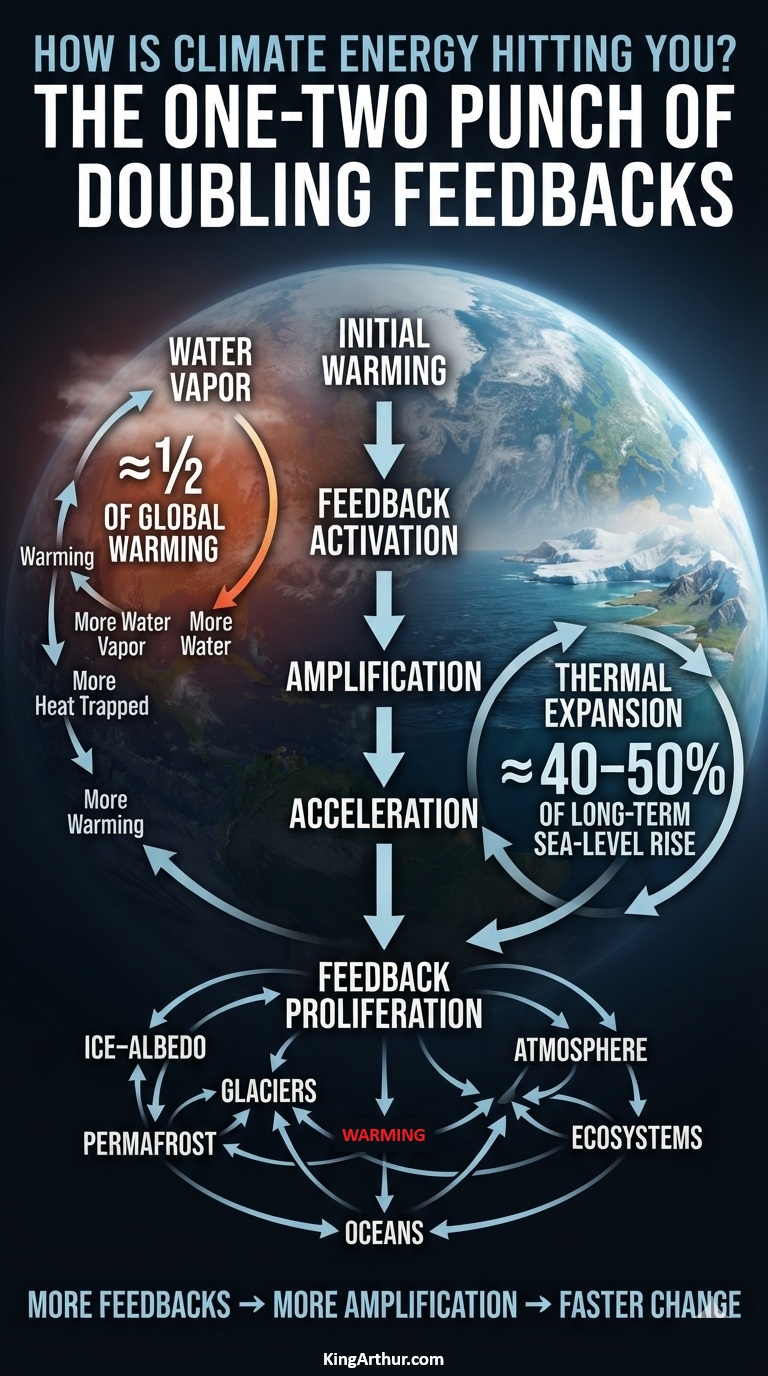
Water Vapor: The First Punch
Water vapor is Earth’s most important natural greenhouse-gas feedback.
As the atmosphere warms, it can hold more water vapor. Because water vapor is itself a powerful greenhouse gas, additional atmospheric moisture traps more outgoing infrared radiation, causing further warming. That additional warming allows the atmosphere to hold still more water vapor.
It is a reinforcing cycle:
Warming → more water vapor → more heat trapped → more warming
Water-vapor feedback is Earth’s greatest climate amplifier. As temperatures rise, the atmosphere holds more water vapor, which traps additional heat and amplifies the initial warming. Water-vapor feedback is responsible for approximately half of the global warming observed since the 1990s, making it one of the most powerful mechanisms accelerating Earth-system warming.
Thermal Expansion: The Second Punch
The ocean delivers a different kind of climate response.
More than 90% of the excess heat accumulating in the Earth system is absorbed by the ocean. As seawater warms, it expands, increasing ocean volume and contributing to global sea-level rise.
This process is called thermal expansion or steric sea-level rise.
Thermal expansion has historically contributed roughly 40% to 50% of long-term global sea-level rise, with the remainder coming primarily from melting glaciers and ice sheets. The exact contribution varies over time and depends on the period and measurement method.
The process is straightforward:
Ocean warming → seawater expands → sea level rises → coastal erosion + increased basal melting → more meltwater → further sea-level rise
The One-Two Punch
The water-vapor and thermal-expansion processes demonstrate two different ways excess climate energy can double the impact of climate change. Water-vapor feedback can approximately double the warming impact of greenhouse-gas emissions, while thermal expansion can approximately double the sea-level-rise impact by adding substantial additional sea-level rise beyond the contribution from melting land ice alone.
Water vapor amplifies warming.
Thermal expansion raises the oceans.
And neither operates in isolation.
As warming increases, additional feedbacks can become activated or strengthened—including ice-albedo feedback, permafrost carbon release, glacier and ice-sheet loss, and changes in ocean and atmospheric circulation.
The result is not a simple linear response.
More warming → more feedbacks → more warming → greater physical impacts
That is the one-two punch of climate feedbacks: the initial energy imbalance changes the climate system, while reinforcing processes can amplify the consequences.
The question is no longer simply “How much has Earth warmed?”
The more consequential question is:
“What is that additional climate energy doing to the Earth system—and how quickly are the feedbacks making it worse?”