by Daniel Brouse
Ocean Heat Accumulation
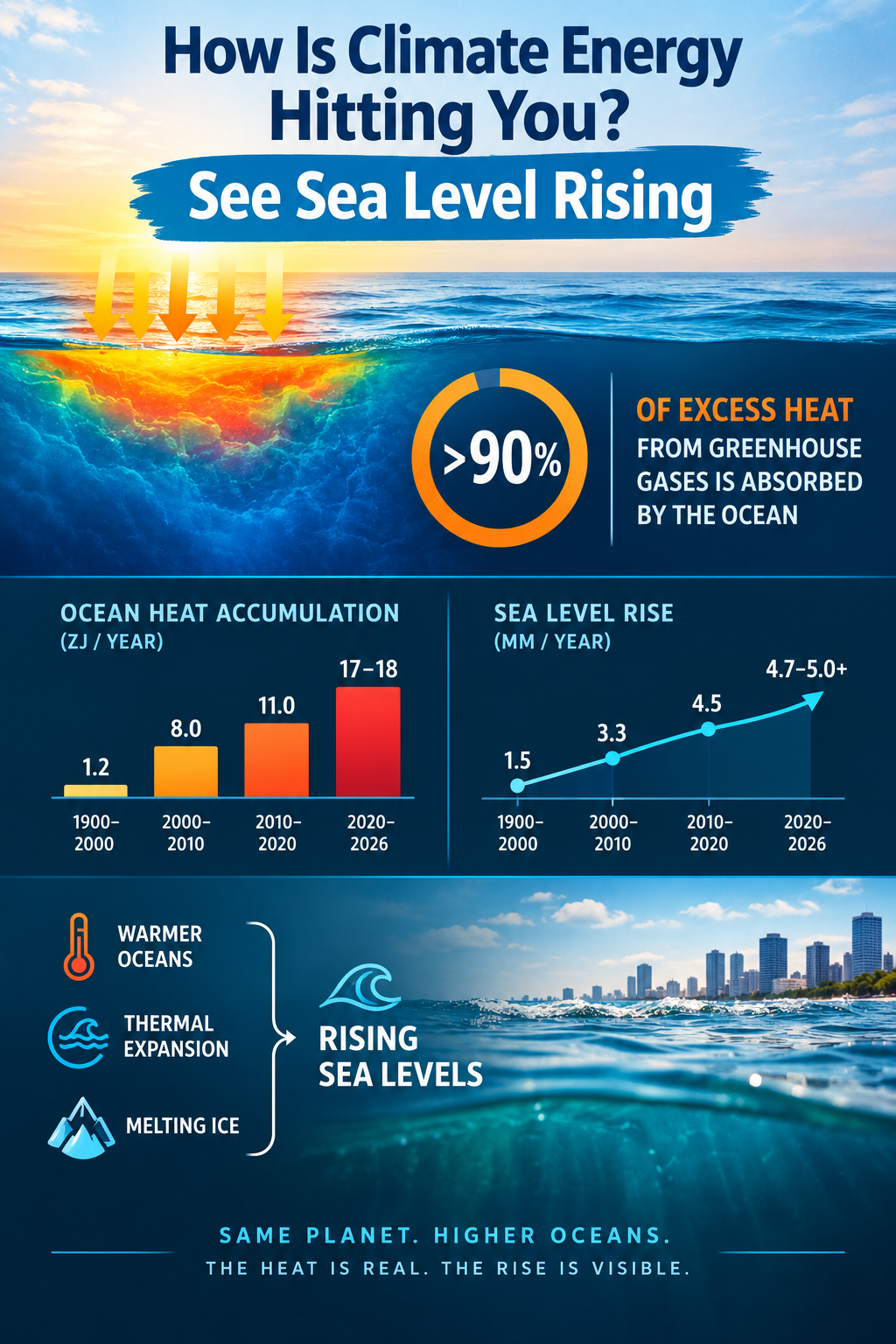
More than 90% of the excess heat trapped in Earth’s climate system by human-caused greenhouse gas emissions is absorbed by the ocean.
Because water has a much higher heat capacity than air, the global ocean acts as a massive climate buffer. Without this vast heat reservoir soaking up the energy from burning fossil fuels, the atmosphere and land surfaces would be warming at a drastically faster, potentially unlivable rate.
But the ocean’s ability to absorb heat does not make that energy disappear. It stores the energy and redistributes it throughout the climate system—with consequences that include rising sea levels, melting ice, changing ocean circulation, and increasingly energetic climate feedbacks.
Estimated Rates of Ocean Heat Accumulation
| Period | Approximate Rate |
|---|---|
| 1900–2000 | ~1.2 ZJ/year |
| 2000–2010 | ~8.0 ZJ/year |
| 2010–2020 | ~11.0 ZJ/year |
| 2020–2026 | ~17.0–18.0 ZJ/year |
Key Factors Behind the 2026 Update
The 2025–2026 Acceleration
The 2020–2025 baseline average of approximately 16 ZJ/year was shattered by a massive, record-breaking surge reported in early 2026.
Peer-reviewed findings from the Institute of Atmospheric Physics (IAP/CAS) and Copernicus Marine revealed that the ocean absorbed an astonishing ~23 ZJ of excess heat in 2025 alone—up from ~16 ZJ in 2024.
That increase represents more than simply a large amount of additional heat. It is evidence of an accelerating rate of energy accumulation in the ocean.
Thermal Expansion
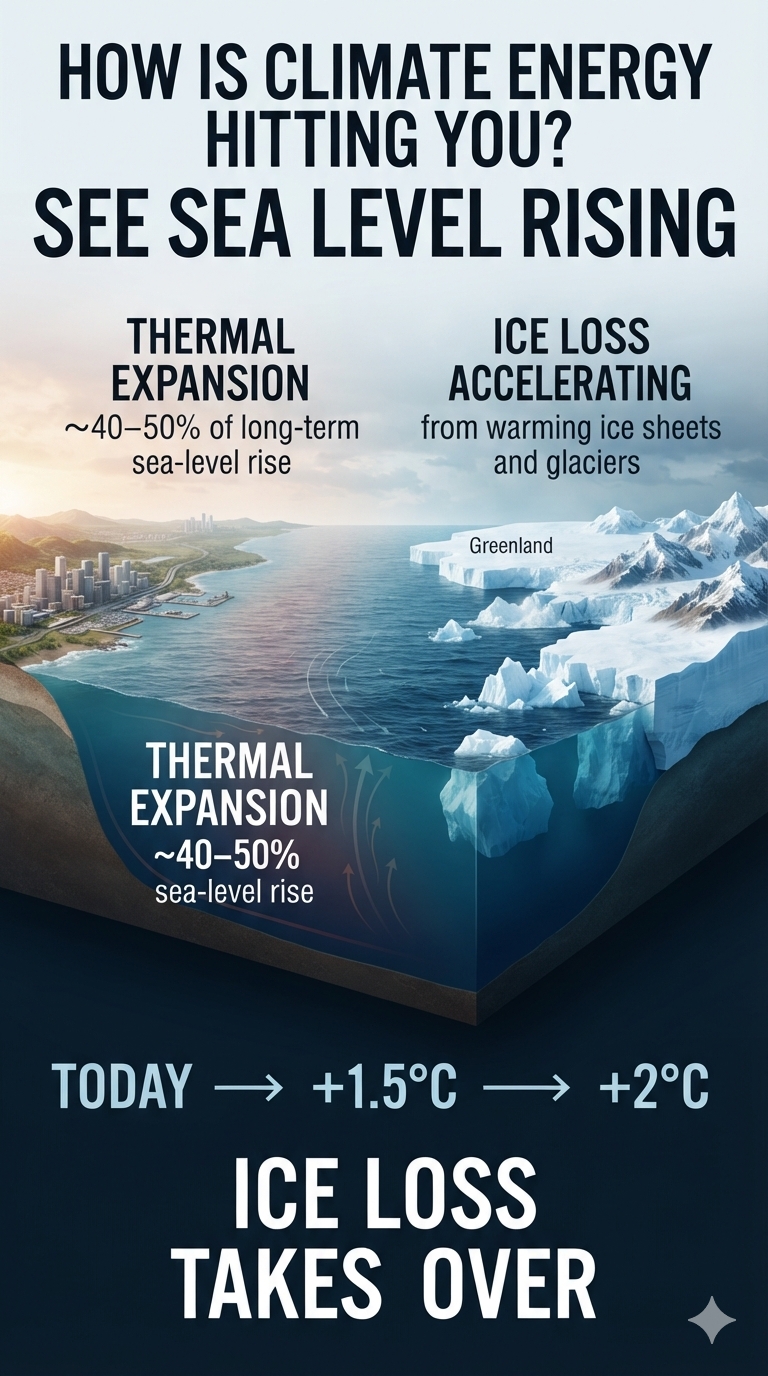
Thermal expansion is responsible for roughly 40% to 50% of long-term global sea-level rise. Over the last few decades, the drivers of rising oceans have generally been split roughly down the middle between thermal expansion—the swelling of water as it heats up—and meltwater from glaciers and ice sheets.
The percentage can fluctuate dramatically from year to year because of global weather patterns.
For instance, according to a NASA analysis, a massive surge in ocean heat during the 2024 El Niño caused a temporary flip: two-thirds, or about 66%, of that year’s accelerated sea-level rise came from thermal expansion alone.
Because the ocean is so vast, it acts like a giant, slow-moving thermal battery. Even if global greenhouse gas emissions were to completely stop today, the heat already trapped in the climate system would continue to move into the deep ocean for centuries.
This means sea levels will continue to rise from thermal expansion long after surface temperatures stabilize. As global temperatures rise beyond 1.5°C to 2°C, the rate of ice sheet melt is projected to grow exponentially, drastically outpacing thermal expansion. By the end of the century, scientists expect melting ice sheets and glaciers to become the overwhelmingly dominant driver, shrinking thermal expansion’s proportional share well below its current 40%–50% baseline.
The ocean therefore provides a critical buffer against even faster atmospheric warming—but that buffer comes with a cost. The energy being absorbed by the ocean is physically expanding the water and helping drive sea-level rise.
Rate of Sea-Level Rise
| Period | Approximate Rate |
|---|---|
| 1900–2000 | ~1.5 mm/year |
| 2000–2010 | ~3.3 mm/year |
| 2010–2020 | ~4.5 mm/year |
| 2020–2026 | ~4.7–5.0+ mm/year |
Sea Level Rise Is Accelerating
Sea-level rise is not occurring at a constant rate.
The rate has increased substantially over the past century, from roughly 1.5 mm/year during 1900–2000 to approximately 4.7–5.0+ mm/year during 2020–2026.
In other words, sea level rise is accelerating—and the acceleration itself is accelerating.
What happens in the ocean does not stay in the ocean.
The heat accumulating in the world’s oceans is becoming a physical signal we can see: sea level rising.