by Daniel Brouse
Introduction
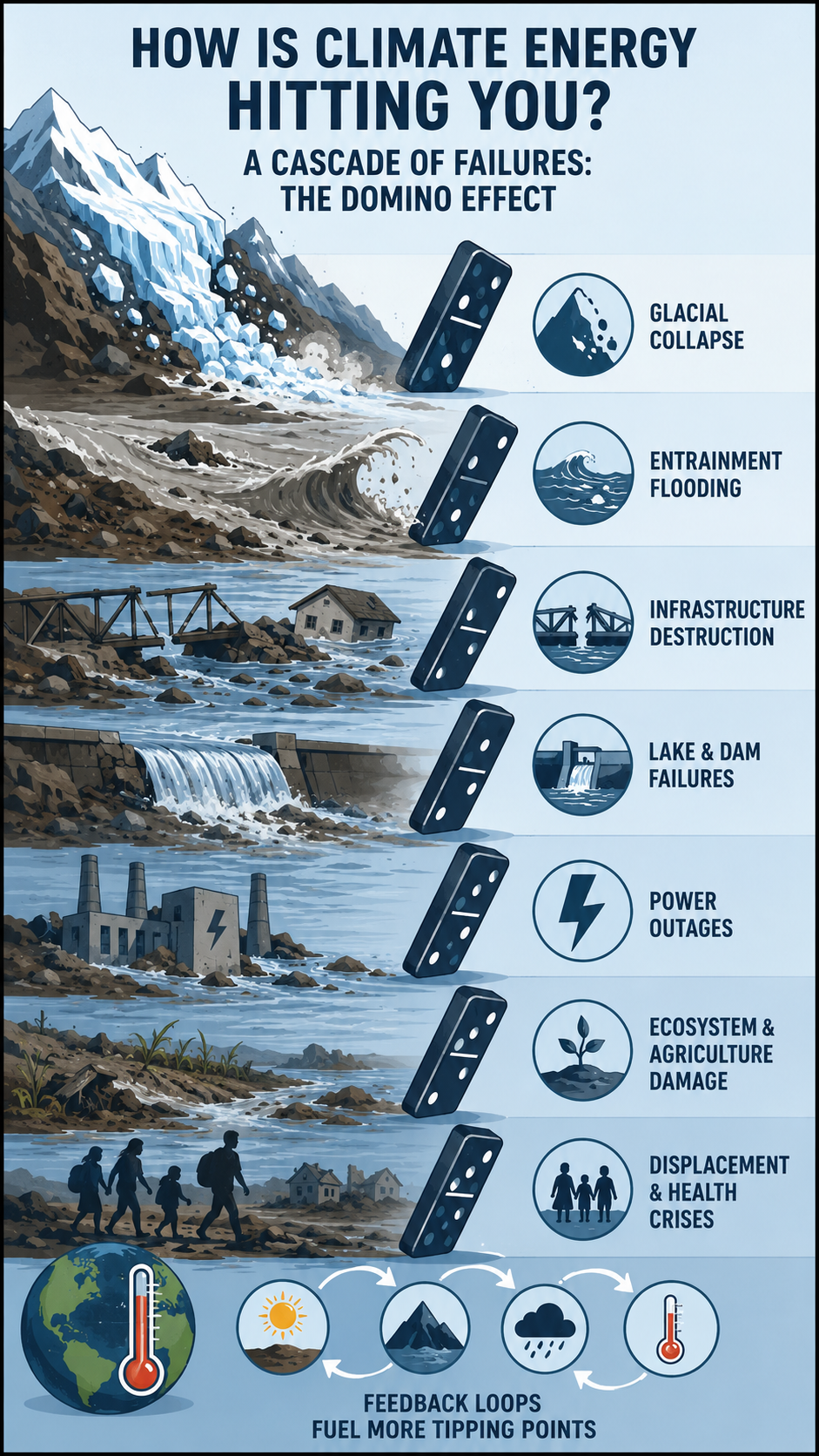
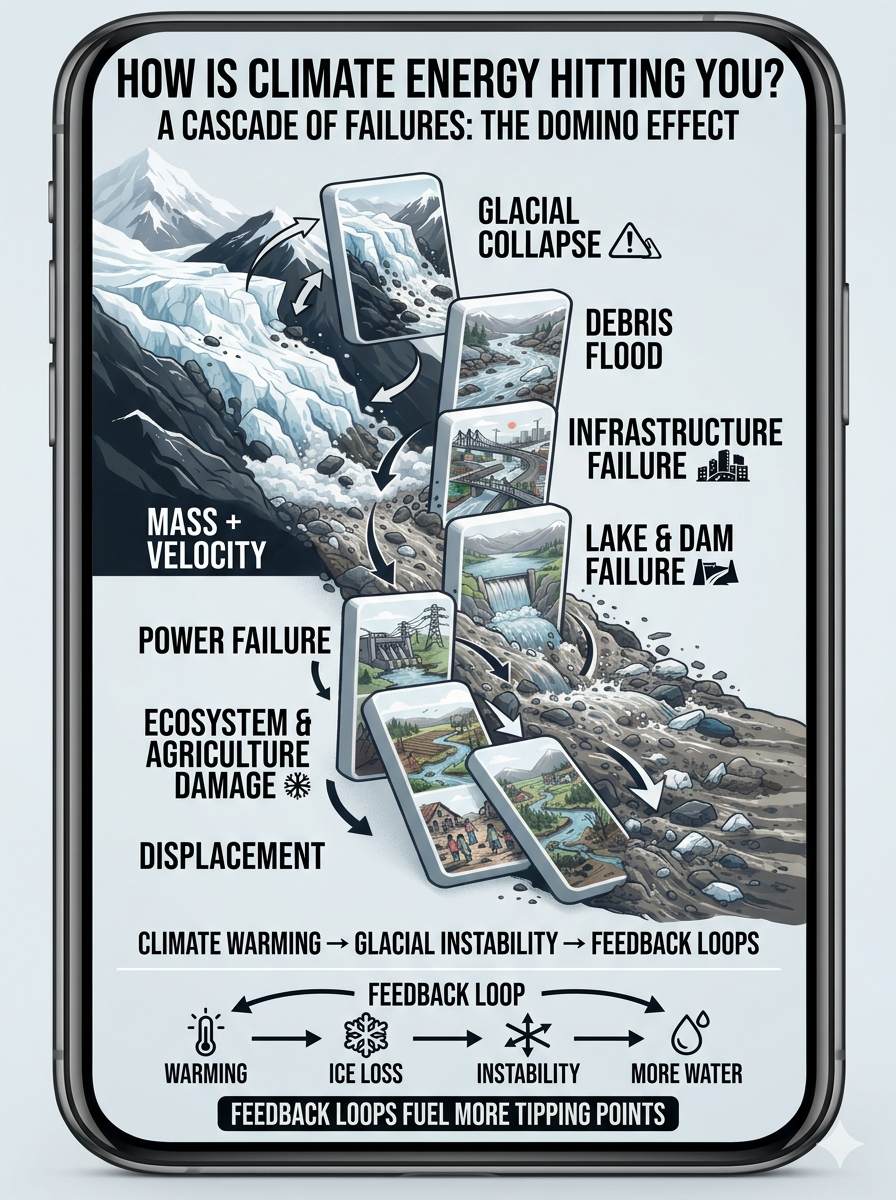
A glacial collapse is a powerful example of how climate change can turn one tipping point into a cascading chain of failures—the domino effect.
The first domino is literal: an enormous mass of ice, rock, snow, and sediment breaks loose and cascades down the mountainside in a massive avalanche or landslide. But the collapse does not end when the material reaches the valley floor. It can trigger the next domino: entrainment flooding.
As floodwater picks up soil, sediment, rocks, ice, trees, and other debris, it can transform into an extraordinarily dense, wet, cement-like slurry. This is no longer simply water flowing downstream. It is a moving mass with enormous mass, density, and velocity—and therefore enormous destructive energy.
As this debris-laden flow accelerates through steep mountain valleys, it can sweep away bridges, roads, buildings, power infrastructure, and entire sections of communities. But the dominoes still do not stop.
The flood can undermine riverbanks, destabilize slopes, overwhelm reservoirs, damage hydropower facilities, and compromise other natural or engineered barriers—including dams and glacial lakes. A single upstream failure can therefore create the conditions for multiple downstream failures.
And then comes the most dangerous part: the cascade can reinforce the very climate and physical feedbacks that made the system unstable in the first place.
The initial collapse can expose dark rock and soil, reducing surface albedo and increasing heat absorption. It can expose and destabilize permafrost. Meltwater and rainfall can infiltrate fractures and sediments, reducing friction and increasing lubrication. Additional water can enlarge glacial lakes and increase pressure against unstable moraine dams. Continued warming can accelerate glacier retreat and meltwater production, while changing precipitation patterns and more intense rainfall can add still more water and mechanical stress to an already destabilized landscape.
The chain becomes:
Glacier retreat → increased meltwater → glacial-lake expansion → permafrost thaw → ice and rock destabilization → landslide or glacial collapse → entrainment flooding → infrastructure failure → secondary lake and dam failures → additional flooding → further destabilization.
The energy does not simply disappear when the first domino falls.
It is transferred from ice to rock, from rock to water, from water to sediment, and from the moving flood into everything in its path.
This is the critical distinction between viewing climate change as a gradual change in temperature and understanding it as a dynamic physical system capable of cascading failures.
The question is no longer simply how much the planet is warming.
The question is:
How much energy is being loaded into the system—and what happens when the dominoes start falling?
A Continuous Cascade of Failures: The Nepal-Tibet Domino Effect
A mountain disaster rarely ends where it begins.
On Wednesday, August 26, 2026, a major glacial collapse in the Nepal–Tibet border region triggered devastating flash flooding. By Friday, August 28, the emergency had escalated again: an enormous new barrier lake, created when landslide debris choked a river confluence, was overflowing continuously under ongoing heavy rain.
The immediate danger is obvious—the potential failure of the unstable debris dam and the sudden release of millions of cubic meters of water downstream.
But the larger story is the cascade.
When ice collapses, rock moves. When rock blocks a river, water accumulates. When water overtops the blockage, the barrier can erode. When the barrier fails, a flood carries enormous quantities of sediment and boulders downstream. That surge can destabilize other slopes, erode riverbanks, damage infrastructure, and potentially trigger additional lake or moraine failures.
One failure can therefore become the next failure.
This is the domino effect of climate energy.
The First Domino: Ice, Rock, Water and Gravity
The massive debris generated by the initial landslide has choked the confluence of the Chhochen Khola and Purepu Tsangpo rivers on the Tibetan side, trapping an estimated 2.5 million cubic meters of water.
Ongoing heavy rainfall is adding even more water to an already unstable system.
The resulting barrier lake is not a conventional engineered dam. It is a temporary structure composed of landslide debris—rock, sediment, ice and soil—whose stability can change rapidly as water rises and begins eroding the barrier.
If the barrier breaches, the result would not simply be a larger river.
It could be a rapidly moving mixture of water, mud, sediment, boulders and debris, capable of scouring river channels, destroying bridges and roads, damaging hydropower facilities, and destabilizing additional natural barriers downstream.
The first domino would have fallen.
The Second Domino: A Network of Vulnerable Glacial Lakes
The danger does not end with the newly formed barrier lake.
The high mountains of the Nepal–Tibet region contain numerous glacial lakes held back by natural moraine and debris dams. Some have expanded dramatically as glaciers retreat and meltwater accumulates.
This creates a dangerous characteristic of mountain watersheds:
The hazards are connected.
A flood originating high in a watershed can travel rapidly downstream, carrying enough water and sediment to erode banks, undercut slopes, destabilize moraines, and overwhelm infrastructure.
That does not mean every lake will fail in sequence. It means that the failure of one component can increase stress on other components of an already unstable system.
Among the glacial lakes and hazard zones requiring close attention are:
Thulagi Glacial Lake — Marsyangdi River Basin
Located in the Manang District, Thulagi Glacial Lake has long been recognized as a significant glacial-lake hazard.
Its vulnerability is associated with the stability of its natural moraine dam and the potential for disturbances—including upstream ice or rock avalanches—to generate sudden waves or overtopping.
Lower Barun Glacial Lake — Sankhuwasabha District
Lower Barun lies in a rapidly changing high-altitude environment where glacier retreat and changing meltwater inputs can alter lake volume and moraine stability.
Its expansion illustrates a fundamental climate problem:
The landscape itself is changing faster than the infrastructure and hazard-management systems built around it.
Lumding Tsho — Solukhumbu District
Lumding Tsho represents another potential component of a connected high-mountain hazard system.
Rapid changes in surrounding glaciers, slopes and permafrost can alter the conditions controlling lake stability. A major avalanche, landslide or flood entering the lake could potentially produce dangerous waves or overtopping.
Hongu 2 — Solukhumbu District
Hongu 2 is another glacial-lake hazard requiring monitoring and risk reduction because of vulnerabilities associated with its natural damming structures.
The important point is not that every lake will suddenly fail.
It is that multiple unstable components exist within interconnected watersheds.
That changes the nature of the risk.
A Transboundary Domino Effect
The geography makes the situation even more dangerous.
The Himalaya is a connected hydraulic system. Water generated at extreme elevations can travel from the Tibetan Plateau into steep Nepalese valleys, where narrow channels concentrate enormous amounts of energy.
A flood does not recognize an international border.
A landslide in Tibet can therefore become an infrastructure emergency in Nepal.
A flood generated hundreds of kilometers upstream can destroy roads, bridges, hydropower facilities, agricultural land and communities downstream.
Past Himalayan GLOF events demonstrate how quickly an upstream disturbance can become a downstream catastrophe.
The July 2025 supraglacial lake outburst north of Langtang Himal is one example of the speed with which high-altitude water hazards can propagate into populated and economically important river corridors.
The critical issue is connectivity.
The mountains, glaciers, lakes and rivers are not independent hazards.
They are components of one interconnected system.
Climate Warming Loads the System With More Energy
This is where the story becomes larger than a single landslide or flood.
Climate change is altering the physical conditions that determine how much energy is stored in the mountain environment and how easily that energy can be released.
Warming contributes to:
- Glacier retreat
- Increasing meltwater production
- Expansion of some glacial lakes
- Thawing mountain permafrost
- Destabilization of ice and rock
- Changing precipitation patterns
- More intense rainfall events in some regions
- Increasing exposure of unstable slopes
The result is not simply more water.
It is a landscape containing more potential pathways for rapid energy release.
Water provides mass.
Gravity provides acceleration.
Steep terrain provides a pathway.
And when water interacts with loose sediment, ice and fractured rock, the resulting flow can become dramatically more destructive.
Permafrost: The Mountain’s Hidden Glue
High-altitude permafrost acts in part as a structural component of mountain slopes.
When permanently frozen ground warms and thaws, ice that previously helped bind rock and sediment together can disappear.
That can weaken slopes.
The consequences can include:
Rockfall → landslide → avalanche → river blockage → barrier lake → outburst flood.
Each stage creates the possibility of the next.
The initial failure can also expose previously frozen ground to warmer air, rain and meltwater, potentially accelerating local instability.
This is a critical climate feedback:
Warming destabilizes the mountain. Mountain collapse exposes more material. Exposed material absorbs heat and water. Instability increases.
Albedo Loss: From White Ice to Dark Rock
Ice and snow reflect a large proportion of incoming solar radiation.
Rock, soil, mud and exposed debris absorb considerably more.
When glaciers retreat or collapse, their reflective surfaces are replaced by darker terrain.
That creates a local energy imbalance:
Less reflection → more absorption → more warming → more melting and thawing.
Albedo loss is therefore another feedback mechanism operating alongside glacier retreat and permafrost thaw.
The mountain landscape is not simply losing ice.
It is changing the way it absorbs and stores energy.
Friction, Lubrication and the Release of Stored Energy
There is another physical mechanism that matters: friction.
Rock, ice and sediment can remain relatively stable when friction holds them in place.
But meltwater and rainfall can penetrate fractures and saturated sediments, reducing effective friction and increasing lubrication along some surfaces.
Under glaciers, meltwater can also act as a lubricant, allowing ice to move more rapidly across the bed.
The basic physical principle is straightforward:
When friction decreases, movement becomes easier.
That means climate-driven increases in meltwater can affect not only the amount of water entering a watershed, but also the mechanical stability and mobility of ice, sediment and rock.
The result is another pathway through which climate energy can become kinetic energy.
The Economic Domino Effect
The physical cascade rapidly becomes an economic cascade.
Hydropower
Himalayan hydropower facilities are particularly vulnerable because they are located directly within steep, confined river corridors.
Floods carrying enormous quantities of sediment, gravel and boulders can:
- Damage intake structures
- Fill reservoirs with sediment
- Destroy transmission infrastructure
- Erode turbines and mechanical equipment
- Block access roads
- Force prolonged shutdowns
The destruction of a single hydropower facility can therefore produce consequences far beyond the immediate flood zone.
Roads and Bridges
High mountain communities depend on relatively few transportation corridors.
When a bridge or highway is destroyed, there may be no practical alternative route.
A single failure can isolate entire communities and make emergency response and reconstruction substantially more difficult.
Transboundary infrastructure—including major crossings such as the Friendship Bridge—can become critical points of failure.
Agriculture
Floodwater does not simply deposit fertile soil.
A high-energy debris flood can bury agricultural land beneath layers of:
- Rock
- Gravel
- Sand
- Mud
- Coarse sediment
- Organic debris
Fields can become unusable for multiple growing seasons.
The agricultural domino effect becomes:
Flood → soil burial → crop loss → food insecurity → income loss → displacement.
The Ecological Domino Effect
The ecological consequences can be equally profound.
Rivers Become Sediment Conveyors
Extreme sediment loads can dramatically increase turbidity and reduce water quality.
Fine sediment can smother aquatic habitat while larger debris physically alters channels.
Fish populations can decline, disrupting food webs that extend from aquatic insects and fish to birds, mammals and human communities.
Protected Ecosystems Are Not Immune
Mountain ecosystems are among the most fragile environments on Earth.
Floods and landslides can destroy habitat within protected areas such as Langtang National Park.
Species adapted to narrow ecological zones have limited ability to escape rapidly changing landscapes.
The loss of habitat therefore becomes another domino:
Physical destruction → habitat fragmentation → population stress → biodiversity loss.
The Human Health Domino Effect
A major flood also creates an immediate public-health emergency.
Floodwaters can destroy sanitation systems and contaminate drinking-water supplies with sewage, animal waste, debris and other pollutants.
Where clean water becomes unavailable, the risk of waterborne disease increases.
But health consequences extend beyond infectious disease.
Survivors may lose:
- Homes
- Livelihoods
- Schools
- Transportation
- Family members
- Community networks
The psychological consequences of sudden disaster can persist long after the floodwaters recede.
Displacement Becomes the Final Domino
When communities are repeatedly exposed to catastrophic flooding, landslides and infrastructure failure, relocation can become unavoidable.
That produces a final cascade:
Climate disruption → disaster → infrastructure loss → economic collapse → displacement.
People displaced by climate-related disasters may face years of uncertainty rather than a temporary interruption.
And when multiple communities experience the same process simultaneously, the effects can spread well beyond the original disaster zone.
This Is What a Cascade Looks Like
The most important lesson from the Nepal–Tibet emergency is not simply that a glacier collapsed.
It is that the consequences of climate change increasingly emerge as connected chains of physical failure.
The sequence can look like this:
Warming
↓
Glacier retreat + permafrost thaw
↓
Ice and slope destabilization
↓
Landslide / avalanche / glacial collapse
↓
River blockage
↓
Barrier lake formation
↓
Lake expansion + overtopping
↓
Glacial Lake Outburst Flood
↓
Sediment + boulders + debris
↓
River-channel erosion
↓
Secondary landslides and infrastructure failures
↓
Hydropower disruption
↓
Road and bridge destruction
↓
Agricultural losses
↓
Water contamination
↓
Ecosystem collapse
↓
Economic disruption
↓
Displacement
The dominoes are connected.
And the energy driving them is not theoretical.
It is stored in ice, water, rock, gravity and the atmosphere.
Climate change is altering how much energy is available, where it is stored, and how quickly it can be released.
That is why the question is not simply:
How much is the planet warming?
The more important question is:
How Is Climate Energy Hitting You?
Because when the Earth starts moving, one failure can become another—and another—and another.