by Daniel Brouse
How Is Climate Energy Hitting You Nepal-Tibet?
A: Like Wet Concrete (Fluidize Physics)
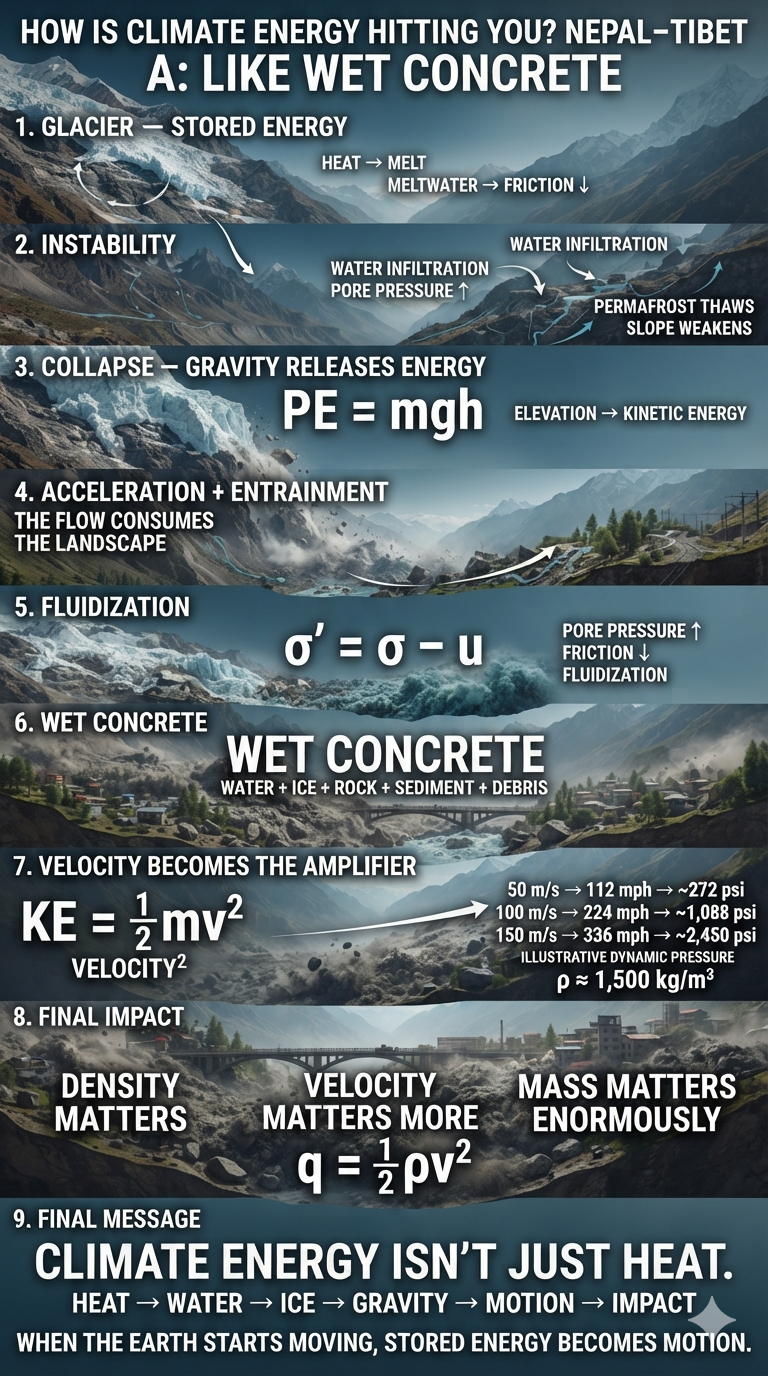
Heat melts ice. Meltwater changes friction. Water infiltrates soil. Pore pressure rises. Permafrost thaws. Slopes weaken. Glaciers destabilize. Gravity converts elevation into kinetic energy. Moving water entrains sediment. Sediment increases density. Increasing density increases the potential force of the flow. Velocity increases kinetic energy according to v². And then the landscape itself becomes part of the moving mass.
The Physics of the Langtang Lirung Glacier Collapse
The sequence is more accurately understood as a progression from glacier failure to gravitational acceleration, fragmentation, collision and deformation, water and sediment entrainment, increasing pore-water pressure, reduced effective friction, partial fluidization, and ultimately high-mobility debris-flow propagation.
There was a video of what appeared to be a large boulder rolling along the top of the entrained material, sometimes seeming to bob up and down as the flow moved beneath it. At first, I thought I was simply watching rock being carried by a flood. But the more I watched, the more complicated the physics appeared to be.
The bulk of the larger rock and ice appears to have come through first, driven by the initial collapse, gravity, and the rapidly moving water and debris. In doing so, it essentially carved and scoured a channel through the valley. Then came something very different: an enormous mass of mud, sediment, ice, rock, vegetation, and structural debris—apparently reaching several stories in depth—that overwhelmed and buried villages.
As for whether what we are seeing is rock or ice, it was probably a combination of both. One report described the material as being like “wet concrete,” which is actually a remarkably useful way to visualize what was happening. It captures something that ordinary words like “flood” or “mudslide” don’t fully convey. This wasn’t simply water carrying a little mud. It was a dense, multiphase mixture of water, sediment, rock, ice, vegetation, and everything else it encountered, moving together as a highly energetic mass.
The Bridge Experiment Nobody Intended to Conduct
I also saw video of a bridge collapse that really demonstrated the power of the flow. What amazed me was what initially looked almost like “buoyancy.” The entrainment was so dense and forceful that the bridge appeared to be lifted onto the surface of the moving material, carried downstream, and then used almost like another projectile when it encountered a second bridge. The second bridge appeared to do something similar.
Both structures were ultimately carried downstream, taking out virtually anything and everything in their path. Of course, this isn’t true buoyancy in the simple sense of a bridge floating in water. The physics is more complicated. A dense debris flow can exert enormous upward, lateral, and drag forces on an object. A structure can become partially supported, displaced, rotated, or entrained by the moving mass beneath and around it. Once a structure becomes part of the flow, it is no longer simply an obstacle. It becomes debris—and that debris becomes part of the destructive machinery of the flow.
That is the remarkable thing about these events. Water, sediment, rock, ice, trees, buildings, bridges, and pieces of the riverbank can become mechanically coupled into one enormous moving system. The density increases. The mass increases. The momentum increases. And the destruction compounds.
The Physics Begins With Gravity
The most important number in understanding this event may not be the one-kilometer distance over which the material traveled. It may be the approximately 1,200–1,300 meters of elevation that the collapsing mass lost between the glacier and the valley floor.
The lower section of the unnamed glacier was reportedly located at approximately 5,200 meters—about 17,000 feet—on the northern slopes of the Mount Langtang Lirung massif. The Lhende Khola valley floor lies roughly 3,900–4,000 meters above sea level. That means the system had approximately 1,200–1,300 meters of vertical gravitational head.
That is an enormous amount of stored gravitational energy.
The gravitational potential energy of a mass is:
PE = mgh
where m is mass, g is gravitational acceleration, and h is the vertical elevation difference.
For every kilogram of material, a 1,200–1,300 meter elevation loss represents approximately 11,800–12,800 joules of gravitational potential energy. If all of that energy could somehow be converted perfectly into kinetic energy, the corresponding free-fall-equivalent velocity would be:
v = √(2gh)
For a 1,200-meter drop, that produces approximately 153 m/s, or 343 mph. For a 1,300-meter drop, it produces approximately 160 m/s, or 357 mph.
Those numbers are startling, but they need to be understood correctly. They do not mean that the debris actually struck the valley floor at 343–357 mph. They represent an idealized upper-bound velocity scale—the speed a mass would acquire if gravitational potential energy were converted perfectly into kinetic energy without energy losses.
A real glacier collapse is nothing like free fall. Energy is consumed by fracturing ice and rock, deformation, friction, collisions, turbulence, air resistance, terrain geometry, erosion, entrainment, and the conversion of organized gravitational motion into chaotic motion within the debris mass. The actual velocity would therefore have been substantially lower and would have varied throughout the event.
But the calculation is still important because it tells us how much energy gravity made available to the system.
When Ice, Rock, Water, and Debris Become One Moving System
The original material at the top was probably heterogeneous. There could have been ice, snow, rock, sediment, water, and other material mixed together. As the mass accelerated, it was subjected to enormous stresses. Ice fractured. Rock fractured. Sediment was stripped from the landscape. Water was incorporated into the moving material. Trees and vegetation were uprooted. Structures and riverbank material were entrained.
Every collision changed the composition of the flow.
This is where the term “entrainment” becomes extremely important. The moving mass doesn’t simply travel over the landscape. It consumes the landscape. It picks up additional sediment, rock, water, vegetation, soil, and structures along the way. That increases the mass of the flow while simultaneously changing its physical properties.
Once the material becomes heavily saturated, another process becomes critically important: pore-water pressure.
Water Can Reduce Friction
This is one of the strangest aspects of the physics. We generally think of water as something that slows things down. But water under pressure between particles can reduce the friction holding those particles together.
In simplified form:
σ′ = σ − u
where σ′ is effective stress, σ is total stress, and u is pore-water pressure.
As pore-water pressure rises, effective stress falls. As effective stress falls, frictional resistance can decrease. That can make a slope or debris mass dramatically more mobile.
This is one reason why a wet, saturated mass can behave very differently from the dry rock, soil, and ice from which it originated. The material doesn’t literally turn into water. Instead, the water becomes part of a coupled solid-fluid system in which fluid pressure helps support and mobilize the solid particles. Under sufficiently energetic conditions, a granular mass can become partially liquefied or fluidized.
That is the “wet concrete” effect.
Another Lubrication Effect: Meltwater Beneath the Ice
There is also the possibility of basal lubrication beneath moving ice. Meltwater accumulating beneath a glacier can reduce basal friction and permit basal sliding, sometimes dramatically increasing the mobility of the ice.
That makes footage showing substantial water emerging from beneath the glacier particularly interesting. If meltwater was present beneath the ice, it could have contributed to the initial mechanical instability. If water was also available downstream, it could subsequently become incorporated into the collapsing ice-rock mass.
This creates the possibility of a coupled sequence: meltwater can reduce basal friction and increase glacier movement; movement can contribute to collapse; collapse releases gravitational potential energy; acceleration causes fragmentation and entrainment; and increasing water content and pore pressure can subsequently reduce internal friction and promote fluidization.
This is not one process. It is several physical processes interacting with one another.
The Ground Itself Can Become Part of the Flow
There is another important factor. Thawing permafrost and destabilized soil and peat can weaken the material that normally helps hold mountain slopes together. Add unusually warm conditions and significant precipitation preceding the event, and you potentially have several destabilizing mechanisms operating simultaneously: meltwater infiltration, increasing water pressure, reduced basal friction, thawing ground, weakened sediment and rock, and gravity acting on a huge mass of ice and rock.
That is why I am hesitant to characterize an event like this simply as an “ice collapse” or a “rockslide.” It appears more useful to think of it as a coupled ice-rock-water system in which one failure mechanism can trigger another.
What Happened to the Ice?
The ice-water mixture near the top of the fall may have been predominantly ice. But after a 1,200–1,300 meter descent, followed by rapid fragmentation, collision, deformation, mixing, and entrainment, the material at the bottom would have been physically very different from the material at the top.
That doesn’t mean all of the ice necessarily melted during the descent. There is not enough information to make that claim. But the ice could have been extensively fractured and broken apart, while meltwater and pre-existing water became mixed with rock, sediment, and debris.
The composition of the moving mass could therefore have changed rapidly as it descended. By the time it reached the valley floor, the system could contain a complex mixture of water, ice, fine sediment, sand, gravel, large rocks, trees, soil, and structural debris.
The result can look almost like a giant mass of wet concrete.
And that visual description isn’t merely poetic. It reflects the fact that the material can have a density much greater than water while simultaneously behaving as a highly mobile fluid-solid mixture.
An Estimate of the Force of the Flow: The Damage and the Impact
The simplest starting point for thinking about the destructive pressure of a moving mass is dynamic pressure:
q = ½ρv²
The density of the individual components varies enormously. Water has a density of approximately 1,000 kg/m³; ice about 917 kg/m³; wood roughly 400–700 kg/m³; wet sediment roughly 1,500–2,000 kg/m³; concrete and masonry roughly 2,200–2,400 kg/m³; and rock approximately 2,500–3,000 kg/m³.
But the flow is not one of these materials. It is a mixture.
For a water-rich ice/water/debris flow containing substantial sediment and rock, a reasonable illustrative bulk-density range might be approximately 1,200–2,000 kg/m³. For calculations, approximately 1,500 kg/m³ is a useful illustrative midpoint.
That is about 50 percent denser than water.
And density matters because:
q ∝ ρv²
Velocity is squared. That is the critical point.
If velocity doubles, dynamic pressure increases by approximately four times. The same principle applies to kinetic energy:
KE = ½mv²
If velocity doubles, kinetic energy also increases by a factor of four.
This is why velocity is such a powerful amplifier of destructive energy.
Using the illustrative bulk density of 1,500 kg/m³, a flow moving at 50 m/s—about 112 mph—would have a dynamic pressure of approximately 1.9 MPa, or roughly 272 psi. At 100 m/s, about 224 mph, the calculated dynamic pressure rises to approximately 7.5 MPa, or roughly 1,088 psi. At 150 m/s, about 336 mph, it reaches approximately 16.9 MPa, or roughly 2,450 psi.
At the same velocity, a 1,500 kg/m³ debris mixture has 1.5 times the dynamic pressure, momentum density, and kinetic energy density of water. But its destructive potential can be substantially greater because the flow also carries solid mass—boulders, trees, ice, vehicles, structures and sediment—that can strike, crush and penetrate objects rather than simply flow around them.
The underlying relationship: density matters, velocity matters even more, and mass matters enormously.
The Energy Doesn’t Disappear When the Flow Hits
When the moving mass reaches the valley floor, the kinetic energy has to go somewhere. It cannot simply vanish. It is transformed into crushing, fracturing, deformation, heating, melting, turbulence, particle collisions, pore-water pressure, erosion, lateral spreading, and the acceleration of additional material.
And that is where the destruction can become self-reinforcing.
A moving rock strikes the ground and fractures. The fragments become part of the flow. The flow picks up more sediment. Water pressure rises. The material becomes more mobile. More material is entrained. More mass is now moving.
Structures are struck. Structures break apart. Their components become additional debris. The flow becomes both the delivery mechanism and the source of new projectiles.
This is why the damage can propagate far beyond the location of the original glacier failure.
The Three-Story-Deep Problem
When you see villages buried beneath what appears to be an enormous layer of mud, it can look almost as though the ground itself has turned into solidifying concrete or quicksand.
That visual impression makes sense. A deep, water-saturated debris flow can behave nothing like ordinary soil. It can be dense enough to support and transport very large objects while simultaneously being fluid enough to flow around buildings, trees, vehicles, bridges, and terrain.
The surface can look deceptively solid. But underneath, the material may still be moving.
That creates an extraordinarily dangerous environment for rescuers. The footage of rescue teams moving carefully across the surface—sometimes crawling on their bellies—is a powerful illustration of this physical reality. The surface is not necessarily solid ground. It may be the upper surface of a dense, unstable, water-saturated debris mass.
A person standing on it is not necessarily standing on stable earth.
They may be standing on the moving aftermath of a mountain.
Climate Energy Is Not Just Heat
This is where the event gives me a completely different perspective on climate change physics.
When we talk about climate change, we often talk about temperature. But temperature is only one part of the energy story.
Climate energy can move through the Earth system as water, ice, air, sediment, and rock.
Heat melts ice. Meltwater changes friction. Water infiltrates soil. Pore pressure rises. Permafrost thaws. Slopes weaken. Glaciers destabilize. Gravity converts elevation into kinetic energy. Moving water entrains sediment. Sediment increases density. Increasing density increases the potential force of the flow. Velocity increases kinetic energy according to v². And then the landscape itself becomes part of the moving mass.
That is the larger lesson.
The climate system doesn’t have to “create” the energy of a landslide. Gravity already provides the energy. Climate change can alter the conditions that determine when, where, and how that gravitational energy is released.
A warmer atmosphere can increase the amount of water available to the system. Melt can add water. Rain can add water. Thawing ground can remove structural stability. Water pressure can reduce friction. And once a mountain begins moving, gravity takes over.
That is what I mean by:
How Is Climate Energy Hitting You?
Sometimes it arrives as heat.
Sometimes as water.
Sometimes as ice.
Sometimes as a flood.
And sometimes, after passing through enough interconnected physical processes, it arrives as something that looks like wet concrete moving down a mountain.
That is climate energy in motion.
Public Access Version
How Is Climate Energy Hitting You Nepal-Tibet?
A: Like Wet Concrete
My homework assignment for tonight was born from curiosity about the Nepal-Tibet glacial collapse.
What was in the mixture? How did it change as it moved? Did the enormous amount of energy involved cause it to fluidize?
The answer appears to be yes.
What began as a mixture of ice, rock, water, and sediment transformed into an extremely dense, rapidly moving mass—something remarkably like wet concrete.
This is where “entrainment” becomes critical.
The moving mass doesn’t simply travel over the landscape.
It consumes the landscape.
It picks up sediment, rock, water, vegetation, soil, trees, and structures along the way. That increases the mass of the flow while simultaneously changing its physical properties.
Water increases pore pressure. Pore pressure reduces friction. Reduced friction increases mobility. Increased mobility produces more entrainment.
It becomes a feedback loop: more water, more mobility, more mass, more destructive energy.
And that is what grabbed my attention.
Climate energy isn’t just heat.
Heat melts ice. Water changes friction. Gravity converts elevation into kinetic energy. And once the Earth starts moving, the landscape itself can become part of the moving mass.
That’s how climate energy can hit you:
Like wet concrete.