How Climate Change Is Increasing the Destructive Energy of Hail and Driving Up Insurance Losses
By Daniel Brouse and Sidd Mukherjee
Simplified Overview
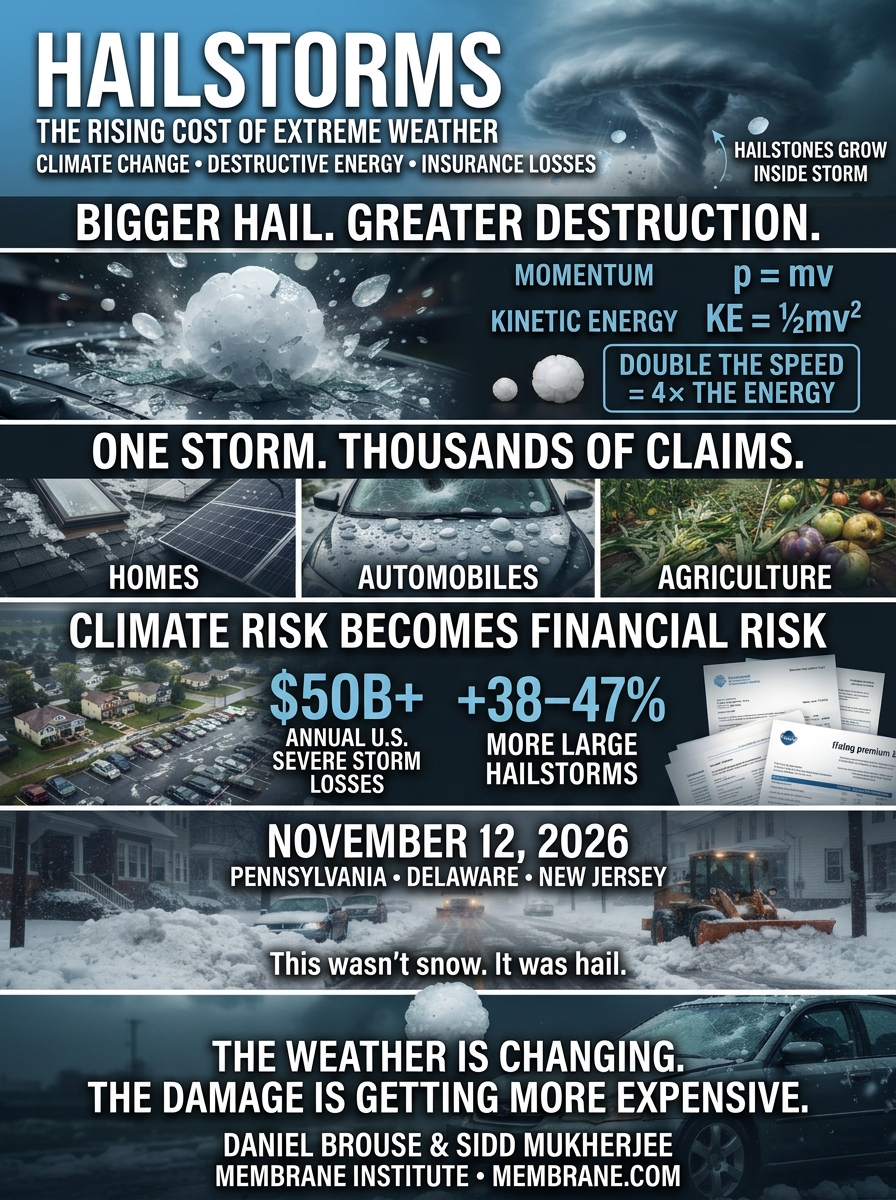
🌩️ HAILSTORMS — THE RISING COST OF EXTREME WEATHER AND INSURANCE
Hail isn’t just frozen rain. It’s a delivery system for destructive kinetic energy!
As hailstones grow larger, their mass and impact energy increase dramatically. And there’s an important physics lesson behind the damage:
KE = ½mv²
Double the impact velocity and you quadruple the kinetic energy!
The consequences are showing up everywhere:
🚗 AUTOMOBILES: Hailstorms are generating billions of dollars in vehicle damage, making hail one of the largest sources of comprehensive auto insurance claims.
🏠 HOMES: Damaged roofs, shattered skylights, broken windows, and destroyed solar panels are driving up repair costs and insurance deductibles.
🌾 AGRICULTURE: Hail can destroy an entire season’s crops in minutes.
💰 INSURANCE: U.S. insured losses from severe convective storms exceeded $50 billion annually in 2023, 2024, and 2025.
And then came November 12, 2026!
Across Pennsylvania, Delaware, and New Jersey, extraordinary thunderstorms dumped so much hail that streets in Parkside Borough, Delaware County, looked like they were buried under snow. Road crews actually brought out snowplows to clear the ice. Vehicles were stranded, and streets were closed.
This wasn’t snow. It was hail!
Our paper explores the physics behind hail’s destructive potential, the changing dynamics of severe storms, and the growing connection between climate risk and financial risk.
The progression is clear:
Atmospheric warming → More damaging storm environments → Greater hail impacts → Billions in property losses → Higher insurance premiums.
The weather is changing. The damage is getting more expensive. And we’re all paying for it.
📖 Read the paper:
Hailstorms: The Rising Cost of Extreme Weather and Insurance
#ClimateChange #ExtremeWeather #Hailstorms #InsuranceCrisis #KineticEnergy #ClimateRisk #AutoInsurance #FinancialRisk #DanielBrouse #MembraneInstitute
Introduction
Climate change is intensifying the atmospheric conditions that produce severe convective storms—including hail, damaging straight-line winds, and tornadoes. Collectively, severe convective storms have become one of the costliest insured natural-disaster categories of the 21st century.
Warmer atmospheric conditions and increased moisture availability influence thunderstorm development, precipitation, and hail formation. Powerful storm updrafts can keep ice particles suspended longer, allowing them to grow before falling. Although warmer air also causes smaller hailstones to melt more readily, the largest stones that survive can deliver substantially greater destructive energy when they reach the ground.
Research projects that storms producing hail larger than large marbles will increase by approximately 38% to 47% by the end of the century. Meanwhile, U.S. insured losses from severe convective storms exceeded $50 billion annually in 2023, 2024, and 2025.
The consequences extend well beyond storm damage. Increasing hail losses are changing insurance coverage, raising premiums, increasing deductibles, and transferring more financial risk to homeowners, vehicle owners, and farmers.
An important part of understanding this growing threat is the physics of falling hail. Its destructive potential depends not simply on how fast a hailstone falls, but also on its mass and the kinetic energy it carries at impact. As hailstones grow larger, their mass increases substantially, producing a disproportionate increase in the energy delivered when they strike a roof, vehicle, person, or agricultural field.
The Physics of Destructive Hail: Momentum and Kinetic Energy
Our research into hail began as part of the Violent Rain and the Momentum of Rain series.
https://www.kingarthur.com/global_warming/momentum-of-rain.html
One of the central principles of this research is that velocity is only one factor in determining the destructive potential of falling precipitation. The mass of the precipitation matters just as much.
Momentum: Mass and Velocity
Momentum describes the quantity of motion carried by a moving object.
p = mv
Where:
- p = momentum
- m = mass
- v = velocity
A larger hailstone has more mass than a smaller one. At the same velocity, the larger stone carries proportionally more momentum.
But momentum is only part of the story.
Kinetic Energy: The Destructive Potential
Kinetic energy describes the energy associated with an object’s motion. It is especially important when examining the damage caused by hail striking a stationary object.
<escape>KE = ½mv²</escape>
Where:
- KE = kinetic energy
- m = mass
- v = impact velocity
The critical distinction is that velocity is squared.
Increasing a hailstone’s mass increases its kinetic energy proportionally. Increasing its velocity increases kinetic energy by the square of that change.
For example:
- Double the mass at the same velocity: twice the kinetic energy.
- Double the velocity at the same mass: four times the kinetic energy.
- Double both mass and velocity: eight times the kinetic energy.
This helps explain why large hailstones can cause such extraordinary damage.
Consider two hailstones of the same density. If their diameters double, their volumes and masses increase approximately eightfold. At the same impact velocity, the larger stone therefore carries approximately eight times the kinetic energy.
Actual impacts also depend on shape, orientation, material properties, impact location, and how the target absorbs or distributes the energy. Nevertheless, the relationship demonstrates why relatively modest increases in hailstone diameter can produce dramatically greater damage.
A golf-ball-sized hailstone and a four-inch hailstone are not simply different-sized pieces of ice. They represent dramatically different impact-energy hazards.
From Impact Energy to Real-World Damage
When hail strikes a roof, vehicle, skylight, or crop, its kinetic energy is transferred into the material at the point of impact.
Depending on the material and impact conditions, that energy can:
- Crack or penetrate roofing materials.
- Shatter windshields and skylights.
- Dent vehicle body panels.
- Damage solar panels and their protective surfaces.
- Break branches, strip leaves, and destroy agricultural crops.
The financial consequences multiply when thousands of hailstones strike thousands of properties and vehicles during the same storm.
This is where atmospheric physics becomes an insurance-industry problem.
Sector-by-Sector Impact: Damage and Insurance Shifts
| Sector | Climate-Driven Damage Trends | Insurance and Claims Shifts |
|---|---|---|
| Homeowners | Larger hailstones deliver greater impact energy, cracking asphalt shingles, denting metal roofs, smashing skylights, and damaging residential solar panels. A single storm can damage thousands of homes across an entire metropolitan area. | Insurance carriers have sharply increased premiums—by approximately 65% over five years in states such as Colorado. Many have introduced separate percentage-based wind and hail deductibles, commonly 1% to 5% of dwelling value, alongside depreciated Actual Cash Value (ACV) roof payouts. |
| Automobiles and Fleets | Hailstones transfer kinetic energy into windshields, body panels, roofs, and advanced driver-assistance systems. A single metropolitan storm can damage tens of thousands of vehicles simultaneously. | Higher repair costs for modern vehicles and increasing total-loss claims have pushed comprehensive auto insurance costs upward. Insurers are also tightening rules concerning unrepaired prior damage. Hail has become one of the largest—and in many markets the leading—sources of comprehensive auto insurance claims and losses. We are talking about billions of dollars in vehicle damage, rising insurance payouts, and ultimately higher premiums for everyone. |
| Crops and Agriculture | Large hailstones carry sufficient impact energy to shred leaves, strip grain heads, bruise fruits and vegetables, and destroy developing crops. Combined with extreme heat, drought, and excessive moisture, these events increase agricultural losses and threaten entire harvests. | Hail accounted for approximately $9.7 billion in U.S. federal crop insurance payouts between 2001 and 2022. Farmers increasingly depend on specialized private crop-hail policies alongside federal revenue protection to cover growing production risks and input costs. |
Key Drivers Amplifying Insurance Losses
1. Larger hailstones deliver disproportionately greater damage.
Research reported by Inside Climate News shows that human-caused warming has increased the probability of damaging hailstorms and influenced hailstone size. Hailstones ranging from small pebbles to golf-ball-sized chunks can cause dramatically different levels of destruction.
The physics explains why.
Larger hailstones have more mass and, at comparable impact velocities, carry more kinetic energy. Because kinetic energy increases with the square of velocity, the combination of greater mass and higher impact speed can produce exceptionally destructive impacts.
Although smaller hailstones melt more readily in warmer atmospheric conditions, the largest stones can survive their descent and deliver devastating impacts.
2. Death by a thousand cuts: Increasing cumulative losses.
Unlike relatively infrequent catastrophic hurricanes, severe convective storms occur repeatedly throughout the spring and summer and now increasingly in the fall. Their cumulative financial impact is enormous.
According to Claims Journal, the United States recorded 142 days with hail measuring at least two inches in diameter during 2025, compared with a 20-year average of 122 days.
Each event generates another round of vehicle claims, roof replacements, property repairs, and agricultural losses. The cumulative burden creates a persistent financial challenge for insurance companies.
3. Expanding urban footprints and rising repair costs.
Suburban development across hail-prone regions, including the Great Plains and Colorado’s Front Range, places more high-value homes, vehicles, commercial buildings, and solar installations in harm’s way.
At the same time, inflation in construction labor, roofing materials, and specialized automotive components increases the average cost of individual claims.
Modern vehicles are particularly expensive to repair. Damage to cameras, sensors, windshields, and integrated electronic systems can turn what once would have been a relatively inexpensive repair into a substantial insurance claim.
4. Compounding agricultural volatility.
According to the Environmental Working Group, climate-related weather events—including drought, excessive moisture, heat, freezes, and hail—accounted for approximately $118.75 billion, or 73%, of federal crop insurance indemnities between 2001 and 2022.
Even a localized hailstorm can destroy an entire season’s production in minutes.
Federal multi-peril crop insurance policies often carry deductibles that leave farmers exposed to isolated hail damage. Consequently, agricultural producers increasingly purchase supplemental private crop-hail policies, including coverage with low or zero deductibles.
Violent Rain, Hail, and the Momentum of Precipitation
During our initial research, I asked Sidd:
“Is there a limiting factor to the size of raindrops that will prevent them from becoming lethal?”
Sidd replied:
“If it freezes, yes, it can kill you.”
He continued:
“I imagine around a centimeter is about as big as raindrops can get… would break up bigger than that for sure.
“Never heard of raindrops killing anyone, but hail, yes.”
A week later, a news report provided a tragic illustration of the distinction.
“Giant hailstones kill toddler and injure 50 people in Spanish town.”
https://www.birminghammail.co.uk/news/world-news/giant-hailstone-kill-toddler-spain-24897594
A violent hailstorm struck Catalonia, Spain. Hailstones measuring up to 10 centimeters (approximately four inches) fell over a 10-minute period, killing a 20-month-old girl and injuring approximately 50 people.
This tragedy illustrates the extraordinary destructive potential of frozen precipitation.
The difference between rain and hail is not simply temperature. It is the combination of mass, velocity, momentum, and kinetic energy.
A large hailstone carries substantial energy into its impact. The resulting damage depends on how that energy is transferred into the object it strikes.
Example: November 12, 2026 — An Extraordinary Severe Weather Outbreak
Thursday, November 12, 2026, brought an extraordinary late-autumn severe weather outbreak across the Greater Philadelphia region, Delaware, and New Jersey.
The storm system developed as a complex area of low pressure moved north from Virginia. Rapid intensification produced an unusually unstable atmosphere, generating powerful thunderstorms before a dramatic transition to much colder, winter-like conditions.
What followed was one of the most unusual November weather events many residents in the region have experienced.
Snow-Like Hail Blankets Delaware County
Photographs and video captured by 6 ABC Action News documented some of the extraordinary conditions.
Parkside Borough and Aston: Slow-moving thunderstorms dumped enormous quantities of hail, with some stones reaching approximately 1.25 inches in diameter.
Road closures and snowplows: Hail accumulated so deeply along Edgmont Avenue and Route 352 in Parkside that police closed sections of roadway. Pickup trucks became stranded in drifts resembling those normally associated with a midwinter snowstorm.
Road crews brought out shovels and snowplows to clear the accumulated ice.
This wasn’t snow. It was hail accumulating faster than road crews could clear it.
6 ABC Action News described the scene:
“No, it’s not snow! Massive piles of hail blanketed parts of Parkside Borough in Delaware County on Thursday.”
Gloucester City, New Jersey: Hail Pounds Streets and Vehicles
Two additional videos captured streets and vehicles in Gloucester City, New Jersey, being pelted by the storm.
The footage illustrates another important dimension of the insurance problem: hail damage is not limited to individual properties.
A single storm can simultaneously damage entire neighborhoods, parking lots, vehicle fleets, and commercial properties.
Each hailstone delivers its own impact energy. Collectively, thousands of impacts across thousands of vehicles create a massive concentration of property damage and insurance claims.
When thousands of vehicles and buildings sustain damage during the same event, insurers face a concentrated wave of claims and repair costs.
The Bigger Picture: Climate Risk Becomes Financial Risk
Hailstorms demonstrate how climate change translates into tangible economic consequences.
The progression is increasingly clear:
Atmospheric warming → changing storm environments → larger or more damaging hail → increased impact energy → widespread property and vehicle damage → escalating insurance claims → higher premiums and deductibles.
This is more than a weather problem. It is an insurance affordability problem, a property-value problem, an agricultural security problem, and an increasingly important component of household financial risk.
The insurance industry is already absorbing billions of dollars in severe convective storm losses annually. Those costs ultimately circulate through the economy, affecting homeowners, drivers, farmers, businesses, and consumers.
Understanding hail requires understanding both atmospheric energy and the physics of impact. Mass determines how much material is falling. Velocity determines how fast it is moving. Together, they determine its momentum and kinetic energy—and help explain why larger, faster hailstones can produce disproportionately greater destruction.
As hailstorms become an increasingly important source of insured losses, the relationship between atmospheric energy, storm dynamics, precipitation physics, and financial exposure becomes essential to understanding the changing economics of extreme weather.
The weather is changing. The destructive energy of severe storms is an increasingly important financial risk. The damage is becoming more expensive. And the insurance industry is passing an increasing share of that cost back to the public.