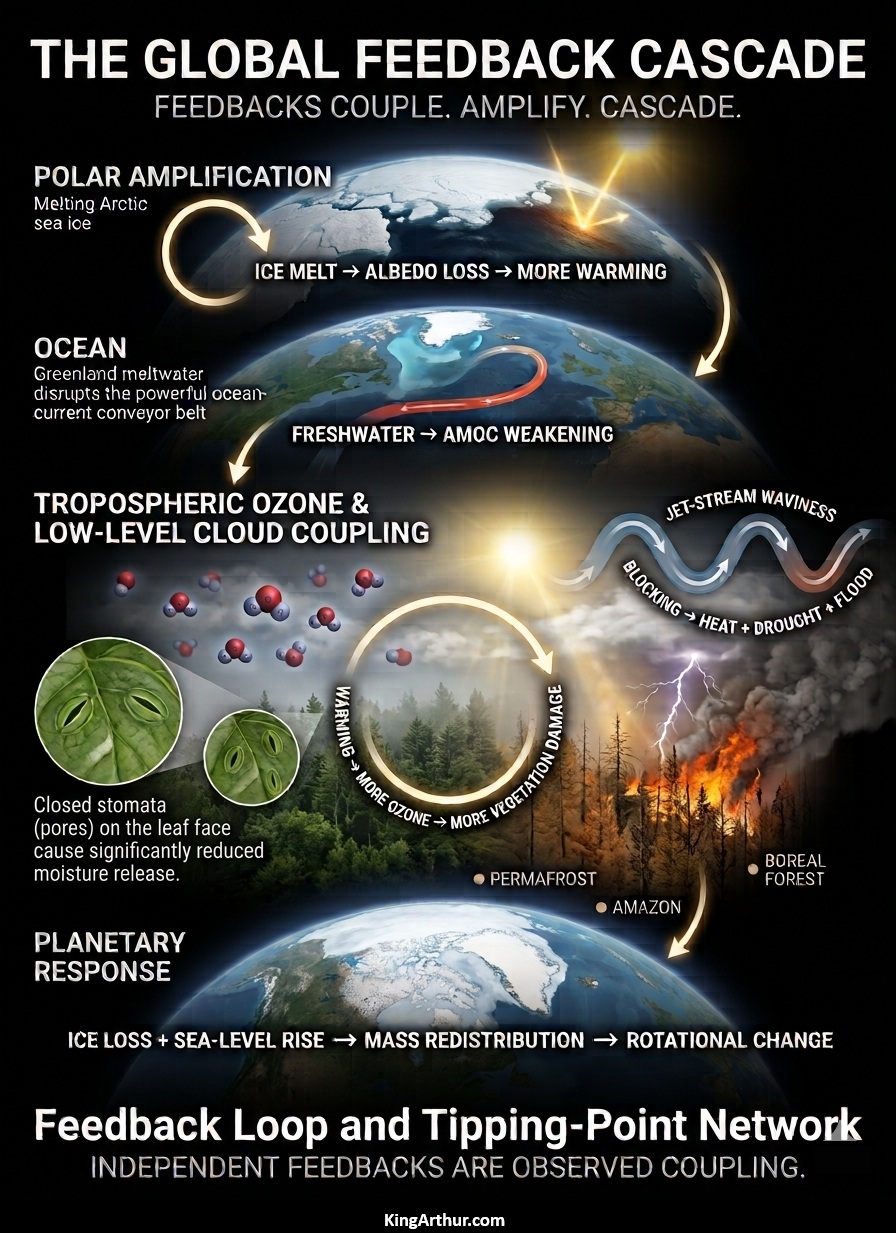
Polar amplification → weakened equator-to-pole temperature gradients → reduced thermal contrast → atmospheric circulation changes → accelerated Arctic and Greenland ice melt → ICE–ALBEDO FEEDBACK: ice loss → darker surface → greater solar absorption → more warming → more ice loss ↺ → MELT–ELEVATION FEEDBACK: ice loss → lower ice-sheet elevation → warmer air → faster surface melt → further elevation loss ↺ → LAPSE-RATE FEEDBACK: Arctic warming → weaker vertical temperature gradient → reduced atmospheric cooling efficiency → additional near-surface warming → more ice melt ↺ → COUPLED CRYOSPHERIC AMPLIFICATION → freshwater input into the North Atlantic → reduced salinity + density → AMOC weakening →
AMOC–CLOUD FEEDBACK: AMOC weakening → North Atlantic temperature + circulation changes → altered moisture transport → declining low-level clouds → reduced reflection of incoming solar radiation → increased solar absorption → additional ocean warming → further AMOC stress ↺ →
AMOC–OZONE FEEDBACK: AMOC weakening + altered circulation → changes in atmospheric chemistry + precursor transport → tropospheric ozone → vegetation damage → reduced stomatal conductance + photosynthesis → reduced evapotranspiration → lower atmospheric moisture → declining low-level clouds → increased solar absorption → additional warming → further AMOC stress ↺ →
AMOC–ICE-MELT FEEDBACK: AMOC weakening → altered North Atlantic heat transport → regional ocean-atmosphere temperature redistribution → Greenland + Arctic ice melt → freshwater discharge → reduced salinity + density → weaker deep-water formation → further AMOC weakening ↺ →
GLACIAL-RETREAT FEEDBACK: warming → glacier + ice-sheet retreat → reduced reflectivity + lower ice-sheet elevation → greater solar absorption + enhanced surface melt → additional warming + ice loss ↺ → SEA-LEVEL RISE → coastal inundation + saltwater intrusion + altered ocean circulation → additional cryospheric + ecosystem stress →
WILDFIRE–OZONE FEEDBACK: warming + drought → increased wildfire risk → vegetation loss + smoke + atmospheric emissions → increased ozone precursors → tropospheric ozone formation → vegetation damage → reduced carbon uptake + evapotranspiration → greater warming + drying → increased wildfire risk ↺ →
WILDFIRE–CLOUD FEEDBACK: wildfire smoke + vegetation loss → altered aerosol loading + moisture flux → changes in cloud formation + persistence → altered shortwave radiation → regional warming or cooling → precipitation disruption → greater drought and fire risk ↺ →
LIGHTNING–OZONE FEEDBACK: warming + convective instability → increased lightning → lightning-generated NOₓ → increased tropospheric ozone formation → vegetation damage → reduced carbon uptake → additional warming → increased atmospheric instability + lightning potential ↺ →
LIGHTNING–WILDFIRE FEEDBACK: warming + drying → increased fuel flammability → lightning ignition → wildfire → vegetation loss + carbon emissions → additional warming + drying → greater wildfire risk ↺ →
LOW-LEVEL CLOUD–OZONE COUPLING: tropospheric ozone → vegetation damage → reduced stomatal conductance → reduced transpiration → reduced atmospheric moisture → declining low-level clouds → increased shortwave solar absorption → warming → increased ozone formation/persistence under favorable conditions → additional vegetation damage ↺ →
JET-STREAM COUPLING: weakened Arctic-to-midlatitude thermal contrast → altered polar jet → amplified Rossby waves → interaction with subtropical jet + storm tracks → greater jet-stream waviness + slower progression → persistent blocking + omega blocks + meridional flow → stalled atmospheric rivers + prolonged heat domes + drought–flood swings → hydroclimatic whiplash → agriculture + infrastructure + ecosystems + public health stress → increased wildfire + vegetation stress ↺ →
PERMAFROST TIPPING ELEMENT: Arctic warming → permafrost thaw → CO₂ + CH₄ release → additional greenhouse forcing → Arctic warming ↺ →
BOREAL FOREST TIPPING ELEMENT: warming + drought + wildfire + ozone damage → forest degradation → reduced carbon uptake + carbon release → additional warming ↺ →
AMAZON RAINFOREST TIPPING ELEMENT: warming + drought + fire + ozone damage → reduced stomatal function + evapotranspiration → reduced rainfall recycling + declining low-level clouds → greater drought → forest loss + carbon release → additional warming ↺ →
WEST ANTARCTIC ICE-SHEET TIPPING ELEMENT: ice instability → accelerated ice loss → sea-level rise → additional cryospheric stress → global land-ice loss + groundwater redistribution → planetary mass redistribution → altered moment of inertia → rotational dynamics → slight rotational slowing → changes in length of day.