by Daniel Brouse
Preface
This summer, I began noticing a significant decline in both my overall sleep quality and, in particular, my REM (Rapid Eye Movement) sleep. After reviewing the data from my sleep tracker, I was able to link much of the disruption to elevated nighttime temperatures. Then, last night, another factor became impossible to ignore: severe thunderstorms, high winds, and frequent lightning repeatedly interrupted my sleep.
The connection became even more compelling when I realized my dog had been experiencing the same restless nights. Heat, noise, and rapidly changing weather were affecting both of us. That realization led me to a broader question: if these environmental changes are disrupting sleep in my own home, how many millions of others are experiencing the same effects?
I woke up inspired to explore the science behind these observations. This paper examines how climate change—through rising nighttime temperatures, increasing humidity, and more frequent extreme weather events—is affecting sleep quality, REM sleep, and ultimately human health and well-being.
Abstract
Climate change is increasingly recognized as a public health crisis extending far beyond heat-related mortality and cardiovascular disease. One of its lesser-known but rapidly emerging consequences is the degradation of human sleep, particularly Rapid Eye Movement (REM) sleep. REM sleep is essential for memory consolidation, emotional regulation, learning, creativity, and cognitive performance. A warming climate disrupts REM sleep through multiple interacting mechanisms including elevated nighttime temperatures, increased humidity, wildfire smoke, air pollution, psychological stress, and extreme weather disasters. These impacts are compounded by the increasing frequency, duration, and intensity of heatwaves and the accelerating rise in nighttime minimum temperatures. This review examines the physiological basis of REM sleep, the mechanisms through which climate change disrupts REM architecture, and the broader implications for human health and societal resilience.
Introduction
Sleep represents one of the body’s most critical restorative processes. Among its various stages, Rapid Eye Movement (REM) sleep plays a unique role in maintaining healthy brain function. During REM sleep, memories are consolidated, emotional experiences are processed, neural pathways are strengthened, and learning occurs.
Historically, sleep evolved under predictable environmental conditions characterized by cool nights and stable seasonal temperature cycles. Anthropogenic climate change is fundamentally altering these conditions. Rising greenhouse gas concentrations have increased average global temperatures while disproportionately elevating nighttime minimum temperatures. The resulting loss of nocturnal cooling increasingly prevents the human body from maintaining the thermal conditions necessary for uninterrupted REM sleep.
Climate change therefore represents not only an environmental crisis but also a growing neurological and public health challenge.
Normal REM Sleep
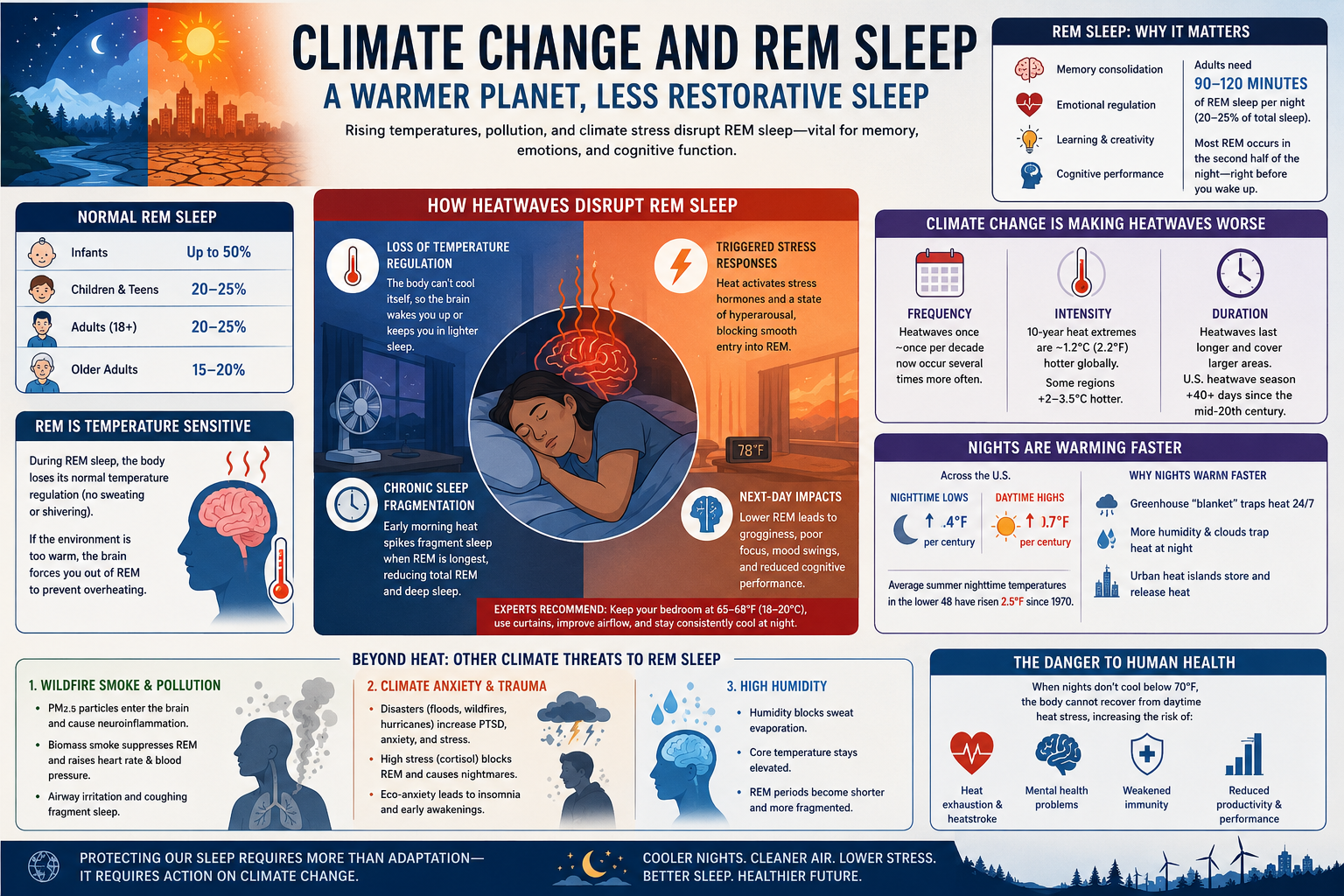
Healthy adults typically require approximately 90 to 120 minutes of REM sleep each night, representing roughly 20–25% of total sleep time. REM sleep supports numerous neurological functions, including:
- Memory consolidation
- Emotional regulation
- Learning
- Creativity
- Cognitive flexibility
- Neural development
REM sleep becomes progressively longer throughout the night, with the largest REM periods occurring during the final third of sleep immediately before awakening.
Age influences REM requirements:
| Age Group | Approximate REM Sleep |
|---|---|
| Infants | Up to 50% |
| Children & Adolescents | 20–25% |
| Adults | 20–25% |
| Older Adults | 15–20% |
Because REM occurs predominantly during the second half of the night, disturbances during early morning hours disproportionately reduce total REM sleep.
Thermoregulation During REM Sleep
REM sleep differs fundamentally from every other sleep stage because the body’s normal temperature regulation is largely suspended.
During REM sleep:
- sweating is greatly reduced
- shivering ceases
- metabolic heat production decreases
- behavioral temperature regulation becomes impossible
This temporary loss of thermoregulation makes REM sleep particularly vulnerable to elevated ambient temperatures.
If body temperature rises excessively, the brain interprets overheating as an immediate survival threat. Rather than remaining in REM sleep, protective neural circuits trigger arousal, forcing the sleeper into lighter sleep stages or complete awakening.
Consequently, REM sleep becomes the first major casualty of excessive nighttime heat.
Heatwaves and REM Sleep
Heatwaves interfere with sleep architecture through several overlapping physiological mechanisms.
Failure of Core Body Cooling
Normal sleep requires a gradual decline in core body temperature.
When nighttime temperatures remain elevated:
- heat dissipation slows
- skin temperature remains elevated
- the brain struggles to initiate deeper sleep stages
- REM duration decreases
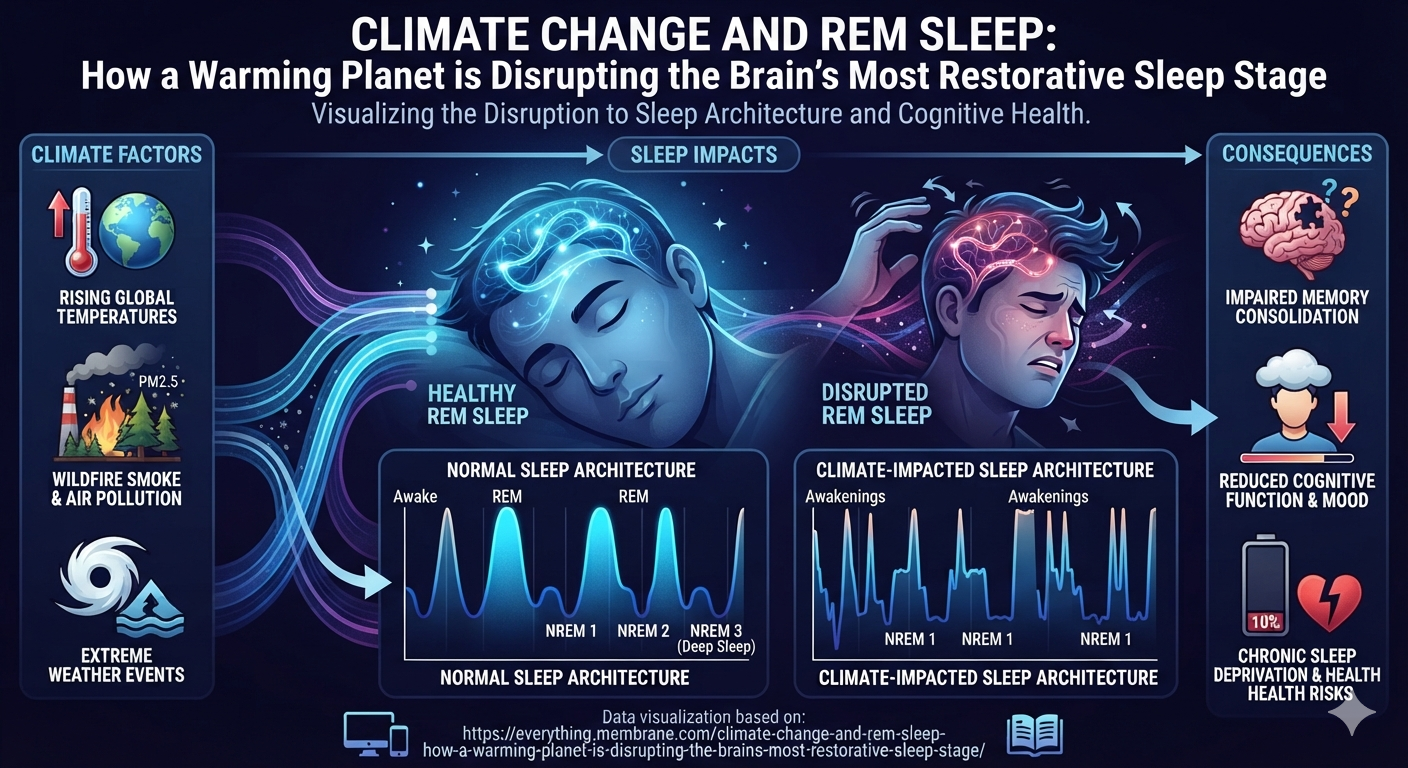
Without adequate cooling, REM episodes become shorter and increasingly fragmented.
Activation of Stress Responses
Persistent heat activates multiple stress systems including:
- sympathetic nervous system activation
- elevated cortisol
- increased heart rate
- heightened neuronal arousal
Instead of transitioning smoothly into REM sleep, individuals remain trapped in lighter sleep characterized by repeated awakenings.
Sleep Fragmentation
Because REM sleep predominates during the second half of the night, rising early morning temperatures have an especially damaging effect.
Even brief awakenings interrupt REM cycles.
Repeated fragmentation produces:
- reduced REM duration
- impaired emotional regulation
- slower reaction times
- diminished concentration
- poorer memory formation
Research increasingly shows that elevated nighttime temperatures reduce both REM sleep and slow-wave (deep) sleep, leaving individuals less physically and mentally restored upon waking.
Climate Change Has Intensified Heatwaves
Anthropogenic climate change has dramatically altered the characteristics of extreme heat events.
Increased Frequency
Heatwaves that historically occurred approximately once every decade now occur several times more frequently under approximately 1.2–1.4°C of global warming.
Across the United States, the annual number of extreme heat events has increased substantially since the mid-20th century.
Greater Intensity
Modern heatwaves are significantly hotter.
Globally, heat extremes that historically occurred once every ten years are now approximately 1.2°C (2.2°F) warmer than they would have been without human-caused climate change.
Some regional heatwaves have been intensified by 2–3.5°C due to anthropogenic greenhouse gas emissions.
Longer Duration
Heatwaves now persist for longer periods.
Persistent atmospheric blocking patterns, commonly known as heat domes, allow hot air masses to remain stationary for days or even weeks.
In the United States, the heatwave season has expanded by more than 40 days compared with the mid-twentieth century.
Rising Nighttime Temperatures
Perhaps the most important climate-related threat to REM sleep is the rapid rise in nighttime minimum temperatures.
Across much of the United States:
- overnight temperatures are increasing nearly twice as fast as daytime highs
- nighttime minimum temperatures have increased approximately 1.4°F per century
- daytime maximum temperatures have increased roughly 0.7°F per century
Climate Central reports that average summer nighttime temperatures across the contiguous United States have risen approximately 2.5°F since 1970.
This phenomenon is known as asymmetric warming.
Why Nights Are Warming Faster
Several physical mechanisms contribute to accelerated nighttime warming.
Greenhouse Blanket Effect
Greenhouse gases continuously absorb and re-radiate outgoing infrared radiation.
During daylight hours, incoming solar radiation dominates Earth’s energy balance.
At night, however, greenhouse gases slow radiative cooling by trapping heat near the surface, preventing the Earth from shedding accumulated daytime energy.
Increased Humidity
A warmer atmosphere holds more water vapor.
Water vapor is itself a powerful greenhouse gas.
Higher humidity:
- traps additional infrared radiation
- slows nighttime cooling
- prevents sweat evaporation
- keeps body temperature elevated
This directly interferes with the physiological cooling required for REM sleep.
Increased Cloud Cover
Clouds act differently during day and night.
During daytime they reflect some incoming sunlight.
At night they behave like insulating blankets, absorbing outgoing infrared radiation and re-emitting heat back toward the surface.
The result is warmer nights.
Urban Heat Islands
Concrete, asphalt, brick, and other urban materials absorb enormous amounts of solar energy during daylight.
After sunset they slowly release stored heat.
Urban environments therefore remain significantly warmer than surrounding rural areas throughout the night, reducing opportunities for nocturnal cooling.
Wildfire Smoke and REM Sleep
Climate change has substantially increased wildfire frequency and burned area across many regions.
Wildfire smoke contains extremely high concentrations of fine particulate matter (PM₂.₅).
These microscopic particles affect REM sleep through multiple biological pathways.
Neuroinflammation
PM₂.₅ particles can enter the brain through the olfactory system.
Inflammation develops within regions involved in sleep regulation, impairing normal REM transitions.
Suppression of REM Sleep
Experimental studies have demonstrated that inhalation of biomass smoke suppresses paradoxical sleep—the scientific term for REM sleep—while simultaneously increasing nighttime heart rate and blood pressure.
Airway Irritation
Smoke exposure increases:
- coughing
- airway inflammation
- respiratory resistance
These physiological disturbances repeatedly awaken sleepers from deeper sleep stages, fragmenting REM sleep.
Climate Anxiety and REM Sleep
Climate change also affects REM sleep psychologically.
Increasing exposure to floods, hurricanes, wildfires, droughts, and heatwaves elevates rates of:
- anxiety
- depression
- post-traumatic stress disorder (PTSD)
- chronic stress
Elevated cortisol levels associated with these conditions interfere with normal REM initiation.
In addition, growing concern about future climate risks—often termed eco-anxiety—can produce intrusive thoughts, nightmares, insomnia, and repeated nighttime awakenings.
Instead of facilitating healthy emotional processing, REM sleep becomes increasingly disrupted by persistent activation of the brain’s threat-detection networks.
Humidity and REM Sleep
Humidity represents another important but often overlooked consequence of climate change.
Successful REM sleep requires efficient evaporative cooling.
When humidity is high:
- sweat evaporates poorly
- body temperature remains elevated
- heat loss slows
- REM episodes become abbreviated
Rather than entering long uninterrupted REM periods near morning, sleepers cycle repeatedly through brief periods of lighter sleep.
Public Health Implications
Declining REM sleep carries consequences extending well beyond daytime fatigue.
Chronic REM deprivation has been associated with:
- impaired memory
- reduced learning capacity
- diminished decision-making
- slower reaction times
- depression
- anxiety disorders
- impaired emotional regulation
- weakened immune function
- increased cardiovascular risk
- reduced workplace productivity
- higher accident rates
Because climate change affects millions of people simultaneously, widespread reductions in REM sleep may have substantial economic and societal consequences.
Sleep loss may become an increasingly important—but largely invisible—component of climate-related disease burden.
Mitigation and Adaptation
Although climate change is driving long-term warming trends, several measures can help preserve REM sleep.
Recommended strategies include:
- Maintaining bedroom temperatures between 65–68°F (18–20°C).
- Using blackout curtains to reduce daytime solar heating.
- Increasing nighttime ventilation and airflow.
- Limiting indoor heat accumulation during daytime.
- Using air conditioning or evaporative cooling where available.
- Reducing exposure to wildfire smoke through high-efficiency filtration.
- Maintaining consistent sleep schedules.
- Addressing climate-related psychological stress through appropriate mental health interventions.
Ultimately, however, adaptation alone cannot eliminate the problem. Long-term protection of human sleep requires reducing greenhouse gas emissions and slowing global warming.
Conclusion
Climate change is reshaping one of humanity’s most fundamental biological processes: sleep. Rising nighttime temperatures, prolonged heatwaves, increasing humidity, worsening wildfire smoke, deteriorating air quality, and climate-related psychological stress all converge on the same vulnerable target—REM sleep.
Unlike many climate impacts that unfold gradually over decades, sleep disruption is immediate, measurable, and experienced nightly by millions of people. Because REM sleep underpins memory, emotional regulation, learning, cognitive performance, and neurological health, its progressive loss represents a significant but underappreciated consequence of anthropogenic climate change.
As the planet continues to warm, protecting REM sleep will require both personal adaptation and systemic climate mitigation. Ensuring cooler nights, cleaner air, and a more stable climate is not merely a matter of comfort—it is essential for preserving the restorative sleep upon which human health, resilience, and cognitive function depend.