bookmark_borderFrance Ups Cybersecurity

France said the number of cyber attacks against the defence ministry have doubled each year. 24,000 attacks had been thwarted in 2016.

Security services have warded off attacks aimed at “tarnishing the image of the ministry as well as strategic attacks – harassment, surveillance, espionage – and even attempts to disrupt our drone systems,” Defence Minister Jean-Yves Le Drian said. “Thankfully, our defences were sufficient and none of these attacks were successful.”

“France reserves the right to respond by all means it deems appropriate,” he said. “That could be through the cyber arsenal at our disposal but also by conventional means. Everything would depend on the effects of the attack.”

“If there was an attempt to influence or manipulate the US presidential election, it would be a very serious incident. If it were led by a state government, it would be an intolerable interference. Targeting a country’s electoral process is an attack on its democratic foundations and its sovereignty, he added. Of course our services have discussed the issue, if only to learn lessons for the future,” said Le Drian

France plans to deploy 2,600 “digital soldiers” by 2019.

bookmark_borderU.S. Security-clearances Hacked

by Daniel Brouse for Membrane Domain Cybersecurity

In 2014 and 2015, there were two major breaches of U.S. government databases holding personnel records and security-clearance files of at least 22.1 million people, including Social Security numbers and some fingerprints, of not only federal employees and contractors but their families and friends.

U.S. officials have privately said the hacks were traced to the Chinese government.

“It is a very big deal from a national security perspective and from a counterintelligence perspective,” FBI Director James B. Comey said. “It’s a treasure trove of information about everybody who has worked for, tried to work for, or works for the United States government.”

The “new number is staggering,” said William R. Dougan, president of the National Federation of Federal Employees. “It is not yet clear how OPM can handle this massive increase, when they were already struggling with the initial 4.2 million. Now, not only do federal employees have to worry about their own personal information being exposed – but they must also worry about their spouse and children having their information compromised.”

“If you have my SF 86, you know every place I’ve lived since I was 18, contact people at those addresses, neighbors at those addresses, all of my family, every place I’ve traveled outside the United States,” Comey said. “Just imagine if you were a foreign intelligence service and you had that data.”

bookmark_borderRussia Attempts to Hack Electric Grid

by Membrane Domain Cybersecurity

Malware associated with a Russian hacking operation, Grizzly Steppe, was found on a Burlington Electric computer. It appears as though Russia was trying to access the power grid; however, the infected computer was not connected to the network.

“Vermonters and all Americans should be both alarmed and outraged that one of the world’s leading thugs, Vladimir Putin, has been attempting to hack our electric grid, which we rely upon to support our quality-of-life, economy, health, and safety,” Vermont Governor Shumlin said in a statement. “This episode should highlight the urgent need for our federal government to vigorously pursue and put an end to this sort of Russian meddling.”

Senator Patrick J. Leahy said, “This is beyond hackers having electronic joy rides — this is now about trying to access utilities to potentially manipulate the grid and shut it down in the middle of winter,” Leahy said in a statement. “That is a direct threat to Vermont and we do not take it lightly.”

Representative Peter Welch said, “It’s systemic, relentless, predatory.They will hack everywhere, even Vermont, in pursuit of opportunities to disrupt our country. We must remain vigilant, which is why I support President Obama’s sanctions against Russia and its attacks on our country and what it stands for.”

According to the Department of Homeland Security:

GRIZZLY STEPPE: Russian Malicious Cyber Activity

Russia’s civilian and military intelligence services engaged in aggressive and sophisticated cyber-enabled operations targeting the U.S. government and its citizens. The U.S. Government refers to this activity as GRIZZLY STEPPE. These cyber operations included spearphishing campaigns targeting government organizations, critical infrastructure entities, think tanks, universities, political organizations, and corporations, and theft of information from these organizations. This stolen information was later publicly released by third parties.

In operations targeting other countries, including U.S. allies and partners, Russian intelligence services (RIS) have undertaken damaging or disruptive cyber-attacks, including on critical infrastructure—in some cases masquerading as third parties or hiding behind false online personas designed to cause the victim to misattribute the source of the attack.

How Do Russian Intelligence Services Operate in Cyberspace?

RIS often uses spearphishing to gain access to targeted systems (see Figure 1 below). In one 2015–16 operation (detailed in our Joint Analysis Report (JAR)), Russian cyber actors conducted a spearphishing campaign to establish presence and persistence on a target network, obtain higher-level privileges, and steal (or “exfiltrate”) information.

These actors tricked recipients into changing their passwords through a fake website that was designed by the Russians cyber actors to appear legitimate. The actors then used those credentials—the username and password—to access the network as if they were legitimate users. They installed other malicious files, moved freely throughout the target network, gathered data and information, and exfiltrated it from the target network. Russian cyber actors continue to conduct spearphishing campaigns, including one launched as recently as November 2016, just days after the U.S. election.

What is the U.S. Government Doing?

The Department of Homeland Security (DHS) and Federal Bureau of Investigation (FBI) released a Joint Analysis Report (JAR), which provides details of the tools and infrastructure used by Russian intelligence services (RIS) to compromise and exploit networks and infrastructure associated with the recent U.S. election, as well as a range of U.S. government, political, and private sector entities. The JAR also arms network defenders with the tools they need to identify, detect, and disrupt Russia’s global campaign of malicious cyber activity. We urge users and administrators to use this information to better protect your networks.

What Is Spearphishing?

Spearphishing is the use of forged emails, texts, and other messages to manipulate users into opening malware or malicious software or clicking on malicious links.

Spearphishing attacks can lead to credential theft (e.g., passwords) or may act as an entry point for threat actors into an organization to steal or manipulate data and disrupt operations.

For more information, see the US CERT Tip on Avoiding Social Engineering and Phishing Attacks.

Screenshot of email that states: Incoming eFax: Elections Outcome could be revised [Facts of Elections Fraud]. Sent by Taylor Fax <securefaxsolutions@gmail.com> on Wednesday, November 9, 2016 at 10:39 To undisclosed-recipients. Attachment: election-headlines-FTE2016.docm (1.1 MB). Preview. eFax Solution. You have received a secure message from eFax Solution Corp. Please open the attachment election-headlines-FTE2016 in this email and enter PIN CODE: 3209. SUBJECT: ELECTIONS OUTCOME CUOLD BE REVISED [FACTS OF ELECTIONS FRAUD]. Please note: if you have trouble opening the message, please try the following 1. In your web browser, delete the temporary internet files and cookies. 2. Close the web browser. 3. Open the election-headlines-FTE2016 file in your secure email. End of screenshot.

Figure 1: Sample of Russian Post-Election Spearphishing

Lifecycle of Successful Spearphishing Operation. Starts on the left in Adversary Space, Russian Intelligence Services. Grizzly Steppe 1.) Leverages Operational Infrastructure (Neutral Space, in the middle) 2.) Crafts email with malicious link 3. ) Sent to Recipient (in Victim Space, on the right) 4.) Clicks on link and enters credentials into Website that looks legitimate (in Neutral Space), 5.) Gathers credentials in operational infrastructure, 6.) Uses credentials to Access Targeted System (in Victim Space) 7.) Install malicious files and 8.) Move through targeted systems and 9.) Gather Data of interested which is 10.) Exfiltrated to Operational Infrastructure (in Neutral Space).

Figure 2: Lifecycle of Successful Spearphishing Operation

What Information is in the JAR?

The JAR includes information on computers, servers, and other devices around the world that RIS uses to conduct command-and-control activity between compromised devices, send spearphishing emails, and steal credentials. The JAR identifies these devices by each one’s Internet Protocol (IP) address, which is a set of numbers that serves as an “address” for each computer and is used to transmit data between computers. Because RIS is using other people’s networks without their owners’ knowledge to hide their malicious activity, the computers at these IP addresses typically also host legitimate websites or other Internet services. In some cases, the cybersecurity community was aware of this infrastructure. In other cases, this information has been newly declassified by the U.S. government. The map in Figure 3 shows the 60 countries in which newly declassified IP addresses are located. The JAR also includes information on how RIS typically conducts their activities. This information can help network defenders understand how this adversary operates and can help identify new activity or disrupt ongoing intrusions by RIS.
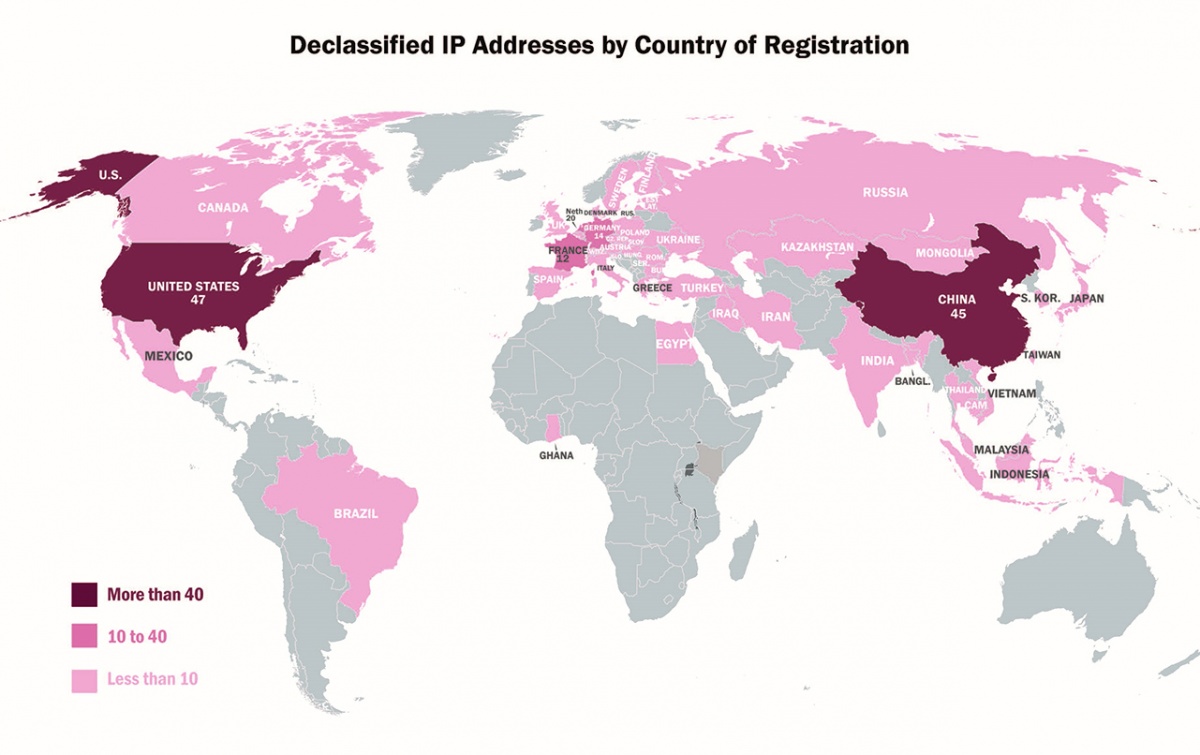
Declassified IP Addresses by Country of Registration. United States: 47. Canada, Mexico, India, Iraq, Egypt, Turkey, Greece, Russia, Kazakhstan, Mongolia, Thailand, Cambodia, Malaysia, Indonesia, Vitenam, South Korea, Japan, Taiwan, Ukraine, Sweden, Finaldn, Poland, Slove, UK, Spaine, Italy, Austria, Poland, and Ghana: Less than 10. France: 12. Germany: 14. Netherlands: 20. China: 45.

Figure 3: Declassified Worldwide Infrastructure Co-Opted by Russian Intelligence Services

How You Can Protect Yourself and Your Networks

A commitment to good cybersecurity and best practices is critical to protecting networks and systems. Here are some questions you may want to ask of your organization to help prevent and mitigate against attacks.

  • Backups: Do we backup all critical information? Are the backups stored offline? Have we tested our ability to revert to backups during an incident?
  • Risk Analysis: Have we conducted a cybersecurity risk analysis of the organization?
  • Staff Training: Have we trained staff on cybersecurity best practices?
  • Vulnerability Scanning and Patching: Have we implemented regular scans of our networks and systems? Do we appropriately patch known system vulnerabilities?
  • Application Whitelisting: Do we allow only approved programs to run on our networks?
  • Incident Response: Do we have an incident response plan? Have we practiced it?
  • Business Continuity: Are we able to sustain business operations without access to certain systems? For how long?
  • Penetration Testing: Have we attempted to hack into our own systems to test the security of our systems and our ability to defend against attacks?

What to Do If You See Signs of Malicious Cyber Activity

If you find signs of malicious cyber activity, we encourage you report it to DHS’s National Cybersecurity and Communications Integration Center (NCCICCustomerService@hq.dhs.gov or 888-282-0870) or the FBI through your local field office or the FBI’s Cyber Division (cywatch@ic.fbi.gov or 855-292-3937).

bookmark_borderRussia And Cybersecurity

by Membrane Domain Cybersecurity

Cozy Bear and Fancy Bear are two hacking organizations from Russia. Cozy Bear (classified as advanced persistent threat APT29) are believed to be associated with Russian intelligence. Fancy Bear (also known as APT28, Pawn Storm, Sofacy Group, Sednit and STRONTIUM) is a cyber espionage group believed to be sponsored by the Russian government.

According to the Christian Science Monitor: “Traditionally, Cozy Bear targets potential victims with phishing attacks – email messages that appear to be from a legitimate, trusted friend or associate. Those messages may contain malicious software that scans a machine for antivirus software, then plants malware on the target machine that make it possible for attackers to monitor keystrokes, communications, documents and other sensitive material on target computers. Fancy Bear is known for stealing targets’ usernames and passwords by setting up dummy websites that appear real enough to convince users to input their email and password information.”

In September of 2015, Special Agent Adrian Hawkins of the Federal Bureau of Investigation called the Democratic National Committee to inform them of a security breech. The FBI referred to Cozy and Fancy Bears as “The Dukes”. Since that time 17 U.S. intelligence agencies have implicated Russia in the hack of the DNC.

It is believed that Putin used the information to undermine the Democrats in the election process. It is also believed that the Russian hackers breached the Republicans. The stolen Republican data will be used to blackmail the new President.

“No one should really be surprised they’d go after the DNC,” said Jason Healey, a senior research scholar at Columbia University. “It’s not really that different from going after the political and military information we suspect the US is also going after.”

bookmark_borderYahoo Hacked

by Membrane Domain Cybersecurity

In September, Yahoo disclosed that 500 million user accounts had been hacked. In December 2016, Yahoo announced that an additional one billion accounts had been hacked.

“What’s most troubling is that this occurred so long ago, in August 2013, and no one saw any indication of a breach occurring until law enforcement came forward,” said Jay Kaplan, the chief executive of Synack, a security company. “Yahoo has a long way to go to catch up to these threats.”

In what could be the biggest hack ever, the Yahoo user accounts included passwords, phone numbers, birth dates, and security questions.

Verizon is in the process of buying-out Yahoo. Verizon is also known for its lackadaisical cybersecurity and has had breeches of their customer data, as well.