By Daniel Brouse and Sidd Mukherjee
Simplified Overview
CARBON THRESHOLD DYNAMICS — THE CARBON BATHTUB EXPLAINS WHY CO₂ KEEPS RISING
Why does atmospheric CO₂ continue to rise even when human emissions decline?
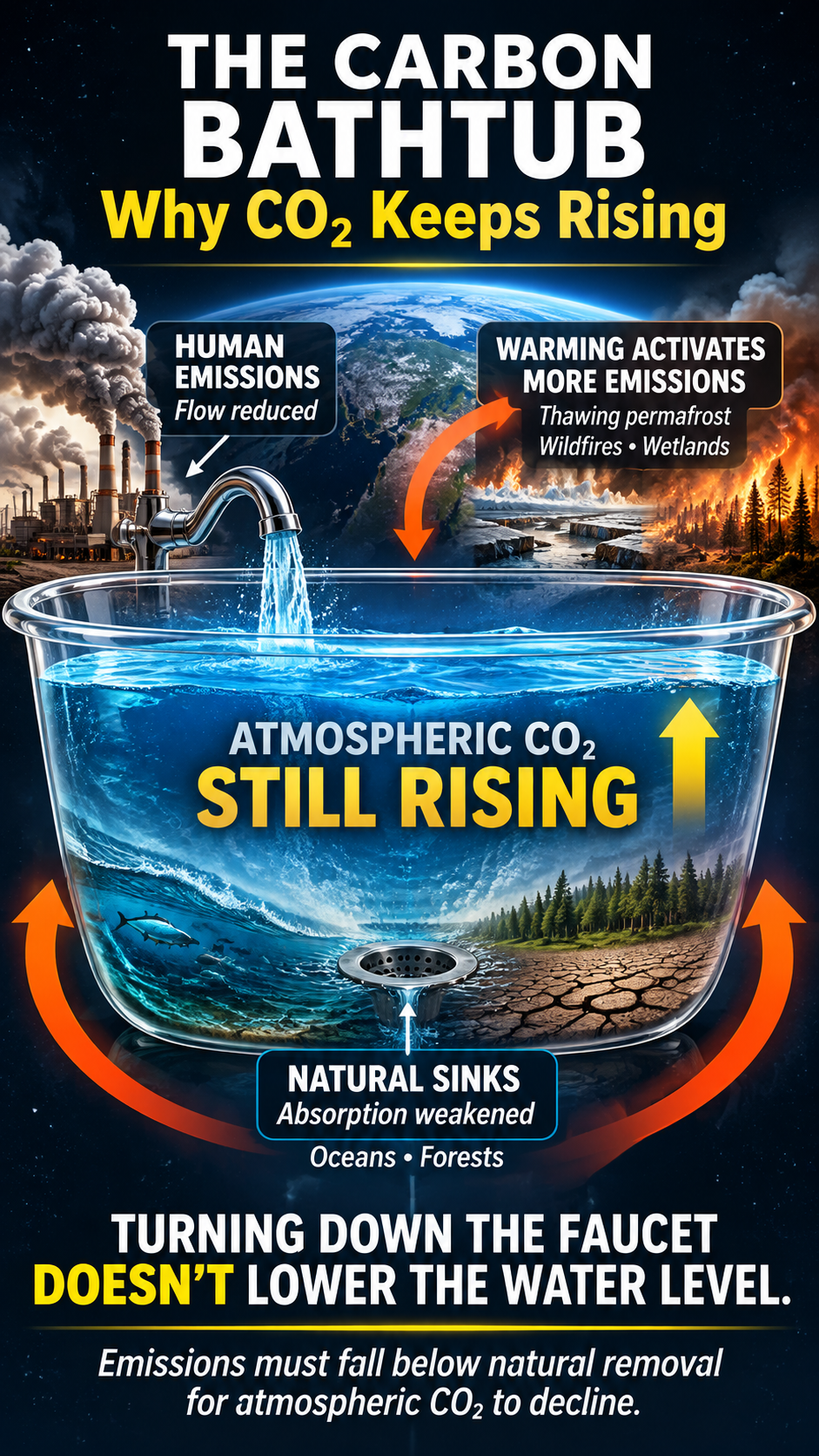
Think of the atmosphere as a bathtub.
Human emissions are the faucet. Natural carbon sinks—primarily the oceans and terrestrial ecosystems—are the drain. Turning down the faucet slows the rise, but it does not lower the water level while more carbon continues entering the atmosphere than nature removes.
And there is another problem: climate warming is weakening the drain while activating additional sources of carbon emissions.
Warming affects the oceans, forests, wetlands, and frozen landscapes. Wildfires, ecosystem disruption, and thawing permafrost add further pressure to an already overloaded carbon cycle. These processes interact, creating feedbacks that amplify the original warming.
This is the central message of our new paper, Carbon Threshold Dynamics: Emissions, Feedback Amplification, and the Approach to a Tipping Point, by Daniel Brouse and Sidd Mukherjee.
The paper examines:
- Why atmospheric CO₂ continues accumulating despite changes in annual human emissions.
- The difference between reducing emissions and actually reducing atmospheric CO₂.
- How natural carbon sinks influence the rate of atmospheric accumulation.
- How warming activates and strengthens interconnected natural feedbacks.
- Why the combined effects of emissions, feedback amplification, and carbon-cycle disruption matter more than any single year’s emissions figure.
- How these dynamics move the climate system toward increasingly dangerous thresholds.
The critical distinction: slowing the inflow is not the same as lowering the water level.
To bring atmospheric CO₂ down, total carbon emissions must fall below the amount being removed from the atmosphere. That challenge becomes harder as warming weakens natural removal and activates additional carbon sources.
The carbon bathtub is a simple way to understand a complex problem: we are not just managing the faucet. We are changing the entire system that determines how much carbon enters, how much leaves, and how much remains.
Read the paper below.
#ClimateScience #CarbonCycle #ClimateFeedbacks #GlobalWarming #ClimateTippingPoints #CarbonEmissions
Abstract
A decline in annual fossil-fuel emissions does not mean atmospheric carbon dioxide concentrations will decline. As long as human-generated emissions exceed the combined removal capacity of natural carbon sinks, atmospheric CO₂ will continue to accumulate. This fundamental distinction between emissions and atmospheric concentration is central to understanding the accelerating dynamics of climate change.
The 2026 carbon outlook illustrates this imbalance. Although fossil-fuel emissions are projected to decline slightly, total anthropogenic emissions remain exceptionally high. At the same time, warming is destabilizing natural carbon reservoirs, increasing emissions from terrestrial and aquatic systems, and weakening the capacity of natural sinks to absorb additional carbon.
These processes create a compounding feedback problem: human emissions increase atmospheric CO₂, rising temperatures activate natural carbon feedbacks, and those feedbacks add further greenhouse gases to the atmosphere. Consequently, reductions in the original human emissions source do not necessarily produce an immediate reduction in the rate of atmospheric carbon accumulation.
Historical emissions downturns demonstrate that this behavior is not new. Even during major economic disruptions, atmospheric CO₂ continued rising. The significance of the present situation, however, extends beyond the persistence of human emissions. It is the growing interaction between anthropogenic forcing, natural carbon-cycle responses, and interconnected climate feedbacks that makes the current trajectory increasingly consequential.
1. The 2026 Carbon Budget: A Decline in Emissions Is Not a Decline in Atmospheric CO₂
The latest Global Carbon Budget, released in November 2026, provides a particularly clear demonstration of the difference between reducing emissions and reversing atmospheric carbon accumulation.
The preliminary 2026 estimates show:
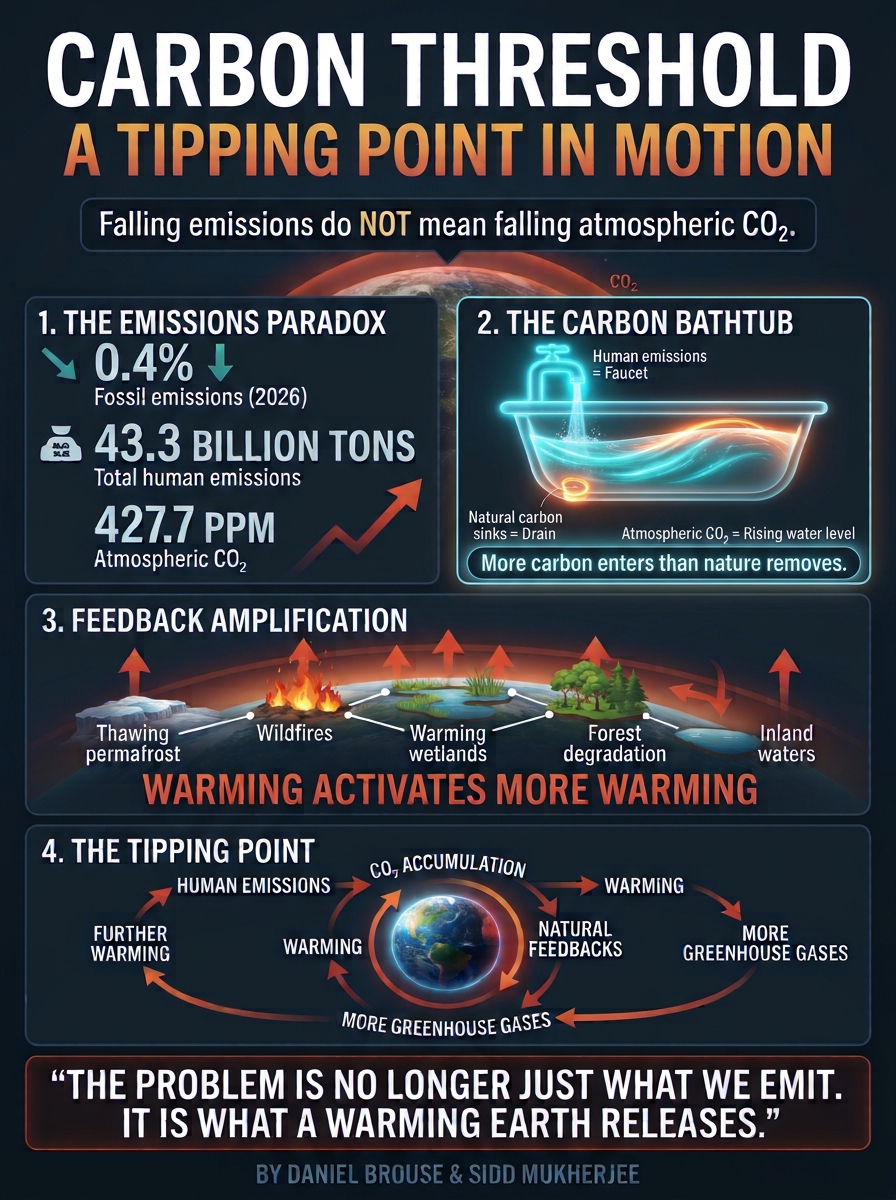
- Fossil-fuel and cement emissions: 38.2 billion metric tons of CO₂, down approximately 0.4% from 38.4 billion tons in 2025.
- Land-use emissions: Increasing, driven in part by peat fires and forest degradation in Southeast Asia.
- Total anthropogenic emissions: Projected to reach 43.3 billion metric tons, compared with 42.8 billion tons in 2025.
- Atmospheric CO₂: Projected to reach 427.7 ppm, approximately 54% above preindustrial levels.
The distinction is fundamental. A reduction in the annual flow of emissions does not reverse the accumulated atmospheric concentration. The atmosphere continues to gain CO₂ whenever total emissions exceed the amount removed by the oceans and terrestrial ecosystems.
In fact, the 2026 carbon budget estimates that land and ocean sinks absorbed approximately 49% of total anthropogenic emissions over the preceding decade. The remaining fraction accumulated in the atmosphere.
This is why a 0.4% decline in fossil emissions cannot be interpreted as evidence that atmospheric carbon accumulation has peaked. Total emissions remain enormous, land-use emissions are increasing, and natural sinks are increasingly exposed to climate-related disruption.
The Carbon Bathtub: Understanding the Accumulation Problem
The atmosphere behaves much like a bathtub:
- Human emissions are the faucet.
- Oceans and terrestrial ecosystems are the drain.
- Atmospheric CO₂ concentration is the water level.
Reducing the flow from the faucet does not lower the water level while water continues entering faster than it leaves.
Even a substantial temporary reduction in emissions does not reverse atmospheric accumulation when the remaining emissions continue to exceed the removal capacity of natural sinks.
There is an additional complication: warming can weaken the drain while activating new sources of greenhouse gases. This creates a feedback between atmospheric accumulation, rising temperatures, and natural carbon-cycle disruption.
The central issue is therefore not simply how much humanity emits in a particular year. It is how the combined emissions and removal processes evolve as the climate system warms.
2. Natural Carbon Feedbacks: The Amplification Mechanism
The carbon cycle is not a passive system. Its biological, geological, and physical components respond to changing environmental conditions.
As temperatures rise, several natural systems release additional greenhouse gases or lose some of their capacity to absorb atmospheric carbon.
Important mechanisms include:
Permafrost thaw: Warming exposes previously frozen organic material to microbial decomposition, releasing CO₂ and methane.
Wildfires: Increasing heat and drought contribute to fire conditions that release stored carbon, damage forests, and reduce future carbon sequestration.
Wetlands: Warming changes microbial activity and hydrological conditions, influencing the release of methane and CO₂.
Inland waters: Rivers, lakes, and other freshwater systems respond to warming and changing hydrology, altering carbon processing and greenhouse-gas emissions.
Forest degradation: Heat, drought, fire, and other disturbances reduce vegetation productivity and weaken terrestrial carbon storage.
These mechanisms do not operate independently. They interact with one another and with the larger climate system, creating pathways through which initial warming produces additional greenhouse-gas emissions.
Quantifying the Additional Warming
A September 2026 study in Environmental Research Letters, examining warming-induced greenhouse-gas emissions from permafrost, wetlands, freshwater systems, and wildfires, estimated that these natural feedback emissions could amplify post-2020 anthropogenic warming by approximately 20%–30%.
The projected additional warming by 2100 was estimated at approximately 0.2°C–0.4°C.
The significance of these findings is that anthropogenic emissions are not the only source of future atmospheric greenhouse-gas increases. Warming itself activates additional sources, creating an amplification mechanism that persists alongside human emissions reductions.
These feedbacks do not make emissions reductions irrelevant. They make rapid reductions more consequential because every additional increment of warming increases the pressure on natural carbon reservoirs and sinks.
3. Historical Evidence: Atmospheric CO₂ Continues Rising During Emissions Downturns
The relationship between annual emissions and atmospheric CO₂ accumulation is demonstrated repeatedly in the historical record.
Since direct atmospheric measurements began at Mauna Loa in 1958, the long-term atmospheric CO₂ concentration has increased continuously. Major economic disruptions, energy crises, and temporary reductions in fossil-fuel emissions have not reversed that accumulation.
Several historical periods illustrate the distinction.
2020: COVID-19 Pandemic
The COVID-19 pandemic produced one of the largest annual reductions in fossil-fuel emissions ever recorded.
- Global fossil-fuel emissions declined approximately 5.4% in 2020.
- Atmospheric CO₂ nevertheless increased approximately 2.5 ppm.
- Global atmospheric CO₂ reached approximately 412.5 ppm.
The emissions reduction was substantial, but it represented only a temporary interruption in the rate of human carbon input. It was insufficient to reverse atmospheric accumulation.
NOAA’s State of the Climate in 2020 documented that the emissions reduction did not materially alter atmospheric CO₂ accumulation, which remained within the range of natural year-to-year variability.
2009: Global Financial Crisis
The global financial crisis significantly slowed industrial production, trade, and energy demand.
However, global fossil-fuel emissions did not actually decline on an annual basis in 2009. They increased slightly, despite the economic contraction.
Atmospheric CO₂ continued rising, reaching approximately 387.6 ppm at Mauna Loa.
This distinction matters: economic slowdowns can reduce emissions growth without necessarily producing an absolute decline in global emissions, much less a decline in atmospheric concentration.
1991–1992: Dissolution of the Soviet Union
The economic disruption accompanying the dissolution of the Soviet Union contributed to substantial regional emissions reductions.
At the same time, atmospheric CO₂ growth slowed dramatically in 1992.
NOAA research examining atmospheric measurements from 1981–1992 found that the reduced atmospheric growth rate was primarily associated with increased carbon uptake by Northern Hemisphere ecosystems, rather than reductions in fossil-fuel emissions alone.
The estimated Northern Hemisphere carbon sink increased from approximately 3.9 to 5.0 billion metric tons of carbon per year between 1991 and 1992.
This is particularly important because it demonstrates that atmospheric CO₂ growth is governed by the combined behavior of emissions and natural sinks, not emissions alone.
1980–1982: Global Oil and Economic Crises
The energy crises and economic disruptions of the early 1980s slowed the growth of fossil-fuel consumption.
However, global atmospheric CO₂ continued its long-term increase.
The broader historical record demonstrates that temporary changes in emissions growth do not reverse the accumulated atmospheric carbon burden.
4. The Nonlinear Problem: From Emissions Accumulation to Feedback Amplification
The distinction between anthropogenic emissions and atmospheric CO₂ concentration becomes increasingly important as the climate system approaches critical thresholds.
Under relatively stable conditions, natural carbon sinks absorb a substantial proportion of human-generated emissions. This moderates the rate of atmospheric accumulation.
But those sinks are not independent of climate conditions.
As warming intensifies:
- Permafrost thaw exposes additional carbon to decomposition.
- Wildfires release stored carbon and damage future carbon-absorbing vegetation.
- Wetland and freshwater systems alter their greenhouse-gas emissions.
- Forest degradation reduces terrestrial carbon sequestration.
- Ocean warming and circulation changes influence ocean carbon uptake.
- Interactions among these processes increase the potential for additional feedback activation.
The resulting system is fundamentally different from one in which atmospheric CO₂ increases solely as a function of human emissions.
Instead, the climate system increasingly participates in its own amplification.
This creates a reinforcing sequence:
Anthropogenic CO₂ emissions → Atmospheric CO₂ accumulation → Increasing radiative forcing and warming → Activation and coupling of natural feedbacks → Additional greenhouse-gas emissions and weakened sinks → Further climate amplification.
As these processes become increasingly interconnected, the distinction between the original forcing and the system’s internally generated responses becomes progressively less meaningful.
The result is a nonlinear climate response in which the magnitude and trajectory of warming increasingly depend on feedback interactions, not simply the annual rate of human emissions.
5. Approaching a Carbon-Cycle Tipping Point
A critical distinction must be made between crossing a temperature threshold, activating individual feedback mechanisms, and reaching a self-sustaining transition in the climate system.
These are related but not interchangeable events.
The activation of a feedback does not automatically establish that the entire climate system has crossed an irreversible tipping point. However, the increasing interaction of multiple feedback mechanisms raises the possibility of cascading transitions across interconnected Earth systems.
The 2026 carbon budget provides an important measurement of the underlying pressure:
- Fossil-fuel emissions remain near record levels despite their slight annual decline.
- Total anthropogenic emissions continue increasing.
- Atmospheric CO₂ continues accumulating.
- Natural carbon reservoirs are increasingly exposed to warming-driven disruption.
- Additional greenhouse-gas emissions from natural feedbacks amplify anthropogenic warming.
The significance is not that one annual emissions reduction failed to reverse atmospheric accumulation. That outcome is expected from the physics of the carbon cycle.
The more consequential development is that the natural systems responsible for absorbing and storing carbon are themselves being altered by the warming they have historically helped moderate.
This creates the conditions for a transition from predominantly human-driven carbon accumulation toward an increasingly coupled system of anthropogenic forcing and internally amplified natural emissions.
6. Conclusion: The Threshold Is Not Defined by Emissions Alone
The 2026 emissions decline illustrates a fundamental limitation in evaluating climate progress through annual emissions statistics.
A 0.4% reduction in fossil-fuel emissions does not represent a reduction in atmospheric CO₂. Total anthropogenic emissions remain above 43 billion metric tons annually, atmospheric concentrations continue rising, and warming-driven natural feedbacks introduce additional sources of greenhouse gases.
Historical evidence reinforces this conclusion. Even the substantial emissions reductions associated with the COVID-19 pandemic did not produce a decline in atmospheric CO₂.
The emerging concern is therefore larger than the persistence of anthropogenic emissions.
It is the progressive coupling of human-generated forcing with natural carbon-cycle feedbacks, creating an increasingly self-reinforcing climate response.
The critical threshold is not simply the point at which human emissions stop increasing. It is the point at which warming-driven natural feedbacks become sufficiently interconnected and powerful to sustain substantial additional climate-system amplification despite reductions in the original human forcing.
That is the fundamental distinction between an emissions problem and a climate-system feedback problem.
And it is why the current trajectory must be evaluated through the combined dynamics of emissions, atmospheric accumulation, natural sink deterioration, feedback activation, and cascading Earth-system responses.