Heat Risks Are Higher Than Many Realize
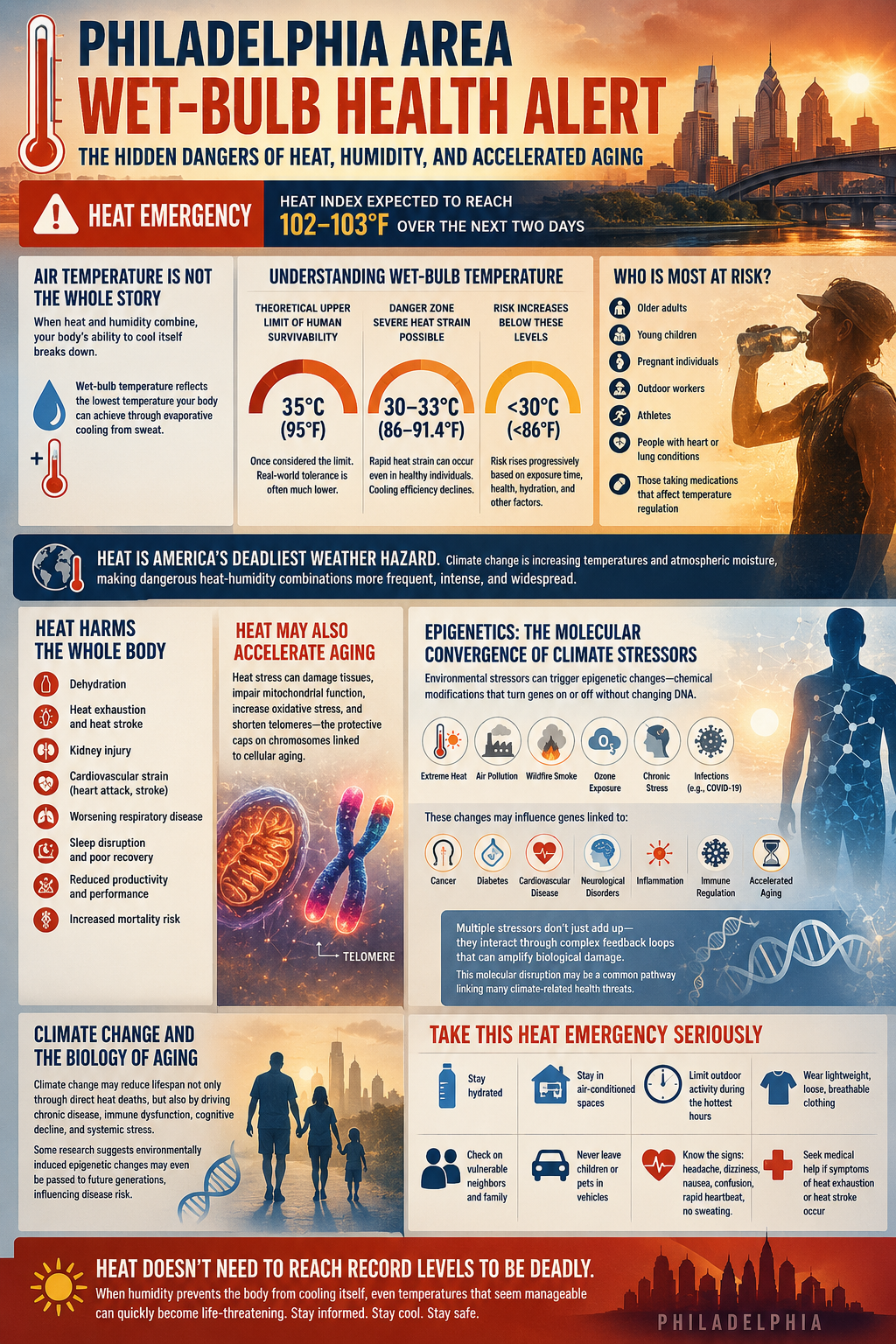
The Philadelphia region is currently under a heat emergency, with heat index values expected to reach approximately 102–103°F over the next two days. While many people focus on air temperature alone, the greater threat often comes from the dangerous combination of heat and humidity.
One of the best measures of this combined stress is wet-bulb temperature, which reflects the lowest temperature the body can achieve through evaporative cooling from sweat. As humidity rises, the body’s ability to cool itself declines, increasing the risk of heat exhaustion, heat stroke, organ damage, and death.
For years, scientists considered a wet-bulb temperature of 35°C (95°F) to be the theoretical upper limit of human survivability. More recent physiological and climate-chamber studies, however, suggest that real-world tolerance is often substantially lower, particularly during prolonged exposure, physical activity, direct sunlight, poor air circulation, or inadequate hydration.
Research increasingly indicates that wet-bulb temperatures in the range of 30–33°C (86–91.4°F) can produce severe heat strain even in healthy adults. At these levels, the body’s natural cooling mechanisms begin to lose effectiveness, causing internal temperatures to rise and placing increasing stress on virtually every organ system.
Heat Stress Begins Before the Extreme Thresholds
Importantly, dangerous heat conditions do not begin at a single threshold. Human thermoregulation deteriorates progressively as heat and humidity increase.
Risk rises substantially for:
- Older adults
- Young children
- Pregnant individuals
- Outdoor workers
- Athletes
- Individuals with cardiovascular disease
- People with respiratory illnesses
- Those taking medications that impair temperature regulation
The duration of exposure also matters. Even conditions that appear manageable can become dangerous after several hours, especially when nighttime temperatures remain elevated and prevent the body from recovering.
Heat: America’s Deadliest Weather Hazard
Heat remains one of the deadliest weather-related hazards in the United States, often causing more fatalities than floods, hurricanes, tornadoes, or lightning.
As climate change warms the atmosphere, the air can hold more water vapor, increasing humidity levels and making dangerous heat-humidity combinations more common. This trend is expanding the geographic reach of extreme heat events and increasing their frequency, intensity, and duration.
For many regions, including the Philadelphia metropolitan area, what were once rare heat emergencies are becoming increasingly routine.
The Growing Health Consequences of Extreme Heat
Exposure to elevated temperatures affects far more than comfort. Heat places stress on nearly every system in the human body and is associated with:
- Dehydration
- Heat exhaustion and heat stroke
- Acute kidney injury
- Cardiovascular strain
- Increased risk of heart attack and stroke
- Worsening respiratory disease
- Sleep disruption and impaired recovery
- Reduced physical and cognitive performance
- Lower labor productivity
- Increased mortality risk
Researchers are also finding evidence that repeated heat exposure may accelerate the aging process itself.
Emerging studies suggest that heat stress can damage tissues, impair mitochondrial function, increase oxidative stress, and contribute to the shortening of telomeres—the protective caps on chromosomes that are closely associated with cellular aging.
These findings suggest that climate change may influence health not only through immediate heat-related illness but also through long-term biological wear and tear.
Epigenetics: The Molecular Convergence of Climate Stressors
One of the most important emerging areas of climate-health research involves epigenetics—chemical modifications that influence how genes are expressed without changing the underlying DNA sequence.
These mechanisms function somewhat like biological dimmer switches, turning genes on or off in response to environmental conditions.
Increasing evidence suggests that extreme heat, particularly when combined with other environmental stressors, may trigger epigenetic changes throughout the body.
These stressors include:
- Air pollution
- Wildfire smoke
- Ground-level ozone
- Chronic psychological stress
- Infectious diseases such as COVID-19
- Exposure to environmental toxins
Research indicates that epigenetic alterations may influence genes associated with:
- Cancer
- Diabetes
- Cardiovascular disease
- Neurological disorders
- Inflammation
- Immune system regulation
- Metabolic dysfunction
- Accelerated aging
Critically, these environmental stressors do not operate independently. Their impacts may interact through complex biological pathways, creating feedback loops that amplify overall physiological damage.
This molecular-level disruption may represent a common underlying mechanism linking many seemingly separate climate-related health threats.
Climate Change and the Biology of Aging
The implications are profound.
Climate change may affect human health not only through direct heat-related deaths and injuries, but also through the gradual amplification of chronic disease, immune dysfunction, cognitive decline, and systemic physiological stress across entire populations.
Researchers are increasingly examining whether repeated exposure to extreme heat and other environmental stressors may contribute to accelerated biological aging at the population level.
Some scientists are also investigating the possibility of transgenerational effects, where environmentally induced epigenetic changes in one generation may influence disease susceptibility and health outcomes in future generations.
While this field remains an active area of research, the evidence increasingly suggests that climate change is not simply altering the environment around us—it may also be influencing biological processes within us.
Take This Heat Emergency Seriously
If you live in the Philadelphia area, take this heat emergency seriously.
- Stay hydrated.
- Limit outdoor activities during the hottest hours of the day.
- Seek air-conditioned environments whenever possible.
- Wear lightweight, breathable clothing.
- Check on elderly relatives, neighbors, and vulnerable individuals.
- Never leave children or pets in vehicles.
- Watch for signs of heat exhaustion and heat stroke.
Heat does not need to reach record-breaking levels to become life-threatening.
When humidity prevents the body from cooling itself effectively, temperatures that may seem manageable can rapidly become dangerous. As climate change continues to intensify extreme heat events, understanding the risks posed by wet-bulb temperatures may become increasingly important for protecting public health.
* Our probabilistic, ensemble-based climate model — which incorporates complex socio-economic and ecological feedback loops within a dynamic, nonlinear system — projects that global temperatures are becoming unsustainable this century. This far exceeds earlier estimates of a 4°C rise over the next thousand years, highlighting a dramatic acceleration in global warming. We are now entering a phase of compound, cascading collapse, where climate, ecological, and societal systems destabilize through interlinked, self-reinforcing feedback loops.
We examine how human activities — such as deforestation, fossil fuel combustion, mass consumption, industrial agriculture, and land development — interact with ecological processes like thermal energy redistribution, carbon cycling, hydrological flow, biodiversity loss, and the spread of disease vectors. These interactions do not follow linear cause-and-effect patterns. Instead, they form complex, self-reinforcing feedback loops that can trigger rapid, system-wide transformations — often abruptly and without warning. Grasping these dynamics is crucial for accurately assessing global risks and developing effective strategies for long-term survival.
Feedback Loops → Tipping Points → Domino Effect
Feedback loops amplify climate change and can push interconnected Earth systems past critical tipping points. As tipping points are crossed, they can trigger additional feedback loops and destabilize other climate systems. This cascading “Domino Effect” compresses timescales, accelerates change, and increases the risk of rapid, nonlinear climate transformations.
The Climate Crisis: Violent Rain | Deadly Humid Heat | Health Collapse | Extreme Weather Events | Insurance | Trees and Deforestation | Soil | Rising Sea Level | Food and Water | Updates