How Rising Energy Costs Move Through the Agricultural Supply Chain and Into Consumer Prices
By Daniel Brouse; Independent Economist, Financial Analyst, and Independent Climatologist
Simplified Overview
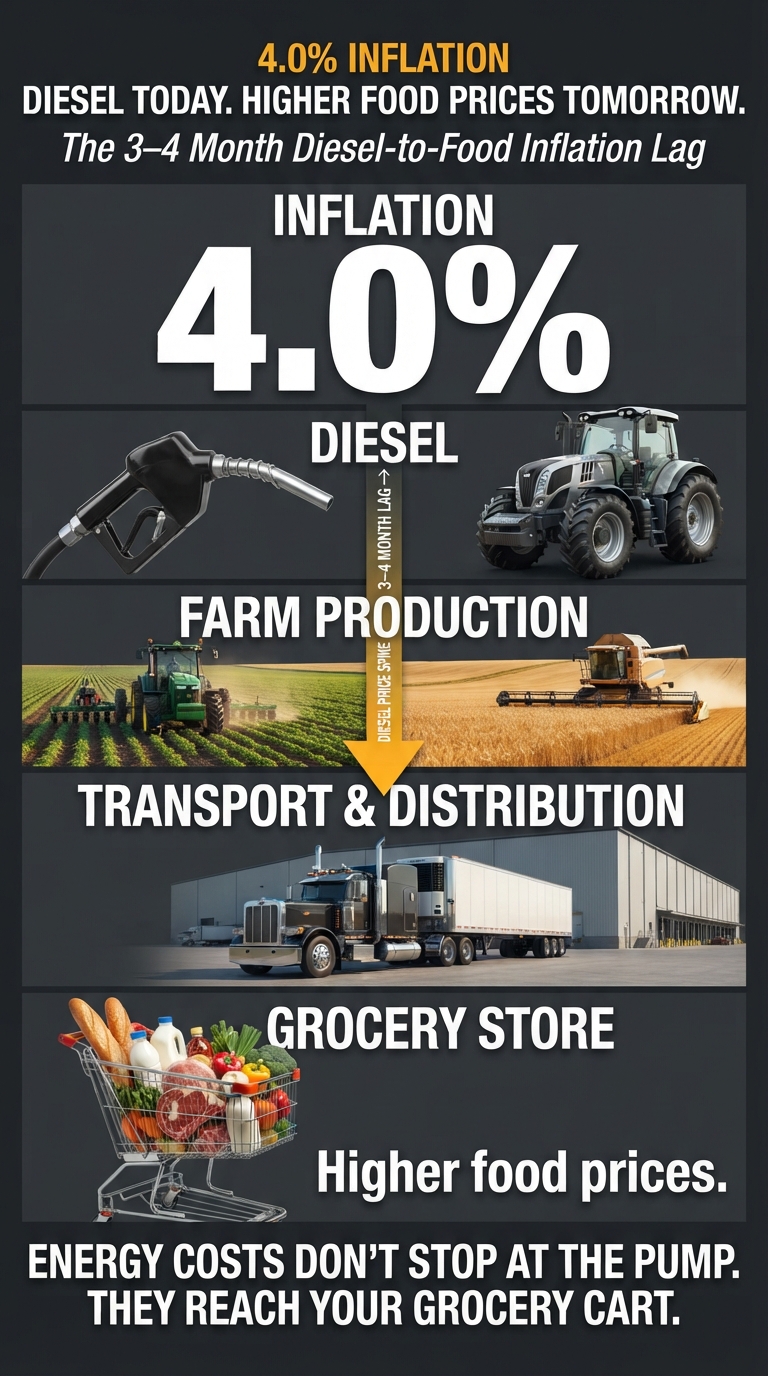
📈 4.0% INFLATION: DIESEL PRICES AND THE COMING FOOD INFLATION
With third-party calculations estimating annual consumer-price increases at 4.0%, up from 3.7% in September, monitoring diesel prices becomes particularly important when evaluating where food inflation is headed.
What you pay at the grocery store tomorrow may already be reflected in the diesel prices businesses are paying today.
Diesel is the lifeblood of the agricultural supply chain. It powers farm machinery, transports crops, moves food through processing facilities, and delivers products to grocery stores.
When diesel prices rise, the inflationary impact doesn’t stop at the fuel pump. It moves through the entire food supply chain, creating an estimated 3–4 month delay before higher operating costs work their way into consumer food prices.
🚜 Farm production
🚛 Freight and transportation
🏭 Food processing and distribution
🛒 Grocery-store prices
The economic lesson: Watch diesel prices today to understand food inflation tomorrow.
A closer look at the relationship between energy costs, agricultural production, and the inflationary pressures facing American households.
— Daniel Brouse
#Inflation #DieselPrices #FoodInflation #Economics #CPI #EnergyCosts #CostOfLiving
Introduction
Energy prices are a major driver of food inflation. Among the most important indicators is diesel fuel, which powers the machinery, transportation networks, and logistics infrastructure supporting the entire agricultural supply chain.
Diesel price increases can provide an early warning of broader food-price inflation, with an estimated transmission lag of approximately three to four months. This delay reflects the time required for higher fuel and operating costs to move through agricultural production, freight transportation, food processing, distribution, and retail pricing.
The relationship is particularly important because food inflation does not respond to energy-price increases instantaneously. Instead, rising costs accumulate throughout the supply chain, creating a delayed inflationary effect that eventually reaches consumers.
This process resembles a supply-chain bullwhip effect: an initial increase in fuel costs propagates through multiple stages of production and distribution, amplifying operating expenses before they appear in retail food prices.
1. The October 2026 Inflation Report
The October 2026 Consumer Price Index (CPI) report released by the U.S. Bureau of Labor Statistics showed that overall consumer prices increased 0.4% month-over-month, while core inflation, which excludes volatile food and energy prices, increased 0.3%.
Third-party inflation calculations estimate that overall U.S. consumer prices are running approximately 4.0% higher than a year ago, up from an estimated 3.7% in September.
Although the October annual comparison is not an official BLS twelve-month CPI calculation, the third-party estimate provides an additional perspective on the continuing inflationary pressures affecting American households.
The distinction matters because inflation is not simply a measurement of what consumers paid last month. It reflects the cumulative increase in the cost of living, including the essential expenses of food, transportation, housing, and energy.
The relationship between energy costs and food prices deserves particular attention because changes in fuel prices can affect agricultural production and distribution well before their full impact appears in consumer inflation statistics.
2. Why Diesel Prices Lead Food Inflation
Diesel is one of the fundamental inputs supporting the modern food economy. Its influence extends across four interconnected stages of the agricultural supply chain.
A. Agricultural Production: The Farm-Level Lag
Diesel powers much of the heavy equipment required to produce food, including:
- Tractors and planting equipment.
- Combines and harvesting machinery.
- Irrigation pumps and agricultural transport vehicles.
- Equipment used for moving crops and materials around farms.
The transmission mechanism:
When diesel prices increase, farmers face higher operating costs for planting, cultivating, irrigating, and harvesting crops.
Those expenses become embedded in production costs. Depending on the crop, growing season, and timing of the fuel purchase, the increased costs may not be reflected in food prices until the resulting harvest moves through processing and distribution.
The inflationary effect: Higher agricultural production costs eventually place upward pressure on wholesale and retail food prices.
B. Freight and Logistics: The Transportation Lag
Food is particularly dependent on transportation because it must move from farms to processors, warehouses, distributors, and grocery stores.
Diesel powers much of the transportation infrastructure, including:
- Commercial trucking fleets.
- Agricultural freight transportation.
- Diesel-powered rail locomotives.
- Port equipment and certain shipping operations.
The transmission mechanism:
When diesel prices rise, trucking and logistics companies experience higher operating expenses. Fuel surcharges, freight-rate adjustments, and contract renegotiations transmit these increases to food distributors and manufacturers.
Existing transportation contracts and pricing arrangements can delay the full pass-through of higher fuel costs.
The inflationary effect: Higher freight expenses increase the delivered cost of food, creating additional upward pressure on wholesale and retail prices.
C. Food Processing, Warehousing, and Distribution
The agricultural supply chain does not end when crops leave the farm. Food must be processed, packaged, refrigerated, stored, and distributed before reaching consumers.
These operations depend on substantial energy inputs and transportation infrastructure.
The transmission mechanism:
Higher diesel prices increase the cost of moving agricultural commodities, transporting processed products, operating distribution fleets, and maintaining inventory throughout the supply chain.
Food manufacturers and retailers also operate under existing purchasing agreements and inventory cycles. They may temporarily absorb increased expenses rather than immediately passing every cost increase to consumers.
As inventories turn over and contracts are renewed, accumulated cost increases become more visible in wholesale and retail pricing.
The inflationary effect: Energy and transportation costs work their way through processing and distribution, extending the time between an initial diesel-price increase and its appearance at the grocery store.
D. Fertilizer and Agricultural Input Costs
Fuel prices also interact with the broader agricultural energy market.
Natural gas is a major feedstock for nitrogen fertilizer production, while petroleum-based inputs and diesel-powered transportation contribute to the cost of manufacturing and distributing agricultural chemicals and fertilizers.
The transmission mechanism:
Higher energy prices can increase fertilizer manufacturing, transportation, and distribution expenses. Farmers then face higher input costs when purchasing fertilizer for subsequent planting seasons.
Depending on the timing and magnitude of these increases, farmers may pay more for fertilizer, adjust application rates, or change planting decisions.
These decisions can affect production costs and, in some circumstances, crop yields during subsequent growing and harvesting cycles.
The inflationary effect: Higher agricultural input costs can contribute to additional food-price pressures months after the original energy-price increase.
3. The Three-to-Four-Month Inflation Transmission Window
The combined effects of agricultural production, transportation, processing, and distribution create a delay between changes in diesel prices and their eventual impact on consumer food prices.
The estimated three-to-four-month window represents a useful economic hypothesis for monitoring inflationary pressures. It is not a fixed delay applying equally to every food category or every fuel-price increase.
Different commodities respond at different speeds:
- Fresh produce can experience relatively rapid transportation-cost pass-through.
- Meat and poultry prices are influenced by feed costs, production cycles, processing, and refrigeration.
- Grain products reflect agricultural input costs, harvesting, storage, milling, and distribution.
- Packaged foods can experience longer delays because of inventory management, purchasing agreements, and manufacturing cycles.
The important economic principle is that energy-price increases propagate through the supply chain over time. Consequently, today’s diesel prices can provide information about potential food-price pressures in the months ahead.
4. Why This Relationship Matters for Inflation Forecasting
Traditional inflation analysis frequently concentrates on the latest CPI readings. However, CPI is a lagging indicator of many underlying production and distribution costs.
Diesel prices offer a different perspective because they reflect an important operating expense throughout the physical economy.
Monitoring diesel prices alongside food prices can help identify emerging inflationary pressures before they become fully visible in retail statistics.
A useful forecasting model would examine:
- Monthly changes in national diesel prices.
- Changes in agricultural production and input costs.
- Changes in freight transportation costs.
- Subsequent changes in wholesale food prices.
- The eventual pass-through into grocery-store food prices.
Comparing these indicators over multiple years would help establish the actual transmission lag, quantify the relationship, and determine whether the three-to-four-month estimate holds consistently.
A particularly useful approach would be to compare diesel-price movements against the BLS Food at Home CPI, using time-lagged correlations and regression analysis. This would help distinguish the predictive relationship from the influence of other variables, including weather, crop yields, commodity markets, labor costs, and international supply disruptions.
5. Economic Implications
Food and energy are essential household expenses. When both experience sustained price increases, the resulting pressure on household budgets can be substantial.
Higher diesel prices affect more than what consumers pay at the pump. They increase the cost of producing, transporting, processing, and distributing the food Americans purchase every day.
This creates an important distinction between the initial inflationary shock and its downstream consequences.
Even when diesel prices stabilize, previously accumulated increases in production, freight, and distribution costs can continue working their way through the supply chain. Consequently, food inflation can remain elevated after the original fuel-price increase has subsided.
For policymakers, investors, businesses, and consumers, monitoring diesel prices provides an additional tool for evaluating future inflation risks.
Conclusion: Watch Diesel Today to Understand Food Inflation Tomorrow
Diesel is more than a transportation expense. It is a fundamental operating input throughout the agricultural economy.
Its influence extends from planting and harvesting to processing, refrigeration, transportation, warehousing, and retail distribution.
The estimated three-to-four-month transmission window illustrates why changes in diesel prices deserve attention when evaluating the future direction of food inflation.
With third-party calculations placing annual consumer-price increases at approximately 4.0%, up from 3.7% in September, the inflationary pressures affecting American households remain an important economic concern.
The broader economic lesson is straightforward:
By the time higher diesel costs appear in grocery-store prices, the inflationary pressures responsible for those increases have already been moving through the agricultural supply chain for months.
Monitoring diesel prices today provides an opportunity to anticipate tomorrow’s food inflation.