by Daniel Brouse
Indonesia: Still Burning — When Wildfire Becomes a Climate Feedback
Indonesia’s wildfire carbon dioxide emissions surged to the highest level in the world in early September 2026, driven by an intense El Niño season and extreme drought.
As reported earlier this month, Indonesia is experiencing a dangerous convergence of climate stress: extreme drought, human land-use change, and increasingly intense wildfires across Sumatra and Borneo.
See: https://www.kingarthur.com/global_warming/Climate-Energy-Orangutans.html
Record Emissions
According to the EU’s Copernicus Atmosphere Monitoring Service, as reported through Fire Emissions Watch, Indonesian fires released approximately 19.7 million metric tons of CO₂ between September 1 and September 7, 2026.
That represented more than one-third of global wildfire CO₂ emissions during that period and surpassed Russia.
The significance goes beyond the immediate emissions. Indonesia contains some of the world’s largest tropical peatlands—vast stores of carbon accumulated over thousands of years. When these peatlands dry out and burn, they can release carbon that has been locked away for centuries or millennia.
Regional Haze and Health Impacts
The consequences are not confined to the fire zones.
Smoke haze has spread across neighboring countries, including Singapore, Malaysia, and the Philippines, producing hazardous air-quality conditions. The resulting disruption has included school closures, remote learning affecting more than a million students, and widespread air-quality warnings.
What begins as a regional wildfire can therefore become a regional atmospheric event—with consequences for human health, transportation, education, agriculture, and ecosystems.
Orangutans Under Threat
Critically endangered orangutans are also facing an escalating survival crisis.
Intense wildfires are destroying and fragmenting habitat across Borneo and Sumatra. Extreme drought makes forests and peatlands more vulnerable to ignition, while the combination of drought, land-use change, and El Niño conditions can transform individual fires into large-scale ecological disasters.
For orangutans, the loss is not simply the burning of individual trees. It is the destruction and fragmentation of an already limited habitat.
When Wildfire Becomes a Climate Feedback
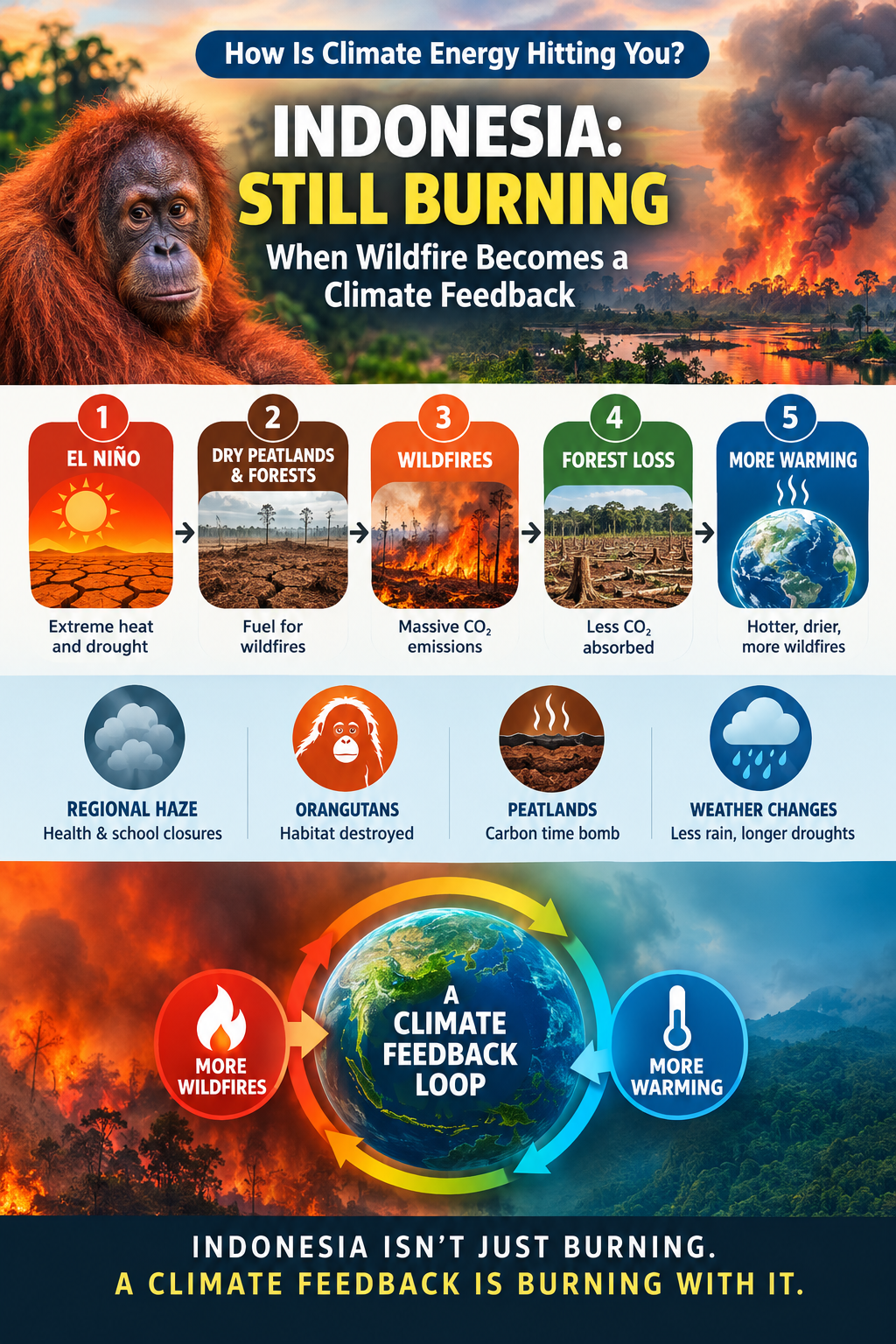
The Indonesian fires illustrate a dangerous climate feedback loop: warming and climate variability can create conditions that produce more wildfire, while the resulting fires release additional greenhouse gases and destroy carbon-absorbing ecosystems.
In other words:
Warming → drought → wildfire → CO₂ release + carbon-sink loss → more warming
Indonesia’s tropical peatlands make this feedback particularly important.
1. The Peatland Carbon Bomb
The process:
Peatlands consist of thick, waterlogged layers of partially decomposed plant material. Because decomposition is slowed under waterlogged conditions, enormous quantities of carbon can accumulate over long periods.
During severe drought, such as that associated with strong El Niño conditions, water tables can fall and peat can dry out.
The feedback:
Once dry, peat can ignite and continue smoldering underground. Unlike an ordinary surface forest fire, a peat fire can persist beneath the surface and release enormous quantities of stored carbon.
That produces a potentially powerful feedback:
Drought → dried peat → peat fire → CO₂ release → increased atmospheric warming → greater drought risk → more peat vulnerability
The critical point is that peat fires can release not only carbon from recently grown vegetation but also carbon accumulated over much longer periods.
2. Destruction of the Rainforest Carbon Sink
The process:
Healthy tropical forests function as major carbon sinks. Through photosynthesis, trees and other vegetation remove CO₂ from the atmosphere and store carbon in biomass and soils.
The feedback:
Wildfire can kill trees, degrade soils, and fragment the forest canopy. The loss of living vegetation reduces the ecosystem’s capacity to remove atmospheric CO₂.
At the same time, dead and damaged vegetation decomposes or burns, returning additional carbon to the atmosphere.
A forest that once removed carbon from the atmosphere can therefore become a source of greenhouse-gas emissions following severe disturbance.
The feedback becomes:
Forest loss → reduced CO₂ uptake + additional emissions → higher atmospheric CO₂ → greater warming
This is a critical distinction: wildfire does not merely add emissions. It can simultaneously remove part of the natural system that would otherwise absorb those emissions.
3. Regional Weather and Surface-Albedo Changes
Wildfires can also modify the physical environment.
Dense smoke and aerosol plumes can spread across enormous areas, reducing incoming sunlight at the surface while altering atmospheric heating. Meanwhile, burned landscapes have different surface characteristics from intact forests, including changes in surface reflectivity, vegetation, soil moisture, and evaporation.
These changes can disrupt local and regional energy and water cycles.
The resulting effects are complex and can vary with atmospheric conditions, but prolonged smoke and vegetation loss can alter evaporation, convection, rainfall patterns, and the persistence of dry conditions.
When drought delays the return of heavy rainfall, peat fires can continue burning underground for extended periods.
The Climate Feedback Loop
The Indonesian situation can be summarized as a sequence:
| Step | Action | Impact |
|---|---|---|
| 1. Trigger | El Niño + climate warming | Increased heat and drought stress |
| 2. Amplification | Peatlands and forests dry out | Landscapes become increasingly fire-prone |
| 3. Event | Peatlands and forests burn | Large quantities of stored carbon are released |
| 4. Carbon-sink loss | Forests are damaged or destroyed | Less CO₂ is removed from the atmosphere |
| 5. Atmospheric response | CO₂ and other greenhouse gases increase | Additional radiative forcing |
| 6. Feedback | Increased warming and ecosystem stress | Greater risk of future drought and wildfire |
The Bigger Picture
The Indonesian fires demonstrate why climate change cannot be understood solely as a gradual increase in average temperature.
Climate energy moves through interconnected Earth systems.
A period of extreme heat and drought can trigger wildfire. Wildfire can release stored carbon. The same wildfire can destroy vegetation that would otherwise absorb atmospheric CO₂. Smoke and land-surface changes can alter regional energy and water cycles. The resulting environmental changes can increase the vulnerability of the system to the next extreme event.
That is a feedback.
And when multiple feedbacks begin operating simultaneously, the climate system can become increasingly difficult to treat as a simple linear progression.
Indonesia isn’t just burning.
A climate feedback is burning with it.