by Daniel Brouse
Simplified Introduction
🌎 Earth’s Energy Imbalance
Climate change can be understood in one deceptively simple equation:
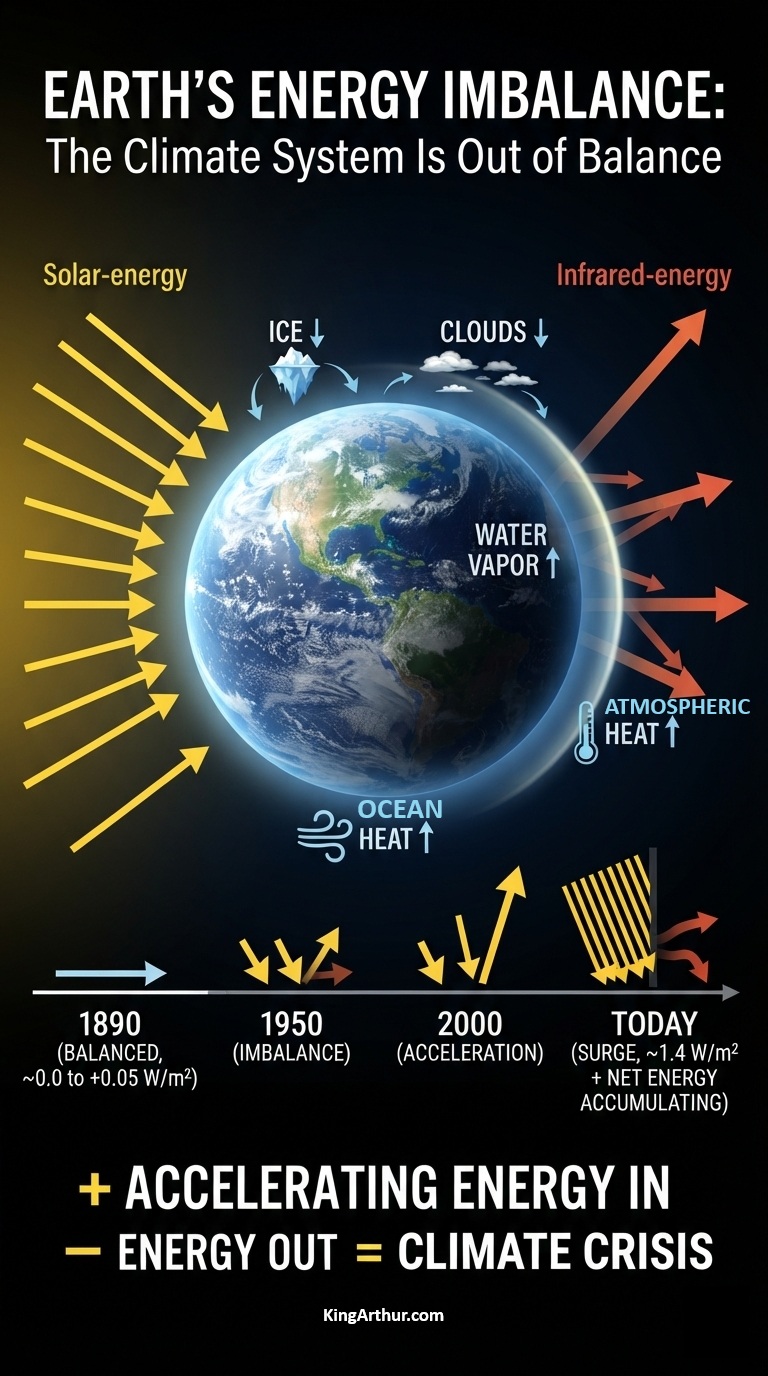
ENERGY IN − ENERGY OUT = ENERGY ACCUMULATING
Earth has been accumulating excess energy for decades. Most of that excess heat—roughly 90%—is going into the oceans.
What matters now is not just that Earth is out of balance, but that the imbalance itself is changing.
The recent acceleration in Earth’s energy imbalance raises an important question:
Are we moving from a relatively steady warming system toward a climate system increasingly driven by interacting feedbacks?
Ice loss. Clouds. Water vapor. Ocean heat. Carbon sinks.
When these systems interact, the climate response can become increasingly nonlinear.
ACCELERATING ENERGY IMBALANCE = ACCELERATING CLIMATE CHANGE
The simplest way to understand global warming may be to stop looking only at the thermometer—and start looking at the energy.
Read the full paper:
The Energy Imbalance (EEI)
A simple way to understand climate change and global warming is through Earth’s energy balance—or, more precisely, the growing lack of balance known as Earth’s Energy Imbalance (EEI).
Earth’s climate is governed by a fundamental exchange: energy arrives primarily from the Sun, while Earth returns energy to space as reflected sunlight and outgoing infrared radiation. When incoming and outgoing energy are equal over the long term, the planet is approximately in energy balance. When more energy enters the Earth system than leaves it, the difference is stored within the climate system, producing warming.
The Basic Energy Equation
There are two fundamental pathways involved in Earth’s energy budget:
- Energy enters and leaves.
Sunlight brings energy into the Earth system, while reflected sunlight and outgoing infrared radiation carry energy back into space. - Energy enters and is temporarily stored.
Some of the incoming energy remains within the Earth system as heat. It warms the oceans, land, and atmosphere and melts snow and ice. Today, roughly 90% of the excess energy associated with the imbalance is stored in the ocean.
The important point is that energy cannot simply disappear. If less energy leaves the Earth system than enters it, the difference accumulates somewhere within the system.
From Balance to Imbalance
For thousands of years before large-scale industrialization, Earth’s climate system fluctuated around a long-term energy balance. Beginning with the Industrial Revolution, however, human activities increasingly altered that balance.
The primary driver is the buildup of greenhouse gases such as carbon dioxide and methane. These gases reduce the rate at which Earth can emit infrared energy to space. As a result, more energy remains in the Earth system.
This does not mean that every year must be warmer than the preceding year. Natural variability—including El Niño and La Niña—can temporarily redistribute energy between the ocean and atmosphere and produce substantial year-to-year fluctuations. But over longer periods, a persistent positive EEI means that the Earth system continues accumulating energy.
The Imbalance Is Increasing
The remarkable development is not simply that Earth has a positive energy imbalance. The rate of energy accumulation has increased.
NASA and NOAA observations combining CERES satellite measurements with ocean observations found that Earth’s energy imbalance approximately doubled between the first decade of the 21st century and the 2005–2019 period. A 2024 observational assessment likewise found that CERES measured an increase from approximately 0.5 ± 0.2 W/m² during 2000–2009 to 1.0 ± 0.2 W/m² during 2010–2019.
The increase was not simply a matter of more greenhouse gases trapping infrared radiation. The CERES analysis found that absorbed solar radiation increased by about 0.9 W/m², while outgoing longwave radiation increased by about 0.4 W/m², partially offsetting that additional absorbed solar energy.
That distinction is important.
The Earth system can become more energetically unbalanced through changes in both:
- how much solar energy is absorbed, and
- how much infrared energy escapes to space.
Why the Post-2020 Period Matters
The years since 2020 have attracted particular scientific attention because several factors have combined to produce unusually large changes in Earth’s radiation budget.
One important contributor is the sharp reduction in sulfur emissions from international shipping following the IMO 2020 regulations. Sulfate aerosols reflect sunlight and can brighten clouds, producing a cooling influence. Their reduction therefore allows more solar radiation to reach and remain within the Earth system.
A 2024 modeling study estimated a global effective radiative forcing from IMO 2020 of approximately +0.14 W/m², primarily through aerosol-cloud interactions. The study estimated that the regulation could contribute about 0.046°C of additional global warming during 2020–2029, while emphasizing that other factors are required to explain the exceptional warmth of 2023.
This is significant, but it should not be interpreted as meaning that shipping regulations alone caused the recent surge in Earth’s energy imbalance.
The climate system is responding simultaneously to greenhouse-gas forcing, aerosol changes, clouds, water vapor, surface albedo, ocean circulation, volcanic activity, and internal variability.
A Rapidly Changing Radiation Budget
CERES observations provide direct measurements of changes in Earth’s radiation budget from space. The data show substantial changes in both absorbed solar radiation and outgoing longwave radiation.
The year 2023 was particularly unusual. Global annual mean absorbed solar radiation was about 1.75 W/m² above the CERES reference climatology, while outgoing longwave radiation was about 0.85 W/m² above the reference. The resulting annual mean net radiation anomaly was approximately +0.90 W/m².
NASA has also reported that 2023 produced exceptionally large anomalies in absorbed solar radiation, with values exceeding the 90% confidence interval for much of March through September. The exceptionally large absorbed-solar and outgoing-longwave anomalies continued into early 2024.
These observations demonstrate something important:
Earth’s energy budget is not static. It is changing.
And the changes involve multiple interacting components of the climate system.
Energy Imbalance and Climate Feedbacks
This is where the concept of climate feedback becomes important.
An initial warming can trigger changes that alter the amount of energy entering or leaving the Earth system. Some of those changes amplify the original warming.
Examples include:
- Water vapor: Warmer air can hold more water vapor, and water vapor is itself a greenhouse gas.
- Ice and snow: Melting reduces Earth’s reflectivity, allowing more sunlight to be absorbed.
- Clouds: Changes in cloud amount, altitude, composition, and properties can alter both reflected sunlight and outgoing infrared radiation.
- Ocean warming: The ocean absorbs most of the excess energy, affecting circulation, evaporation, sea level, and atmospheric processes.
- Carbon-cycle feedbacks: Warming and changing environmental conditions can alter the ability of terrestrial and oceanic systems to absorb carbon.
These feedbacks do not create energy from nothing. Rather, they change the pathways through which energy moves through the Earth system.
That distinction is crucial.
A feedback can cause the Earth to absorb more solar energy or retain more infrared energy, increasing the rate at which the existing energy imbalance grows.
The Energy Accumulation Is Enormous
The units used to measure EEI—watts per square meter—can make the imbalance sound deceptively small.
For example, 1.0 W/m² means that, averaged across the entire surface of Earth, approximately one additional joule of energy is accumulating every second for every square meter.
Across the entire planet, even a 1.0 W/m² imbalance corresponds to roughly 510 terawatts of continuous power.
At an imbalance of 1.45 W/m², the corresponding rate would be roughly 740 terawatts.
That is an extraordinary amount of energy.
The comparison can be expressed another way. Using the approximate energy yield of the Hiroshima bomb, an EEI of 1.45 W/m² corresponds to an energy accumulation rate on the order of 11 Hiroshima-scale explosions every second.
The important point is not the metaphor itself. It is the scale of the energy involved.
The Earth Is Not Just Getting Warmer
Temperature is only one visible consequence of the energy imbalance.
The accumulated energy is distributed throughout the Earth system. It:
- heats the oceans,
- warms the land,
- warms the atmosphere,
- melts glaciers and ice sheets,
- reduces sea ice,
- expands seawater,
- increases evaporation,
- intensifies the hydrological cycle,
- and contributes to changes throughout the climate system.
NASA’s CERES program estimates that about 93% of the current excess energy is stored in the ocean, illustrating why ocean heat content is such an important measure of Earth’s changing energy budget.
This is why looking only at surface temperature can obscure part of the story.
The climate system is an energy system.
Surface temperature is one measurement of that system—not the system itself.
The EEI Timeline
| Historical Period / Era | Approximate EEI Average (W/m²) | Primary Radiative Drivers & Climate Context |
|---|---|---|
| 1890–1910 (Early Industrialization) | ~0.0 to +0.05 | The climate remains in near-equilibrium. Early fossil fuel emissions are largely offset by natural variability and background volcanic activity. |
| 1910–1950 (Mid-Century Rise) | +0.05 to +0.15 | EEI begins a slight upward crawl. A steady expansion of global manufacturing and coal combustion begins trapping marginal longwave heat. |
| 1950–1970 (The Aerosol Masking Era) | +0.15 to +0.25 | The “Great Acceleration” of industry begins. However, heavy sulfur dioxide pollution creates a reflective aerosol blanket, blocking sunlight and masking up to half of greenhouse warming. |
| 1970–1990 (Emerging Imbalance) | +0.30 to +0.50 | Clean air regulations reduce sulfur pollution while greenhouse gases continue to climb. The planet begins absorbing noticeably more solar radiation. |
| 1990–2005 (Systemic Multi-Decade Warming) | +0.50 to +0.65 | Satellite programs launch. Except for a brief drop following the 1991 Mount Pinatubo volcanic eruption, the EEI remains locked in a consistently positive, warming state. |
| 2005–2019 (The First Acceleration) | +0.70 to +0.90 | The long-term EEI average effectively doubles compared to prior decades. Ocean heat content spikes dramatically as the oceans absorb roughly 90% of this excess energy. |
| 2020–2023 (The Post-2020 Surge) | +1.00 to +1.30 | Slashed marine shipping pollution (IMO 2020 regulations) rapidly clears atmospheric haze over the oceans, forcing a massive, sudden spike in absorbed solar energy. |
| 2024–Present (Nonlinear Feedback Phase) | +1.40 to +1.48+ | EEI hits unprecedented, record-breaking territory. Strong climate feedbacks—such as collapsing Antarctic sea ice and thinning cloud decks—darken the planet, causing it to absorb immense amounts of solar radiation. |
Near balance → emerging imbalance → acceleration → post-2020 surge → nonlinear feedback phase
The observational record therefore supports a clear long-term conclusion: Earth’s energy imbalance has increased substantially over recent decades.
The precise attribution of the most recent changes remains an active area of research.
The Bigger Picture
The simplest way to understand global warming is not to begin with a thermometer.
Begin with energy.
Earth receives energy from the Sun. Earth emits energy back into space. Greenhouse gases, clouds, aerosols, ice, water vapor, and other components of the climate system influence how much energy enters, how much leaves, and how quickly the system responds.
When the equation is balanced, Earth’s average climate can remain relatively stable.
When the equation is persistently unbalanced, energy accumulates.
And when the rate of that accumulation changes, the climate system changes with it.
Global warming is therefore not merely a temperature problem. It is an energy-accounting problem.
The central question is simple:
How much energy is entering the Earth system, how much is leaving, and how rapidly is the difference changing?
That difference is Earth’s Energy Imbalance.
And it is one of the most fundamental measurements of a changing climate.