by Daniel Brouse
Indonesia’s Orangutans and the Peatland Carbon Bomb
Indonesia is experiencing a dangerous convergence of climate stress, extreme drought, human land-use change, and wildfire across Sumatra and Borneo. As of September 2026, satellite observations indicate that more than 200,000 hectares have burned, releasing enormous quantities of greenhouse gases while blanketing large portions of Southeast Asia in toxic smoke and haze.
For Indonesia’s orangutans, this is more than a wildfire crisis. It is an accelerating ecosystem crisis in which climate change, drought, deforestation, and peatland destruction reinforce one another.
The Climate Change Feedback Loop
Climate change does not have to ignite a wildfire to make a fire catastrophe more likely. Instead, warming can intensify the environmental conditions that allow fires to spread, burn longer, and become increasingly difficult to control.
Indonesia’s recurring dry seasons are strongly influenced by natural climate variability, particularly El Niño. But a warmer climate can load the system with additional heat and alter the background conditions under which these natural cycles operate. During an exceptionally strong El Niño, prolonged drought and extreme heat can turn already vulnerable landscapes into tinderboxes.
That becomes particularly dangerous in Indonesia’s peatlands.
The Peatland Carbon Bomb
Indonesia contains vast tropical peatlands—wetlands formed from layers of partially decomposed organic material accumulated over thousands of years. When these ecosystems remain saturated, the waterlogged peat is relatively resistant to burning.
But decades of drainage and conversion for agriculture, palm-oil production, pulpwood plantations, roads, and other development have transformed many peatlands into something fundamentally different: enormous stores of carbon sitting above the water table.
Once dried, peat can ignite and continue smoldering underground. A surface fire may disappear while combustion continues below ground, allowing fires to persist for weeks or months and re-emerge far from the original ignition point.
The result is a powerful positive feedback:
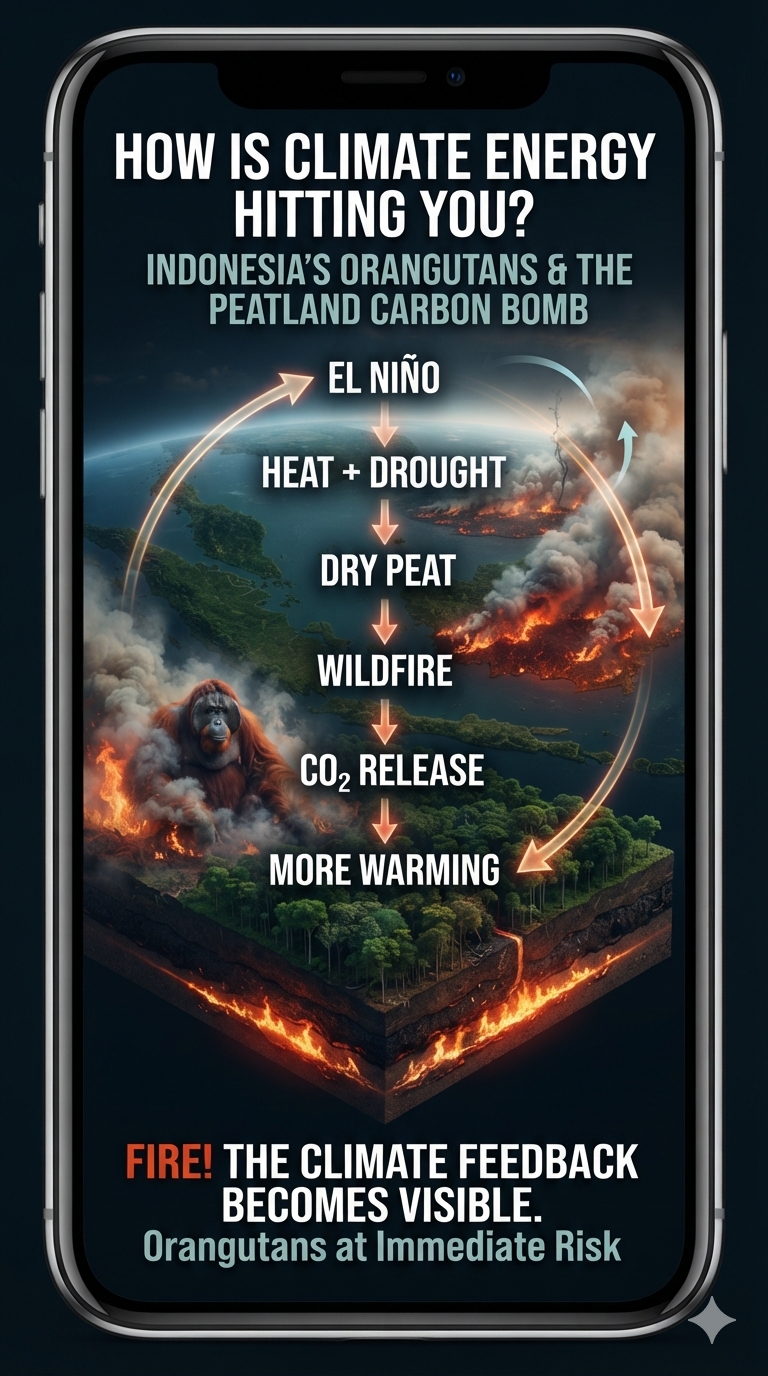
Drought → dry peat → wildfire → carbon emissions → more atmospheric warming → greater climate stress
Peat fires are also major sources of fine particulate pollution, creating severe health impacts across Indonesia and neighboring countries. Unlike an ordinary forest fire, a peat fire can continue consuming carbon-rich soil beneath the surface, releasing greenhouse gases long after the visible flames have disappeared.
From Forest Fire to Climate Feedback
The significance extends far beyond the individual fire.
When forests and peatlands burn, carbon that had been stored in vegetation and soil for centuries or millennia is rapidly transferred into the atmosphere. The resulting greenhouse-gas emissions contribute to additional warming, while the loss of forest reduces the ecosystem’s capacity to store carbon in the future.
This creates another reinforcing loop:
Forest and peatland destruction → carbon release → atmospheric warming → greater drought and heat stress → increased fire vulnerability
The system can therefore begin amplifying itself.
The Orangutan Connection
Orangutans are among the most visible casualties of this feedback system. Their remaining habitat is concentrated primarily in the forests and peatlands of Borneo and Sumatra. When these landscapes are cleared, drained, fragmented, or burned, orangutans lose not simply individual trees but entire interconnected ecosystems on which their survival depends.
Fire can kill animals directly, separate populations, destroy food sources, and further fragment already shrinking habitat. Smoke and prolonged drought add additional stress.
The orangutan therefore provides a remarkably tangible way to understand climate energy.
The heat accumulating in the Earth system does not remain an abstract number on a graph. It manifests through drought, altered rainfall, drying wetlands, wildfire, habitat destruction, ecosystem collapse, and ultimately the loss of living organisms.
A Global Feedback
The danger does not end at Indonesia’s borders.
Between September 1 and September 7, 2026, reported wildfire emissions were estimated to have increased dramatically, with approximately 19.7 million tons of carbon dioxide released during that period. If confirmed, such emissions demonstrate how rapidly a regional ecological disturbance can become part of the global climate system.
Indonesia’s peatlands are effectively biological carbon reservoirs. When they remain wet and intact, they help keep carbon out of the atmosphere. When they are drained and burned, they can become carbon sources instead.
That is the paradox of the peatland carbon bomb:
The ecosystem that once stored carbon becomes an engine for releasing it.
Climate Energy Is Coming Back Around
This is what makes Indonesia’s wildfire crisis so important in understanding climate change.
Climate energy moves through the Earth system. The atmosphere warms. Oceans redistribute enormous quantities of heat. Atmospheric circulation changes. Drought and precipitation patterns shift. Vegetation becomes stressed. Wetlands dry. Fire releases stored carbon. Carbon dioxide and other greenhouse gases increase atmospheric energy retention.
The process is not a simple straight line from warming to fire.
It is a feedback system.
Warming → drought → fire → carbon release → more warming → greater vulnerability
And in Indonesia, that feedback is colliding with one of the planet’s most biologically important ecosystems.
The orangutan is not separate from the climate system.
Neither is the peat beneath its feet.
The fire is where the climate feedback becomes visible.