by Daniel Brouse
🏔️ SIMPLIFIED INTRODUCTION: MOUNTAIN GLACIERS AT THE EDGE
Mountain glaciers are disappearing faster.
But the bigger danger may be what happens to the mountains when the ice disappears.
Record global heat and the powerful 2023–2024 El Niño helped drive extraordinary glacier mass loss worldwide. Now, with another potentially powerful El Niño developing against an already overheated climate, the consequences extend far beyond shrinking glaciers.
Extreme heat melts glacier ice.
Permafrost thaws.
Mountain slopes weaken.
Rain replaces snow.
Atmospheric rivers deliver enormous amounts of water.
Landslides block rivers.
Temporary lakes form.
And those lakes can suddenly burst downstream.
The danger is no longer simply ICE LOSS.
It is SYSTEM INSTABILITY.
This is what happens when multiple climate-sensitive systems begin moving together—and feedbacks start turning one disturbance into another.
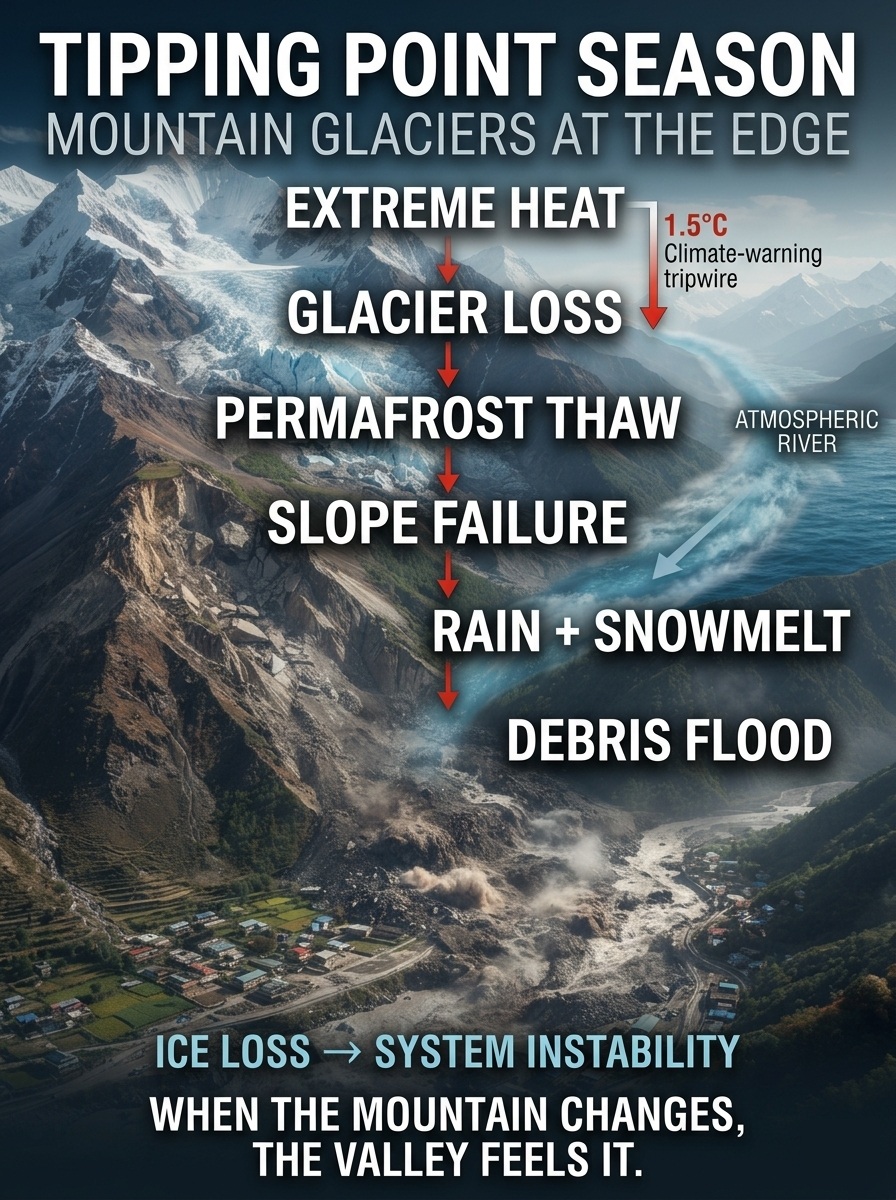
Tipping Point Season: Mountain Glaciers at the Edge
The mountain isn’t just losing ice.
The mountain is changing.
The Full Report
The combination of the powerful 2023–2024 El Niño and record-breaking global heat severely accelerated the loss of mountain glaciers worldwide, producing some of the largest glacier mass-balance deficits ever recorded. What makes this period particularly important is not simply the amount of ice being lost, but the way extreme heat, altered precipitation, permafrost thaw, and increasingly volatile hydrology are beginning to interact across high-mountain environments.
2023–2024: A Global Glacier Mass-Loss Shock
Data compiled by the World Glacier Monitoring Service (WGMS) and the United Nations illustrate the extraordinary scale of recent glacier deterioration. The compounding effects of human-induced climate change and the 2023–2024 El Niño contributed to exceptionally severe melting conditions.
Record-breaking global mass loss
During the 2023 hydrological year, glaciers experienced a record-breaking global mass loss equivalent to approximately 1.1 meters of ice thickness. The total loss was roughly 600 gigatons of water, making 2023 the largest annual glacier mass loss recorded since systematic measurements began in 1976.
The deterioration continued in 2024. The 2024 hydrological year ranked as the fourth-worst year on record, with glaciers losing another approximately 450 billion tonnes of ice. It also marked the third consecutive year in which all 19 glacier regions monitored globally experienced a net mass loss.
The significance of these numbers extends beyond the glaciers themselves. Mountain glaciers function as frozen reservoirs, storing water that is gradually released into downstream river systems. Their rapid depletion therefore represents both a cryospheric transformation and a growing threat to water security, ecosystems, agriculture, hydropower, and communities downstream.
Tropical Glaciers: Exceptionally Vulnerable
Tropical glaciers, particularly those in the Andes and Indonesia, are exceptionally sensitive to changes in precipitation and temperature. The 2023–2024 El Niño amplified those vulnerabilities.
In the Peruvian Andes, research on the Quelccaya Ice Cap has shown how El Niño can suppress wet-season snowfall, replacing it with warmer and drier conditions. Fresh snow normally provides a highly reflective surface that returns much of the incoming solar energy back to space. When snowfall fails and bare glacier ice is exposed, the darker surface absorbs substantially more solar energy.
This creates a powerful feedback: less snowfall means less reflective snow cover; less reflective snow means greater absorption of solar energy; greater energy absorption accelerates melting and exposes still more bare ice.
Indonesia’s Puncak Jaya glaciers face an even more precarious future. These rare tropical glaciers were already critically endangered, and drought and temperature anomalies associated with El Niño accelerated the timeline toward potential disappearance.
European Alps and North American Ranges
El Niño does not directly control the climate of every mountain region. Its effects are superimposed on a much larger background trend of human-driven global warming.
In the European Alps, persistent and intense summer heatwaves produced severe glacier degradation. Melting occurred even at elevations above approximately 3,100 meters—heights that historically provided substantially greater protection from summer heat.
The North Cascades of the United States experienced a similar pattern. In areas such as North Cascades National Park, monitored glaciers continued to lose mass through both 2023 and 2024, consistent with a broader regional trend in which glacier melt rates have increased dramatically over recent decades.
The important signal is therefore not simply that glaciers are retreating. It is that the elevation, duration, and intensity of melting are changing. Ice that once remained protected through the summer is increasingly being exposed to temperatures capable of transforming both the surface and the internal structure of mountain glaciers.
The 2023–2024 Glacier Signal
| Metric / Region | Impact from 2023–2024 Heat and El Niño |
|---|---|
| Global Mass Loss | 2023 was the worst year on record, with approximately 600 Gt of ice lost. 2024 ranked fourth-worst. All 19 monitored glacier regions experienced net loss. |
| Tropical Glaciers | Reduced seasonal snowfall combined with extreme heat exposed darker bare ice, accelerating thinning and shortening extinction timelines. |
| Mid-Latitude Glaciers | Extreme high-elevation temperatures pushed the melt zone upward, exposing previously protected ice to rapid melting, fracturing, and structural deterioration. |
| Sea-Level Contribution | Glacier mass loss adds freshwater directly to the oceans, compounding sea-level rise driven by thermal expansion and other sources. |
But the story does not end with glacier retreat.
The more consequential question is what happens when a warming atmosphere begins to destabilize the mountains surrounding and supporting those glaciers.
2026–2027: From Glacier Loss to Mountain Instability
The emerging 2026–2027 El Niño is occurring against an already unprecedented background of global warming. If the event develops with the exceptional strength currently being discussed, its influence will not be confined to ocean temperatures or atmospheric circulation.
High-mountain environments are particularly vulnerable because they sit at the intersection of several climate-sensitive systems: glaciers, snowpack, permafrost, steep rock faces, atmospheric circulation, and rapidly responding river networks.
The result can be a chain reaction in which one disturbance increases the probability or severity of another.
1. The Nepal–Tibet Glacial Collapse
The catastrophic disaster reported along the Nepal–Tibet border on August 26, 2026, provides a stark example of how extreme heat can intersect with high-altitude geological instability.
A massive section of glacier collapsed at approximately 5,200 meters, triggering an enormous avalanche of ice, rock, and mud that moved into the Trishuli and Bhotekoshi River valleys. The resulting destruction affected communities and critical infrastructure, including hydropower facilities and border transportation routes.
The thermal environment preceding the collapse is particularly significant. Meteorological analysis reportedly found prolonged and exceptional warmth at the elevation of the glacier, with temperatures averaging approximately 5°C (41°F) over a six-day period. Such temperatures are extraordinary at 5,200 meters and illustrate how extreme atmospheric warmth can penetrate environments historically protected by elevation.
The lesson is larger than a single glacier failure.
When temperatures rise far enough, high altitude is no longer the same form of protection it once was.
2. Feedback Mechanism: Permafrost Thaw and Slope Failure
Glacier retreat is only one component of high-mountain destabilization. Permafrost provides another critical structural control.
Permafrost consists of permanently frozen soil, rock, and ice. In steep mountain terrain, frozen water can act as a form of geological glue, binding fractured rock and stabilizing slopes.
Extreme warming attacks that structural support.
As temperatures rise, permafrost can thaw progressively deeper into mountain slopes. Ice within fractures melts, reducing the cohesion between rock surfaces. Water can then penetrate deeper into the fractured rock, while repeated freeze-thaw cycles and changing hydraulic pressures further weaken the structure.
The result can be slope failure.
A destabilized glacier, hanging ice mass, or fractured rock face may collapse as a single event, but the material released does not necessarily remain an avalanche of ice. It can entrain enormous quantities of rock, soil, sediment, and meltwater.
What begins as a glacier or rock failure can therefore become a high-speed debris flow or mudslide carrying millions of tonnes of material downstream.
This is a critical transition: climate change is not simply removing ice from mountains; it can alter the mechanical stability of the mountains themselves.
3. Feedback Mechanism: Supersized Atmospheric Rivers
The other half of the problem is water.
El Niño reorganizes global atmospheric circulation and changes the distribution of heat and moisture across the planet. Warmer ocean surfaces provide greater evaporation potential, increasing the amount of water vapor available to the atmosphere.
That additional atmospheric moisture can feed powerful atmospheric rivers—long, narrow corridors transporting enormous quantities of water vapor.
When these systems encounter mountain ranges, the consequences can become extreme.
Instead of falling as snow, warm atmospheric rivers can produce rain at elevations that historically received substantial snowfall. This creates a particularly dangerous combination: rain-on-snow events occurring simultaneously with already accelerated glacier and snowpack melt.
4. The Hydro-Thermal Double Whammy
Rain falling on snow and ice does more than add water.
Rain transfers sensible and latent heat directly into the snowpack and glacier surface. At the same time, the enormous volume of rainfall can rapidly increase runoff.
The result is a hydro-thermal double whammy:
Heat accelerates melting while water accelerates runoff.
Mountain drainage systems can become overwhelmed as rainfall, snowmelt, and glacier melt converge. Steep terrain magnifies the response, sending water and sediment rapidly into narrow valleys.
If landslides or debris flows block those valleys, temporary lakes can form behind natural dams of rock, ice, and sediment. Such impounded water can subsequently breach the blockage, generating devastating downstream floods, including glacial lake outburst floods (GLOFs).
The hazard therefore moves through the system:
Heat → glacier melt → permafrost thaw → slope failure → debris flow → river blockage → temporary lake → sudden flood.
One climate disturbance can become a cascade of physical disturbances.
The Compounding Cycle of Mountain Hazards
| Climate Driver | Direct Physical Change | Resulting Environmental Hazard |
|---|---|---|
| Record Ambient Heat | Extreme high-elevation temperatures accelerate surface melting and weaken glacier structures. | Rapid ice loss, glacier destabilization, and structural collapse. |
| Permafrost Thaw | Ice binding rock and soil begins to melt, weakening the mountain’s internal structure. | Whole-slope failures, massive rockfalls, and debris-laden mudslides. |
| El Niño–Driven Moisture | Warmer oceans increase evaporation and atmospheric moisture availability. | More powerful atmospheric rivers and extreme precipitation events. |
| Rain-on-Snow Events | Warm rainfall adds heat and water directly to mountain snow and ice. | Accelerated melt, rapid runoff, flooding, and landslides. |
| Cascading Hydrology | Landslide and debris-flow material blocks narrow river channels. | Temporary lakes and potentially catastrophic glacial lake outburst floods. |
Tipping Point Season
The most important signal may therefore not be the disappearance of an individual glacier.
It may be the increasing synchronization of multiple mountain processes.
Glacier loss changes surface reflectivity and water storage. Permafrost thaw weakens mountain slopes. Extreme heat raises the elevation of the melt zone. Atmospheric rivers deliver greater quantities of warm precipitation. Rain-on-snow events accelerate runoff. Landslides alter river channels. Temporary lakes form behind unstable debris dams. Those lakes can subsequently fail.
Each process can amplify another.
This is what makes mountain glacier loss a potential tipping-point problem. The danger is not necessarily one dramatic threshold at which a glacier suddenly disappears. The danger is a system in which multiple thresholds are approached simultaneously, feedbacks proliferate, interactions strengthen, and individual disturbances begin producing consequences far beyond their original location.
The mountain system becomes increasingly nonlinear.
A glacier that once functioned primarily as a frozen reservoir can become a source of floodwater. Permafrost that once stabilized a mountain slope can become a liability when it thaws. Snow that once stored water safely through the winter can become a mechanism for rapid runoff when warm rain falls on it. A landslide that once would have been a localized geological event can block an entire river and create a secondary flood disaster.
The result is a shift from ice loss to system instability.
That may be the larger lesson of Tipping Point Season: climate change is not simply making glaciers smaller. It is changing the physical relationships among ice, rock, water, atmosphere, and gravity.
And when those relationships begin changing together, the mountain can stop behaving like the mountain we knew.