by Daniel Brouse
The First Law of Thermodynamics and the Redistribution of Earth’s Excess Energy
Energy Cannot Be Created or Destroyed
The principle that energy cannot be created or destroyed is known as the Law of Conservation of Energy, or the First Law of Thermodynamics. In simple terms, the total energy within an isolated system remains constant. Energy can change form, move from one place to another, or be stored in different components of the system—but it does not simply disappear.
That principle provides a powerful way to understand today’s changing climate.
Since the beginning of the Industrial Revolution, human activities have fundamentally altered Earth’s energy balance by increasing concentrations of greenhouse gases in the atmosphere. These gases reduce the rate at which infrared energy escapes to space, leaving the climate system with a persistent energy imbalance.
The result is not simply a warmer atmosphere.
The additional energy is being redistributed throughout the Earth system—primarily into the oceans, but also into the atmosphere, land, ice, and biosphere. On the scale of the entire climate system, the accumulated excess energy is enormous: hundreds of zettajoules. One zettajoule (ZJ) is equal to one sextillion joules:
1 ZJ = 1,000,000,000,000,000,000,000 joules
And the rate of accumulation has accelerated dramatically in recent decades. The climate system is now absorbing roughly 14–16 zettajoules of additional energy per year.
That energy cannot simply vanish.
So Where Does It Go?
This is the critical question.
The First Law tells us that the energy must go somewhere. The climate system continuously transforms and redistributes it through processes involving ocean heating, atmospheric circulation, evaporation, water vapor, melting ice, changing pressure patterns, storms, droughts, and biological responses.
In other words, climate change is not merely a temperature problem.
It is an energy-distribution problem.
A warmer ocean can provide additional energy and moisture to the atmosphere. Increased evaporation transfers energy into the water cycle as latent heat. Water vapor itself is a powerful greenhouse gas, creating additional warming feedback. Atmospheric circulation then transports heat and moisture across continents and oceans, sometimes concentrating enormous amounts of energy in particular regions.
The result can be expressed in many different ways:
🌊 More heat stored in the oceans
💨 More water vapor and atmospheric energy
🔥 More intense heat extremes
🌧️ Heavier precipitation and flooding
🌵 More rapid drying and flash drought
🌀 More energetic storms
🧊 Accelerated ice loss
🌡️ Longer and more persistent heatwaves
🌊 Rising sea levels and coastal flooding
🌲 Stress on ecosystems and agriculture
These are not separate energy problems. They are different manifestations of the same underlying physical reality.
Climate Energy Does Not Stay Where It Enters
The atmosphere and oceans are coupled components of a planetary system. Energy entering one part of the system can be transported, transformed, stored, and released somewhere else.
A pulse of additional energy absorbed in the tropical Pacific, for example, does not necessarily remain confined to the Pacific. Atmospheric circulation can redistribute heat and moisture across vast distances. Ocean currents can transport heat toward higher latitudes. Changes in evaporation can alter rainfall thousands of miles away. Changes in atmospheric pressure can modify storm tracks and circulation patterns.
This is why the consequences of a warming climate can appear far from the original source of the energy.
The energy is not being destroyed.
It is being rerouted.
The Question We Should Be Asking
The important question is therefore not simply:
“How much has the planet warmed?”
A more revealing question is:
“Where is all of this additional energy going—and how is it being redistributed through the climate system?”
That question shifts our focus from temperature alone to the physics of an increasingly energized planetary system.
The First Law of Thermodynamics gives us the starting point:
Energy cannot be created or destroyed.
But it can be transformed.
It can be transported.
It can be stored.
And it can be released.
The climate system is doing all four.
The question is no longer whether the energy exists.
The question is: How is that energy hitting you?
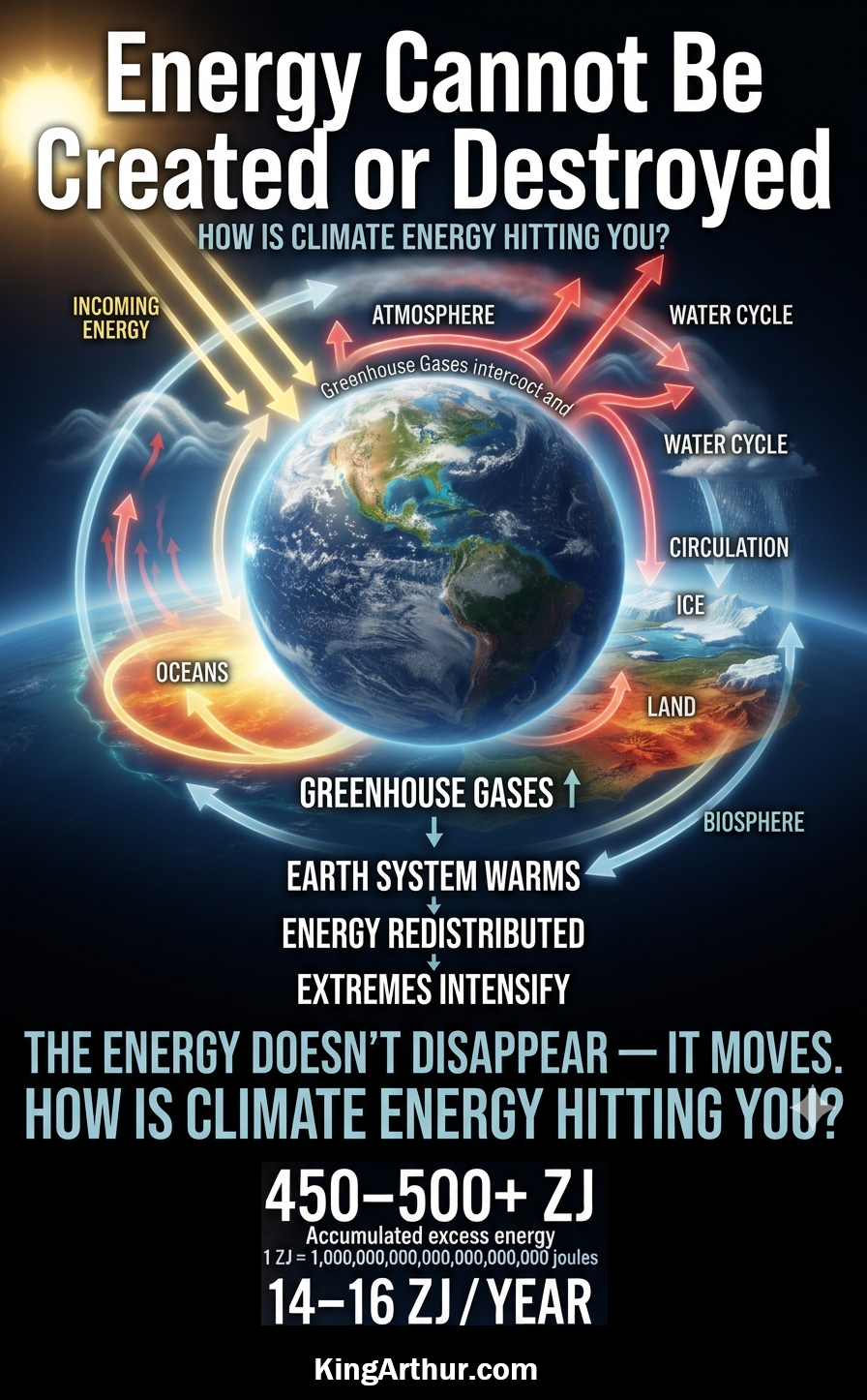
Public Access Introduction
🌎⚡ ENERGY CANNOT BE CREATED OR DESTROYED
So where does all that extra energy in the climate system go?
It doesn’t disappear.
It moves. 🌊💨💧🌀🧊🌱
The oceans absorb enormous amounts of heat. The atmosphere transports energy and moisture. Evaporation moves latent heat. Storms redistribute energy through intense precipitation. Ocean currents carry heat across the planet. Ice melts. Land heats and dries. Ecosystems respond.
And the greenhouse effect changes the planet’s energy balance—leaving more energy within the Earth system before it can ultimately escape to space.
450–500+ ZJ
🌡️ Accumulated excess energy
14–16 ZJ / YEAR
⚡ Approximate additional energy absorbed annually
The important question isn’t simply “How much has the temperature risen?”
It is:
HOW IS CLIMATE ENERGY HITTING YOU?
Weather. Water. Heat. Flooding. Drought. Ecosystems. Agriculture. Infrastructure. Risk.
The energy doesn’t disappear.
THE ENERGY DOESN’T DISAPPEAR — IT MOVES.
🌎⚡ How is climate energy hitting you?