by Daniel Brouse
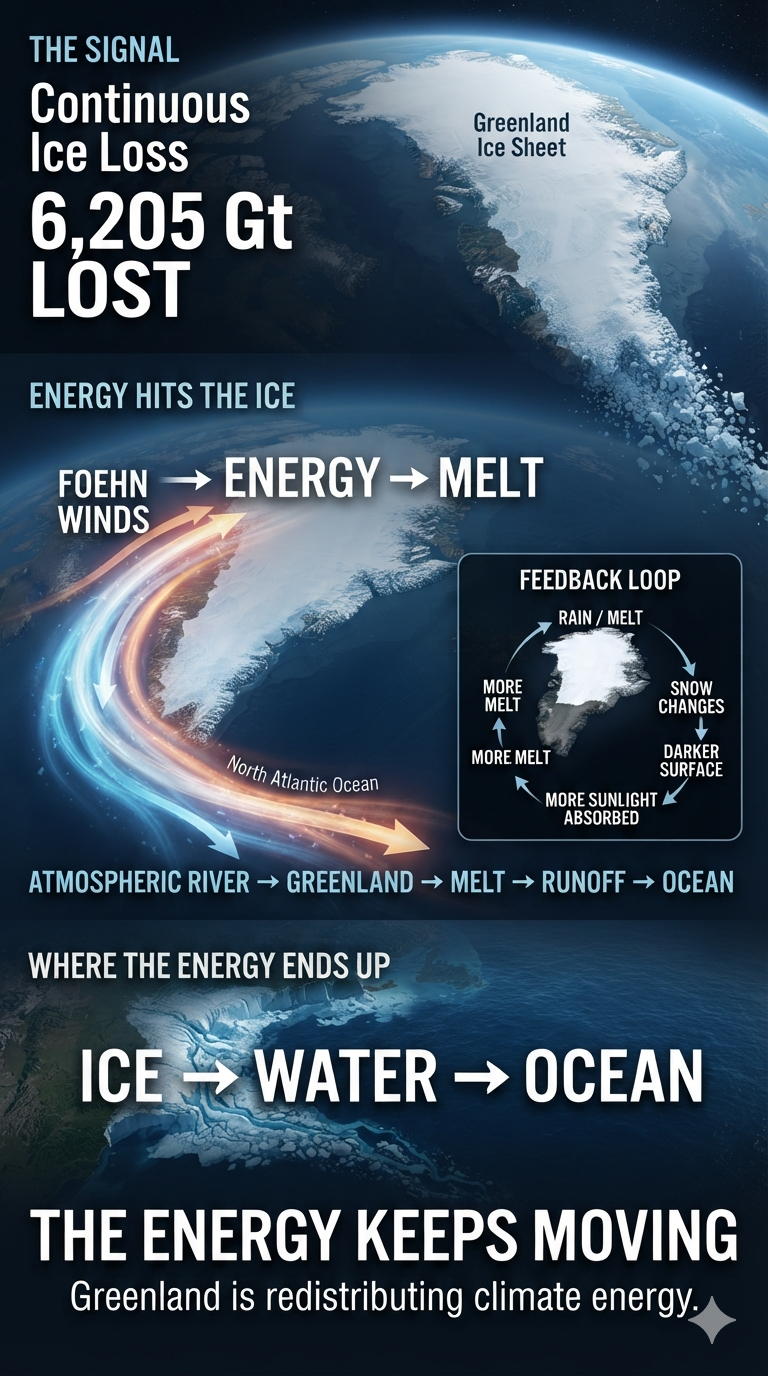
Greenland: 6,205 Gigatons of Ice Gone—and the Energy Behind It
Thirty Years of Continuous Ice Loss
Greenland’s Ice Sheet has now experienced 30 consecutive years of negative total mass balance.
According to the Geological Survey of Denmark and Greenland (GEUS), the Greenland Ice Sheet lost approximately 173 billion tonnes (173 Gt) of ice during the 2025/26 melt year. Since the 1996/97 melt year, every year has ended with Greenland losing more ice than it gained from snowfall and other accumulation. GEUS describes this uninterrupted 30-year sequence as a climate signal, rather than simply a collection of independent weather anomalies.
The longer record is even more striking.
From 1986/87 through 2025/26, Greenland lost approximately:
6,205 Gt of ice
That loss contributed approximately:
17.4 millimeters of global sea-level rise.
GEUS estimates that if the entire Greenland Ice Sheet were eventually lost, global sea level would rise by approximately 7.4 meters.
One year’s loss can be strongly influenced by weather. Thirty consecutive years with a negative mass balance tell a very different story.
The signal is persistent. The system has changed. And that brings us to the question:
Where Is the Energy Going?
The Greenland Ice Sheet can be understood not simply as a giant frozen thermometer, but as an enormous energy-processing component of the climate system.
Energy enters the climate system continuously.
It can be:
- reflected
- absorbed
- stored
- transported
- converted between sensible and latent forms
- moved by atmospheric circulation
- transferred between the atmosphere, ocean, snow, and ice
- used to melt ice
- used to evaporate water
- released again when water freezes or condenses
Greenland sits directly inside this planetary energy-transfer system.
When additional energy reaches the ice sheet, the consequences do not stop at a thermometer reading. Energy can change the temperature of the air, alter precipitation from snow toward rain, melt the surface, increase runoff, transform the snowpack, accelerate glacier flow, and ultimately transfer freshwater from the land to the ocean.
The ice is where some of the energy leaves a fingerprint.
Climate change is not simply about a warmer atmosphere. It is about where the excess energy goes—and what happens when the climate system has to process it.
The Energy Required to Melt 6,205 Gigatons of Ice
To simply convert 6,205 gigatons (Gt) of ice at 0°C into liquid water at 0°C requires approximately 2.05 × 10²¹ joules of thermal energy—or about 2,052 exajoules (EJ).
This calculation uses the latent heat of fusion of ice, approximately 3.34 × 10⁵ joules per kilogram (J/kg).
In other words, the loss of 6,205 Gt of Greenland ice represents an enormous amount of energy that had to be absorbed to accomplish the phase change from solid ice to liquid water—without even accounting for the additional energy required to warm the ice to 0°C or the energy involved in evaporation and other processes.
Greenland Is Part of a Larger Energy Network
Greenland is also connected to the North Atlantic atmosphere-ocean system.
When ice melts and freshwater leaves the ice sheet, it ultimately enters the ocean. That freshwater can influence ocean salinity and density, particularly in the North Atlantic. Changes in density can affect ocean circulation, while ocean circulation transports heat around the planet.
The potential chain is therefore:
Energy → Greenland ice loss → freshwater → density gradients → ocean circulation → heat transport → atmospheric circulation
The important point is not that every Greenland melt event automatically triggers a major circulation change. It doesn’t. The point is that Greenland’s mass loss is coupled to other components of the climate system.
A change in one reservoir can propagate through the network.
That is a teleconnection.
Atmospheric Rivers: When the Energy Arrives by Pipeline
One of the most fascinating examples involves atmospheric rivers (ARs).
Atmospheric rivers are long, narrow corridors that transport enormous quantities of water vapor through the atmosphere. For Greenland, they can be both beneficial and destructive. An atmospheric river can deliver snowfall and temporarily increase the ice sheet’s mass.
But when the transported air is sufficiently warm, the same moisture conveyor can deliver rain, clouds, heat, and intense melt conditions.
The result is a remarkable paradox:
The same atmospheric phenomenon can feed the ice sheet with snow—or attack it with heat and rain.
Research has demonstrated a particularly important connection in northeast Greenland: atmospheric rivers striking northwest Greenland can generate foehn winds downstream in northeast Greenland. These warm, dry downslope winds can produce extreme melting.
Near low-elevation outlet glaciers, researchers found that 80–100% of extreme melt occurred during foehn conditions, while 50–75% occurred during atmospheric-river conditions. The researchers also found that these combined AR-foehn events have become more frequent during the 21st century.
This is climate energy being transported thousands of kilometers and then converted into melt.
The Foehn Effect: Energy Transformed by Topography
The mechanism is beautifully simple. An atmospheric river approaches Greenland carrying warm, moisture-rich air. The air is forced upward as it encounters the ice sheet.
As it rises:
Moisture condenses → precipitation occurs → latent heat is released
The air then crosses the ice divide and descends on the opposite side. As it descends, it becomes warmer and drier.
The result is a foehn wind.
The atmospheric river has effectively transported energy toward Greenland and then, through topography and phase changes, transformed that energy into a powerful downslope heating mechanism.
A 2014 event provides a striking example. An atmospheric river reached northwest Greenland and subsequently produced foehn conditions in northeast Greenland. Modeling estimated approximately 19 Gt of surface melt in northeast Greenland over several days.
This is more than weather.
It is energy being rerouted through the climate system.
The Arctic Moisture Pipeline Is Changing
A warmer atmosphere can carry more water vapor.
The Clausius-Clapeyron relationship tells us that, near Earth’s surface, the atmosphere’s water-vapor-holding capacity increases by roughly 7% per °C of warming, assuming other conditions remain comparable.
That matters enormously for atmospheric rivers. A warmer ocean can provide more moisture. A warmer atmosphere can transport more moisture. And a warmer atmosphere raises the freezing level, increasing the probability that precipitation arrives as rain rather than snow at elevations where snow historically dominated.
The result is a potentially dangerous combination:
More moisture + more heat + higher freezing levels + extreme precipitation
Greenland has already provided a dramatic example.
On August 14, 2021, rain fell at Summit Station, approximately 3,216 meters—or 10,551 feet—above sea level. Temperatures remained above freezing for about nine hours. The National Snow and Ice Data Center reported that there had been no previous report of rainfall at that location.
The thermal and hydrological boundaries of Greenland are changing.
Rain Does More Than Add Water
Rain falling on a cold ice sheet is not simply water falling onto ice. It can alter the physical structure of the snowpack.
When meltwater or rain penetrates the snow and firn and subsequently refreezes, it releases latent heat. Repeated melt-and-refreeze events can create dense ice layers and alter the permeability of the firn.
Research has shown that extreme melt seasons can produce extensive ice layers that reduce firn permeability and change how efficiently the snowpack can retain subsequent meltwater.
This matters because the snowpack is not merely a white surface. It is also a hydrological storage system.
When that storage capacity is altered, more meltwater can become runoff rather than remaining temporarily stored within the ice sheet.
The energy and water budgets become coupled.
Atmospheric Rivers and the Albedo Feedback
There is another feedback. Fresh snow is highly reflective. As snow grains become larger, wetter, older, or contaminated with impurities, the surface generally becomes less reflective. That means more incoming solar radiation is absorbed.
Consider the simplified energy balance:
Fresh snow: albedo ≈ 0.85–0.90
Only about 10–15% of incoming sunlight is absorbed.
If the effective albedo falls to approximately 0.60, about 40% is absorbed.
That represents roughly 2.7 times as much absorbed solar energy as a surface with an albedo of 0.85, all else being equal.
If bare glacier ice with an albedo near 0.40 becomes exposed, approximately 60% of incoming sunlight is absorbed—about four times as much as the 0.85-albedo fresh snow surface.
Darker surface → more absorbed solar energy → more melting → darker surface.
That is an albedo feedback.
The Coupled Feedback
An intense atmospheric-river event can therefore initiate a sequence such as:
Warm, moisture-rich air
↓
Rain / melt / cloud changes
↓
Snowpack transformation
↓
Refreezing and ice-layer formation
↓
Reduced snowpack permeability
↓
More efficient runoff under some conditions
↓
Snow loss and exposure of darker surfaces
↓
Lower albedo
↓
More absorbed solar energy
↓
More melting
Extreme melt events can leave the ice sheet physically different after the storm has passed, potentially affecting its response to subsequent weather and sunlight. Research on Greenland extreme melt events has specifically identified reduced albedo and persistent surface changes as mechanisms that can compound subsequent melt.
The storm can therefore be more than a temporary disturbance.
It can become a conditioning event.
Are Atmospheric Rivers Accelerating Greenland’s Ice Loss?
Yes—atmospheric rivers are an important driver of extreme Greenland melt, particularly when they interact with foehn winds.
Greenland’s total mass balance reflects multiple processes:
- snowfall
- surface melting
- meltwater runoff
- refreezing
- glacier acceleration
- iceberg calving
- ocean interactions
- atmospheric circulation
- long-term warming
Atmospheric rivers can affect several of these processes.
A recent analysis of Greenland’s surface mass balance found that the contribution of atmospheric rivers increased over successive five-year periods, reaching 48.2% during 2015–2019.
From Meltwater to Sea-Level Rise
Greenland’s ice loss becomes a global problem when ice that was stored on land becomes water in the ocean.
There are two major components of Greenland’s mass loss:
Surface mass loss
Snow and ice melt → meltwater runs off → freshwater reaches the ocean.
Dynamic mass loss
Ice flows toward the coast → icebergs calve → land-based ice is transferred to the ocean.
Together, these processes determine Greenland’s total mass balance.
GEUS estimates that Greenland lost approximately 6,205 Gt between 1986/87 and 2025/26, contributing approximately 17.4 mm to global mean sea level.
That is not a theoretical future consequence.
It is already in the ocean.
The Bigger Picture
Greenland contains enough ice to raise global sea level by roughly 7.4 meters if the entire ice sheet were lost. That is not a prediction that Greenland will suddenly disappear.
It is the size of the reservoir we are dealing with.
The more immediate issue is the continuing contribution to sea-level rise.
NASA estimates that roughly one-third of present-day global sea-level rise comes from Greenland and Antarctica combined, with Greenland and Antarctica expected to become increasingly important contributors in the future.
And GEUS has now documented something difficult to dismiss as ordinary weather:
30 consecutive years of negative total mass balance.
Thirty years.
A full climatological reference period.
Every year ending with less ice than the year before.
HOW IS CLIMATE ENERGY HITTING YOU?
This is the deeper lesson from Greenland.
Climate energy does not simply sit in the atmosphere as a higher temperature.
It moves.
It transforms.
It travels through atmospheric rivers.
It condenses.
It releases latent heat.
It becomes sensible heat.
It changes precipitation.
It melts snow.
It transforms the firn.
It exposes darker surfaces.
It increases solar absorption.
It produces runoff.
It moves ice toward the ocean.
And eventually, some of that energy-driven transformation appears on coastlines thousands of miles away as higher sea levels.
Greenland is therefore not merely a frozen landscape responding to a warmer planet.
It is an enormous energy reservoir and processing system embedded within a planetary network of atmosphere, ocean, ice, and water.
The 6,205 gigatons already lost are the accounting entry.
The atmospheric rivers, heat, rainfall, melting, runoff, circulation, and ocean response are the transactions.
And the climate system keeps moving the energy around.
The question is no longer whether the energy exists.
The question is where it goes next—and what it hits.