by Daniel Brouse
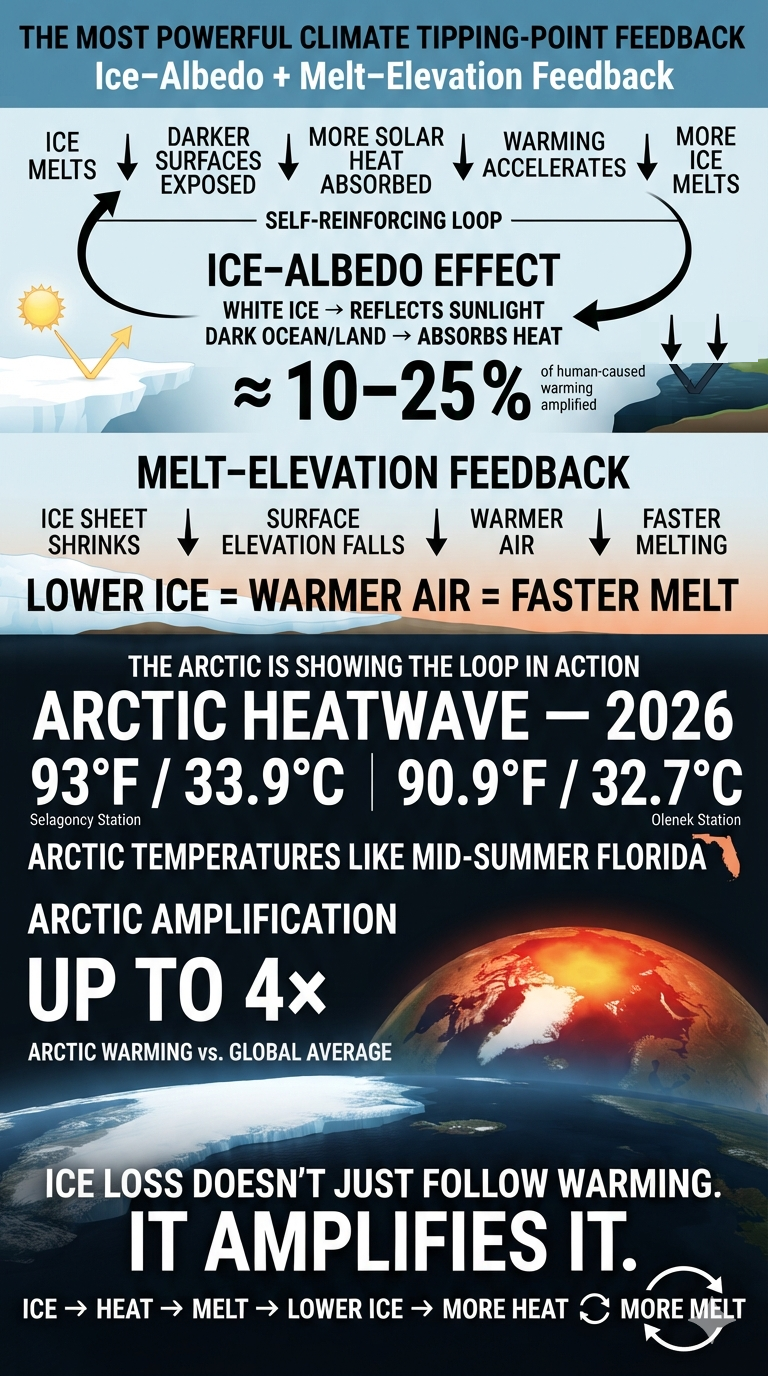
The astonishing Arctic heatwave of 2026 is a stark illustration of how rapidly the polar climate is changing. Freshly published data highlighted by Scientific American confirm that temperatures in northern Russia have routinely surpassed 90°F (32.2°C)—temperatures more characteristic of midsummer in places far to the south.
These extraordinary readings are not simply isolated temperature records. They are occurring within a broader system of Arctic amplification, in which the Arctic is warming up to four times faster than the global average. That accelerated warming is interacting with snow and ice loss, permafrost thaw, atmospheric circulation, forest drying, and wildfire behavior to create increasingly powerful feedback loops.
Arctic Heatwave: Temperatures More Typical of Florida
Several remote northern stations have recorded extraordinary heat.
- Selagoncy Station: Located near the Arctic Circle, this remote meteorological station registered a blistering 93.0°F (33.9°C).
- Olenek Station: Another notoriously cold northern outpost reached an extreme high of 90.9°F (32.7°C).
- The comparison: According to climate data compiled by weather information service Ogimet and analyzed by climatologist Maximiliano Herrera, these temperatures are comparable to midsummer conditions in Orlando, Florida.
The significance of these temperatures becomes clearer when they are placed within the larger Arctic climate system.
Arctic Amplification: A Self-Reinforcing Feedback System
Meteorologists and climate scientists identify Arctic amplification as a major reason the polar region is warming so rapidly. The Arctic can warm at up to four times the rate of the global average because several reinforcing processes operate simultaneously.
The Loss of Reflective Surfaces
Snow and sea ice are highly reflective. They return a substantial portion of incoming solar radiation back into space.
As warming removes that reflective white surface, darker land and ocean surfaces are exposed. These surfaces absorb significantly more solar radiation.
The feedback becomes:
warming → snow and sea-ice loss → darker surfaces → greater solar absorption → additional warming
This is the classic ice-albedo feedback, and it helps explain why warming in the Arctic can accelerate faster than the global average.
The Ice–Albedo Effect, combined with the Melt–Elevation Feedback, represents the most powerful and consequential tipping-point mechanisms in the climate system. Together, these feedbacks create a self-reinforcing cycle in which warming causes ice loss, ice loss increases heat absorption, and shrinking ice exposes the remaining ice to progressively warmer atmospheric conditions. The Ice–Albedo Effect alone is estimated to account for roughly 10% to 25% of the total warming associated with human greenhouse-gas emissions.
Permafrost Thaw
Extreme Arctic heat also threatens to accelerate the thawing of ancient permafrost.
Frozen soils contain enormous quantities of carbon accumulated over thousands of years. As permafrost thaws, previously trapped organic material becomes available for decomposition, potentially releasing massive quantities of methane and carbon dioxide back into the atmosphere.
The resulting feedback is:
warming → permafrost thaw → greenhouse-gas release → additional warming
The Arctic therefore contains the potential for multiple reinforcing mechanisms to operate simultaneously.
From Arctic Heat to Canadian Wildfires
The extreme Arctic heatwave—including the 93.0°F (33.9°C) reading at Selagoncy and absolute records reaching 100.4°F (38°C)—creates a cascading climate feedback system that can directly supercharge the conditions driving Canadian wildfires.
Because Canada’s Arctic is warming up to four times faster than the global average, this extraordinary polar heat can dramatically reshape atmospheric circulation and fuel conditions across North America.
The critical connection occurs through the atmosphere.
The Atmospheric Link: Jet Stream Disruption
The jet stream is strongly influenced by the temperature difference between the warm equator and the frigid polar regions.
As the Arctic overheats, that temperature contrast shrinks.
The result can be a slower, more meandering, increasingly “wobbly” jet stream.
Instead of rapidly transporting weather systems from west to east, the altered circulation can allow large-scale atmospheric patterns to become persistent.
Atmospheric Blocking and Heat Domes
A sluggish, highly meandering jet stream can contribute to massive, stagnant areas of high pressure known as heat domes.
Rather than moving along normally, these high-pressure systems can become parked over regions such as the Northwest Territories and Alberta.
The result is prolonged exposure to:
- extreme heat,
- clear skies,
- suppressed precipitation,
- intense evaporation,
- soil-moisture loss,
- and increasingly severe drought.
The feedback becomes:
Arctic warming → reduced equator-to-pole temperature contrast → altered jet-stream behavior → atmospheric blocking → persistent heat dome → prolonged drought and drying
This atmospheric connection helps transform an episode of extreme Arctic heat into a much broader continental climate hazard.
The Boreal Fuel Link: Vapor Pressure Deficit
Once extreme heat reaches Canada’s vast northern boreal forests, another physical feedback becomes increasingly important: vapor pressure deficit (VPD).
Warm air can hold significantly more water vapor than cold air.
When temperatures rise without a corresponding increase in atmospheric moisture, the difference between the atmosphere’s moisture-holding capacity and its actual moisture content increases.
This produces a high vapor pressure deficit, meaning the atmosphere becomes increasingly aggressive in drawing moisture from the landscape.
It effectively begins sucking moisture out of the soil, trees, vegetation, and forest floor.
Turning the Forest Into a Tinderbox
As VPD increases:
warm air → greater atmospheric moisture demand → increased evaporation and plant water loss → drying vegetation and soils → highly flammable fuels
Lichen, moss, pine needles, grasses, deadwood, and other organic materials can rapidly dry into volatile wildfire fuel.
Once dried by Arctic-driven heatwaves and persistent atmospheric blocking, the boreal landscape can require very little additional energy to ignite.
This creates another reinforcing chain:
heat → high VPD → drying → greater fuel flammability → wildfire
When Wildfires Create Their Own Weather
The feedback does not necessarily stop once a fire begins.
Under sufficiently intense conditions, the wildfire itself can begin modifying the atmosphere.
Pyrocumulonimbus Clouds: Firestorms in the Sky
The immense heat generated by large Canadian wildfires can force towering columns of hot air and smoke miles into the atmosphere.
These columns can develop into pyrocumulonimbus clouds, often called firestorms.
These fire-generated thunderstorms can produce extreme atmospheric turbulence, powerful wind shifts, and lightning.
More Lightning, More Fires
The resulting storms can generate intense lightning, including dry lightning that occurs with little or no meaningful rainfall.
That creates a dangerous secondary feedback.
Lightning strikes can hit already-parched forests surrounding the original fire and ignite entirely new fire fronts.
The process becomes:
extreme heat and drought → dry vegetation → wildfire → enormous heat column → pyrocumulonimbus formation → lightning and wind shifts → new ignitions → more wildfires
The fire is therefore no longer simply responding to weather.
Under extreme conditions, it can begin creating its own weather, which can then generate additional fires.
The Long-Range Result: Smoke Across North America
The consequences of these interconnected feedbacks extend far beyond the original fire zones.
Canada’s burned area has surged past its 10-year average, while enormous plumes of smoke from northern Canada have been observed by NASA traveling thousands of miles.
These smoke plumes can blanket the U.S. East Coast and continue outward over the Atlantic Ocean, triggering hazardous air-quality alerts for millions of people.
A climate disturbance originating in the Arctic and northern Canadian boreal forest can therefore propagate through the atmosphere across an entire continent.
The chain is increasingly interconnected:
Arctic warming → atmospheric disruption → heat dome → drought → high VPD → dry forests → wildfire → pyrocumulonimbus → lightning → additional fires → massive smoke transport
Each individual link has its own physical mechanism, but together they form a much larger climate feedback system.
The Cryosphere Is Also Under Accelerating Stress
The atmosphere and biosphere are not the only components undergoing severe disruption.
The cryosphere—the Earth’s frozen zones—has also experienced severe and accelerated changes.
Both mountain glaciers and the Antarctic continent are setting alarming physical records.
These changes matter because the cryosphere is not simply a passive indicator of climate change. Ice and snow actively influence Earth’s energy balance, freshwater systems, and global sea level.
Mountain Glaciers: An Extreme Summer Ice Deficit
The world’s mountain glaciers are experiencing increasingly severe mass loss.
The Protective Blanket Vanished Early
In July 2026, Switzerland’s glacier monitoring network, GLAMOS, reported that the entire winter snowpack over the Swiss Alps had completely melted.
This occurred nearly a month ahead of schedule.
The loss of the reflective snowpack is particularly significant because the snow acts as a protective, high-albedo blanket over the underlying glacier.
Once the white snow disappears, darker glacier ice is exposed directly to solar radiation.
That creates another albedo feedback:
snow loss → dark glacier ice exposed → greater solar absorption → accelerated surface melting
Under these extreme conditions, glacier surface loss can reach up to a meter in just 10 days.
A 400-Billion-Ton Annual Glacier Deficit
According to the World Glacier Monitoring Service (WGMS), the world’s mountain glaciers are experiencing a net loss of more than 400 billion tonnes of ice mass annually.
That represents an extraordinary physical transfer of water from glaciers into the world’s oceans.
The loss contributes approximately 1.1 millimeters directly to global sea-level rise each year, outpacing the direct contribution from the Antarctic Ice Sheet.
The significance extends beyond sea-level rise.
Mountain glaciers function as enormous natural freshwater reservoirs. Their continued loss threatens to alter water availability for ecosystems, agriculture, communities, and river systems dependent upon seasonal meltwater.
The Mid-Century Glacier Disappearance Timeline
A newly published comprehensive model in Nature Climate Change projects that global mountain glacier mass loss will peak by mid-century.
Under current high-emission trajectories, the subtropical Andes and European Alpine glacier networks face near-total structural collapse.
The implications are profound.
Glaciers that have persisted for centuries or millennia can disappear within a matter of decades once warming pushes the system beyond its ability to maintain a stable ice mass.
The process can therefore shift from gradual retreat toward increasingly rapid structural loss.
Antarctica: Melting From Below
Antarctica represents a different but equally alarming component of the cryosphere crisis.
The continent’s ice loss is strongly influenced not only by atmospheric warming but also by ocean-driven melting beneath floating ice shelves.
The Human Greenhouse-Gas Signature
A study published in The Cryosphere provided physical evidence that human-caused greenhouse-gas emissions have accelerated the retreat of Pine Island Glacier—the fastest-melting glacier in West Antarctica—by up to 20% since the 1940s.
Pine Island Glacier is one of the major drainage systems of the West Antarctic Ice Sheet and is an important contributor to global sea-level rise.
The finding is significant because it demonstrates how human greenhouse-gas emissions can alter the trajectory of an already vulnerable Antarctic ice system.
Melting From Below
Oceanographic measurements collected through deep drilling into Antarctic ice shelves have revealed that major ice margins can melt rapidly from below.
The mechanism involves upwelling warm ocean currents reaching the underside of floating ice shelves.
Because these shelves extend from grounded ice into the ocean, they provide an important structural restraint on the flow of inland ice toward the sea.
When warm ocean water melts them from below:
warm ocean currents → basal melting → ice-shelf thinning → weakened structural restraint → increased ice discharge → rising sea levels
The process is particularly dangerous because the atmosphere does not have to become dramatically warmer at the surface for ocean-driven melting to continue.
The ocean can effectively attack the Antarctic ice system from underneath.
A 135-Billion-Ton Annual Antarctic Ice Deficit
Satellite monitoring conducted by NASA confirms that Antarctica is shedding an average of approximately 135 billion metric tons of ice into the ocean every year.
That enormous annual loss represents another major contribution to global sea-level rise.
And unlike seasonal snow, this is primarily the loss of land-based ice. When grounded Antarctic ice enters the ocean, it adds water to the global ocean system.
The implications extend far beyond Antarctica itself.
Continued Antarctic mass loss contributes to long-term sea-level rise, increasing risks for coastal communities, infrastructure, ecosystems, ports, and low-lying regions around the world.
One Connected Climate System
The Arctic heatwave, Canadian wildfires, melting mountain glaciers, and accelerating Antarctic ice loss may appear to be separate stories.
They are not.
They are different manifestations of an interconnected Earth system in which the atmosphere, ocean, cryosphere, land surface, and biosphere continuously interact.
The Arctic heatwave demonstrates how polar amplification can intensify warming through the loss of reflective snow and ice and through the thawing of carbon-rich permafrost.
Atmospheric circulation changes can influence the persistence of heat domes and drought across Canada.
High temperatures and high vapor pressure deficits can dry boreal forests into highly combustible fuel.
Wildfires can then generate pyrocumulonimbus storms capable of producing lightning and new fires.
Meanwhile, the same warming system is removing mountain glacier mass and contributing to the destabilization of Antarctic ice.
The feedback chains can be summarized as:
Arctic warming
↓
snow and sea-ice loss
↓
darker surfaces
↓
greater solar absorption
↓
additional warming
At the same time:
Arctic warming
↓
jet-stream disruption and atmospheric blocking
↓
persistent heat domes
↓
drought and high VPD
↓
boreal forest drying
↓
wildfire
↓
pyrocumulonimbus storms
↓
lightning and new fires
↓
massive smoke transport
And across the cryosphere:
warming
↓
snowpack loss and glacier melting
↓
glacier mass loss
↓
sea-level rise
While in Antarctica:
warming ocean
↓
sub-surface ice-shelf melting
↓
ice-shelf thinning
↓
reduced restraint on grounded ice
↓
accelerated ice discharge
↓
sea-level rise
These are not isolated linear changes.
They are interacting components of a climate system in which feedbacks can reinforce one another, amplify existing warming, and increase the speed and severity of downstream impacts.
The significance of the current Arctic heatwave therefore extends far beyond a few extraordinary temperature readings.
A 93°F Arctic temperature, a 100.4°F absolute record, rapidly drying Canadian forests, fire-generated thunderstorms, 400 billion tons of annual mountain-glacier loss, and 135 billion tons of annual Antarctic ice loss are all physical measurements of a planet undergoing profound change.
The critical issue is not any single record.
It is the growing evidence that the climate system is becoming increasingly dominated by interacting feedbacks—processes in which warming changes the physical environment in ways that can produce still more warming, more extreme conditions, and more rapid disruption across interconnected Earth systems.