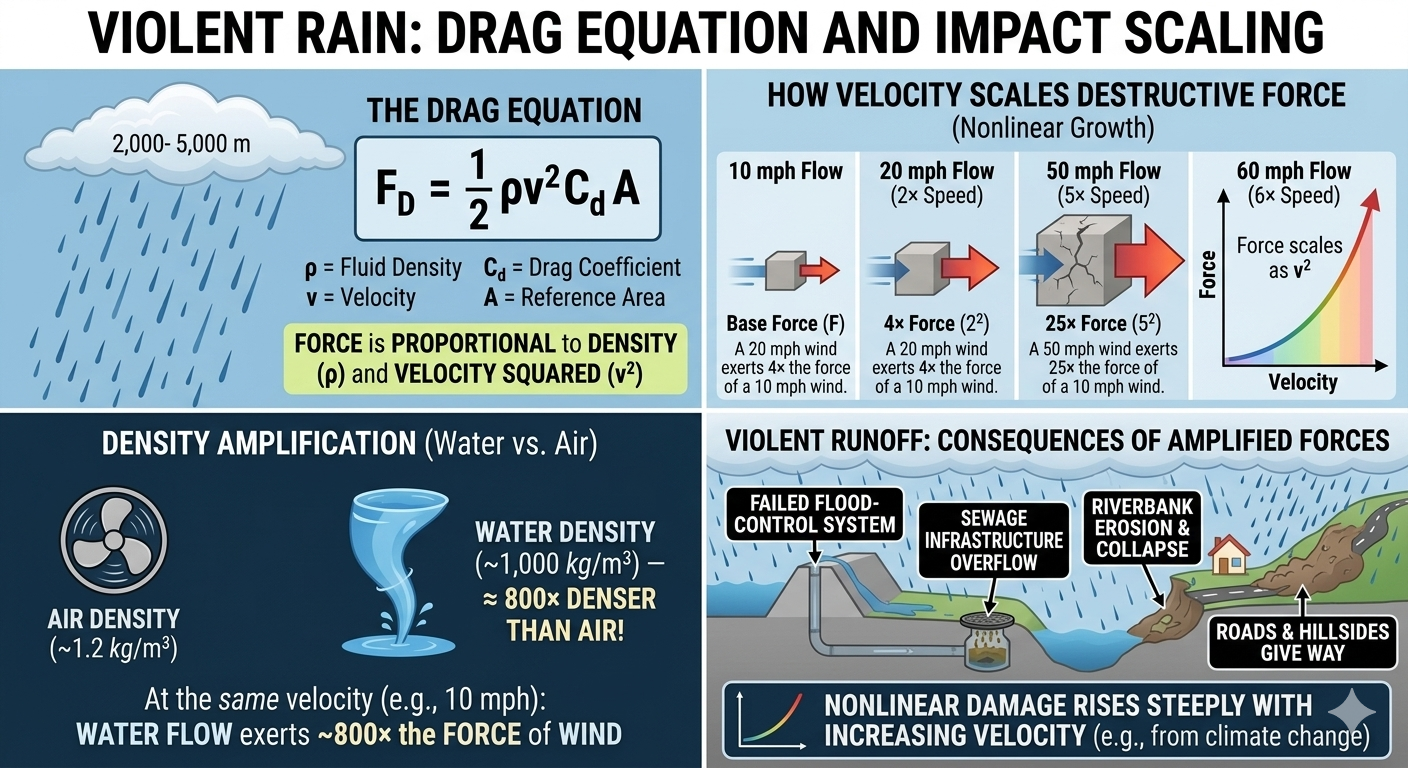
The destructive power of both wind and water is governed by the drag equation:
Fd = 0.5 × Cd × ρ × A × v²
where:
- Fd = drag force (destructive force)
- Cd = drag coefficient (shape and surface effects)
- ρ = density of the moving fluid
- A = exposed surface area
- v = velocity of flow
The most important factor in extreme events is the velocity term (v²). Because force increases with the square of velocity, small increases in wind speed or water flow velocity create disproportionately larger increases in destructive power.
For example:
A 10% increase in velocity produces approximately a 21% increase in force:
(1.10)² = 1.21
A 25% increase in velocity produces approximately a 56% increase in force:
(1.25)² = 1.56
A 50% increase in velocity produces approximately a 125% increase in force:
(1.50)² = 2.25
This nonlinear relationship means that climate-driven increases in wind speed, rainfall intensity, river velocity, and wave energy can create much larger increases in destructive potential than the original increase in speed would suggest.
Density further amplifies the difference between wind and water forces. Water has a density of approximately 1,000 kg/m³, while air has a density of approximately 1.2 kg/m³:
1000 ÷ 1.2 ≈ 833
Therefore, moving water can exert roughly 800 times more force per unit volume than moving air at the same velocity.
A 10 mph flow of water is not simply equivalent to a 10 mph wind. Because water contains far more mass, it carries vastly greater momentum and destructive capability.
Climate change increases these destructive forces through several coupled mechanisms:
1. Warmer air increases atmospheric moisture capacity
The Clausius–Clapeyron relationship shows that the atmosphere can hold approximately 7% more water vapor for every 1°C of warming:
Moisture increase = (1.07)^T
where:
- T = warming in degrees Celsius
At 2°C warming:
(1.07)² = 1.145
The atmosphere can hold approximately 14.5% more moisture than the preindustrial climate.
At 3°C warming:
(1.07)³ = 1.225
The atmosphere can hold approximately 22.5% more moisture.
When that additional moisture is released during extreme precipitation events, rainfall intensity and flooding potential increase significantly.
2. Storm intensity compounds through velocity feedbacks
Because destructive force scales as:
Force ∝ density × velocity²
a 20% increase in flow velocity produces:
(1.20)² = 1.44
or approximately a 44% increase in destructive force.
A 40% increase in flow velocity produces:
(1.40)² = 1.96
or nearly a 96% increase in destructive force.
3. Feedback coupling accelerates extreme events
Climate change does not increase only one variable. It simultaneously modifies multiple components of the climate system:
- Higher temperatures increase atmospheric moisture.
- More moisture increases latent heat energy.
- Greater energy increases storm intensity.
- Stronger storms increase wind speeds and precipitation rates.
- Increased precipitation increases runoff velocity and flooding.
- Flooding damages ecosystems and infrastructure, reducing resilience.
These processes interact and amplify one another.
What does this mean?
The physics of extreme events is nonlinear. Wind and water damage do not increase in a simple one-to-one relationship with climate change because destructive force scales with the square of velocity.
The consequences are:
- 10% increase in wind or water velocity → ~21% increase in force
- 25% increase in velocity → ~56% increase in force
- 50% increase in velocity → ~125% increase in force
As climate feedbacks become increasingly coupled, extreme events can become more intense, more frequent, and longer lasting. Climate change is not simply producing more storms or heavier rainfall; it is altering the physical conditions that determine how much energy these events contain and how much damage they can inflict.