by Daniel Brouse
How Lapse-Rate and Ice–Albedo Feedbacks Couple to Create a Powerful Self-Reinforcing Warming Loop
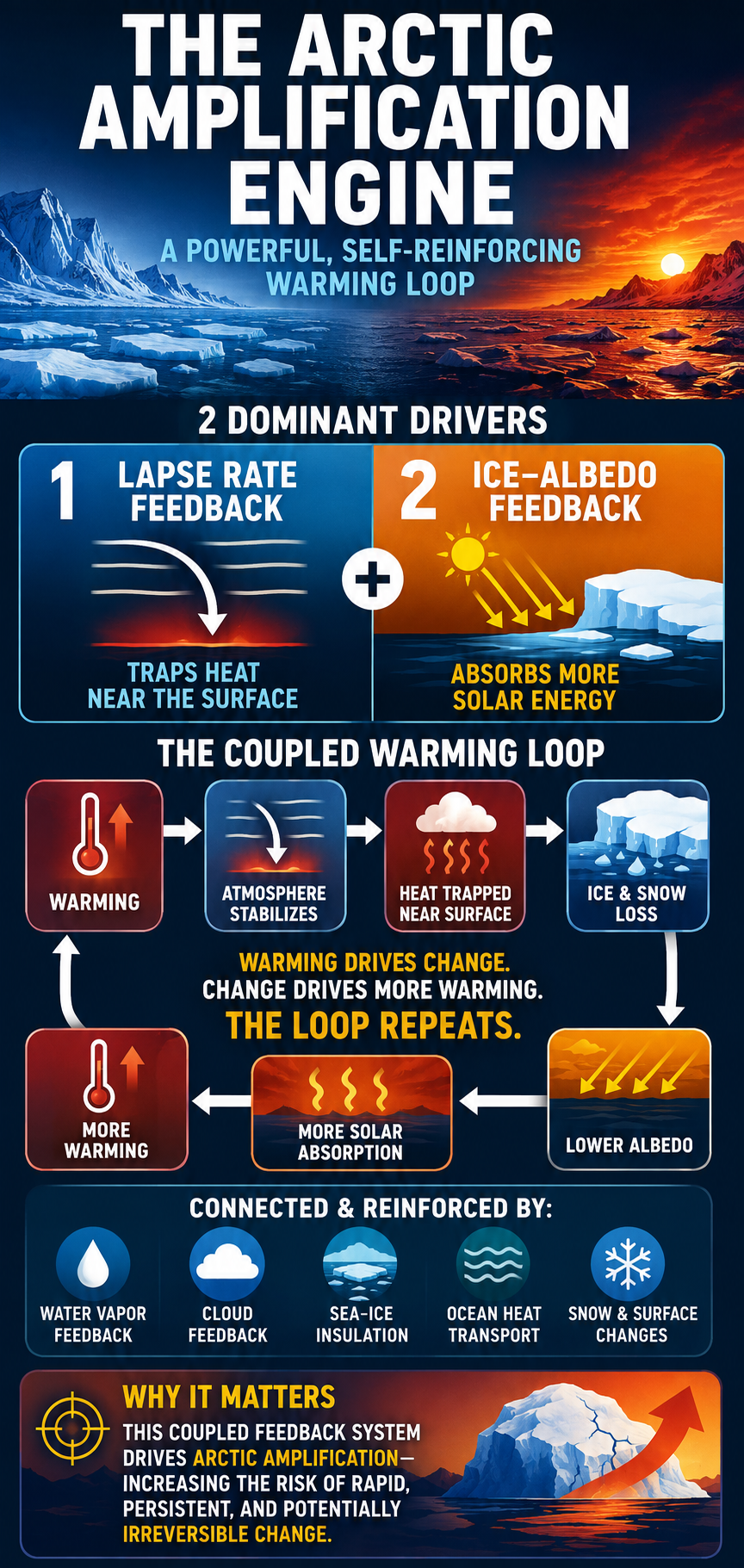
The Two Dominant Drivers of Arctic Amplification
Arctic amplification is not produced by a single climate feedback. It emerges from the interaction of several processes that redistribute, trap, and amplify energy within the Arctic climate system.
Two of the most important are the lapse-rate feedback and the ice–albedo feedback. They operate through different physical mechanisms, but they are tightly coupled:
Lapse-Rate Feedback → Traps Heat Near the Surface
Ice–Albedo Feedback → Converts More Sunlight Into Heat
Together, they create a reinforcing loop:
Warming → Atmospheric Stabilization → Surface Heat Retention → Ice and Snow Loss → Lower Albedo → Greater Solar Absorption → More Warming
This coupling helps explain why the Arctic can warm substantially faster than the global average.
1. Lapse-Rate Feedback: The Primary Atmospheric Amplifier
The Arctic atmosphere behaves very differently from the atmosphere of the tropics.
In the warm tropics, intense solar heating produces strong convection. Warm air rises, expands, mixes vertically, and transports energy high into the atmosphere. This vertical mixing helps distribute surface heating through a deep atmospheric column, where energy can ultimately be radiated to space.
The Arctic atmosphere is often much more stable.
During periods of strong surface cooling—especially over snow- and ice-covered surfaces—cold, dense air can accumulate near the ground while warmer air remains above it. This creates a temperature inversion, in which temperature increases with height rather than decreasing.
The result is a strongly stratified atmosphere with limited vertical mixing.
When greenhouse gases and other processes add energy to the Arctic system, that energy is therefore more readily retained near the surface rather than rapidly redistributed upward by convection.
This produces a critical asymmetry:
Tropical warming → strong vertical mixing
Arctic warming → weak vertical mixing and enhanced near-surface warming
The lapse-rate feedback therefore changes how efficiently the Arctic atmosphere can respond to additional radiative energy.
As the Arctic warms, the vertical temperature structure changes. The characteristic lapse rate—the rate at which temperature changes with altitude—affects the amount of infrared radiation escaping to space. Because the Arctic surface and lower atmosphere can warm disproportionately, the region’s radiative response differs substantially from that of warmer, more convective regions.
The result is an atmospheric environment particularly favorable to near-surface warming and Arctic amplification.
2. Ice–Albedo Feedback: The Solar Amplifier
The lapse-rate feedback is only part of the story.
The Arctic is covered by highly reflective surfaces—especially snow and sea ice—that normally reflect a substantial fraction of incoming sunlight back toward space.
Ice and snow therefore act as a planetary-scale solar shield.
But warming begins to remove that shield.
As snow and ice melt, they expose darker surfaces:
Bright snow and ice → dark ocean and land
Dark surfaces absorb much more solar radiation than bright, reflective surfaces.
That additional absorbed energy warms the surface and surrounding environment, which promotes additional melting.
The loop becomes:
Warming → Ice/Snow Loss → Lower Albedo → More Solar Absorption → More Warming
This is the classic ice–albedo feedback.
Unlike the lapse-rate mechanism, which primarily alters the vertical distribution and radiative behavior of atmospheric energy, the ice–albedo feedback changes the amount of incoming solar energy absorbed by the surface.
The two mechanisms therefore attack the climate system from different directions.
3. The Coupling: When Two Feedbacks Reinforce Each Other
The real significance emerges when the feedbacks are considered together.
The lapse-rate feedback helps concentrate warming near the Arctic surface.
The ice–albedo feedback increases the amount of solar energy absorbed by that same surface.
That creates a powerful coupling:
Greenhouse Forcing
↓
Atmospheric Stability / Lapse-Rate Effects
↓
More Near-Surface Heat Retention
↓
Warmer Surface
↓
Snow and Ice Loss
↓
Lower Surface Albedo
↓
More Solar Energy Absorbed
↓
Additional Surface Warming
↓
Further Snow and Ice Loss
The result is not simply two independent feedbacks operating side by side.
It is a coupled amplification system.
4. Why the Coupling Matters
The most important feature of this system is that each feedback can strengthen the conditions that make the other more effective.
A warmer Arctic atmosphere can accelerate snow and ice loss.
Less snow and ice exposes darker surfaces and increases solar absorption.
Greater surface absorption increases warming.
Meanwhile, changes in snow and ice cover, surface temperature, moisture, clouds, and atmospheric structure can alter the Arctic’s vertical temperature profile and stability.
This creates a network of interacting processes rather than a single linear chain.
The Arctic climate system can therefore be represented conceptually as:
External Warming
→ Lapse-Rate / Atmospheric Stability Effects
→ Enhanced Near-Surface Warming
→ Snow & Ice Loss
→ Lower Albedo
→ Greater Solar Absorption
→ More Surface Warming
→ Further Atmospheric and Cryospheric Change
→ Feedback Intensification
This is why Arctic amplification is best understood as an interconnected feedback network.
5. The Feedbacks Do Not Operate in Isolation
The lapse-rate and ice–albedo feedbacks also interact with other major Arctic processes.
Water-Vapor Feedback
A warmer atmosphere can contain more water vapor. Because water vapor is itself a greenhouse gas, increased atmospheric moisture can enhance infrared heat retention.
Warming → More Water Vapor → Greater Greenhouse Effect → More Warming
Cloud Feedbacks
Changes in Arctic clouds can alter both incoming solar radiation and outgoing infrared radiation. Their net effect varies with season, surface conditions, cloud properties, and atmospheric structure, making clouds an important but complex component of Arctic amplification.
Sea-Ice Insulation Feedback
Sea ice acts as an insulating barrier between the relatively warm ocean and the cold atmosphere.
When thick sea ice is replaced by thinner ice or open water, the ocean can release substantially more heat into the atmosphere during the cold season.
Ice Loss → Greater Ocean–Atmosphere Heat Transfer → Atmospheric Warming
Ocean Heat Transport
Warm water entering the Arctic from lower latitudes can contribute to sea-ice loss and influence the timing and magnitude of Arctic warming. Oceanic heat transport therefore connects Arctic amplification to the broader global climate system.
Snow and Surface Feedbacks
Snow cover is especially important because snow has a very high albedo. Losing snow exposes darker ground, vegetation, or ice and can rapidly change the surface energy balance.
These mechanisms can interact with the two dominant feedbacks, increasing the complexity—and potentially the strength—of the overall amplification.
The Arctic as a Coupled Amplification System
The critical insight is that Arctic amplification is not caused by one feedback acting alone.
It is generated by the coupling of atmospheric, cryospheric, oceanic, and radiative processes.
Among these, the lapse-rate feedback and ice–albedo feedback form a particularly important coupled pair:
Lapse Rate
Keeps more warming concentrated near the surface
↓
Ice–Albedo
Turns more incoming sunlight into absorbed energy
↓
Surface Warming
↓
Snow & Ice Loss
↓
Even Greater Solar Absorption
↓
Additional Warming
The system is further reinforced by water vapor, clouds, sea-ice insulation, ocean heat transport, and other cryospheric processes.
The result is a climate system in which warming changes the physical conditions that determine how readily additional warming occurs.
That is the essence of a positive climate feedback.
From Feedback to Tipping Dynamics
The most consequential question is not whether these processes amplify warming—they do—but how strongly they interact and whether their combined effects can push portions of the Arctic system toward thresholds or tipping behavior.
A feedback does not automatically constitute a tipping point.
A tipping point occurs when a system crosses a threshold after which a change becomes difficult to reverse or continues because internal feedbacks sustain it.
This distinction is crucial.
The coupled Arctic feedback system can progressively reduce the resilience of snow, sea ice, permafrost, and ice-sheet systems. Once substantial cryospheric changes occur, recovery can become increasingly difficult because the climate state that originally maintained the ice has itself been altered.
The broader chain can therefore be viewed as:
Global Warming
→ Arctic Amplification
→ Coupled Atmospheric + Cryospheric Feedbacks
→ Accelerated Snow and Ice Loss
→ Reduced Reflectivity + Greater Heat Retention
→ Further Warming
→ Increasing Cryospheric Instability
→ Potential Threshold Crossing
This does not mean that the Arctic is inevitably headed toward runaway warming or irreversible collapse.
It means that the feedback structure itself can increase the rate and persistence of change, making the Arctic one of the most important regions for understanding nonlinear climate dynamics.
The Central Insight
The Arctic is not simply warming faster because it receives more heat.
It is warming faster because the Arctic climate system can transform an initial radiative disturbance into a series of reinforcing physical responses.
The lapse-rate feedback helps determine how efficiently heat is retained and redistributed within the lower atmosphere.
The ice–albedo feedback determines how much incoming sunlight is absorbed by the surface.
Water vapor, clouds, sea-ice insulation, ocean heat transport, snow cover, and other feedbacks connect these mechanisms into a larger network.
The resulting system can be summarized in one sentence:
The Arctic amplification engine is powered by greenhouse forcing, intensified by atmospheric heat retention, accelerated by the loss of reflective ice and snow, and reinforced by the increasingly dark, warm surface that replaces them.
That coupling—not any single feedback alone—is what makes Arctic amplification such a powerful expression of nonlinear climate change.