by Daniel Brouse
Introduction: Tree Mortality
Many people believe that planting trees is one of the most important ways to help save the planet and reverse climate change. Planting trees can certainly help—but planting a tree and growing a healthy, mature forest are two very different things.
The problem is that climate change is increasing the stresses that kill trees and changing where forests can survive. Rising temperatures, increasing vapor pressure deficits, drought, extreme heat, wildfire, flooding, disease, and insect outbreaks are interacting in ways that can overwhelm trees faster than forests can adapt.
Wildfire is an increasingly important part of the problem. Climate-driven increases in fire weather have contributed to substantially greater forest and tree-cover losses in many regions. Drought and extreme heat compound that damage by reducing soil moisture and increasing atmospheric demand for water. In warmer air, a higher vapor pressure deficit (VPD) increases the drying power of the atmosphere, causing trees to lose water through their leaves faster and potentially creating hydraulic stress when roots cannot keep up.
Tree mortality is also occurring through less spectacular but equally important pathways. Long-term studies have documented increasing mortality in some tropical forests, while drought, heat, insects, and disease have produced severe die-offs in temperate and boreal forests. In California, prolonged drought and heat have contributed to the death of tens of millions of trees. Elsewhere, drought and increasingly volatile weather have reduced the survival of newly planted trees and complicated reforestation efforts.
This creates a fundamental problem with the simple “plant more trees” solution.
A planted seedling must first survive. Then it must grow large enough to become ecologically significant, reproduce, and ultimately become part of a functioning forest. A tree that dies after a few years has absorbed only a fraction of the carbon it might have stored over decades—and the resources invested in planting it may accomplish little. Multiple prominent scientific studies and forestry reports confirm that replanted saplings face staggering failure rates, with mortality exceeding 70% to 80% within 5-to-10-years.
That is why tree survival matters as much as tree planting.
Multiple studies of reforestation and tree establishment have found substantial seedling mortality, particularly under drought, heat, competition, poor site conditions, and other environmental stresses. Mortality can become extremely high when newly planted trees encounter conditions outside the climate range to which they are adapted.
The question for the future, therefore, is not simply:
How many trees can we plant?
It is:
Which trees can survive long enough to become the forests of tomorrow?
That is the question behind this experiment.
Penn’s Sylvania: Penn’s Woods
On March 4, 1681, King Charles II granted William Penn a royal charter for a vast tract of land in North America. The grant contained more than 28 million acres, making it one of the largest private land grants in history. The King awarded the territory to Penn partly to settle a debt of £16,000 owed to Penn’s late father, Admiral Sir William Penn.
But the story behind the name is especially fitting for a state whose identity is so closely tied to its forests.
William Penn wanted to call his new territory “Sylvania,” from the Latin silva, meaning woodland or forest. In other words, Penn envisioned a land defined by its woods.
King Charles II, however, insisted that “Penn” be placed before Sylvania to honor Admiral William Penn. The result was Pennsylvania—literally, “Penn’s Woods.”
Penn reportedly worried that people would assume he had named the colony after himself, when the name was actually the King’s tribute to his father.
More than three centuries later, the name remains remarkably appropriate.
Penn’s Sylvania was a land of forests.
The question now is whether the forests that gave Pennsylvania its name can survive the rapidly changing climate of the land itself.
Penn’s Sylvania Experiment
Since the 1960s, I have studied trees in Pennsylvania. Over the decades, I have watched the conditions affecting our forests change—and, more recently, deteriorate rapidly. Several factors are driving this decline, including ozone pollution, hydroclimatic whiplash, and ecosystem conversion.
The goal is not simply to document what is happening, but to find ways to adapt to the conditions we have now while working to change the trajectory that is producing them.
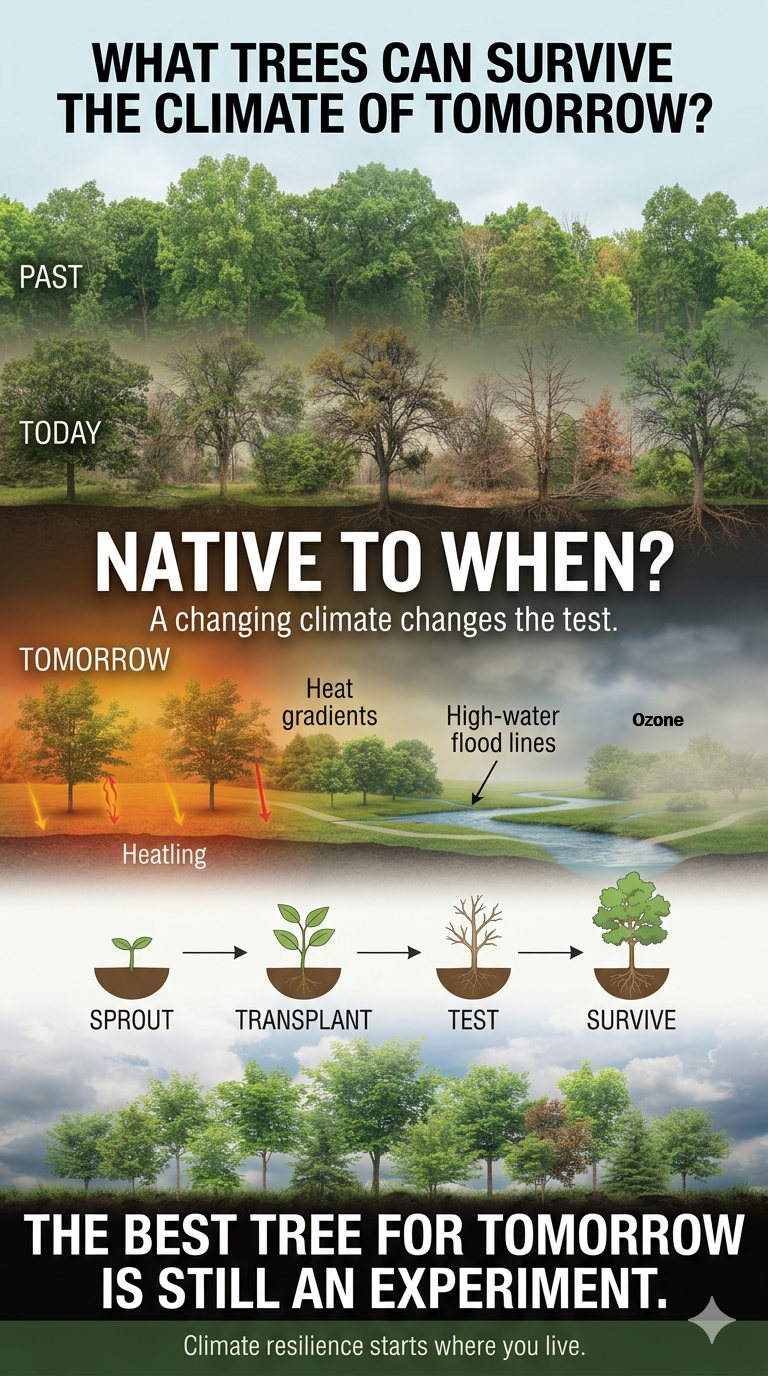
Unfortunately, “native species” is not necessarily the answer—at least not without defining what we mean by native and, more importantly, native to when? A species that evolved in Pennsylvania under the climate of the past may not necessarily be well suited to Pennsylvania’s rapidly changing climate today.
That is the premise behind this experiment.
I transplanted trees that began sprouting naturally around my property, along with trees I obtained for free or on special occasions. Some were Arbor Day giveaways. Others were small ornamental trees purchased at post-Christmas sales. Nothing particularly scientific or selective went into acquiring them. They were simply trees that became available to me.
For several years, I have been testing these trees for climate resilience in my location.
That may be one of the most useful ways to identify the trees of the future: an evolving experiment conducted where you actually live. There is no single “best tree” for tomorrow because tomorrow’s climate is still changing—and the speed and acceleration of that change remain uncertain.
One of the most troubling findings is that many of the species we traditionally regard as Pennsylvania’s native trees are struggling under today’s conditions. Some of the old-growth species that once thrived here may no longer be capable of surviving, much less thriving, under the climate they now face.
The question, then, is not simply “What trees are native here?”
It is:
“What trees can survive here as the climate continues to change?”