by Daniel Brouse
1. EXTERNAL FORCING AND PLANETARY ENERGY IMBALANCE
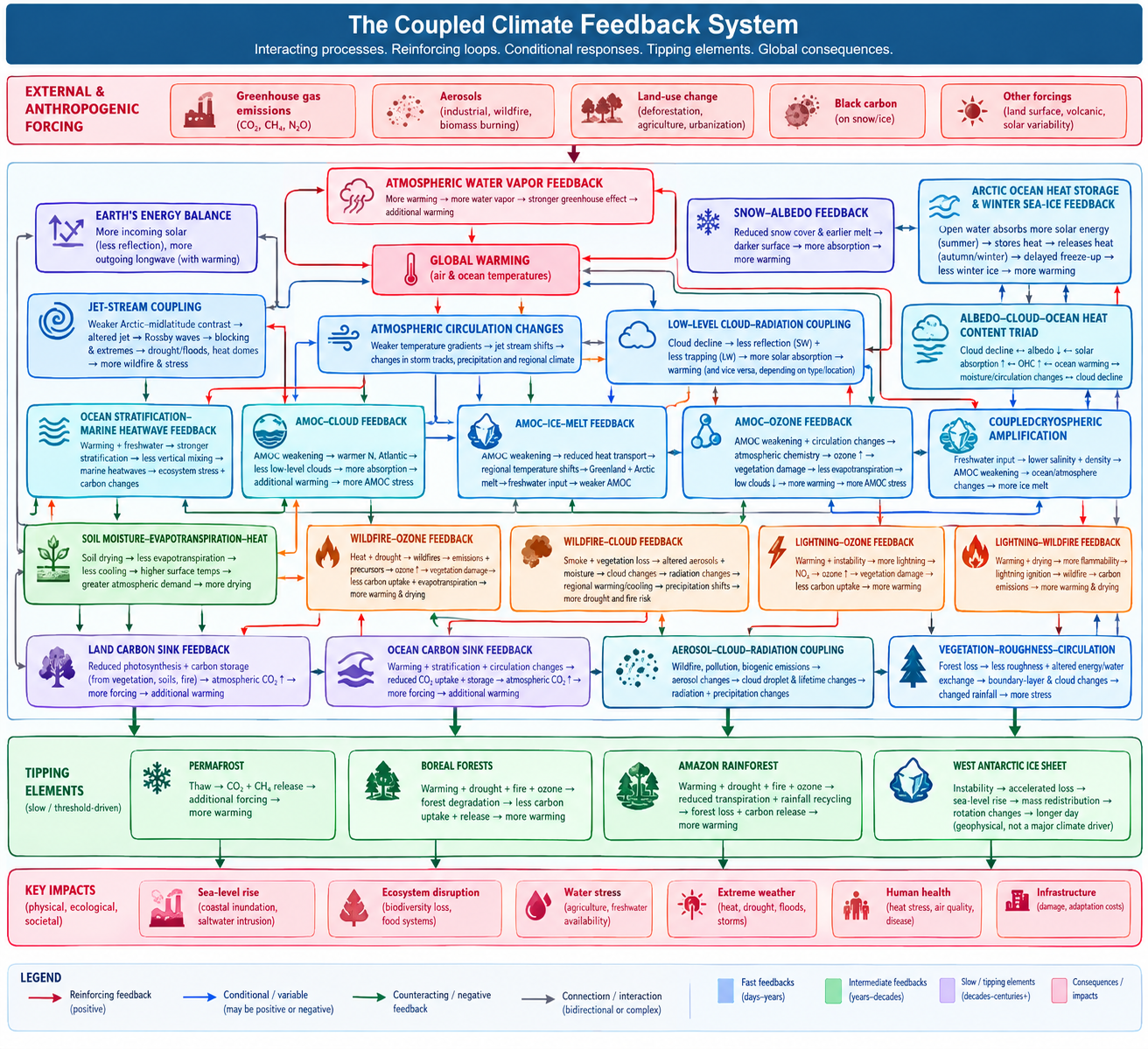
Anthropogenic greenhouse-gas emissions → increased atmospheric absorption of outgoing longwave radiation → increased planetary energy imbalance → accumulation of excess energy in the Earth system → ocean heat uptake, atmospheric warming, land warming, and cryosphere warming → changes in the distribution and movement of energy, moisture, and carbon throughout the climate system.
External and anthropogenic forcings include:
Greenhouse gases → increased longwave radiative forcing.
Anthropogenic aerosols → changes in incoming solar radiation and cloud properties; the net effect varies by aerosol type, altitude, location, and atmospheric conditions.
Land-use change and deforestation → changes in surface albedo, evapotranspiration, roughness, carbon storage, and regional circulation.
Solar and volcanic variability → natural changes in incoming energy and atmospheric composition.
Ocean–atmosphere variability, including ENSO → redistribution of heat and changes in global circulation superimposed on the long-term warming trend.
Forcing → changes in climate-system state → activation or modification of feedbacks → possible amplification, stabilization, or threshold crossing → regional and global impacts.
2. POLAR AMPLIFICATION, CRYOSPHERE, AND ICE-SHEET FEEDBACKS
Polar amplification → weakened equator-to-pole temperature gradients → reduced thermal contrast → changes in atmospheric circulation, storm tracks, and jet-stream behavior → accelerated Arctic warming and Greenland ice loss.
ICE–ALBEDO FEEDBACK
Sea ice and snow loss → darker ocean or land surface exposed → reduced solar reflectivity → increased solar energy absorption during sunlit periods → additional warming → further sea ice and snow loss ↻
MELT–ELEVATION FEEDBACK
Ice-sheet surface melting → reduced ice-sheet elevation → exposure to warmer air at lower elevations → increased surface melt → further elevation loss ↻
REGIONAL LAPSE-RATE FEEDBACK
Arctic surface warming and changes in vertical atmospheric temperature structure → altered lapse rate → greater near-surface warming in some polar conditions → additional surface melt and sea-ice loss.
The lapse-rate feedback varies with latitude, season, atmospheric stability, moisture, and vertical temperature structure. It should not be treated as a uniform global amplification mechanism.
SNOW–ALBEDO FEEDBACK
Earlier seasonal snowmelt or reduced snow cover → darker ground and vegetation exposed → increased absorption of sunlight → regional warming → further snow loss ↻
WILDFIRE–SNOW AND ICE-ALBEDO CROSS-LINK
Wildfire → soot and black-carbon deposition on snow and ice → reduced reflectivity → increased solar absorption → accelerated snowmelt and glacier melt → greater exposure of darker surfaces → further absorption.
The strength of this pathway depends on deposition, snow conditions, sunlight, and the amount and timing of subsequent snowfall.
ARCTIC OCEAN HEAT–WINTER SEA-ICE FEEDBACK
Ocean heat storage and transport into Arctic waters → delayed autumn freeze-up and reduced winter ice formation → thinner or less extensive sea ice → increased ocean–atmosphere heat and moisture exchange during cold seasons → changes in lower-atmospheric stability and circulation → further changes in sea-ice growth and persistence.
The ocean can continue releasing stored heat after seasonal solar input declines, influencing the timing and thickness of sea ice.
GREENLAND AND GLACIER MELT–OCEAN FEEDBACK
Atmospheric warming and ocean heat reaching glacier fronts → increased surface melt and/or submarine melting → glacier retreat and ice discharge → freshwater input to adjacent seas → changes in local stratification, circulation, and ocean heat distribution → potential changes in further glacier-front melting.
The magnitude and direction of ocean feedbacks depend on local bathymetry, currents, freshwater distribution, and glacier geometry.
ICE-SHEET MELT–SEA-LEVEL–COASTAL ECOSYSTEM FEEDBACK
Greenland and Antarctic ice loss → global mean sea-level rise → increased coastal flooding, erosion, and saltwater intrusion → damage or displacement of wetlands, mangroves, marshes, and other coastal ecosystems → potential loss of coastal carbon storage and sequestration → release of some stored carbon or reduced future uptake → additional atmospheric greenhouse-gas forcing.
Coastal ecosystems can also retain or accumulate carbon under favorable conditions; outcomes vary by ecosystem, sediment supply, inundation, and adaptation.
WEST ANTARCTIC ICE-SHEET INSTABILITY
Ocean heat reaching ice shelves → basal melting and thinning → reduced ice-shelf buttressing → faster grounded-ice discharge → ice-sheet retreat and potential marine ice-sheet instability → additional sea-level rise.
The pace and extent depend on ice geometry, ocean circulation, bedrock topography, and the evolution of buttressing. Threshold crossing can create long-lived ice loss even if later warming slows.
GEOPHYSICAL CONSEQUENCE: MASS REDISTRIBUTION AND EARTH ROTATION
Ice-sheet mass loss → redistribution of water from land to ocean → changes in Earth’s mass distribution and rotational properties → small changes in length of day and polar motion.
Groundwater depletion and redistribution → additional changes in Earth’s mass distribution and rotation.
These are geophysical consequences of mass redistribution, not independent climate feedbacks. Their climatic significance should not be conflated with the primary mechanisms driving ice loss.
3. OCEAN HEAT, STRATIFICATION, CARBON UPTAKE, AND AMOC
OCEAN HEAT-CONTENT FEEDBACK NETWORK
Planetary energy imbalance → increased ocean heat content (OHC) → ocean warming and changes in vertical temperature structure → changes in stratification, mixing, circulation, and air–sea heat exchange → altered heat storage and redistribution → changes in regional sea-surface temperatures, atmospheric conditions, and cryosphere melt.
Four related but distinct variables must be tracked:
Ocean heat content → the amount of heat stored throughout the ocean.
Sea-surface temperature → the temperature of the ocean surface, which influences air–sea exchanges, evaporation, convection, and regional weather.
Vertical mixing and stratification → the redistribution of heat between surface and deeper water.
Ocean–atmosphere heat exchange → the transfer of heat between ocean and atmosphere, which can warm or cool the lower atmosphere depending on local conditions.
These variables interact but are not interchangeable. Rising OHC does not imply that every region’s surface temperature rises at the same rate or that every ocean layer warms uniformly.
OCEAN STRATIFICATION–MARINE HEATWAVE FEEDBACK
Surface ocean warming and freshwater input → stronger density stratification in some regions → reduced vertical mixing → less subsurface heat ventilation and altered nutrient transport → increased persistence of marine heatwaves under favorable conditions → ecosystem stress and changes in ocean–atmosphere heat exchange → further regional impacts.
Stronger stratification can also change the depth and timing of heat storage; the effects on surface temperatures vary by location and circulation regime.
NORTH ATLANTIC STRATIFICATION–GLACIER-FRONT HEAT NETWORK
Greenland meltwater and other freshwater inputs → changes in North Atlantic density structure and stratification → altered ocean mixing and current pathways → changes in the delivery of relatively warm water to some glacier fronts → changes in submarine melting and ice discharge → additional freshwater input.
The pathway is spatially dependent and should not be interpreted as a uniform increase in heat delivery to every glacier.
OCEAN CARBON-SINK–CIRCULATION FEEDBACK
Ocean warming and changes in circulation → changes in CO₂ solubility, surface-to-deep-ocean exchange, and biological carbon transport → possible weakening or redistribution of ocean carbon uptake → greater atmospheric CO₂ retention relative to a stronger-sink scenario → additional warming → further changes in ocean carbon uptake.
The ocean remains a major carbon sink. Its future uptake depends on temperature, chemistry, circulation, biological processes, and the rate of human emissions.
AMOC WEAKENING AND FRESHWATER FEEDBACK
Greenland meltwater and changes in precipitation and evaporation → changes in freshwater distribution and North Atlantic density → altered deep-water formation and overturning circulation → potential weakening of the Atlantic Meridional Overturning Circulation (AMOC) → changes in northward ocean heat transport and regional ocean–atmosphere exchanges → changes in Northern Hemisphere temperature patterns, rainfall, and atmospheric circulation → further changes in freshwater distribution and ocean conditions.
AMOC behavior also depends on winds, ocean mixing, water-mass formation, background circulation, and atmospheric heat exchange. Weakening is not synonymous with imminent or inevitable collapse.
AMOC–NORTHERN HEMISPHERE ATMOSPHERIC CIRCULATION CROSS-LINK
AMOC changes → redistribution of North Atlantic and hemispheric heat → changes in atmospheric temperature gradients and ocean–atmosphere heat exchange → potential shifts in storm tracks, regional precipitation, and circulation patterns → altered Greenland surface conditions, European and North Atlantic weather, and Arctic sea-ice conditions → additional ocean and cryosphere responses.
The atmospheric response is complex and regionally dependent; it should not be reduced to a single predictable jet-stream outcome.
TROPICAL OCEAN VARIABILITY–GLOBAL CIRCULATION NETWORK
ENSO and other tropical ocean variability → changes in tropical sea-surface temperatures and convection → shifts in atmospheric heating and pressure patterns → changes in planetary waves, jet streams, monsoons, and storm tracks → changes in regional heat, rainfall, drought, and wildfire conditions → changes in land and ocean energy, water, and carbon exchanges.
Long-term greenhouse warming changes the background conditions on which natural variability operates. Individual ENSO events are not themselves proof of a climate tipping point.
4. LOW-LEVEL CLOUDS, WATER VAPOR, AND RADIATION
ATMOSPHERIC WATER-VAPOR GREENHOUSE FEEDBACK
Warming → increased atmospheric moisture where water is available → increased absorption of outgoing longwave radiation → additional warming → greater atmospheric moisture capacity and, in many regions, increased water vapor ↻
Actual water-vapor changes depend on circulation, relative humidity, and moisture availability. Water vapor is primarily a feedback on warming, while long-lived greenhouse gases are major external drivers.
CLOUD SHORTWAVE–LONGWAVE RADIATION BALANCE
Changes in cloud cover, altitude, thickness, droplet properties, and geographic distribution → changes in reflected incoming shortwave sunlight and absorbed or emitted outgoing longwave radiation → changes in the net cloud radiative effect → changes in planetary energy balance and regional temperatures.
Low clouds often exert a strong cooling effect by reflecting sunlight, while high clouds can exert substantial warming effects by trapping outgoing infrared radiation. The net effect of cloud changes depends on cloud type, location, altitude, optical thickness, season, and underlying surface.
LOW-LEVEL CLOUD–OCEAN HEAT FEEDBACK
Ocean warming and changes in sea-surface temperature, atmospheric stability, moisture, circulation, and aerosols → changes in low-level cloud formation and persistence → changes in reflected sunlight → changes in ocean heat absorption → changes in sea-surface temperature and atmospheric stability → further changes in low-level clouds.
LOW-LEVEL CLOUD DECLINE–ARCTIC AMPLIFICATION CROSS-LINK
Declining low-level cloud cover in locations and seasons where clouds have a net cooling effect → increased solar energy reaching the surface → enhanced surface and ocean warming → sea-ice loss and reduced albedo → Arctic amplification → changes in atmospheric stability, moisture, and circulation → further changes in cloud formation.
This is conditional rather than universal: low-level clouds can also produce warming through longwave trapping, especially during polar night and cold seasons. A claim that cloud decline will double a particular warming outcome requires explicit model, observational, and scenario support.
CLOUD–OCEAN HEAT CONTENT–ALBEDO COUPLING
Changes in cloud cover → changes in solar radiation reaching the ocean → changes in ocean heat uptake and surface temperature → changes in atmospheric stability and moisture → further cloud changes.
Sea-ice loss and changes in surface albedo → additional changes in absorbed sunlight → changes in ocean heat storage and release → changes in cloud formation and atmospheric radiation.
Together, these pathways connect cloud radiative effects, ocean heat content, and cryosphere albedo without treating them as one interchangeable mechanism.
AEROSOL–CLOUD–RADIATION FEEDBACK
Aerosol concentration and composition → changes in cloud condensation nuclei, droplet number, cloud brightness, lifetime, and precipitation → changes in reflected sunlight and cloud persistence → changes in surface energy balance and atmospheric circulation.
Aerosols can cool or warm the climate system directly or indirectly. The magnitude and direction depend on aerosol composition, altitude, location, and interactions with clouds.
LOW-LEVEL CLOUD–OZONE COUPLING
Tropospheric ozone and its precursors → atmospheric chemical changes and vegetation damage → changes in plant transpiration, surface moisture, and regional atmospheric conditions → changes in boundary-layer development and cloud formation → changes in solar radiation reaching vegetation and land → further changes in ecosystem function and atmospheric chemistry.
The direction and strength of this coupling depend on meteorology, land cover, emissions, and the specific cloud and chemical processes involved.
5. ATMOSPHERIC CIRCULATION, MOISTURE, AND EXTREME WEATHER
JET-STREAM AND STORM-TRACK RESPONSE
Polar amplification and changes in meridional temperature gradients → changes in atmospheric thermal structure and circulation → possible changes in jet-stream position, waviness, blocking, and storm tracks → altered persistence or movement of heat, cold, precipitation, and drought patterns → regional impacts on ecosystems, infrastructure, and water resources.
The jet stream is governed by multiple interacting factors, including tropical heating, stratospheric conditions, internal variability, and the evolving temperature gradients. The response is not uniform across all seasons or regions.
SOIL MOISTURE–EVAPOTRANSPIRATION–HEAT FEEDBACK
Heat and drought → declining soil moisture → reduced evapotranspiration and evaporative cooling → more surface energy available for sensible heating → higher land-surface and near-surface air temperatures → increased evaporative demand → further soil-moisture depletion ↻
Where water remains available, evapotranspiration can continue to cool the surface. The strength of this feedback depends on vegetation, soil type, rooting depth, precipitation, and atmospheric demand.
EXTREME PRECIPITATION–CRYOSPHERE CROSS-LINK
Warming → increased atmospheric moisture capacity → potential increases in heavy precipitation where circulation and moisture supply support it → changes in snow accumulation, rain-on-snow events, glacier mass balance, and runoff → changes in flood risk, ice dynamics, and regional water availability.
In cold regions, increased snowfall can temporarily add mass to glaciers and ice sheets, partially offsetting surface-melt losses. The net result depends on the balance between accumulation, melt, and ice discharge.
VEGETATION–ROUGHNESS–CIRCULATION FEEDBACK
Deforestation, vegetation loss, or ecosystem shifts → changes in surface roughness, albedo, rooting depth, and evapotranspiration → changes in boundary-layer mixing, moisture recycling, and regional circulation → changes in rainfall, drought, and vegetation stress → further ecosystem changes.
This pathway can amplify drying in some regions while producing different or even counteracting effects elsewhere.
6. OZONE, VEGETATION, SOIL MOISTURE, AND CARBON-SINK DECLINE
TROPOSPHERIC OZONE–VEGETATION FEEDBACK
Elevated ground-level ozone → oxidative damage to leaves and plant tissues → reduced photosynthesis, stomatal function, growth, and productivity in sensitive vegetation → reduced carbon uptake and changes in ecosystem water use → increased atmospheric CO₂ relative to a healthier-vegetation scenario → additional warming.
Ozone damage varies by species, exposure, season, and ecosystem conditions. It is a climate multiplier through its effects on vegetation and atmospheric chemistry, but its overall radiative and ecological effects must be assessed separately.
OZONE–SOIL MOISTURE–HEAT EXTREMES CROSS-LINK
Ozone exposure → vegetation injury and altered stomatal conductance → reduced or changed transpiration → changes in soil moisture and surface energy partitioning → reduced evaporative cooling in affected conditions → increased risk of local heat extremes → additional plant stress and potentially greater ozone damage.
The sign of the soil-moisture response is not universal: reduced transpiration may conserve soil water in some settings, while vegetation damage can also impair ecosystem functioning and regional moisture recycling. The net effect must be evaluated regionally.
LAND CARBON-SINK–ATMOSPHERIC CO₂ FEEDBACK
Heat, drought, ozone exposure, wildfire, deforestation, and ecosystem degradation → reduced photosynthesis or increased respiration and combustion → weakened terrestrial carbon uptake or release of stored carbon → increased atmospheric CO₂ relative to a healthier-ecosystem baseline → increased radiative forcing → additional warming → further ecosystem stress.
Land ecosystems can continue absorbing carbon where conditions remain favorable. Carbon-sink failure is a risk pathway, not a universal or complete cessation of land uptake.
7. WILDFIRE, AEROSOLS, AND ECOSYSTEM FEEDBACKS
HEAT–DROUGHT–WILDFIRE FEEDBACK
Higher temperatures and prolonged drought → lower fuel moisture and greater vegetation stress → increased fire danger under conducive weather and ignition conditions → wildfire and ecosystem damage → carbon emissions and changes in land cover → additional warming and altered hydrology → increased fire danger.
Actual fire activity also depends on ignition sources, fuel availability, land management, wind, and suppression.
WILDFIRE–CARBON–SOIL FEEDBACK
Wildfire → release of carbon stored in vegetation and soils → reduced living biomass and potential loss of soil carbon → reduced future carbon uptake and, in some cases, greater soil erosion → altered vegetation recovery and hydrology → increased vulnerability to future fire and ecosystem degradation.
Some ecosystems recover or regenerate after fire; the risk of persistent carbon loss increases where fires are severe or recurrent, soils are damaged, or climatic conditions impede recovery.
WILDFIRE AEROSOL–CLOUD–SNOW/ICE CROSS-LINK
Wildfire emissions → aerosol loading and changes in atmospheric chemistry → changes in cloud formation and radiative properties → possible changes in precipitation and regional radiation.
At the same time:
Wildfire emissions → black-carbon deposition on snow and ice → reduced albedo → increased solar absorption → accelerated melt.
Smoke aerosols may reduce sunlight reaching the surface and produce short-term cooling in some circumstances, while black carbon deposited on snow and ice can promote warming. These effects must be distinguished by location, altitude, particle type, and timescale.
8. FORESTS, PERMAFROST, AND HYDROLOGICAL TIPPING ELEMENTS
BOREAL FOREST TIPPING ELEMENT
Warming, drought, insect outbreaks, and wildfire → boreal forest stress and mortality → changes in carbon storage, evapotranspiration, surface roughness, and regional hydrology → altered climate and fire conditions → additional forest stress.
BOREAL FOREST–SNOW–ALBEDO CROSS-LINK
Boreal forest loss → greater snow exposure during snow-covered seasons → increased surface reflectivity → potential regional cooling that can partially counteract greenhouse warming.
However, forest loss also reduces carbon storage, changes evapotranspiration and roughness, and can increase fire risk. The net climate effect depends on latitude, season, snow cover, forest type, and the balance between biogeophysical and carbon-cycle effects.
PERMAFROST THAW–HYDROLOGY–CARBON FEEDBACK
Warming → permafrost thaw → changes in ground stability, drainage, thermokarst, and soil moisture → decomposition of previously frozen organic matter → release of CO₂ and methane under suitable conditions → additional greenhouse warming → further thaw ↻
Permafrost thaw can produce both wetter and drier landscapes depending on terrain, ice content, drainage, and hydrological change. Methane production is especially dependent on anaerobic conditions.
PERMAFROST–FIRE–DEEPER THAW CROSS-LINK
Warming and drying → increased fire risk in susceptible permafrost landscapes → combustion of vegetation and insulating organic layers → deeper seasonal thaw and altered ground hydrology → greater exposure of frozen carbon to decomposition → greenhouse-gas emissions and vegetation changes → increased future vulnerability to fire and thaw.
The pathway is conditional on fire occurrence, ecosystem type, soil characteristics, and post-fire recovery.
WETLAND–METHANE FEEDBACK
Warming and hydrological change → shifts in wetland area, water table, and anaerobic conditions → changes in methane production and emissions → changes in atmospheric greenhouse forcing → additional warming → further changes in wetland hydrology.
Wetland responses can differ substantially: drainage may reduce methane emissions while increasing CO₂ emissions from soils, and some wetlands can remain or become important carbon sinks.
9. COUNTERACTING AND STABILIZING CLIMATE FEEDBACKS
These pathways do not negate the overall warming influence of human greenhouse-gas emissions. They identify processes that can reduce, redistribute, or temporarily counteract warming under particular conditions.
PLANCK RESPONSE: INCREASED OUTGOING INFRARED RADIATION
Earth’s surface and atmosphere warm → greater emission of outgoing longwave radiation → increased energy loss to space → a stabilizing response that opposes the initial warming.
This is a fundamental negative feedback in the climate system, although it does not eliminate the warming caused by increased greenhouse-gas concentrations.
CONDITIONAL CLOUD COUNTERFEEDBACK
Changes in circulation, stability, moisture, and aerosols → increases in low-cloud cover in some locations or seasons → greater reflection of incoming sunlight → reduced local or regional solar energy absorption.
This effect is conditional. Other cloud changes can increase warming, and the global net effect depends on cloud altitude, thickness, location, and shortwave–longwave balance.
INCREASED SNOWFALL AND ICE ACCUMULATION
In some cold regions, increased moisture availability → increased snowfall → greater seasonal snow accumulation or temporary glacier and ice-sheet mass gain → partial offset of surface-melt losses.
This pathway competes with rising temperatures, rain-on-snow events, surface melt, and ice discharge. It does not imply that ice-sheet mass balance will improve overall.
AEROSOL COOLING
Certain anthropogenic aerosols and volcanic aerosols → scattering or reflection of sunlight and, for some aerosol types, cloud-brightening effects → reduced incoming solar energy reaching the surface → temporary cooling that partially offsets greenhouse-gas warming.
The magnitude varies by aerosol composition and location. Reducing harmful air pollution remains important for health even where aerosols have a cooling effect.
CONTINUING TERRESTRIAL AND OCEAN CARBON UPTAKE
Vegetation growth and ocean carbon uptake → removal of some atmospheric CO₂ → partial moderation of atmospheric greenhouse-gas accumulation.
This uptake is finite and responds to temperature, water availability, nutrients, ocean chemistry, circulation, and ecosystem health. Warming can weaken sinks in some conditions without causing all sinks to fail.
COUNTERACTING FEEDBACKS ARE NOT EQUIVALENT TO CLIMATE STABILIZATION
The existence of negative feedbacks does not establish that the climate system will stabilize at a safe temperature. The net trajectory depends on the balance of forcing, reinforcing feedbacks, counteracting responses, carbon emissions, and the timing of possible thresholds.
10. FORCING–FEEDBACK–TIPPING–IMPACT CLASSIFICATION
EXTERNAL FORCINGS
Greenhouse-gas emissions, anthropogenic aerosols, land-use change, and natural solar or volcanic variability → changes in the system’s energy balance and background state.
REINFORCING AND COUNTERACTING FEEDBACKS
Changes in temperature, moisture, clouds, albedo, carbon uptake, ocean heat transport, and ecosystems → processes that amplify or oppose the initial perturbation.
COUPLED TIPPING ELEMENTS
Potentially threshold-sensitive components include Greenland and Antarctic ice sheets, Arctic sea ice, the AMOC, permafrost carbon stores, boreal forests, and some tropical forest systems.
Crossing a threshold may initiate persistent or self-reinforcing change. The evidence, threshold location, reversibility, and timescale differ for each element; not every feedback is a tipping point.
CONSEQUENCES AND IMPACTS
Sea-level rise, extreme heat, drought, heavy precipitation, wildfire, ecosystem disruption, agricultural losses, infrastructure damage, water insecurity, and socioeconomic instability → human and ecological consequences of changes in the physical climate system.
Impacts can feed back into the climate system through land-use change, emissions, ecosystem loss, and changes in resource use, but should not be confused with the physical feedback mechanism that initiated them.
11. INTEGRATED DOMINO EFFECT AND SYSTEM-WIDE COUPLING
The climate system does not operate as a collection of isolated feedbacks. Atmospheric, oceanic, cryospheric, hydrological, chemical, and biological processes interact through energy, moisture, and carbon exchanges. Changes in one component can alter the conditions governing several others.
INTEGRATED CLIMATE DOMINO SEQUENCE
Anthropogenic forcing → planetary energy imbalance → ocean and atmospheric warming → activation or strengthening of climate feedbacks → changes in clouds, water vapor, albedo, and ocean heat distribution → cryosphere loss and changes in ocean circulation → hydrological disruption and ecosystem stress → reduced or altered carbon uptake and increased emissions from some ecosystems → additional greenhouse forcing → further changes in energy distribution and feedback strength.
MAJOR COUPLING PATHWAYS
ATMOSPHERE → OCEAN → CRYOSPHERE
Atmospheric warming and changes in winds → altered ocean heat exchange and transport → glacier-front and ice-shelf melting → freshwater redistribution and sea-level rise → changes in ocean stratification and circulation → further changes in regional heat transport and ice loss.
ATMOSPHERE → VEGETATION → HYDROLOGY → CLOUDS
Ozone exposure, heat, drought, and fire → vegetation damage and changes in stomatal conductance → altered transpiration, soil moisture, and moisture recycling → changes in boundary-layer development and cloud formation → changes in radiation reaching land and vegetation → further ecosystem stress.
CRYOSPHERE → ALBEDO → OCEAN HEAT → ATMOSPHERE
Sea-ice and snow loss → reduced reflectivity → increased solar absorption → ocean heat accumulation and altered seasonal heat release → changes in atmospheric stability and moisture → changes in clouds and circulation → additional changes in sea ice and snow.
OCEAN CIRCULATION → ATMOSPHERIC CIRCULATION → REGIONAL CLIMATE
Changes in AMOC strength, ocean heat distribution, and sea-surface temperatures → changes in atmospheric temperature gradients and heat exchange → shifts in regional circulation and precipitation patterns → changes in Greenland melt, Arctic sea ice, ecosystem stress, and freshwater input → additional ocean and atmospheric changes.
ECOSYSTEMS → CARBON CYCLE → CLIMATE
Ozone damage, drought, wildfire, deforestation, and ecosystem shifts → reduced carbon uptake or release of stored carbon in affected systems → increased atmospheric greenhouse-gas concentrations relative to a healthier-ecosystem baseline → additional warming → further ecological stress.
PERMAFROST → FIRE → CARBON RELEASE
Warming → permafrost thaw and hydrological change → greater vulnerability to some types of wildfire → loss of insulating organic layers and deeper thaw → increased exposure of frozen carbon to decomposition → additional greenhouse-gas emissions → further warming.
These pathways can reinforce one another, but their strength and direction vary. A coupled network can also include stabilizing responses, delays, and competing effects. Coupling does not by itself prove that every component has crossed a tipping point or that the entire system must undergo an irreversible cascade.
12. OVERARCHING DYNAMICAL SEQUENCE
The general sequence connecting forcing to systemic change is:
External forcing → energy imbalance → climate-system response → feedback activation or modification → coupling among subsystems → amplification or counteraction → approach to a threshold → possible threshold crossing → persistent or cascading changes → ecological, physical, and socioeconomic consequences.
A more compact representation is:
WARMING → FEEDBACK ACTIVATION → COUPLING → AMPLIFICATION → THRESHOLD APPROACH → POSSIBLE CASCADE ↻
The sequence is a conceptual framework, not a claim that every climate process follows an identical or inevitable trajectory. Some pathways weaken, reverse, or stabilize; others may persist after the original forcing changes.
13. TIMESCALE CLASSIFICATION
Fast
Atmospheric and short-term processes
Cloud responses, water-vapor changes, aerosol–radiation interactions, atmospheric chemistry, heat extremes, storm development, and many circulation responses.
Typical response: days to years, depending on the mechanism.
Intermediate
Ocean, land, and ecosystem processes
Ocean heat redistribution, marine heatwaves, soil-moisture feedbacks, forest stress, carbon-sink changes, wildfire recovery, and changes in regional circulation.
Typical response: seasons to decades or longer; deep-ocean processes can take much longer.
Slow / threshold-sensitive
Ice sheets, permafrost, forests, and deep-ocean adjustment
Large ice-sheet retreat, long-term sea-level rise, deep-ocean heat redistribution, permafrost carbon release, and persistent ecosystem transitions.
Typical response: decades to centuries or longer, with some changes potentially persisting for millennia.
These timescales overlap. A fast atmospheric response can initiate a slower oceanic or ecological response, while slow changes in ice sheets and ocean circulation can alter atmospheric conditions much sooner than the full physical adjustment is completed.
14. HOW TO INTERPRET THE COMPLETE NETWORK
The integrated network is most useful when it preserves five distinctions:
- Forcing versus feedback: greenhouse-gas emissions can drive warming, while water vapor, albedo, and ecosystem responses can modify the resulting change.
- Feedback versus tipping element: a feedback can operate continuously without a threshold; a tipping element may undergo a substantial and persistent transition after a threshold is crossed.
- Correlation versus causal coupling: simultaneous changes do not by themselves establish a causal connection. Individual links require observational, experimental, or modeling evidence.
- Amplification versus inevitability: a reinforcing pathway can increase risk without proving that a particular outcome, collapse, or cascade is certain.
- Global versus regional effects: a mechanism can amplify warming in one region or season while producing a counteracting effect elsewhere.
The central systems insight is that climate risk depends not only on the magnitude of global temperature rise, but also on how energy, water, and carbon move through a network of interacting processes—and on whether those interactions strengthen, weaken, or persist as conditions change.