by Daniel Brouse
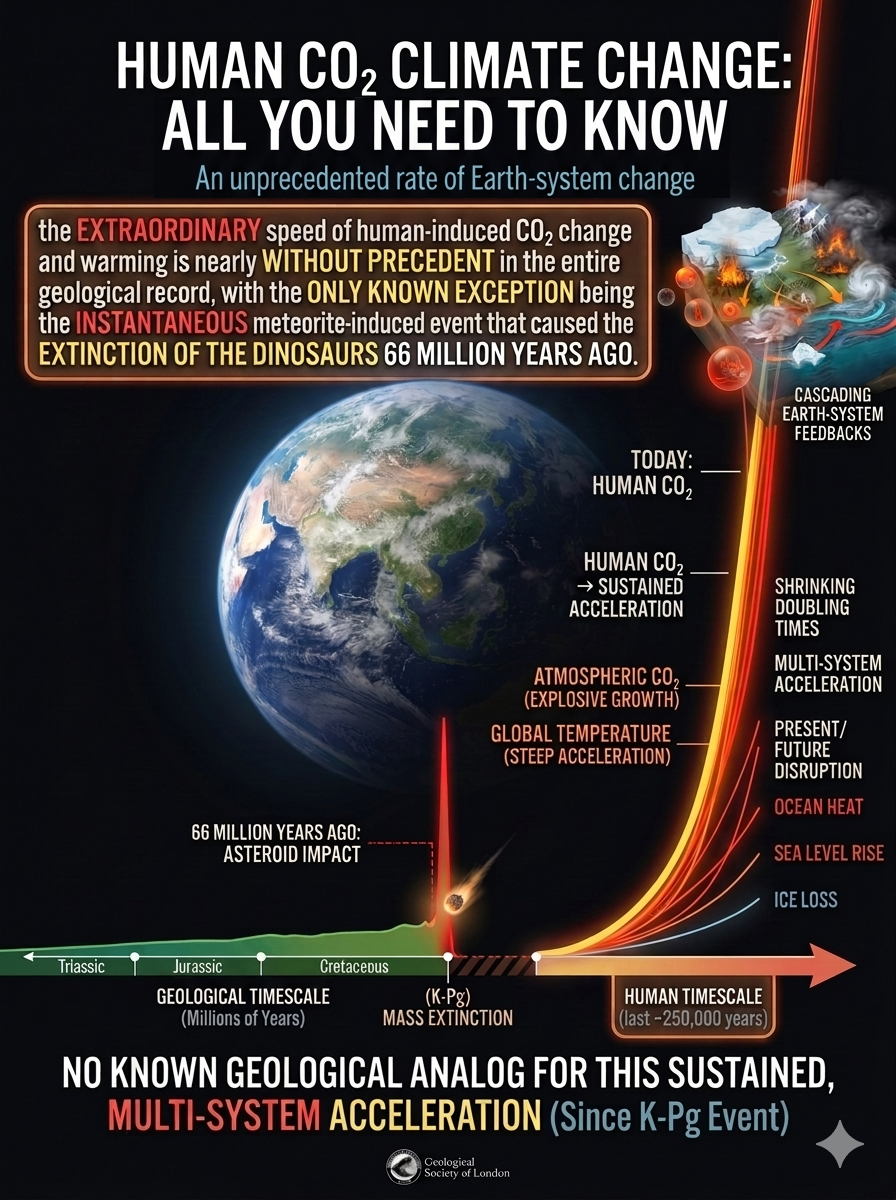
Human CO2 Climate Change: All You Need to Know
An unprecedented rate of Earth-system change.
The Geological Society of London (the UK’s expert association of professional geologists since 1807) says:
” ….the current speed of human-induced CO2 change and warming is nearly without precedent in the entire geological record, with the only known exception being the instantaneous, meteorite-induced event that caused the extinction of non-bird-like dinosaurs 66 million years ago” (H/T Rocky Rex)
We’ve arrived at a very similar observation in our own work, but I don’t think I’ve seen it stated this clearly—or published elsewhere. Thanks, Rocky, for helping to illuminate it.
Juxtapose the two and let me know whether the comparison can be communicated more effectively.
Multiple climate indicators now point to rates of warming-related disruption far beyond those observed during the modern instrumental era.
There is no well-established geological analog for a sustained, multi-variable, decade-scale pattern of accelerating change across the full Earth system at the resolution available in contemporary observations. If sustained, this may represent one of the most abrupt large-scale climate transitions in Earth’s geological history.
Rocky replied:
I’ve been citing that for a long time, and I’m always impressed by how many people can totally ignore it. It’s very much the scientific version of “The Good Ancestor” poem, it should hit people between the eyes and wake them up. All the signs are that we are entering an abrupt climate change process. Have I told you this true story before?
In the mid 1950s, Russell Coope was looking for a PhD project after graduating as a geologist. He noticed beetle remains in ice age deposits in a gravel pit in the UK Midlands. His supervisor, Prof Fred Shotton, said something like: “I expect they are just modern beetles that have got stuck to the surface.” Fred was wrong – a rare event.
Coope decided to base his PhD on recording what kinds of beetles there were in different ice age deposits, to see where it led. He discovered that the mix of beetles was linked to the temperatures at that time.
He did this by comparing his layer-by-layer collections with collections of beetles from different places in the modern world – beetles happen to evolve very slowly, so the actual variety of beetles hasn’t changed much over the last million years or so.
As his research proceeded, Coope was shocked to find that the beetles showed that at times, during the ice ages, temperatures had changed significantly in just a few decades – his beetles showed that the Earth’s climate is not fundamentally stable.
He had discovered abrupt climate change events, a previously unknown phenomenon. Geologists had always assumed that most processes were slow.
I had the good fortune to be a student in Coope’s palaeontology lectures long ago…. and also in Fred’s physical geology lectures. (In 1943, Fred Shotton was involved in a secret project that produced geological maps of certain beaches in northern France…… that’s a movie that should be made by someone)
“We are messing with the trigger that causes climate change….the outcome is likely to be ferocious.”
– Professor Russell Coope (1930-2011)
Russell Coope and his ice age beetles https://www.youtube.com/watch?v=xMyt-UbcUQo

YOUTUBE.COM
Russell Coope on fossil beetles in the Cromer Forest-bed at Happisburgh, Norfolk, UK
Russel
The Human Induced Climate Change Experiment
The climate system is not simply warming—it is changing how it responds to that warming. Coupled climate feedbacks are becoming one of the most consequential dimensions of climate risk in the 21st century because they amplify changes and connect individual tipping-point pathways into larger cascading effects.
The longer warming persists, the more climate feedbacks become active. As these feedbacks interact, we are already observing nonlinear responses, amplification, and cascading impacts across the climate system. Hundreds of feedback mechanisms have been identified, and many can couple and reinforce one another, contributing to the accelerating pace and increasing magnitude of climate change—The Domino Effect.