by Daniel Brouse
Climate tipping points are components of the Earth system that can shift abruptly once critical thresholds are crossed. Their importance is determined not only by the likelihood of crossing those thresholds, but also by the strength of the feedback mechanisms that can amplify warming and destabilize other parts of the climate system.
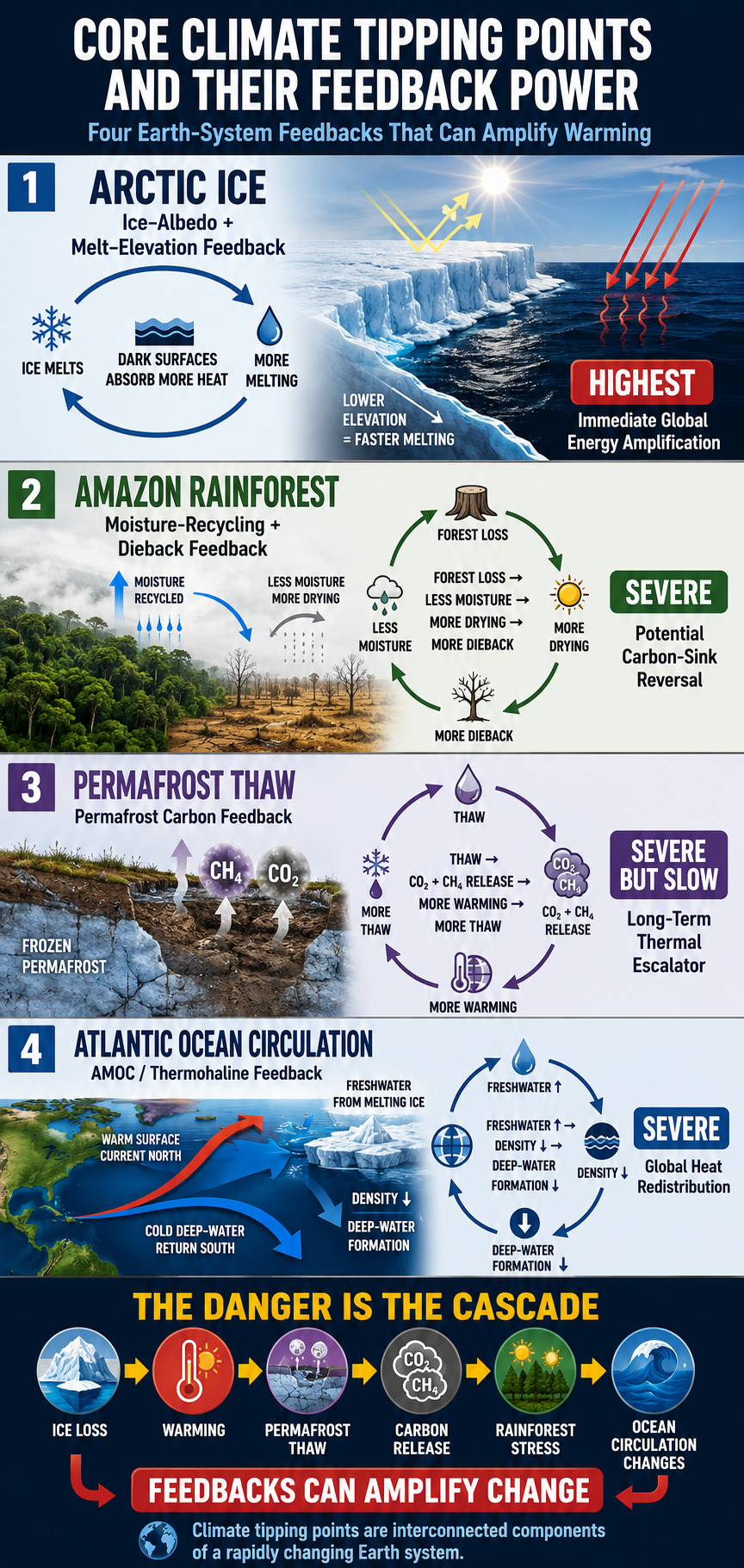
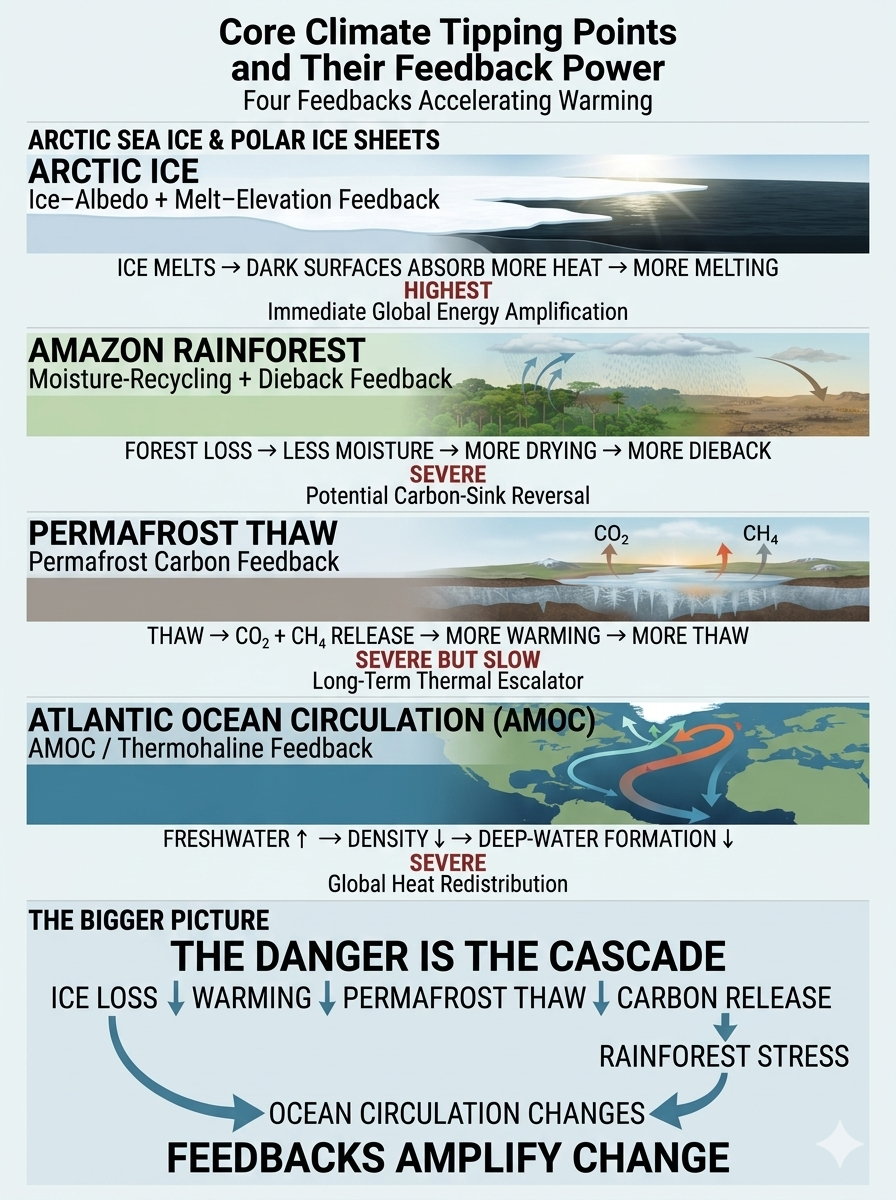
The following comparison highlights four major tipping elements, their core feedback mechanisms, how those feedbacks amplify climate change, and their broader global significance.
| Tipping Element | Core Feedback Mechanism | Amplification Dynamic | Global Threat Level |
|---|---|---|---|
| Arctic Sea Ice & Polar Ice Sheets | Ice–Albedo Effect & Melt–Elevation Feedback | Melting reflective ice exposes darker ocean water or land, which absorbs more solar energy and accelerates further warming and ice loss. As ice sheets lose elevation, warmer air at lower elevations can further accelerate melting. | Highest — Immediate Global Energy Amplification |
| Amazon Rainforest | Moisture Recycling & Dieback Feedback | Warming, deforestation, and reduced rainfall can weaken the rainforest’s ability to recycle moisture. Progressive forest loss can shift portions of the Amazon toward drier ecosystems while releasing stored carbon and reducing a major terrestrial carbon sink. | Severe — Potential Carbon-Sink Reversal |
| Permafrost Thaw | Permafrost Carbon Feedback | Thawing permafrost exposes previously frozen organic matter to decomposition, releasing carbon dioxide and methane. These greenhouse gases increase atmospheric heat retention, contributing to additional warming and further thaw. | Severe but Slow — Long-Term Thermal Escalator |
| Atlantic Meridional Overturning Circulation (AMOC) | Thermohaline Circulation Feedback | Freshwater entering the North Atlantic from melting ice and increased precipitation can reduce seawater density and weaken deep-water formation. A weakening AMOC can redistribute heat, alter precipitation patterns, and produce cascading effects across regional and global climate systems. | Severe — Global Heat Redistribution |
Why Feedback Power Matters
These tipping elements do not operate independently. They are components of an interconnected Earth system in which changes in one subsystem can alter the stability of others.
For example, warming can accelerate sea-ice loss, which reduces planetary reflectivity and increases solar heat absorption. At the same time, warming can accelerate permafrost thaw, releasing additional greenhouse gases. Changes in precipitation and atmospheric circulation can place additional stress on the Amazon rainforest, while freshwater input from melting ice can affect the AMOC.
The key danger is therefore not simply that individual tipping points may be crossed. It is that positive feedbacks can interact, creating cascading changes that amplify climate disruption beyond the initial forcing.
The Central Climate Risk
The most consequential feature of tipping points is their potential to transform gradual warming into self-reinforcing Earth-system change.
Once sufficiently strong feedbacks become active, reducing the original climate forcing may no longer immediately restore the system to its previous state. This creates the possibility of irreversibility, hysteresis, and cascading tipping behavior across multiple interconnected components of the climate system.
In this sense, climate tipping points represent more than isolated environmental thresholds. They are potential amplifiers of planetary change.