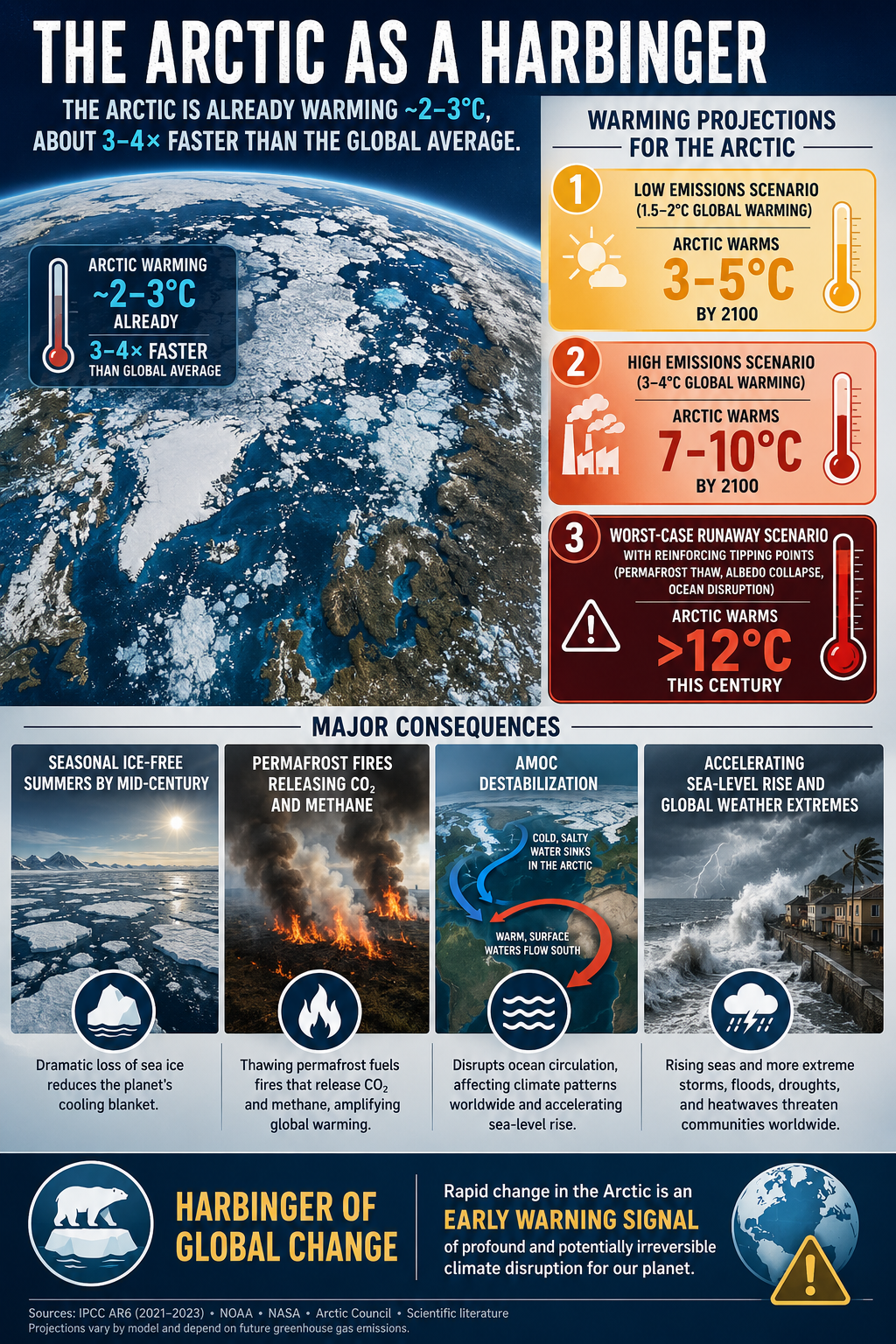
The Arctic is often described as Earth’s “canary in the coal mine” because it is warming dramatically faster than the rest of the planet. Average Arctic temperatures have already risen by approximately 2-3°C above pre-industrial levels, making the region three to four times more sensitive to warming than the global average. This phenomenon, known as Arctic amplification, occurs because multiple feedback mechanisms reinforce one another, causing change to accelerate.
Future warming projections vary depending on global greenhouse gas emissions:
- Low-emissions pathway (~1.5-2°C global warming): Arctic temperatures increase by approximately 3-5°C by 2100.
- High-emissions pathway (~3-4°C global warming): Arctic warming reaches approximately 7-10°C by 2100, with some regions experiencing substantially larger increases.
- Worst-case nonlinear scenario: If major tipping elements reinforce one another—including widespread permafrost thaw, extensive sea-ice loss, and disruptions to ocean circulation—parts of the Arctic could experience more than 12°C of warming this century. The ~12°C figure already appears within mainstream CMIP6/IPCC projections under SSP5-8.5 and does not require invoking additional tipping cascades.
The Arctic’s rapid warming is being driven by several powerful feedback loops. As sea ice disappears, dark ocean water absorbs far more solar energy than reflective ice, intensifying regional heating. Thawing permafrost releases carbon dioxide and methane that have been locked in frozen soils for thousands of years, adding additional greenhouse gases to the atmosphere. Warmer oceans and altered atmospheric circulation patterns further amplify these changes, increasing the probability of abrupt transitions.
The consequences extend far beyond the polar regions. Current projections indicate that the Arctic is likely to experience seasonally ice-free summers by mid-century, fundamentally altering marine ecosystems and atmospheric circulation. Expanding permafrost thaw and increasingly frequent tundra fires could release vast stores of carbon, further accelerating global warming. Large freshwater inputs from melting Greenland ice and changing ocean conditions may also weaken the Atlantic Meridional Overturning Circulation (AMOC), increasing the risk of regional sea-level rise, shifts in precipitation patterns, and more persistent weather extremes.
In this sense, the Arctic functions as an early-warning system for the planet. The region is demonstrating, in compressed form, how reinforcing climate feedbacks can transform gradual warming into rapidly accelerating change. What happens in the Arctic does not stay in the Arctic; it influences ocean circulation, atmospheric dynamics, sea levels, and climate risks across the entire globe.