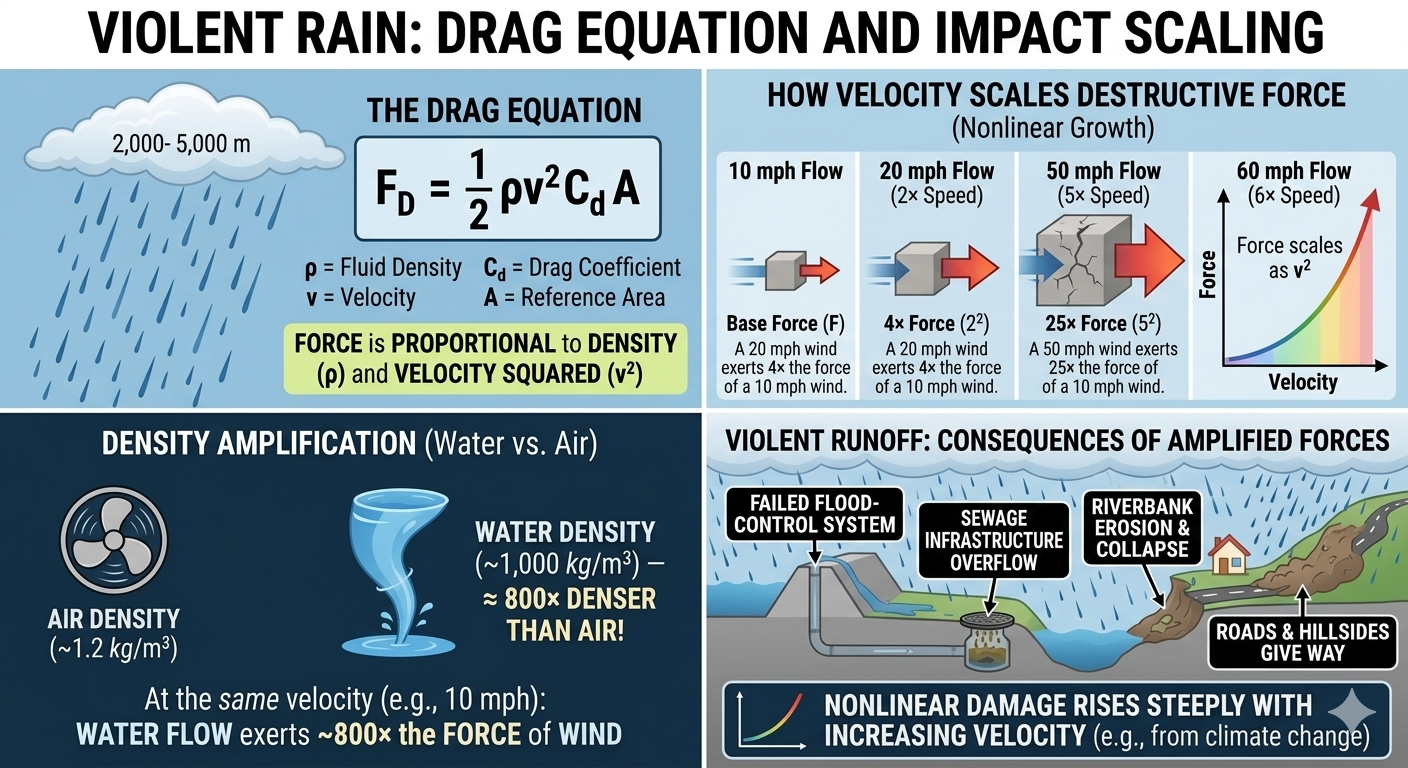
One physical consequence of warming is the formation of larger raindrops, along with an increase in the number of raindrops falling per square foot. Momentum of Rain is defined by the equation:
p = mv
As raindrop mass increases, so does momentum. Part of this increasing momentum transfers to the surrounding air, contributing to greater turbulence, downdrafts, and localized wind variability. Most of the momentum, however, is transferred upon impact. This effect can often be observed as rain splashes higher off roads and sidewalks during intense downpours. Flowing rainwater also carries greater mass and velocity, increasing the destructive power of runoff and floodwaters.
On the ground, concrete, asphalt, solar panels, roofs, vegetation, wildlife, homes, and infrastructure are all struck with greater force as rain momentum rises. Every additional increment of atmospheric moisture translates into greater kinetic energy being transferred to both natural and human systems.
Mass and velocity are part of a larger equation that also includes density. Together, these variables determine the intensity of flow forces and fluid dynamics. Both wind and water forces scale approximately with the square of velocity (v²). Consequently, relatively small increases in flow speed can produce disproportionately large increases in destructive force.
According to drag physics, force is proportional to density multiplied by the square of velocity (v²). For example:
- A 20 mph wind exerts 4 times the force of a 10 mph wind.
- A 40 mph wind exerts 16 times the force of a 10 mph wind.
- A 50 mph wind exerts 25 times the force of a 10 mph wind.
- A 60 mph wind exerts 36 times the force of a 10 mph wind.
Density further amplifies these forces. Water is approximately 800 times denser than air, meaning a 10 mph flow of water can exert roughly 800 times the force of a 10 mph wind. As flow velocities increase due to climate change, the resulting forces and damages rise nonlinearly and can appear exponential in their impacts. Although the precise rate at which climate change alters flow velocities remains an active area of research, the consequences are already visible worldwide as flood-control systems fail, sewage infrastructure overflows, riverbanks erode, roads collapse, and hillsides give way under the amplified force of violent rain and runoff.
In just ten days during July 2025, hundreds of flash floods swept across the United States, inundating communities from coast to coast, killing hundreds of people and causing billions of dollars in damage. At least five 1-in-1,000-year
rainfall events struck Texas, New Mexico, North Carolina, Florida, and Illinois. Meanwhile, Pennsylvania, Delaware, New Jersey, Maryland, Virginia, and Iowa reported multiple 500-year
floods as extreme rainfall overwhelmed infrastructure across much of the country.
These events illustrate a rapidly emerging reality: violent rain is no longer an anomaly. It is becoming one of the defining hazards of a warming planet.