by Sidd Mukherjee and Daniel Brouse
A New Era of Climate Risk Finance
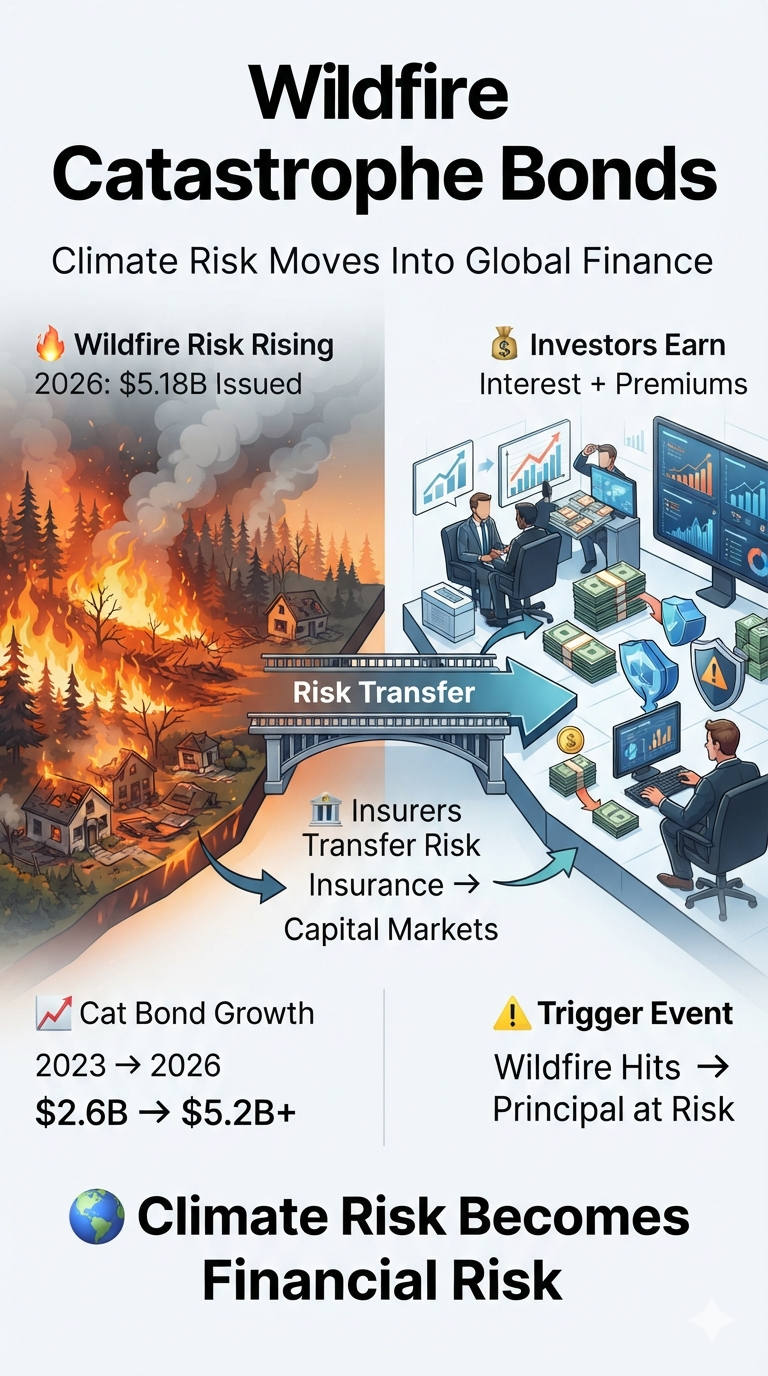
Wildfire-exposed catastrophe bond issuance has surged to $5.183 billion year-to-date in 2026, rapidly approaching the full-year record of $5.55 billion set in 2025. Driven by escalating wildfire losses, expanding climate risks, and increasingly sophisticated risk models, insurers are turning to global capital markets to transfer unprecedented levels of wildfire exposure.
Catastrophe bonds—often called cat bonds—allow insurers and governments to shift extreme disaster risks away from traditional insurance markets and onto investors. Investors receive attractive returns if a defined catastrophe does not occur, but may lose some or all of their principal if a triggering event causes significant losses.
The rapid growth of wildfire-linked cat bonds reflects a fundamental shift: wildfire is no longer viewed as a regional insurance problem but as a major global financial risk.
Wildfire Cat Bond Issuance Reaches Historic Levels
According to data compiled by Artemis, wildfire-related risk capital has experienced dramatic multi-year growth:
- 2023: $2.57 billion issued
- 2024: $2.84 billion issued
- 2025: Record $5.55 billion issued
- 2026 (year-to-date): $5.183 billion issued
The acceleration reflects rising insured wildfire losses, increasing pressure on traditional insurers, and investor demand for alternative assets that are not closely correlated with stocks and bonds.
Wildfire Risk Becomes a Major Alternative Asset Class
From Niche Exposure to Global Investment Market
Wildfire risk is rapidly evolving from a specialized insurance concern into a standalone catastrophe-risk asset class. Investors are increasingly attracted to catastrophe bonds because disaster events generally have little relationship to traditional financial markets.
Unlike stocks, bonds, or commodities, catastrophe bonds are driven primarily by physical climate events rather than economic cycles.
Advanced Climate Risk Modeling
Improved modeling capabilities have increased investor confidence. Companies such as Verisk and Moody’s have developed increasingly sophisticated catastrophe models that incorporate updated climate data, changing fire behavior, and evolving exposure patterns.
These models help investors evaluate wildfire probability, potential losses, and appropriate risk premiums.
Human Mitigation Changes the Risk Equation
Wildfire risk differs from many natural hazards because human actions can influence outcomes. Measures such as vegetation management, defensible space creation, utility improvements, and community fire planning can alter expected losses and affect catastrophe bond risk assessments.
Key Sponsors and Expanding Markets
California FAIR Plan Returns to the Cat Bond Market
California’s insurer of last resort, the California FAIR Plan, returned to the catastrophe bond market through the Golden Bear Re Ltd. Series 2026-2 transaction, successfully raising its target to $400 million.
The move highlights the growing difficulty of relying solely on traditional insurance markets in regions facing persistent wildfire threats.
Mercury General Targets Fire Risk Transfer
Mercury General Corporation sponsored the Luca Re Ltd. Series 2026-1 catastrophe bond transaction, targeting $150 million in fire-related reinsurance protection.
European Insurers Explore Wildfire Risk Transfer
Although wildfire catastrophe bond issuance remains heavily concentrated in California, increasingly severe wildfire seasons are pushing European insurers to explore capital-market solutions and alternative risk-transfer structures.
How Catastrophe Bonds Work
A catastrophe bond transfers disaster risk from an insurer to investors.
The insurer pays investors a premium for assuming the risk. Investors receive regular interest payments, but their principal is placed at risk if a predefined catastrophe occurs.
How Investors Make Money
1. Regular Interest Payments
Investors receive monthly or quarterly coupon payments that compensate them for accepting catastrophe exposure.
2. Risk Premium Spread
Sponsors pay an elevated interest spread because investors are taking on the possibility of losing principal.
3. Collateral Yield
The invested principal is typically held in a secure collateral account that generates additional low-risk interest income.
4. Total Return
The investor’s return combines the catastrophe bond premium spread and collateral investment yield.
How Investors Can Lose Their Principal
Binary Catastrophe Risk
If a wildfire reaches the bond’s predetermined trigger conditions, investors may lose part or all of their principal.
Immediate Capital Transfer
When triggered, the lost principal is transferred to the insurance sponsor to help cover wildfire claims.
No Insurance Company Default Required
Unlike traditional corporate bonds, investors do not lose money because an insurer fails financially. The catastrophe itself triggers the loss.
Full Return Without Trigger
If no qualifying wildfire occurs during the bond term—typically three to five years—the investor receives the full principal back at maturity.
How Wildfire Cat Bond Triggers Work
Indemnity Triggers
Payments are based on the sponsor’s actual insured losses from a wildfire event.
Example: An insurer suffers billions of dollars in wildfire claims, triggering payment from the catastrophe bond.
Parametric Triggers
Payments are based on measurable physical conditions rather than financial losses.
Examples:
- Acres burned
- Fire intensity
- Geographic location
- Wind conditions
- Temperature thresholds
Industry Loss Triggers
Payments are based on total insurance industry losses from a catastrophe, calculated by independent organizations such as catastrophe loss index providers.
Climate Risk Moves Into Global Finance
The rapid expansion of wildfire catastrophe bonds signals a major transformation in how society manages climate risk. As extreme wildfire seasons become more frequent and expensive, insurers are increasingly relying on financial markets to absorb losses that traditional insurance systems can no longer easily contain.
Wildfire risk is becoming not only an environmental challenge but also a major test of global financial resilience.
The Major Perils Behind the Global Catastrophe Bond Market
Tropical cyclones and earthquakes remain the two foundational pillars of the global catastrophe bond market, traditionally accounting for a large share of the roughly $65.6 billion in outstanding risk capital. Wildfire, however, has rapidly expanded into a significant standalone risk category as insurers confront escalating losses and growing climate exposure.
The catastrophe bond market now spans a broad spectrum of natural, human-caused, and emerging systemic risks.
Core Property Perils
Tropical Cyclones — Hurricanes and Typhoons
Tropical cyclones are among the largest sources of catastrophe bond risk. Coverage is concentrated in U.S. hurricanes, particularly along Florida, the Gulf Coast, and the Eastern Seaboard, as well as Japanese typhoons and Australian cyclones.
Earthquakes
Earthquake risk represents one of the longest-established and most consistently modeled catastrophe bond perils. Major exposure centers include California, the Pacific Northwest, Japan, and New Zealand, where severe seismic events can generate enormous insured losses.
Severe Convective Storms
This increasingly important category covers highly localized but frequent atmospheric hazards, including tornadoes, severe hail, and straight-line winds such as derechos. Repeated losses from these events have become a significant source of claims for U.S. property insurers.
Wildfires
Wildfire has rapidly evolved from a relatively specialized exposure into a major standalone catastrophe bond peril. California remains the dominant market, but growing wildfire losses are driving interest in risk-transfer solutions across other regions.
Winter Storms and Floods
Catastrophe bonds can also protect insurers against extreme winter weather, including freezing events, heavy snowfall, ice damage, and infrastructure failures, as well as coastal and inland flooding.
Emerging and Specialized Perils
Cyber Risk
Cyber catastrophe bonds are an emerging non-natural peril designed to protect insurers against systemic cyber events. Potential triggers include widespread cloud-service disruptions, ransomware attacks, or failures of critical digital infrastructure.
Life, Health, and Mortality Risk
Life and health catastrophe securities can transfer the risk of sudden, extreme increases in mortality or health-related losses. Pandemic-scale events represent one potential source of catastrophic exposure.
Operational and Terrorism Risk
Specialized catastrophe structures have also been used to transfer extreme human-caused risks, including terrorism and major operational disruptions affecting businesses, infrastructure, or public institutions.
Multi-Peril vs. Standalone Catastrophe Bonds
Catastrophe bonds do not always cover a single peril. Many transactions combine several risks into a multi-peril structure, allowing insurers to diversify their exposure and potentially provide investors with a broader risk profile.
For example, a single transaction may combine U.S. named storms, earthquakes, severe convective storms, and wildfire under one bond.
This structure is important because catastrophe bonds can function much like a portfolio of climate and disaster risks: investors are exposed to multiple potential events, while insurers gain protection against losses that could otherwise overwhelm traditional reinsurance capacity.
A Market Expanding Beyond Traditional Disasters
The evolution of the catastrophe bond market reflects a broader transformation in global risk. What began primarily as a mechanism for transferring hurricane and earthquake risk has expanded into a sophisticated financial system capable of pricing and transferring exposure to wildfires, severe storms, floods, cyberattacks, pandemics, and other low-probability, high-impact events.
As climate change increases the frequency, severity, geographic reach, or financial consequences of certain extreme events, catastrophe bonds are becoming an increasingly important bridge between physical risk, insurance markets, and global investment capital.