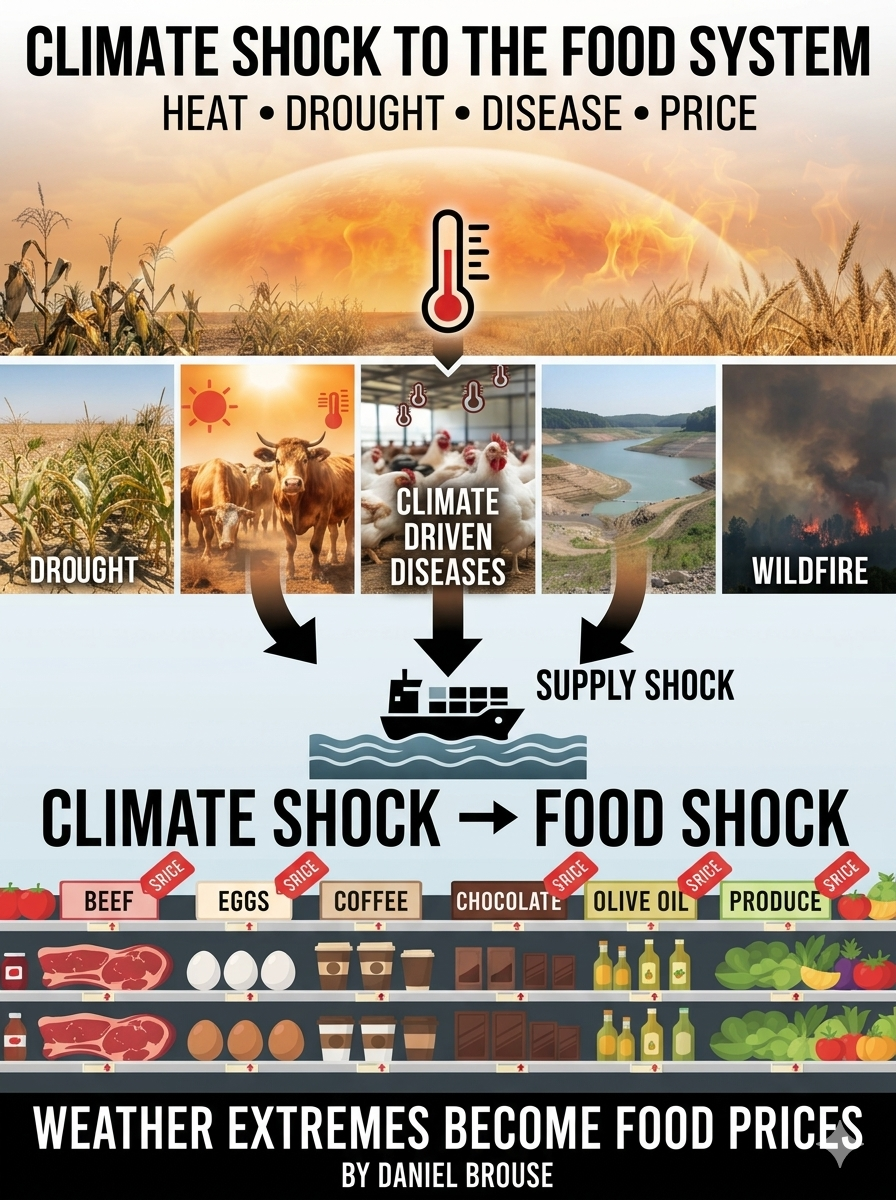
by Daniel Brouse
How Extreme Heat, Drought, Disease, and Global Supply Disruptions Are Reshaping Agriculture and Raising Food Prices
Introduction
Climate change is increasingly affecting agriculture through multiple, interconnected pathways. Extreme heat, prolonged drought, erratic rainfall, declining water availability, wildfire, shifting pest and disease pressures, and disruptions to livestock production are converging to create a more volatile global food system.
The consequences extend far beyond individual farms. When climate extremes reduce harvests or livestock productivity, they can simultaneously tighten global supplies, increase production costs, disrupt international trade, and raise food prices for consumers.
The result is a climate-driven agricultural feedback loop:
Extreme Weather → Lower Production → Tighter Supply → Higher Costs → Higher Food Prices
And because modern food systems are globally interconnected, a crop failure thousands of miles away can eventually appear as a higher price on an American grocery shelf.
1. The Agricultural Climate Shock
Severe droughts, extreme heatwaves, and increasingly erratic rainfall are placing growing pressure on agricultural production.
Major agricultural regions across Europe and North America have experienced significant crop stress from rapid soil drying, water restrictions, excessive heat, and premature crop maturation. In some regions and individual crops, harvest losses have reached extraordinary levels.
Severe Drought and Heat
Intense summer heat can:
- Dry out topsoil before crops reach maturity
- Reduce corn, wheat, soybean, and vegetable yields
- Accelerate crop maturation before plants reach their full potential
- Increase irrigation requirements
- Reduce pasture productivity
- Increase livestock heat stress
When extreme heat arrives during critical stages such as flowering, pollination, or grain filling, even short-lived temperature spikes can produce disproportionately large losses.
Water Shortages
Agriculture is increasingly competing with municipal, industrial, ecological, and energy demands for limited water supplies.
Low river levels, depleted reservoirs, declining groundwater, and prolonged drought have forced irrigation restrictions in portions of Europe and the United States.
Water scarcity creates a second-order effect: farmers may not simply harvest less. They may also reduce the acreage they plant in the first place.
Livestock Stress
Extreme heat is equally damaging to animal agriculture.
Heat-stressed cattle and other livestock often eat less, gain weight more slowly, reproduce less efficiently, and become more vulnerable to illness. Dairy cattle can experience substantial reductions in milk production during periods of severe heat.
Pests, Weeds, and Plant Disease
Climate disruption is also changing the biological environment in which crops grow.
Warmer temperatures can expand the geographic range and seasonal activity of some insects, while altered precipitation can create conditions favorable to weeds and plant pathogens.
The emerging pattern can be summarized as:
“Wetter wets. Drier dries. Greater volatility.”
The agricultural problem is not simply that the planet is becoming warmer. It is that weather conditions are becoming increasingly difficult to manage.
2. The Economic Shock
Agricultural losses propagate rapidly through the economy.
Financial Pressure on Farmers
When yields decline, farmers receive less revenue per acre while many costs remain fixed or increase.
At the same time, drought and heat can require:
- Additional irrigation
- More expensive feed
- Higher fuel consumption
- Additional pest and disease management
- Greater fertilizer expenditures
- Emergency infrastructure repairs
This creates a dangerous combination:
Lower Output + Higher Costs = Collapsing Margins
Higher Food Prices
When production falls faster than demand, commodity prices rise.
The effect can move through the food system in stages:
Crop Failure → Commodity Shortage → Higher Wholesale Prices → Higher Processing Costs → Higher Retail Prices
Consumers therefore experience climate disruption indirectly, even when no climate disaster occurs anywhere near them.
3. The U.S. Protein Crisis
American protein production faces two distinct climate-related pressures:
Direct climate stress on livestock
and
Climate-sensitive disease pressures affecting poultry.
Together, these pressures can reduce domestic production while increasing costs for beef, poultry, eggs, and dairy.
4. Beef and Cattle: Heat, Drought, Fire, and Herd Contraction
The U.S. cattle industry has experienced a historically small cattle inventory after years of drought, elevated feed costs, and herd liquidation.
Extreme Heat
Prolonged triple-digit temperatures across portions of the Plains and Midwest can cause severe cattle heat stress.
Heat-stressed cattle consume less feed, gain weight more slowly, and can experience reduced reproductive performance.
The effects become particularly serious when extreme heat coincides with drought and poor pasture conditions.
Drought and Forage Destruction
Drought reduces the availability of grass, hay, alfalfa, and other livestock feed.
Wildfires can compound the problem by destroying grazing land, fencing, water infrastructure, barns, and other ranch assets.
Smoke exposure can also create respiratory stress for animals.
Feed Scarcity
When drought reduces forage production, ranchers may have to purchase expensive supplemental feed.
That creates an economic dilemma:
Buy Expensive Feed → Absorb Large Losses
or
Sell Breeding Animals → Shrink the Herd
Large-scale liquidation can temporarily increase beef supplies but ultimately reduces the nation’s productive cattle base.
The long-term consequence is a tighter supply of beef and greater vulnerability to subsequent climate shocks.
5. Poultry and Eggs: H5N1 and Climate-Sensitive Disease Risk
The poultry industry has faced an extraordinary challenge from Highly Pathogenic Avian Influenza (H5N1).
Millions of domestic birds have been lost through infection and mandatory depopulation measures designed to prevent further transmission.
Climate change should not be treated as the sole cause of the outbreak. However, climate-driven changes in temperature, precipitation, migration timing, habitat, and wildlife distribution can alter the ecological conditions under which infectious diseases circulate.
Changing Wild-Bird Migration
Wild waterfowl are important reservoirs and carriers of avian influenza viruses.
Changes in climate and weather can affect:
- Migration timing
- Migration routes
- Stopover locations
- Habitat availability
- Population concentration
These changes can alter opportunities for viruses to move between wild birds and commercial poultry.
Extreme Weather and Disease Transmission
Highly variable weather can also change where and when migrating birds congregate.
That can create new opportunities for pathogen transmission and increase biosecurity challenges for poultry producers.
The Depopulation Problem
H5N1 can be devastating to commercial poultry operations.
When infection is detected, strict disease-control protocols can require entire flocks to be destroyed to prevent further spread.
For producers, this creates a severe economic shock:
Infection → Flock Depopulation → Lost Production → Reduced Supply → Higher Prices
The impact is especially severe for smaller producers with limited financial reserves.
Cross-Species Transmission
The emergence of H5N1 infections in additional mammalian species, including dairy cattle, has demonstrated the capacity of the virus to move beyond traditional avian hosts.
That creates a more complicated agricultural disease environment and increases the importance of surveillance, biosecurity, and rapid containment.
6. The U.S. Breadbasket Under Pressure
The United States is one of the world’s most important agricultural producers, but American agriculture is not insulated from climate disruption.
Midwest Yield Pressure
Extreme heat and drought can reduce yields of rain-fed corn and soybeans.
Higher atmospheric carbon dioxide can provide some benefits to certain crops under some conditions, but those benefits can be overwhelmed when heat, water stress, nutrient limitations, and other environmental pressures become sufficiently severe.
The critical issue is therefore not simply:
“More CO₂ = More Growth.”
It is:
CO₂ Benefit − Heat Stress − Water Stress − Other Constraints = Actual Yield
When environmental constraints become severe, theoretical fertilization benefits may provide little protection against major crop losses.
Western Water Crisis
The American West faces a particularly difficult agricultural challenge.
Persistent drought, declining reservoir levels, groundwater depletion, and competing demands for water have forced reductions in irrigation and planted acreage in some agricultural regions.
California’s Central Valley illustrates the problem.
Reduced water availability can threaten the production of fruits, nuts, vegetables, and other high-value crops that depend heavily on irrigation.
Livestock and Dairy
Heat stress also affects cattle and dairy production.
Extreme temperatures can reduce feed intake, fertility, growth rates, and milk production.
The resulting loss is both biological and economic.
7. Climateflation: When Global Weather Hits the American Grocery Store
The climate vulnerability of American food prices does not stop at the nation’s borders.
The United States depends heavily on imports for many commodities, including coffee, cocoa, tropical produce, olive oil, sugar, wine, and other agricultural products.
Consequently, extreme weather overseas can become inflation at home.
This phenomenon can be described as climateflation:
Climate Shock Abroad → Global Supply Reduction → Higher Commodity Prices → Higher U.S. Import Costs → Higher Retail Prices
8. Cocoa and Chocolate
The Climate Shock
A large share of global cocoa production is concentrated in West Africa, particularly Côte d’Ivoire and Ghana.
Changing rainfall patterns, extreme precipitation, heat, and plant disease can simultaneously threaten production.
Black pod disease and other pathogens can become particularly damaging when environmental conditions favor their spread.
The U.S. Impact
When cocoa supplies tighten, American manufacturers face higher input costs.
The consequences can include:
- Higher chocolate prices
- Smaller package sizes
- Recipe reformulation
- Substitution of some expensive ingredients
- Reduced product margins
The consumer may therefore experience climate disruption not as a failed harvest in West Africa, but as a smaller chocolate bar costing more money.
9. Olive Oil
The Climate Shock
Mediterranean agriculture is particularly exposed to heat and drought.
Spain, Italy, and Greece—major olive-producing regions—have experienced severe weather conditions capable of damaging flowering, fruit development, and harvests.
Repeated poor harvests can create persistent supply shortages.
The U.S. Impact
Because the United States imports most of its olive oil, reduced European production can rapidly affect American prices.
A climate-driven decline in Mediterranean production therefore becomes an American grocery-store problem.
10. Coffee
Coffee is another highly climate-sensitive commodity.
Brazil and Vietnam are among the world’s largest coffee producers, making weather conditions in those countries important to global supply.
Heat, drought, excessive rainfall, and shifting disease pressures can damage coffee production and affect both Arabica and Robusta supplies.
The result can be a chain reaction:
Extreme Weather → Lower Coffee Yield → Global Supply Tightening → Higher Wholesale Prices → Higher Retail Prices
For American consumers, the climate signal may ultimately appear as a more expensive cup of coffee.
11. Sugar
Global sugar production is also vulnerable to weather extremes.
Drought, irregular monsoons, heat, and El Niño-related precipitation changes can reduce sugarcane production in major producing countries such as India and Thailand, as well as in parts of Central and South America.
Because the United States operates under a managed sugar import system, global shortages can translate into higher costs for American food manufacturers.
Those costs can eventually appear in:
- Candy
- Baked goods
- Soft drinks
- Processed foods
12. Fruits and Vegetables
The United States imports substantial quantities of fresh produce from Mexico, Central America, and South America, particularly during the winter months.
Extreme heat, drought, flooding, and severe storms in producing regions can produce localized crop failures.
When supply contracts, U.S. consumers can experience sharp price volatility in commodities such as:
- Avocados
- Limes
- Tomatoes
- Berries
- Other fresh produce
The grocery store therefore functions as the final link in a global climate-sensitive supply chain.
13. Wine and Spirits
Climate disruption is also reshaping beverage agriculture.
Traditional wine-producing regions in France, Italy, and Spain face combinations of:
- Extreme heat
- Drought
- Late-season frost
- Wildfire
- Altered precipitation
Mexico’s blue-agave production is similarly exposed to changing rainfall and temperature patterns.
When harvests decline, producers and distributors may have to seek alternative sources, accept higher input costs, or pass those costs on to consumers.
14. The Hidden Vulnerability: Global Food Interdependence
The greatest danger may not be any single crop failure.
It is the coupling of multiple failures.
A drought in the American Midwest can affect corn and soybean production.
A heatwave in Europe can reduce wheat or vegetable output.
Drought in Brazil can affect coffee.
Heat and disease can damage cocoa production in West Africa.
Mediterranean drought can reduce olive oil.
Disease outbreaks can devastate poultry.
When these disruptions occur independently, markets can sometimes compensate.
But when several occur simultaneously, the world’s food system has fewer buffers.
This produces a potentially dangerous nonlinear effect:
One Climate Shock → Manageable
Multiple Simultaneous Shocks → Systemic Stress
15. The Agricultural Feedback Loop
Climate change therefore creates more than isolated agricultural disasters.
It creates interacting feedbacks.
Climate → Agriculture
Heat + Drought + Flooding + Fire + Disease
↓
Lower Crop and Livestock Productivity
↓
Reduced Food Supply
↓
Higher Commodity Prices
↓
Higher Production Costs
↓
Higher Food Prices
↓
Economic Stress
At the same time, declining agricultural productivity can increase pressure to expand production into marginal lands, intensify irrigation, increase fertilizer use, or otherwise compensate for declining yields.
The result is a system under increasing stress from multiple directions.
Conclusion: From Weather Extremes to Food-System Instability
Climate change is increasingly becoming an agricultural problem, an economic problem, and a food-security problem simultaneously.
The threat does not depend on a single catastrophic harvest failure.
The greater danger lies in the simultaneous accumulation of smaller disruptions across interconnected agricultural systems.
Extreme heat stresses crops and livestock.
Drought reduces water and forage.
Wildfire destroys pasture and infrastructure.
Disease attacks crops and animals.
Changing ecological conditions can alter pest and pathogen pressures.
International trade then transmits these disruptions across borders.
The American consumer may ultimately experience the result as a higher price for beef, eggs, coffee, chocolate, olive oil, produce, wine, or everyday processed foods.
The emerging pattern is therefore clear:
Climate Change
↓
More Extreme and Erratic Weather
↓
Agricultural Stress
↓
Lower and More Volatile Production
↓
Tighter Global Food Supplies
↓
Higher Production and Transportation Costs
↓
Food Inflation
↓
Greater Economic and Social Vulnerability
The food system is not a collection of isolated farms.
It is a globally interconnected network.
And as climate extremes intensify, the vulnerability of that network increasingly depends not only on how much food the world can produce—but on whether multiple agricultural shocks arrive at the same time.
That is where climate risk can transform from a collection of local disasters into a systemic food-security problem.