Known Ozone: The Climate Change Agent That Damages the Carbon Sink
By Daniel Brouse
Ozone is a powerful greenhouse gas.
Ozone (O₃) is one of the most important individual greenhouse gases contributing to global warming, ranking behind carbon dioxide (CO₂) and methane (CH₄) in terms of its direct contribution to human-caused warming.
But ozone does something most greenhouse gases don’t: it also damages the plants that remove CO₂ from the atmosphere.
Ozone is a powerful phytotoxin—it harms plants. That creates an important climate feedback: the same ozone pollution that contributes directly to warming can damage vegetation, reduce photosynthesis, weaken carbon sequestration, and leave more CO₂ in the atmosphere.
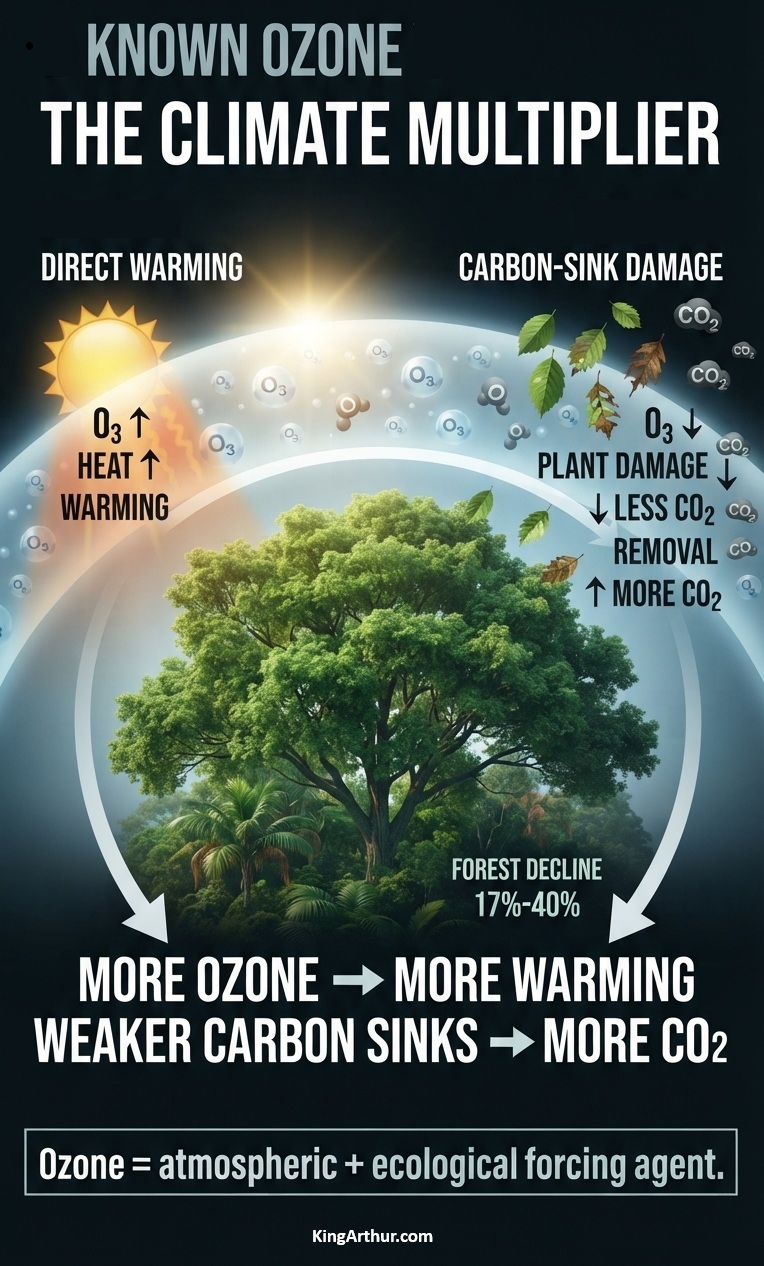
Ozone is therefore both an atmospheric forcing agent and an ecological forcing agent.
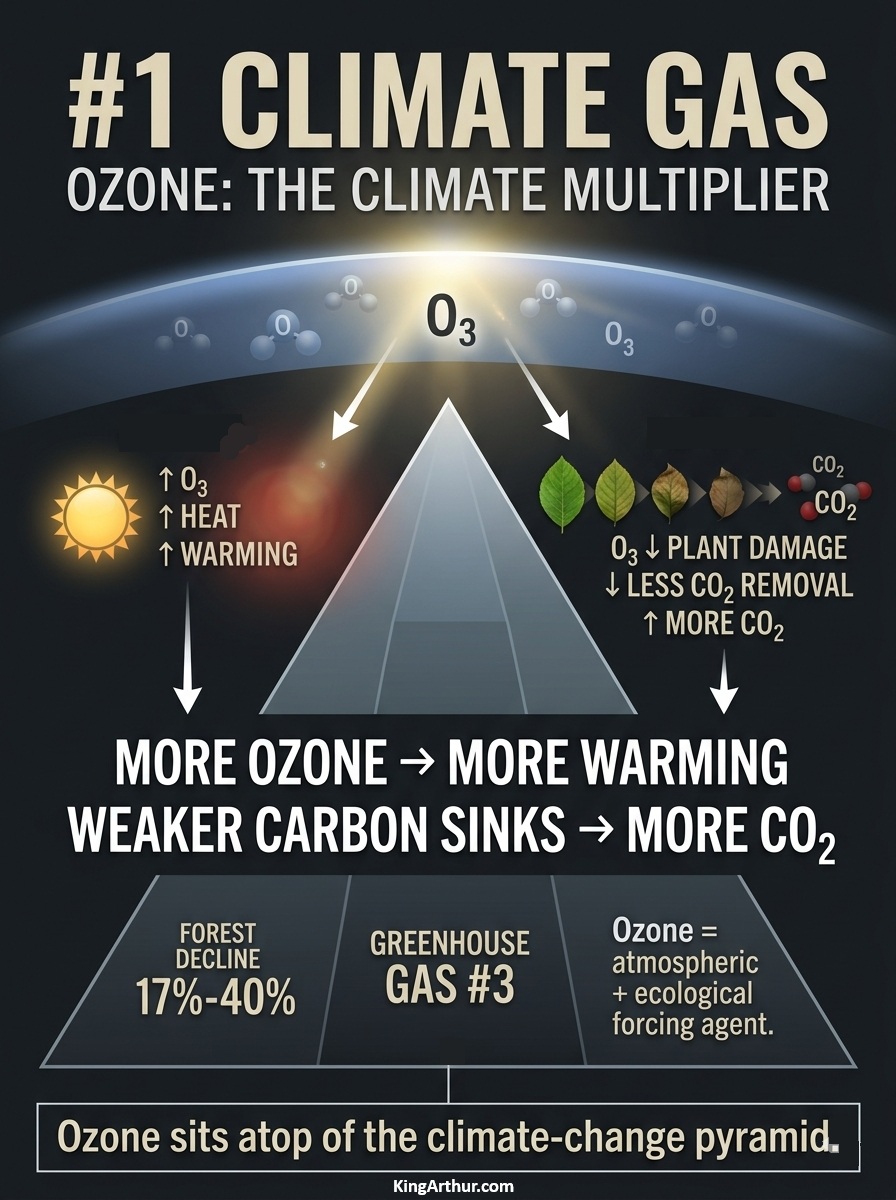
More ozone → more warming
and
More ozone → weaker carbon sinks → more CO₂ → more warming
That second pathway is the part of the ozone story that is often overlooked.
Ozone Damages Tropical Forests
A study published in Nature Geoscience, “Reduced productivity and carbon drawdown of tropical forests from ground-level ozone exposure,” found substantial reductions in tropical forest productivity associated with anthropogenic ground-level ozone exposure.
The study estimated that anthropogenic ozone pollution reduced tropical forest net primary productivity by approximately 17% globally since 2000.
That is a major climate consequence. Tropical forests are among Earth’s most important biological carbon sinks. When ozone reduces their productivity, their capacity to remove carbon from the atmosphere is reduced. Ozone has also been identified as one of the stressors contributing to the risk of Amazon forest dieback, alongside warming, drought, fire, and other interacting pressures.
The message is simple:
Ozone doesn’t just warm the planet. It can damage one of the planet’s major systems for removing CO₂.
Pennsylvania Forests Show the Warning Signs
Long-term observations of mature forests in Pennsylvania provide evidence of serious changes in forest health that warrant examination in the context of ozone exposure, climate stress, and carbon sequestration.
Since approximately 2003, observations across multiple monitoring intervals have reported substantial changes in some old-growth forest systems, including:
- Approximately 40% foliage loss
- Significant canopy thinning
- Approximately 33% reductions in canopy height
- Increased premature mortality
These changes cannot automatically be attributed to ozone alone. Forest decline is produced by interacting stresses, including ozone, heat, drought, hydrological disruption, insects, disease, and extreme weather. But that does not make ozone less important. It makes the interaction more important.
When multiple environmental stresses strike the same forest, ozone can become another force reducing the ability of vegetation to grow, survive, and store carbon.
The Ozone Multiplier
Ozone is therefore more than another greenhouse gas.
It can operate simultaneously through two pathways:
Atmospheric pathway
Ozone → greenhouse warming → more climate stress
Biological pathway
Ozone → plant damage → less photosynthesis → weaker carbon sinks → more atmospheric CO₂ → more warming
Put the two pathways together and ozone becomes a powerful climate multiplier.
The atmosphere warms the biosphere.
The biosphere normally removes CO₂ from the atmosphere.
Ozone interferes with that exchange.
Known Ozone
Ozone’s direct greenhouse effect is well established. Its ability to damage vegetation is also well established. The climate significance comes from putting those two facts together.
Ozone warms the planet.
Ozone damages plants.
Damaged plants remove less carbon.
Less carbon removal leaves more CO₂ in the atmosphere.
More CO₂ means more warming.
That makes ozone more than an air-pollution problem.
It makes ozone part of the climate feedback system itself.
And when the direct warming effect and the carbon-sink effect are considered together, ozone sits atop of the climate-change pyramid.
Known ozone.
Known warming.
Known plant damage.
Known powerful feedback.
Introduction to Ozone and Climate Change
Lightning-Generated Tropospheric Ozone and Earth-System Feedbacks
Ozone as a Climate Multiplier: Key Coupling Agent in Chemistry–Climate Feedbacks
The Domino Collapse: Amazon Rainforest Dieback and the Ozone Feedback Loop
The Dangers of Tropospheric Ozone: A Silent Threat to Health and the Environment