by Daniel Brouse
Super Typhoon Champi: Nonlinear Acceleration and the Growing Power of Earth’s Climate System
Overview
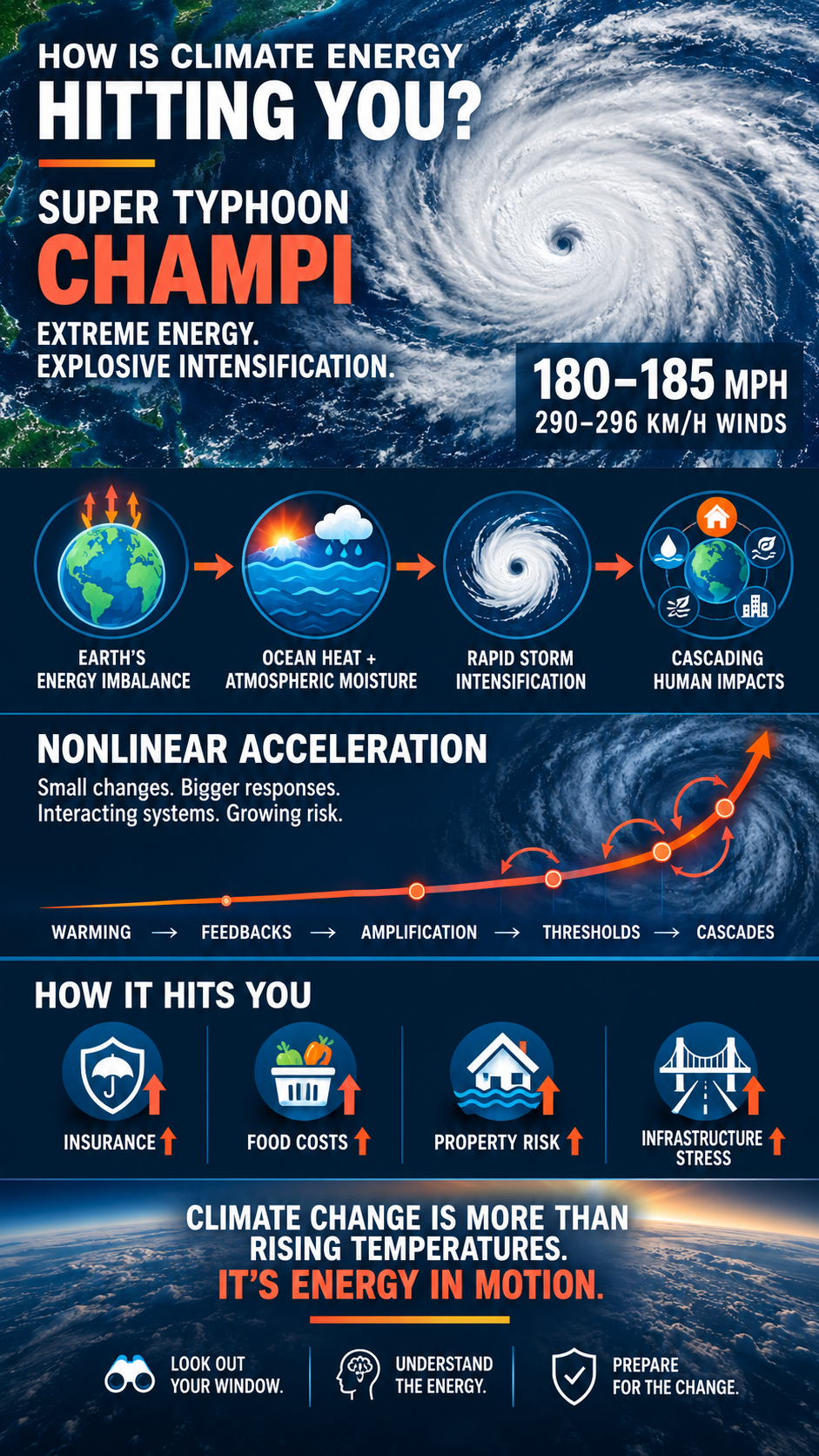
HOW IS CLIMATE ENERGY HITTING YOU? 🌎🌀
SUPER TYPHOON CHAMPI: EXTREME ENERGY. EXPLOSIVE INTENSIFICATION.
Super Typhoon Champi has rapidly intensified, packing maximum sustained winds of 180–185 mph (290–296 km/h).
Earth’s climate system is accumulating excess energy and redistributing it through the oceans, atmosphere, and ecosystems. The change is occurring so fast that measuring the full extent of the energy imbalance and its accelerating consequences is a growing scientific challenge.
🌊 OCEAN HEAT — Earth’s oceans absorb most of the excess heat accumulating in the climate system.
🌀 RAPID INTENSIFICATION — Ocean heat and atmospheric moisture fuel powerful tropical cyclones under favorable conditions.
⚡ NONLINEAR ACCELERATION — Feedbacks interact, changes amplify, thresholds are approached, and consequences cascade through interconnected systems.
🏠 HOW IT HITS YOU — Insurance costs. Food prices. Property risks. Infrastructure damage. Household affordability.
The Nonlinear Acceleration Hypothesis calls for looking beyond average temperatures to examine the speed of change, the interactions among climate processes, and the consequences of Earth’s growing energy imbalance.
This is not simply about a warmer planet. It is about a climate system changing at a rate that challenges our ability to measure, understand, and respond to its full consequences.
THE BOTTOM LINE:
CLIMATE CHANGE IS MORE THAN RISING TEMPERATURES.
IT’S ENERGY IN MOTION.
LOOK OUT YOUR WINDOW.
UNDERSTAND THE ENERGY.
PREPARE FOR THE CHANGE.
#ClimateChange #SuperTyphoonChampi #ClimateScience #NonlinearAcceleration #IntegratedClimateStewardship
1. When Climate Energy Becomes Impossible to Ignore
Climate energy is intensifying so rapidly that we are having trouble measuring the full extent of Earth’s extreme energy imbalance and its consequences.
Super Typhoon Champi has rapidly intensified into a monster Category 5-equivalent storm, packing maximum sustained winds of 180–185 mph (290–296 km/h). This explosive growth makes Champi the strongest tropical cyclone on Earth in 2026 by wind speed, tying or surpassing Super Typhoon Sinlaku. The Weather Network reported peak winds of 296 km/h on October 20, 2026.
Champi is more than an extraordinary weather event. It is a powerful reminder that Earth’s climate system operates through the movement, storage, and redistribution of energy. The atmosphere and oceans are not simply warming uniformly. They are interacting, transferring energy, and producing changes that can develop rapidly when environmental conditions align.
The central question is no longer merely whether the climate is changing. It is how the energy driving that change is affecting the world around us—and how quickly the consequences are emerging.
2. Earth’s Energy Imbalance: The Fuel Behind the Changes
Earth receives energy from the Sun and releases energy back into space. Greenhouse gases reduce the rate at which some of that outgoing energy escapes, creating an energy imbalance. More energy enters the climate system than leaves it.
The oceans absorb the overwhelming majority of the excess heat accumulating in the climate system. The atmosphere, land, and cryosphere also respond, but the ocean is the principal reservoir of this additional energy.
That distinction matters because ocean heat is not merely a measure of warmer water. It represents energy available to influence the entire climate system.
Warm ocean water can supply tropical cyclones with heat and moisture. Higher atmospheric temperatures allow air to hold more water vapor, increasing the potential for intense rainfall. Rising sea levels increase the baseline upon which storm surges act. Changes in sea ice, snow cover, clouds, and atmospheric circulation can further redistribute energy and alter regional conditions.
These processes do not operate independently. Their interactions can amplify or moderate particular outcomes, depending on the conditions.
The result is a climate system in which a relatively gradual global change can produce abrupt, highly localized consequences.
3. The Nonlinear Acceleration Hypothesis
The Nonlinear Acceleration Hypothesis provides a framework for understanding why climate change cannot be evaluated solely by looking at average temperatures or the rate of warming.
In a linear system, a change in the driving force produces a proportional response. In a nonlinear system, the response can become disproportionately large as feedbacks interact, thresholds are approached, and previously limited processes become more influential.
Consider a sequence of interacting processes:
- Warming: Greenhouse gas emissions increase Earth’s energy imbalance.
- Feedback activation: Changes in water vapor, clouds, ice, ecosystems, and ocean circulation alter the system’s response.
- Coupling: Multiple processes begin influencing one another rather than operating independently.
- Amplification: Some interactions reinforce the original change.
- Thresholds: Certain components undergo rapid transitions when critical conditions are crossed.
- Cascades: Changes in one component affect other components, potentially producing additional and increasingly widespread consequences.
The central concern is that the combined response of a complex system may become more difficult to anticipate as its components interact.
4. Champi: A Visible Example of Rapid Intensification
Tropical cyclones offer a dramatic illustration of nonlinear behavior.
A developing storm can intensify gradually and then strengthen much more rapidly when several environmental conditions become favorable. These include warm ocean water, sufficient moisture, relatively low vertical wind shear, and a storm structure that allows heat released through condensation to reinforce its circulation.
As the storm strengthens, its circulation can become more organized, allowing additional heat and moisture to contribute to its development. Under favorable conditions, the result can be explosive intensification.
Champi’s exceptional wind speeds illustrate the potential consequences of this process. Its rapid development also highlights the importance of monitoring changes in storm intensity, rather than relying exclusively on a storm’s earlier classification.
A 2022 study published in Nature Communications found evidence of increasing tropical-cyclone intensification rates in multiple basins, with anthropogenic forcing contributing to the observed changes. The authors also identified increasingly favorable thermodynamic conditions around tropical cyclones.
Separately, NOAA’s Geophysical Fluid Dynamics Laboratory concludes that human-caused ocean warming is likely contributing to more powerful tropical cyclones, while increased atmospheric moisture raises the potential for heavier rainfall.
5. From Ocean Heat to Extreme Weather
How does energy accumulated over decades translate into the weather experienced by people today?
The answer lies in the movement of energy through the coupled ocean-atmosphere system.
Ocean heat: Warmer surface waters and elevated heat content beneath the surface can provide favorable conditions for tropical-cyclone intensification. Subsurface heat matters because strong storms mix ocean water and can bring cooler water toward the surface. A sufficiently deep reservoir of warm water can limit this cooling effect.
Atmospheric moisture: Warmer air can hold more water vapor. When that moisture condenses in a storm, latent heat is released, helping sustain the storm’s circulation. Heavy rainfall can also cause destructive flooding far from the strongest winds.
Sea-level rise: Rising seas elevate the starting point for storm surge. The same storm can therefore produce more damaging coastal flooding than it would under a lower sea-level baseline.
Ice and reflectivity: Declining snow and ice cover can expose darker surfaces that absorb more sunlight. This is an amplifying feedback, although its effects vary by region and season.
Clouds and circulation: Clouds influence how much incoming sunlight is reflected and how much outgoing heat is retained. Their net climate effect depends on cloud type, altitude, location, and other properties. Changes in atmospheric circulation can also redistribute heat and moisture, altering regional extremes.
6. The Domino Effect: When Interactions Matter More Than Individual Changes
The Nonlinear Acceleration Hypothesis becomes particularly important when climate processes are considered as an interconnected system.
A change in one component can affect another. That second change can then influence the first component or activate additional processes.
For example, warming can reduce sea ice, exposing darker ocean water. The resulting increase in absorbed solar energy can contribute to further warming. Meanwhile, additional ocean heat can affect marine ecosystems, ice shelves, and regional weather patterns.
The same systems perspective applies to extreme weather. A storm can produce heavy rainfall, flooding, infrastructure damage, and prolonged disruption. Those impacts can cascade through transportation, electricity, water supplies, insurance markets, food distribution, and household finances.
Not every chain reaction is a self-reinforcing climate feedback. Some are physical feedbacks within the Earth system; others are consequences that propagate through ecological, social, and economic networks.
Both matter when assessing the full impact of climate change.
The important question is not simply how much one variable has changed. It is how changes interact, whether they reinforce one another, and whether the combined effects exceed the capacity of natural or human systems to adapt.
7. How Is Climate Energy Hitting You?
Champi may be developing far from your home, but the consequences of a changing climate do not stop at the storm’s path.
Climate-related risks reach households through several interconnected channels:
- Insurance: Increasing disaster losses can contribute to higher premiums, larger deductibles, narrower coverage, or reduced availability of insurance in high-risk areas.
- Housing: Flooding, wind damage, and repeated repairs can threaten property values and increase maintenance costs.
- Food and water: Heat, drought, flooding, and disrupted transportation can affect agricultural production, food prices, and water supplies.
- Electricity: Extreme temperatures increase heating or cooling demands, while storms can interrupt power and damage infrastructure.
- Public finances: Disaster response, infrastructure repair, and recovery compete with other public priorities.
- Health and safety: Heat exposure, flooding, contaminated water, and storm-related injuries can impose immediate and lasting costs.
These effects do not all occur at the same rate or in every location. Local exposure, building standards, infrastructure, preparedness, and financial resources make a substantial difference.
Nevertheless, the underlying economic principle is straightforward: climate risks can impose costs even on people who never experience a direct hit from a major storm.
The cost of climate change is therefore not limited to disaster declarations and damaged buildings. It can also appear in insurance renewals, utility bills, food purchases, property assessments, and the long-term affordability of housing.
8. Measuring Acceleration Rather Than Looking Only at Averages
Average global temperature remains an essential climate indicator, but it cannot describe every dimension of the changing climate system.
A complete assessment should examine multiple indicators, including:
- Ocean heat content and the rate at which it is increasing.
- Earth’s energy imbalance.
- Sea-surface temperatures and marine heatwaves.
- Sea-level rise and changes in ice mass.
- The frequency and intensity of extreme heat and heavy precipitation.
- Tropical-cyclone intensity, rapid intensification, and rainfall.
- Changes in cloud properties, surface reflectivity, and ecosystem carbon uptake.
The distinction between a level and a rate of change is crucial. Temperature describes a state; the rate of temperature change describes how quickly that state is changing. Acceleration describes how the rate itself changes over time.
For a variable (X), the rate of change is represented by (dX/dt), while acceleration is represented by (d^2X/dt^2). A further change in acceleration can be described by the third derivative, (d^3X/dt^3).
These mathematical measures are useful only when applied to well-defined variables and sufficiently reliable data. Short-term fluctuations, measurement uncertainty, and natural variability can make apparent acceleration difficult to distinguish from persistent trends. Multiple indicators and appropriate statistical methods are therefore necessary.
The goal is not to assume that every climate indicator is accelerating. It is to determine which processes are changing, how their rates are evolving, and whether their interactions are increasing the risk of abrupt or disproportionate impacts.
9. Preparedness and Integrated Climate Stewardship
Understanding climate energy is useful only if it improves decisions.
Preparedness begins with recognizing that extreme events can intensify, compound, and disrupt interconnected systems. Governments need effective forecasting, evacuation plans, resilient infrastructure, and reliable emergency communications. Communities need to understand their flood, wind, heat, and infrastructure risks. Households need practical ways to reduce exposure and protect essential resources.
Integrated Climate Stewardship extends that approach into everyday life through two complementary principles: reduce the resources and emissions associated with household living, and increase beneficial contributions to the environment and community.
The objective is not to depend on a single technology or promise that individual actions can eliminate global climate risk. It is to combine practical reductions in energy and resource consumption with resilience, ecological stewardship, and informed economic decisions.
At the community level, investments in safer buildings, drainage, emergency preparedness, and resilient infrastructure can reduce avoidable losses. At the policy level, emissions reductions address the underlying driver of long-term warming, while adaptation helps communities manage risks that are already present or unavoidable.
Both are necessary. Preparing for climate impacts without reducing greenhouse gas emissions leaves the underlying problem growing. Reducing emissions without preparing for existing risks leaves communities exposed to harm.
10. The Bottom Line: Watch the Energy, Understand the Acceleration
Super Typhoon Champi provides a striking example of the power a tropical cyclone can attain under favorable environmental conditions. Its exceptional intensity deserves attention in its own right, while its relationship to climate change must be evaluated through the evidence.
The broader climate challenge is larger than any single storm.
Earth’s energy imbalance is changing the conditions under which weather, ecosystems, and human communities operate. Feedbacks and interactions can amplify some effects, while thresholds and cascading consequences can make the resulting impacts difficult to anticipate.
The Nonlinear Acceleration Hypothesis asks us to look beyond the current state of the climate and investigate how quickly it is changing, whether that rate is accelerating, and how the system’s components influence one another.
The practical question remains the one at the heart of this series:
How is climate energy hitting you?
Look beyond the headlines. Examine the energy, the trends, the interactions, and the consequences in your own community. Understand the risks before they become emergencies. Reduce avoidable vulnerability. And recognize that the climate system is interconnected with the economic, ecological, and social systems on which we all depend.
Climate change is not just a number on a thermometer. It is a changing distribution of energy, a changing set of risks, and a growing challenge for the systems that sustain everyday life.