by Daniel Brouse
Kyrgyzstan Says, “You Cursed Brat. I’m Melting.”
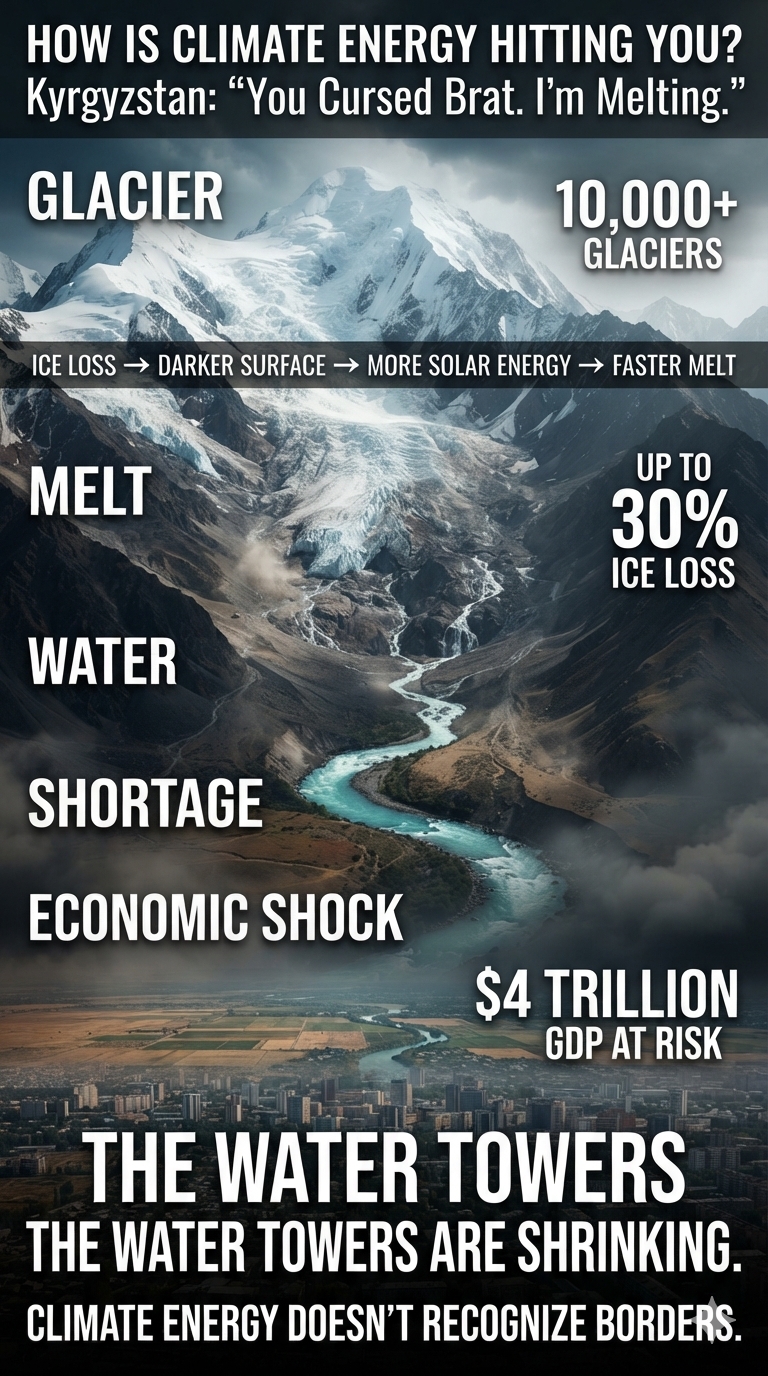
Kyrgyzstan is home to more than 10,000 glaciers covering roughly 4% to 5% of the country’s total land area. Situated primarily within the colossal Tien Shan and Pamir-Alay mountain ranges, these massive stores of ice contain an estimated 590 cubic kilometers of freshwater.
They are the primary “water towers” of Central Asia, feeding major transboundary river systems such as the Naryn and Syr Darya. These rivers provide vital water and electricity to millions of people across Kyrgyzstan, Uzbekistan, Kazakhstan, and Tajikistan.
Now those water towers are rapidly shrinking.
Rapid Climate Retreat
Like neighboring Kazakhstan, Kyrgyzstan’s glaciers are facing a severe climate crisis.
Massive Ice Loss
Scientific models indicate that Kyrgyzstan has lost up to 30% of its glacial volume over the last several decades as rising global temperatures accelerate glacier melt.
Outflow Shifts
Accelerated melting initially increases river flows as more ice is converted into water. But scientists warn of a looming “peak water” tipping point—the point at which glacier loss becomes so extensive that meltwater production reaches its maximum and then begins to permanently decline.
In other words, the very process that temporarily increases water supplies eventually destroys the frozen reservoirs that provide them.
Glacial Lake Outburst Floods
Rapid glacier retreat is also creating hundreds of unstable alpine lakes.
Lakes such as Merzbacher Lake—a famous disappearing lake associated with the Inylchek Glacier—can suddenly drain, producing dangerous glacial lake outburst floods (GLOFs). These events can threaten downstream communities and require advanced monitoring and early-warning systems to reduce the risk to human life and infrastructure.
But the consequences of Kyrgyzstan’s shrinking glaciers do not stop at its borders.
What may appear to be a local cryosphere crisis ripples outward through Central Asia and ultimately into the global climate and economic systems—affecting international supply chains, global economic stability, and contributing to rising sea levels.
1. Contribution to Sea-Level Rise
Mountain glaciers, including those throughout the Tien Shan range, are currently among the largest contributors to global sea-level rise, trailing only ocean thermal expansion as a source of additional ocean volume.
Collectively, mountain glaciers can contribute more to annual sea-level rise than either Greenland or Antarctica individually.
The Global Aggregate
Glaciers worldwide are losing an average of approximately 273 billion tonnes of ice every year.
That is equivalent to roughly 0.75 millimeters of global sea-level rise annually.
And the rate of loss is accelerating.
Kyrgyzstan’s Share
Kyrgyzstan has lost approximately 17% of its total glacier area since 2000.
The water released from its thousands of glaciers enters transboundary river systems and eventually becomes part of the global hydrological cycle. Water that was once locked away as mountain ice is being transferred into liquid water, ultimately contributing to the redistribution of freshwater and, where it reaches the oceans, global sea-level rise.
A glacier melting in Central Asia may seem impossibly far away from a coastal city.
It isn’t.
Climate energy doesn’t recognize national borders.
2. Major Climate Tipping Points
Scientists warn that High Mountain Asia is entering a period of increasingly abrupt cryospheric change.
The region faces multiple interacting tipping points and feedback mechanisms.
The Loss of the “Pamir-Karakoram Anomaly”
For decades, certain glaciers in Central Asia appeared to defy the broader global warming trend by remaining relatively stable or even growing.
This regional behavior became known as the Pamir-Karakoram anomaly. But that resilience is breaking down. Recent observations indicate that some of the region’s previously stable glaciers have crossed important climatic thresholds and are now experiencing accelerating mass loss. The significance is enormous.
For decades, these glaciers appeared to demonstrate that mountain ice could remain resilient despite a warming climate. Now that resilience is increasingly disappearing.
No mountain ice sheet is immune to systemic warming.
The Albedo Flip and Dust Feedback Loop
As glaciers melt and retreat, they expose darker underlying rock and soil. At the same time, intensifying regional desertification can generate increasingly powerful sand and dust storms. That dust can settle directly onto remaining snow and ice, lowering their albedo—their ability to reflect incoming solar radiation.
Instead of reflecting sunlight back into space, darkened snow and ice absorb more solar energy. That additional energy accelerates melting. The result is a potentially powerful positive feedback:
Glacier loss → darker surface → greater solar absorption → more warming → faster glacier loss.
And dust can make the process even more aggressive.
The ice does not simply respond to warming.
The changing ice surface can help amplify the warming that caused it.
3. “Peak Water” and a $4 Trillion Global Economic Threat
The immediate regional consequence of accelerating glacier melt can be an increase in river runoff. But that increase is temporary.
The looming long-term tipping point is “peak water”—the point at which glacier volume has declined so dramatically that river flows stop increasing and begin permanently declining.
That transition could produce a severe economic domino effect extending far beyond Central Asia.
Agricultural and Supply-Chain Collapses
The Naryn and Syr Darya river systems support enormous agricultural regions across Central Asia. Glacier-fed water contributes to irrigation across Uzbekistan and Kazakhstan, supporting production of cotton, wheat, fruits, and other crops. As glacier reserves shrink and runoff becomes increasingly unreliable, agricultural production faces growing water stress.
The consequences do not necessarily remain local.
Disruptions to agricultural production can propagate through international commodity markets and supply chains, creating volatility in food, fiber, and other products traded around the world.
Hydropower Disruption
Kyrgyzstan also depends heavily on hydropower. As glacier and snowmelt patterns change, the timing and reliability of river flows can change with them. That creates another feedback into the economy:
Shrinking glaciers → changing river flows → hydropower instability → economic stress.
The same glaciers that function as natural water reservoirs also function as natural regulators of water availability.
When those reservoirs shrink, the entire system becomes more vulnerable.
The Global GDP Penalty
According to the United Nations Environment Programme (UNEP), the depletion of glacier-fed freshwater networks could jeopardize an estimated $4 trillion of global GDP.
The threat comes through multiple interconnected pathways:
- crippling agricultural production and international trade;
- disrupting hydropower and other energy production;
- increasing competition for freshwater;
- intensifying migration from newly arid regions; and
- destabilizing economies dependent upon reliable mountain water supplies.
This is the climate domino effect.
A glacier disappears at high altitude. Water availability changes downstream. Agricultural production is disrupted. Energy systems are stressed. Supply chains react. Economic losses spread. And eventually, the consequences can reach countries thousands of miles away.
Climate Energy Hitting Kyrgyzstan
Kyrgyzstan demonstrates why climate change cannot be understood simply by looking at the average global surface temperature.
The real danger lies in what happens when warming activates interconnected feedbacks across the Earth system.
Warming → glacier melt → water-storage loss → peak water → water shortages
Warming → glacier retreat → darker surfaces → greater solar absorption → accelerated melt
Warming → glacier retreat → unstable lakes → catastrophic floods
Warming → water disruption → agriculture and energy stress → economic instability
One change triggers another. Another amplifies the next. And the consequences propagate through increasingly interconnected systems.
Kyrgyzstan’s glaciers are not merely melting. They are releasing climate energy into a cascade of physical, ecological, hydrological, and economic consequences. The mountains are losing their frozen reservoirs. The water towers are shrinking. The feedbacks are activating. And the consequences are spreading downstream.
This is how climate energy hits you.