by Daniel Brouse
Coatesville, PA: Hydroclimatic Whiplash — Dying of Thirst in a Flood
The climate problem can arrive through your water tap.
Pennsylvania American Water issued a mandatory water conservation order on Sunday, September 6, 2026, affecting approximately 23,000 customer connections across the Coatesville water system.
Residents were ordered to reduce water consumption by 10% to 15% and temporarily limit their use of water to essential purposes. The affected system includes Coatesville, Atglen, Parkesburg, South Coatesville and surrounding communities in Chester and Lancaster counties.
At first glance, a mandatory water conservation order sounds like a drought story.
It isn’t.
This is something more revealing:
There was too much water—arriving too quickly—and the water system could not process it normally.
Pennsylvania American Water reported that recent weather-related changes in local water sources increased the amount of treatment required at the plant, placing additional demand on filtration systems and temporarily reducing treatment capacity.
The result is a striking example of hydroclimatic whiplash:
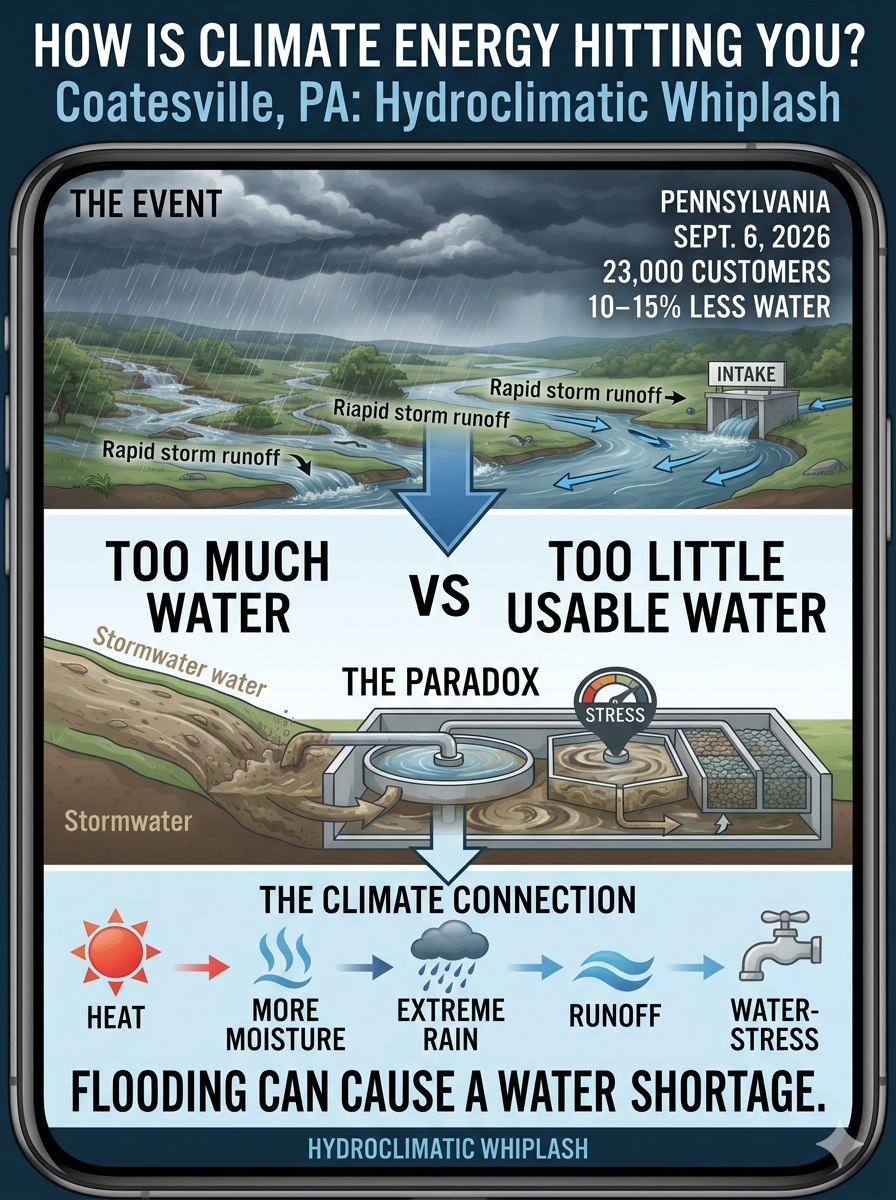
Heavy rainfall → rapid runoff → degraded raw-water quality → increased treatment burden → reduced treatment capacity → mandatory conservation.
In other words:
You can have water everywhere and still have a water shortage.
WHAT IS HYDROCLIMATIC WHIPLASH?
Hydroclimatic whiplash occurs when the hydrologic system swings rapidly between extremes—such as drought and intense rainfall, low flows and flooding, or water scarcity and overwhelming runoff.
The important point is that these extremes do not have to occur months or years apart. The transition itself can become the problem. A landscape stressed by heat and dry conditions can suddenly receive intense rainfall. Instead of that rainfall becoming a stable supply of usable water, much of it can move rapidly across the landscape and into streams. That runoff can carry sediment, organic material and other substances into the water supply.
The result is paradoxical:
The landscape is flooded with water while the community is told to conserve water.
This is not a contradiction in the physics.
It is a consequence of the difference between water being present and water being available as reliable, treated drinking water.
HOW IS CLIMATE ENERGY HITTING YOU?
This is where the Coatesville event becomes more than a local water-system story.
Climate change is fundamentally an energy problem.
A warmer atmosphere and warmer land surface alter evaporation, atmospheric moisture, precipitation intensity and the movement of water through the hydrologic cycle. That additional energy does not simply produce “more rain” or “less rain.” It can produce greater volatility.
Longer dry periods can increase the amount of moisture available to the atmosphere when moisture eventually returns. Heavy precipitation can then arrive in concentrated bursts, producing rapid runoff rather than a gradual recharge of soils, groundwater and reservoirs.
That creates a dangerous sequence:
Heat → drying → atmospheric moisture loading → intense precipitation → runoff → flooding → water-quality disruption.
And then, unexpectedly:
Flooding → water-treatment stress → reduced drinking-water capacity → conservation order.
That is hydroclimatic whiplash.
1. THE FIRST HIT: HEAT AND ATMOSPHERIC ENERGY
The story begins before the rain falls.
Heat increases evaporation from soils, vegetation and surface waters. A warmer atmosphere can also hold more water vapor. That matters because precipitation is not simply a question of whether clouds exist. It is a question of how much moisture and energy are available when atmospheric conditions produce rainfall.
A warmer climate therefore changes the hydrologic operating environment. The atmosphere becomes capable of moving larger quantities of water through the system. But that water does not necessarily arrive when or where communities need it.
2. THE SECOND HIT: RAIN ARRIVES AS A SHOCK
Heavy rainfall can overwhelm the landscape’s ability to absorb water. Instead of slowly infiltrating into soil and groundwater, water rapidly becomes runoff. Streams rise. Banks overflow. Sediment is mobilized. Organic material is flushed from the watershed.
The same rain that looks like an enormous addition to the regional water supply can therefore create an immediate problem for the water-treatment system.
This distinction is crucial:
Floodwater is not drinking water.
A reservoir or stream can contain enormous quantities of water while the fraction that can be economically and reliably converted into potable water temporarily falls.
3. THE THIRD HIT: WATER QUALITY BECOMES WATER AVAILABILITY
This is where the Coatesville event becomes particularly important. Pennsylvania American Water did not announce the conservation order because its customers suddenly consumed all the available water. The problem was that weather-related changes in local water sources increased the treatment burden and temporarily reduced the plant’s treatment capacity. That means the limiting factor shifted. The community did not necessarily run out of water. It encountered a temporary shortage of treatable water capacity. That distinction is becoming increasingly important in a changing climate.
Water infrastructure is engineered around expected ranges of conditions. But when the conditions themselves become more volatile, the infrastructure can be stressed from both directions.
Too little water can be a problem.
Too much water can also be a problem.
And rapid movement between the two can be worse still.
THE INFRASTRUCTURE PROBLEM
Most water systems were designed around historical hydrologic patterns. Treatment facilities have specific capacities. Filtration systems have operating limits. Pumping systems have design requirements. Reservoirs and intakes are built around expected ranges of water quantity and quality. But climate change changes the conditions under which these systems operate.
A treatment plant does not care whether the water arriving at its intake is technically “more water.” It cares about whether that water can be processed reliably.
When a storm rapidly changes raw-water conditions, the plant may have to work harder to produce the same quantity of finished drinking water. And if treatment capacity temporarily falls below normal demand, conservation becomes a tool for balancing the equation.
That is precisely what happened in the Coatesville system.
THE PARADOX: FLOODING CAN CREATE WATER SCARCITY
This is perhaps the most important lesson from Coatesville.
We often think about water security in a simple equation:
Drought = not enough water.
But climate disruption creates a more complicated equation:
Water security = quantity + quality + timing + infrastructure capacity.
You can have enormous quantities of water and still have a water-security problem if:
- the water arrives too quickly,
- the water is contaminated with sediment or organic material,
- treatment requirements suddenly increase,
- filtration capacity becomes constrained,
- infrastructure cannot process the incoming water,
- or the timing of supply does not match the timing of demand.
This is why calling every water problem a “drought” misses part of the story.
The emerging problem is increasingly hydrologic instability.
FROM FLOOD TO FAUCET
The path from atmospheric energy to your kitchen faucet can be surprisingly short:
Climate energy
↓
More evaporation and atmospheric moisture
↓
Heavy precipitation
↓
Rapid runoff
↓
Sediment and organic material enter waterways
↓
Raw-water quality deteriorates
↓
Treatment requirements increase
↓
Filtration capacity is reduced
↓
Available treated-water supply falls
↓
Mandatory conservation
↓
You turn on the faucet—and climate change has arrived at your house.
This is what the “How Is Climate Energy Hitting You?” framework is designed to reveal.
Climate change does not always appear as a dramatic temperature record or a catastrophic storm.
Sometimes it appears as a notice from your water utility telling you to use less water because it just rained too much.
WHY THIS MATTERS BEYOND COATESVILLE
The Coatesville event is local. The underlying mechanism is not necessarily local.
As climate volatility increases, communities can increasingly experience combinations that historically seemed contradictory:
Drought and flooding. Water scarcity and extreme rainfall. Low groundwater and overflowing streams. Dry soils followed by flash flooding. Too much raw water and not enough treated water.
These are not mutually exclusive conditions. They can occur sequentially—or even simultaneously in different parts of the same watershed. That makes traditional definitions of “water availability” increasingly inadequate.
The question is no longer simply:
How much water do we have?
It is becoming:
Can we capture it, store it, treat it and deliver it when people need it?
THE CLIMATE-ENERGY CONNECTION
The deeper lesson is that climate change is altering the rate at which the hydrologic system operates. That rate matters. A gradual rainfall event gives soil, vegetation, streams, reservoirs and treatment systems time to respond. An extreme rainfall event compresses enormous amounts of water movement into a short period. The faster the system is forced to respond, the more likely it is that one component becomes the bottleneck.
That is why climate impacts increasingly need to be understood as dynamic systems problems, rather than isolated weather events.
The Coatesville treatment plant is one component. The watershed is another. The atmosphere is another. The community is another.
They are connected.
When the atmosphere changes the amount, intensity and timing of water entering the watershed, the consequences propagate through the entire system.
WHAT DOES THIS MEAN FOR YOU?
The practical lesson is simple:
Climate resilience is not only about preparing for drought.
It is about preparing for volatility. Water systems need to be capable of handling:
more intense rainfall
larger swings in streamflow
rapid changes in raw-water quality
higher treatment demands
temporary reductions in treatment capacity
and simultaneous pressure from heat, drought and population demand.
For residents, the impact can be surprisingly mundane. A conservation order. A water-use restriction. A warning from your utility. A temporary disruption in normal service. A higher infrastructure bill.
Or simply the realization that the water coming down from the sky cannot necessarily be converted into the water coming out of your faucet.
THE BIGGER PICTURE
Coatesville provides a remarkably clear example of why “How Is Climate Energy Hitting You?” begins with everyday systems rather than abstract global averages.
The atmosphere absorbs additional energy. That energy changes evaporation and atmospheric moisture. Rainfall becomes more extreme. Runoff becomes more abrupt. Water quality changes. Treatment becomes more difficult. Infrastructure reaches its operational limits. And the final consequence can be delivered directly to your home:
Use less water.
That is the climate signal. Not because the community is necessarily running out of water. But because the climate system has temporarily made the water harder to process.
Hydroclimatic whiplash in one sentence:
The same storm that puts too much water on the ground can temporarily leave a community with too little water it can safely deliver through the tap.
That is what happens when climate energy moves through a coupled atmosphere–watershed–infrastructure system.
And it is increasingly how climate change becomes personal.