by Daniel Brouse
California Wildfire Insurance: Who Pays When the Forest Burns?
California is confronting a difficult new reality: increasingly destructive wildfires are no longer just an environmental problem. They are becoming a financial, legal, insurance, and property-risk problem that reaches directly into the lives of homeowners, utilities, insurers, investors, and taxpayers.
California lawmakers and Governor Gavin Newsom have reached a landmark compromise on Senate Bill 492 (SB 492) to reform the state’s wildfire liability system. At the same time, the California Board of Forestry and Fire Protection has finalized strict new “Zone Zero” landscaping requirements for homeowners in high-risk areas.
Together, these actions address two sides of the wildfire problem:
Who pays when utility equipment starts a catastrophic fire—and what can homeowners do to reduce the probability that their property burns?
1. Utility Liability and Wildfire Compensation
After intense negotiations, state lawmakers finalized a compromise version of SB 492 that removes the liability protections sought by California’s investor-owned utilities.
The “Fast-Pay” Program
The legislation establishes an expedited compensation process intended to get money to wildfire victims more quickly. Compensation can cover property losses, pain and suffering, while victims retain the right to pursue litigation and conduct legal discovery.
No Subrogation Limits
One of the most consequential provisions concerns subrogation—the process through which insurance companies seek reimbursement from utilities when utility equipment is responsible for a fire.
Lawmakers rejected efforts to restrict this process.
That matters because a wildfire does not end when the flames are extinguished. The financial losses can continue for years through insurance claims, litigation, infrastructure replacement, and potential utility liabilities.
If utility equipment ignites a catastrophic fire, the utility can remain financially exposed to enormous claims.
2. “Zone Zero”: Moving Fire Prevention Onto the Property
California is also attacking wildfire risk at the individual-property level.
The California Board of Forestry and Fire Protection has adopted what are being described as first-in-the-nation wildfire safety requirements focused on the immediate area surrounding homes in high-risk locations.
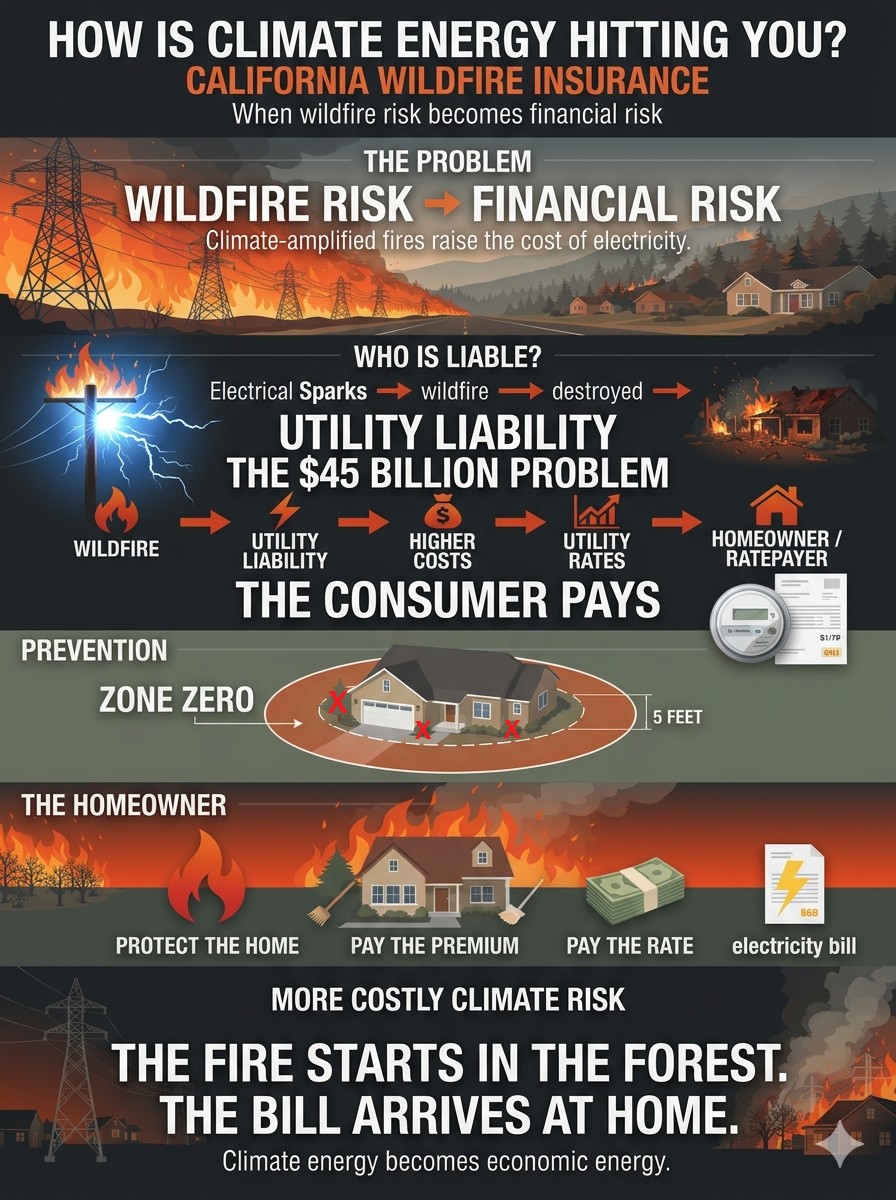
The central concept is Zone Zero—the first five feet surrounding a structure.
The 5-Foot Rule
Homeowners in designated high-hazard areas must remove combustible materials, wooden sheds, and most vegetation within five feet of their homes.
The goal is straightforward:
Create a defensible noncombustible space immediately around the structure.
What Can Remain?
Some vegetation is permitted.
Lawns, flowers, and non-woody plants shorter than 18 inches can remain under specified conditions, provided they are not directly beneath a roofline.
Trees are permitted only when branches are maintained at least five feet away from structures.
Nearly 2 Million Existing Homes
The requirements apply immediately to new construction and will be phased in over five years for nearly 2 million existing homes.
That represents a major shift in wildfire policy.
California is effectively treating individual homes as components of the larger wildfire-risk system. Homeowners who fail to comply with Zone Zero requirements could face fines or other penalties—and, depending on the terms of their insurance policy and applicable law, noncompliance could also jeopardize their wildfire coverage.
3. The Insurance Problem
The insurance industry has raised concerns about inconsistencies in the new rules.
Representatives, including the Personal Insurance Federation of California, have objected to provisions allowing local governments to establish their own exceptions.
From an insurer’s perspective, inconsistent standards create a difficult problem:
How do you accurately price wildfire risk when neighboring jurisdictions can apply different rules to otherwise similar properties?
Insurance depends on the ability to estimate risk.
As wildfire risk becomes more geographically variable—and as losses become more severe—the ability to accurately price that risk becomes increasingly important.
That creates a feedback loop:
Higher wildfire risk → larger losses → higher insurance costs → reduced insurance availability → lower property values → greater financial exposure for homeowners and communities.
And the feedback does not stop there.
Utilities face potentially enormous liabilities. Insurers face increasingly expensive claims. Homeowners face higher premiums and stricter mitigation requirements. Investors must reassess utility risk. Governments may ultimately face pressure to intervene when private insurance markets become unable or unwilling to absorb catastrophic losses.
4. The Market Is Repricing Wildfire Risk
Over the weekend, California lawmakers finalized the compromise version of SB 492, stripping out the liability protections that utility companies had been seeking.
The market reaction has been immediate, with utility stocks—including Edison International and PG&E—coming under significant pressure as investors reassess the potential financial exposure.
The underlying issue is bigger than one bill or one wildfire.
Investors are being forced to reconsider a fundamental question:
What is the true financial liability of operating electrical infrastructure in a climate where extreme wildfire conditions are becoming more dangerous—and how will that liability affect utility rates?
The consumer will foot the bill.
Over the past decade, catastrophic wildfires have cost California’s major electric utilities more than $45 billion through direct settlement payouts, insurance subrogation claims, and historic bankruptcy costs.
California’s strict legal doctrine of “inverse condemnation” adds another layer of financial exposure. Under this doctrine, electric utilities can be held responsible for property damage caused by their equipment even when the utility was not negligent.
The result is a massive financial burden concentrated among California’s largest utilities.
But utilities do not ultimately absorb these costs in isolation. Billions of dollars in wildfire liabilities, infrastructure hardening, insurance costs, legal settlements, financing costs, and risk premiums become part of the economic cost of providing electricity.
And those costs eventually flow back to the ratepayer.
When wildfire risk increases, the cost of electricity infrastructure increases with it:
More extreme fire conditions → greater utility liability → higher insurance and financing costs → billions in wildfire settlements and mitigation spending → higher utility costs → higher electricity rates.
California’s wildfire crisis is therefore becoming an insurance problem, a utility problem, and ultimately a consumer problem.
The question is no longer simply who is legally responsible when a power line starts a fire?
The larger question is:
Who ultimately pays for the growing cost of operating an electrical grid in a climate of escalating wildfire risk?
The consumer will foot the bill.
Climate Energy Becomes Financial Energy
This is what climate change increasingly looks like at the ground level.
It is not simply a hotter atmosphere or a longer fire season.
Climate energy moves through interconnected systems:
Heat → Drought → Vegetation stress → Extreme fire weather → Wildfire → Property destruction → Insurance claims → Utility liability → Litigation → Financial losses → Higher risk premiums and utility rates.
The physical climate system becomes an economic system.
And eventually, that system reaches the homeowner.
California’s wildfire response is therefore becoming something much larger than a debate about fire suppression.
It is becoming a test of whether insurance markets, utility companies, homeowners, investors, and governments can absorb the financial consequences of escalating climate-amplified wildfire risk.
The fire may start in the forest.
But the financial shock can spread far beyond it.