by Daniel Brouse
Abstract
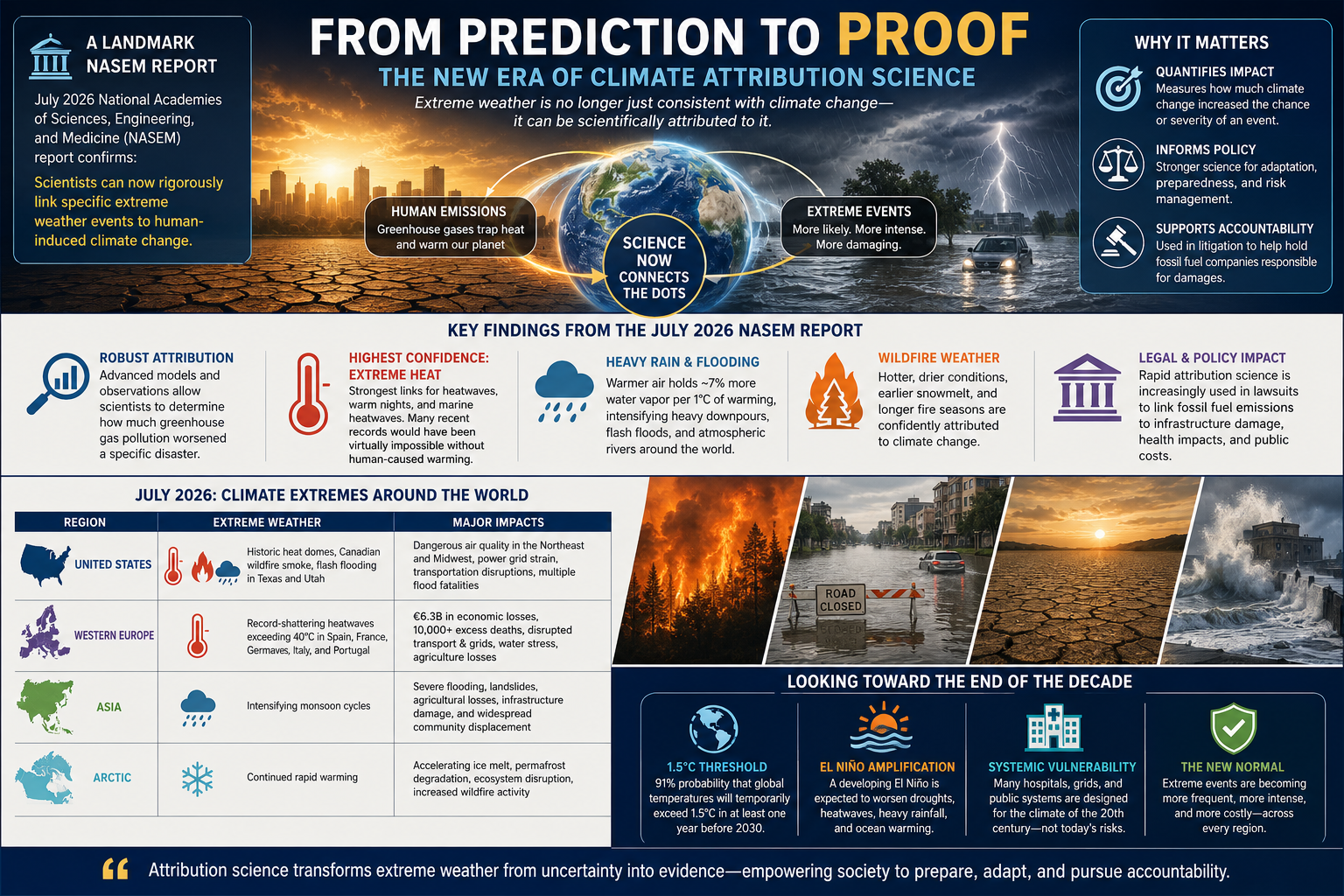
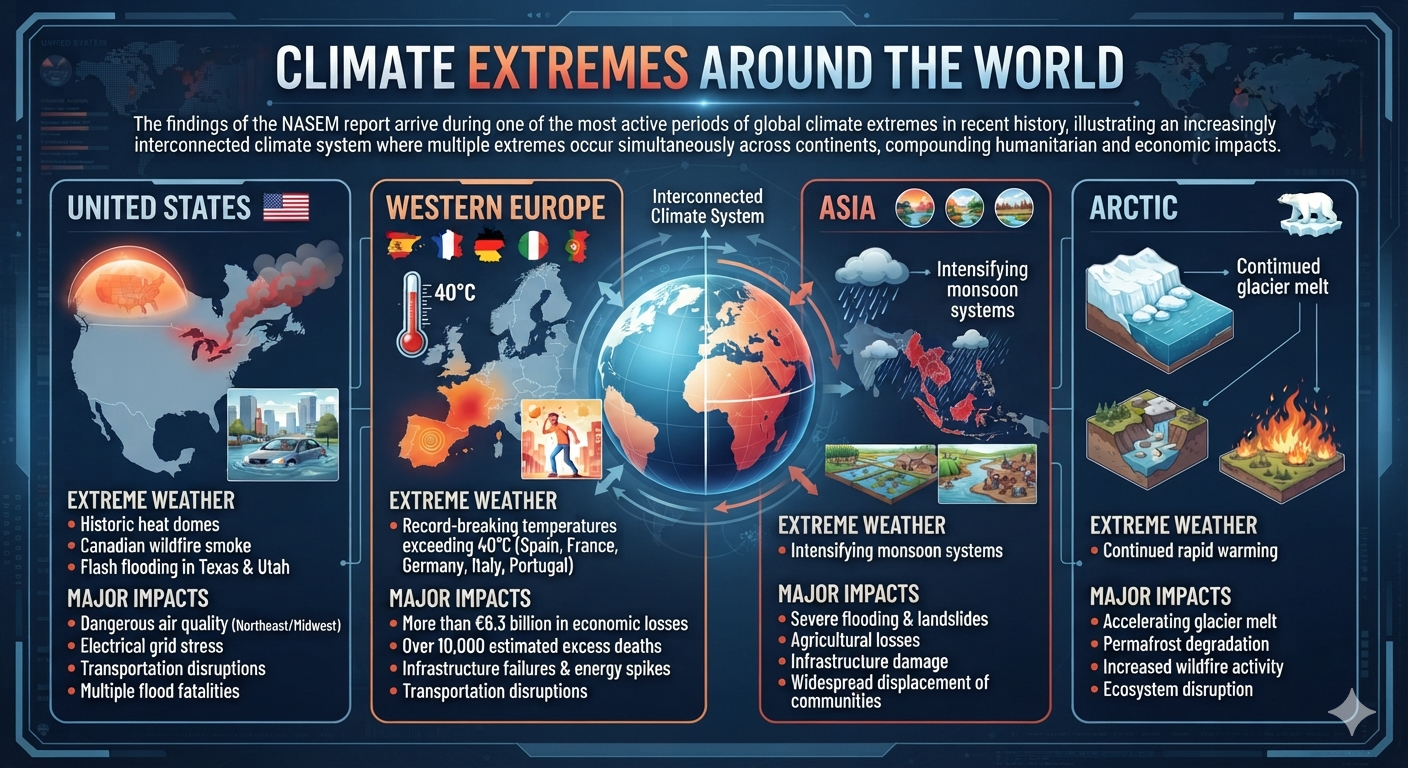
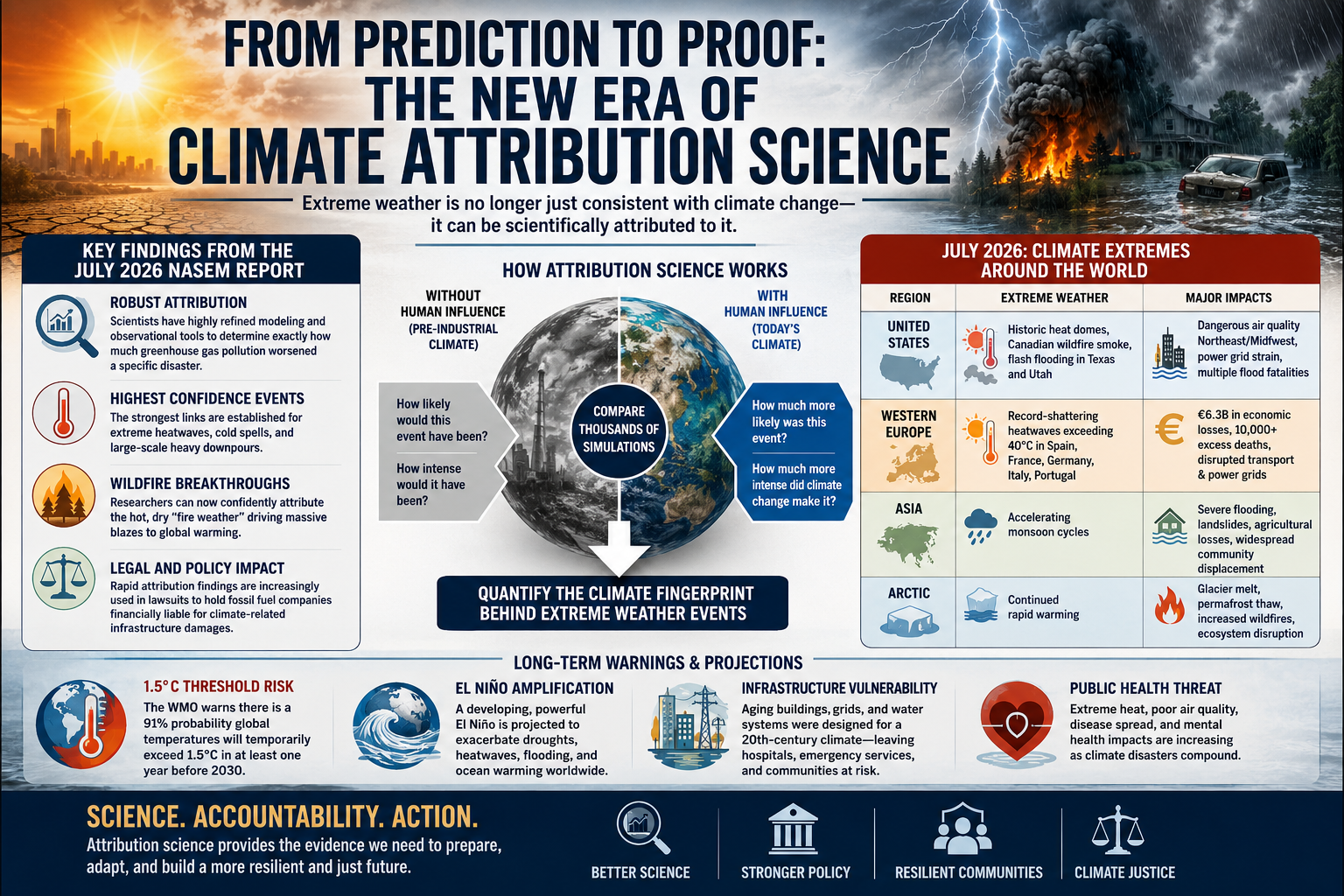
The 2026 National Academies of Sciences, Engineering, and Medicine (NASEM) report on extreme event attribution marks a significant milestone in climate science. It demonstrates that researchers can now rigorously quantify how human-induced climate change has altered the probability and intensity of many individual extreme weather events. While the report focuses on attribution of discrete events, its findings also suggest broader implications for understanding the climate system as a complex, interconnected network. This paper examines those implications through the lens of a nonlinear systems framework, arguing that attribution science is evolving from identifying isolated events toward understanding cascading feedbacks, increasing Earth-system coupling, and migration of the climate system into new dynamic states.
From Linear Forcing to Nonlinear Response
For decades, climate change was often communicated through a relatively simple causal chain:
More atmospheric CO₂ → Higher global temperatures → More frequent extreme weather
Although this framework captures the primary direction of anthropogenic warming, it understates the complexity of the Earth’s climate system.
The NASEM report emphasizes that anthropogenic climate change modifies the environmental conditions under which extreme weather develops, changing both the probability and intensity of many hazardous events. This represents an important conceptual shift. Climate change is no longer viewed merely as adding energy to the atmosphere; it is increasingly recognized as altering the conditions that govern how multiple Earth-system processes interact.
From the perspective of nonlinear climate dynamics, warming changes not only the magnitude of individual hazards but also the state space through which the climate system evolves.
Rather than a simple progression,
CO₂
 ↓
Temperature
 ↓
Extreme Events
the emerging network of interactions more closely resembles:
CO₂
 ↓
Ocean Heat
 ↓
Atmospheric Water Vapor
 ↓
Jet Stream Changes
 ↓
Blocking Patterns
 ↓
Marine Heatwaves
 ↓
Wildfires
 ↓
Smoke Aerosols
 ↓
Vegetation Loss
 ↓
Carbon Release
 ↓
Additional Warming
Each component influences multiple others, producing nonlinear responses that amplify or dampen subsequent changes. Importantly, many of these individual pathways can now be independently observed and quantified. Attribution science has matured sufficiently to isolate numerous links within these interconnected chains, providing an empirical foundation for broader systems-level analyses.
Increasing Feedback Coupling Across the Earth System
One of the defining characteristics of complex systems is that interactions between components become increasingly important as the system evolves.
Historically, climate variables such as the atmosphere, oceans, cryosphere, biosphere, and hydrological cycle were often studied as largely independent subsystems. Contemporary climate science increasingly recognizes that these components respond simultaneously and influence one another through multiple feedback mechanisms.
The NASEM report reflects this evolution by emphasizing that attribution frequently requires integrating observations from multiple Earth-system components rather than examining individual hazards in isolation. This growing recognition of interconnected processes aligns closely with the concept of feedback coupling.
A representative sequence illustrates this interaction:
Warmer Oceans
        ↓
Greater Evaporation
        ↓
Higher Atmospheric Water Vapor
        ↓
More Intense Rainfall
        ↓
Soil Saturation
        ↓
Landslides
        ↓
Vegetation Loss
        ↓
Reduced Carbon Uptake
        ↓
Additional Warming
Each stage strengthens the environmental conditions that enable subsequent stages.
In systems terminology, the effective coupling among climate subsystems increases over time. Rather than operating as loosely connected components, the Earth system increasingly behaves as an integrated network in which disturbances propagate through multiple interacting pathways.
Quantifying these evolving coupling relationships represents an important direction for future climate research.
From Event Attribution to Cascade Attribution
Perhaps the most significant implication of modern attribution science is that it enables researchers to move beyond isolated events toward understanding cascading climate impacts.
Traditional attribution studies ask questions such as:
“Did anthropogenic climate change increase the probability or intensity of this flood?”
A systems-based framework asks a broader question:
“What sequence of prior climate-driven events created the conditions that made this flood possible?”
These questions address different levels of system behavior.
The NASEM report increasingly recognizes compound and cascading events, noting that many impacts arise from interacting hazards rather than isolated extremes.
A typical cascade may unfold as:
Heat Wave
      ↓
Forest Drying
      ↓
Wildfire
      ↓
Hydrophobic Soils
      ↓
Flash Flooding
      ↓
Infrastructure Failure
      ↓
Economic Disruption
      ↓
Migration
      ↓
Political Instability
Each event modifies the initial conditions under which subsequent events occur.
This perspective suggests a natural evolution of attribution science—from Event Attribution, which evaluates individual hazards, toward Cascade Attribution, which seeks to understand how multiple climate-driven events interact across environmental, economic, and social systems.
Rather than viewing disasters as isolated phenomena, cascade attribution recognizes that many impacts emerge from sequential interactions among interconnected feedback processes.
Climate State Space Migration
Another implication of recent attribution science is that extreme events can no longer be viewed solely as statistical outliers within a stationary climate.
Instead, the baseline climate itself is changing.
Within a nonlinear systems framework, this change can be interpreted as migration through climate state space. As greenhouse forcing increases and Earth-system feedbacks intensify, the climate system occupies regions characterized by combinations of conditions that were previously rare or effectively absent.
Consequently, compound events become increasingly probable, including simultaneous occurrences such as:
- Marine heatwaves
- Atmospheric rivers
- Persistent blocking highs
- Extensive wildfire smoke
- Accelerated glacier loss
- Compound coastal and inland flooding
These combinations arise because the underlying probability landscape governing climate behavior is evolving.
While the NASEM report does not explicitly frame these changes in terms of state-space dynamics, its conclusions are consistent with the observation that anthropogenic climate change alters the likelihood, intensity, and characteristics of extreme events. A nonlinear interpretation extends this concept by suggesting that the climate system is transitioning into new dynamic regimes in which unprecedented combinations of hazards become increasingly likely.
Conclusion
The National Academies report represents a major scientific milestone by demonstrating that extreme event attribution has matured into a rigorous and quantitative discipline capable of identifying the influence of human-induced climate change on many individual weather extremes.
Viewed through the lens of nonlinear systems theory, however, the report also points toward a broader scientific frontier. The evidence increasingly supports viewing Earth’s climate as a dynamically coupled network in which interactions among the atmosphere, oceans, cryosphere, biosphere, and human systems become progressively more interconnected.
This perspective suggests several natural extensions of attribution science. First, researchers can expand from attributing isolated events to analyzing cascading sequences of interacting hazards. Second, increasing feedback coupling among Earth-system components may provide measurable indicators of emerging nonlinear behavior. Finally, the migration of the climate system through state space offers a conceptual framework for understanding why compound extremes are becoming more common and why previously unprecedented combinations of events are now emerging.
Together, these ideas outline a research agenda that extends beyond traditional event attribution toward a more comprehensive understanding of climate as a complex adaptive system. As attribution science continues to mature, integrating nonlinear dynamics, feedback coupling, and cascade analysis may become essential for anticipating the evolving risks associated with anthropogenic climate change.