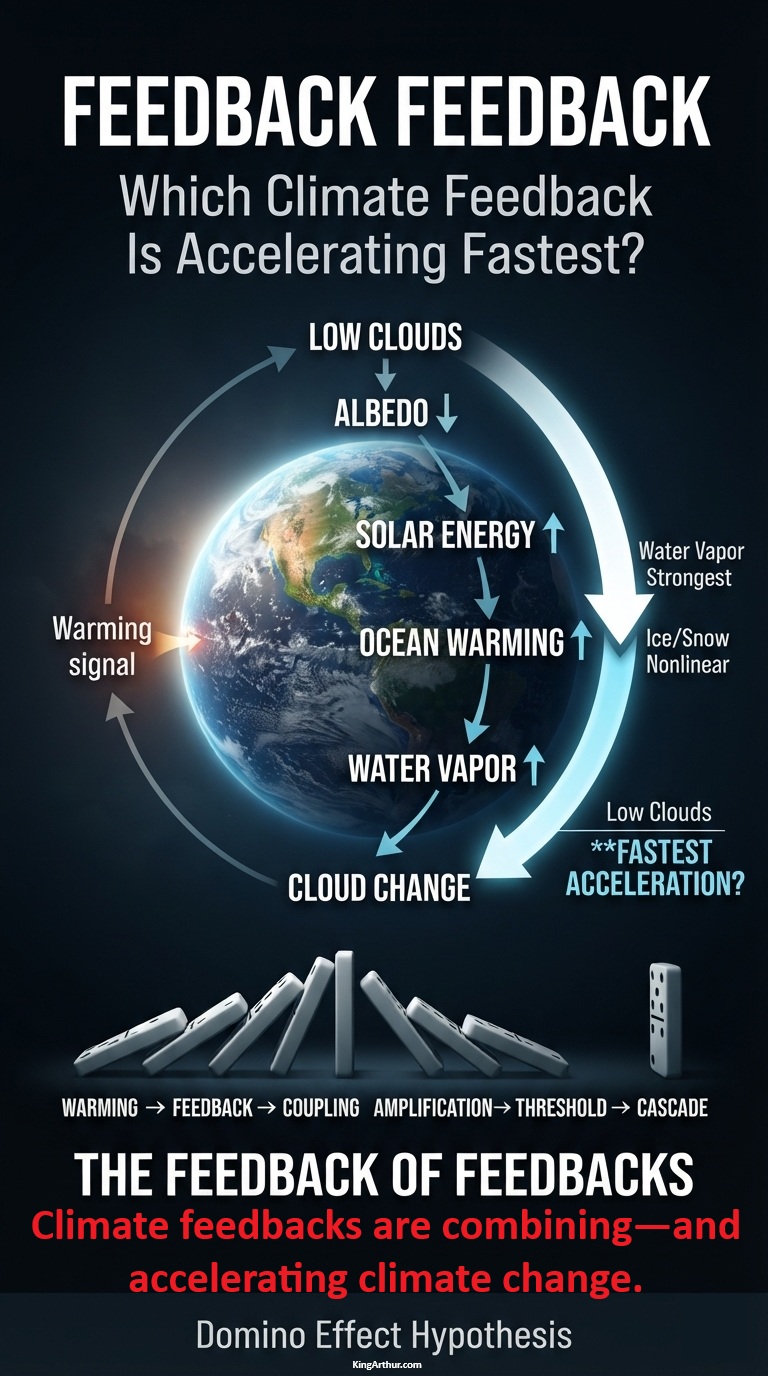
Which Climate Feedback Is Accelerating Fastest?
by Daniel Brouse
In response to the request for feedback on climate feedbacks, here are the current rankings:
- Fastest response: water vapor
- Strongest positive feedback: water vapor + lapse rate
- Most potentially nonlinear physical feedback: ice/snow albedo
- Potentially fastest-growing biogeochemical feedback: natural carbon/CH₄ release
- Largest uncertainty with potentially abrupt behavior: clouds
Which Is the Fastest-Accelerating Feedback?
If we define the question rigorously as the feedback whose rate of amplification is itself increasing fastest—that is, the feedback with the largest positive d²F/dt²—the best current answer is:
Low-cloud / planetary-albedo feedback
| Feedback | F today | dF/dt | d²F/dt² | My assessment |
|---|---|---|---|---|
| Water vapor | Very large | Positive | Probably modest | Strongest feedback, not necessarily fastest acceleration |
| Low-cloud/albedo | Moderate | Positive | Potentially very large | Best candidate |
| Ice/snow albedo | Moderate | Positive | Large regionally | Strong candidate |
| Natural carbon/CH₄ | Growing | Positive | Potentially large | Major emerging candidate |
| Permafrost | Smaller globally | Positive | Potentially large | Long-term accelerator |
| Cloud + ice interaction | Moderate | Positive | Potentially nonlinear | Particularly interesting |
| Sea-level/ice-sheet | Slower | Positive | Positive | Longer-timescale accelerator |
Among Earth’s major climate feedbacks, low-cloud/planetary-albedo feedback is currently one of the strongest candidates for the largest positive second derivative—the feedback whose amplification may itself be accelerating.
When the Whole Is Greater Than the Parts
The relevant accelerating object may not be an individual feedback at all, but the coupling among feedbacks:
low clouds → sea ice → albedo → ocean heating → water vapor → atmospheric circulation → clouds
Each component can influence the others.
It is therefore possible that the climate system is not simply experiencing individual feedbacks becoming stronger, but increasingly coupled feedbacks amplifying one another.
The Feedback of Feedbacks
This raises a more important question.
If F represents feedback strength:
dF/dt > 0 means the feedback is strengthening.
d²F/dt² > 0 means the strengthening of the feedback is itself accelerating.
That is the critical distinction.
A feedback can be large without being the feedback that is accelerating fastest. Water vapor is the clearest example: it is arguably Earth’s strongest positive climate feedback, but its response to warming is comparatively direct and well understood.
The more provocative question is whether another feedback is becoming progressively more powerful as warming proceeds.
Low-cloud/planetary-albedo feedback is particularly interesting because clouds influence Earth’s planetary albedo. A reduction in reflective low clouds allows more incoming solar energy to reach the surface and ocean.
That additional energy produces more warming, potentially contributing to further changes in clouds, sea ice, atmospheric circulation, and the hydrological cycle.
The resulting chain can look like:
warming → low-cloud reduction → lower albedo → greater solar absorption → ocean warming → more atmospheric moisture → atmospheric and circulation changes → further cloud changes
That is no longer simply one feedback operating in isolation.
It is a coupled feedback system:
Climate feedbacks are combining—and accelerating climate change.
The Domino Effect
This is closely related to the Domino Effect Hypothesis:
warming → feedback activation → feedback coupling → amplification → threshold → cascade
The important scientific question is therefore not simply:
Which climate feedback is strongest?
It is:
Which feedback is accelerating fastest—and are multiple accelerating feedbacks becoming increasingly coupled?
Low-cloud/planetary-albedo feedback is currently a leading candidate for the largest positive second derivative.
But the ultimate target for investigation is the second derivative of the coupled feedback system itself.
If that quantity is positive and increasing, we may be looking at a measurable mechanism behind the accelerating climate-system energy imbalance—and potentially a quantitative test of the Domino Effect Hypothesis.