Bomb cyclones (rapidly intensifying mid-latitude extratropical cyclones) are fundamentally driven by baroclinic instability — the conversion of temperature gradients into kinetic energy. Polar amplification is altering those gradients and the background circulation in ways that can favor more extreme storm behavior.
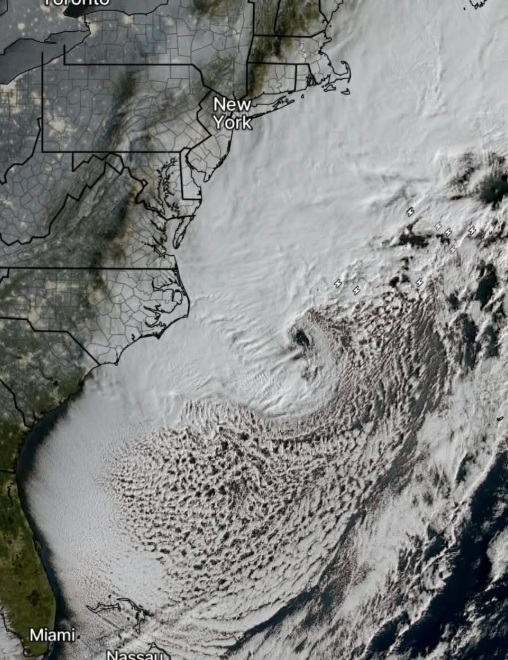
Here’s how the mechanism works.
1. The Energy Source: Temperature Gradients
Mid-latitude cyclones intensify when:
Cold, dense Arctic air collides with
Warm, moist subtropical air
The stronger the horizontal temperature contrast, the greater the available potential energy for storm development.
Polar amplification complicates this picture.
While the average equator-to-pole temperature gradient is weakening, the structure of that gradient is becoming more uneven and episodic. Instead of a smooth gradient, we now see:
Extreme Arctic warming
Increased sea surface temperatures in the western Atlantic
Larger, sharper localized contrasts during cold-air outbreaks
When Arctic air spills southward over abnormally warm ocean waters, explosive cyclogenesis becomes more likely.
The ocean heat is the fuel.
2. Warmer Oceans = More Latent Heat Release
Bomb cyclones intensify when surface pressure drops ≥ 24 mb in 24 hours.
One of the key accelerants is latent heat release from condensing water vapor.
Because:
Warmer air holds ~7% more moisture per °C (Clausius–Clapeyron relation)
Western Atlantic SSTs are significantly warmer than late 20th-century averages
Arctic amplification contributes to open-water heat release in fall and early winter
Storms now tap into greater moisture and ocean heat reservoirs.
This increases:
Pressure falls
Wind speeds
Precipitation intensity
Storm surge potential
The thermodynamic ceiling is higher.
3. Jet Stream Destabilization
Polar amplification reduces the equator-to-pole temperature gradient on average, which weakens and slows the jet stream.
A slower jet stream tends to:
Meander more (amplified Rossby waves)
Stall weather systems
Create deeper troughs and ridges
These amplified waves can:
Pull Arctic air farther south
Inject subtropical moisture farther north
Enhance upper-level divergence (critical for surface pressure drops)
That combination supports explosive cyclogenesis.
So even if the mean gradient weakens, the waviness and variability of the jet can enhance storm intensification events.
4. Arctic Sea Ice Loss
Reduced sea ice contributes in two ways:
Heat Flux into the Atmosphere
Open water releases stored summer heat in autumn and winter, increasing lower-atmosphere instability.
Enhanced Moisture Supply
More evaporation from ice-free Arctic waters adds atmospheric moisture that can feed developing systems.
This modifies the polar air mass characteristics feeding mid-latitude storms.
5. Intensity
Observed trends suggest:
Greater precipitation rates
Higher wind extremes in some basins
Increased rapid deepening events in the North Atlantic
More extreme compound events (cold + heavy snow + coastal flooding)
Frequency trends are more regionally variable, but the tail risk distribution is thickening — meaning the most extreme storms are becoming more extreme.
6. Nonlinear Feedback Context
In our broader framework of nonlinear climate acceleration:
Bomb cyclones represent:
A dynamical response to polar amplification
A thermodynamic response to warmer oceans
A circulation response to jet destabilization
They are not isolated phenomena. They are manifestations of interacting feedback loops:
Ice-albedo feedback
Ocean heat uptake
Jet stream destabilization
Moisture amplification
The system is not simply warming — it is reorganizing energetically.
Bottom Line
Polar amplification does not just warm the Arctic. It alters:
Temperature gradients
Jet stream behavior
Ocean heat distribution
Moisture availability
Those changes create conditions that favor:
More intense rapid cyclogenesis events
Greater precipitation extremes
Larger pressure drops
Stronger winds and storm surge
Bomb cyclones are one visible symptom of a climate system shifting toward higher-energy variability rather than smooth linear warming.
They are dynamical expressions of amplification.