by Daniel Brouse and Sidd Mukherjee
Simplified Overview
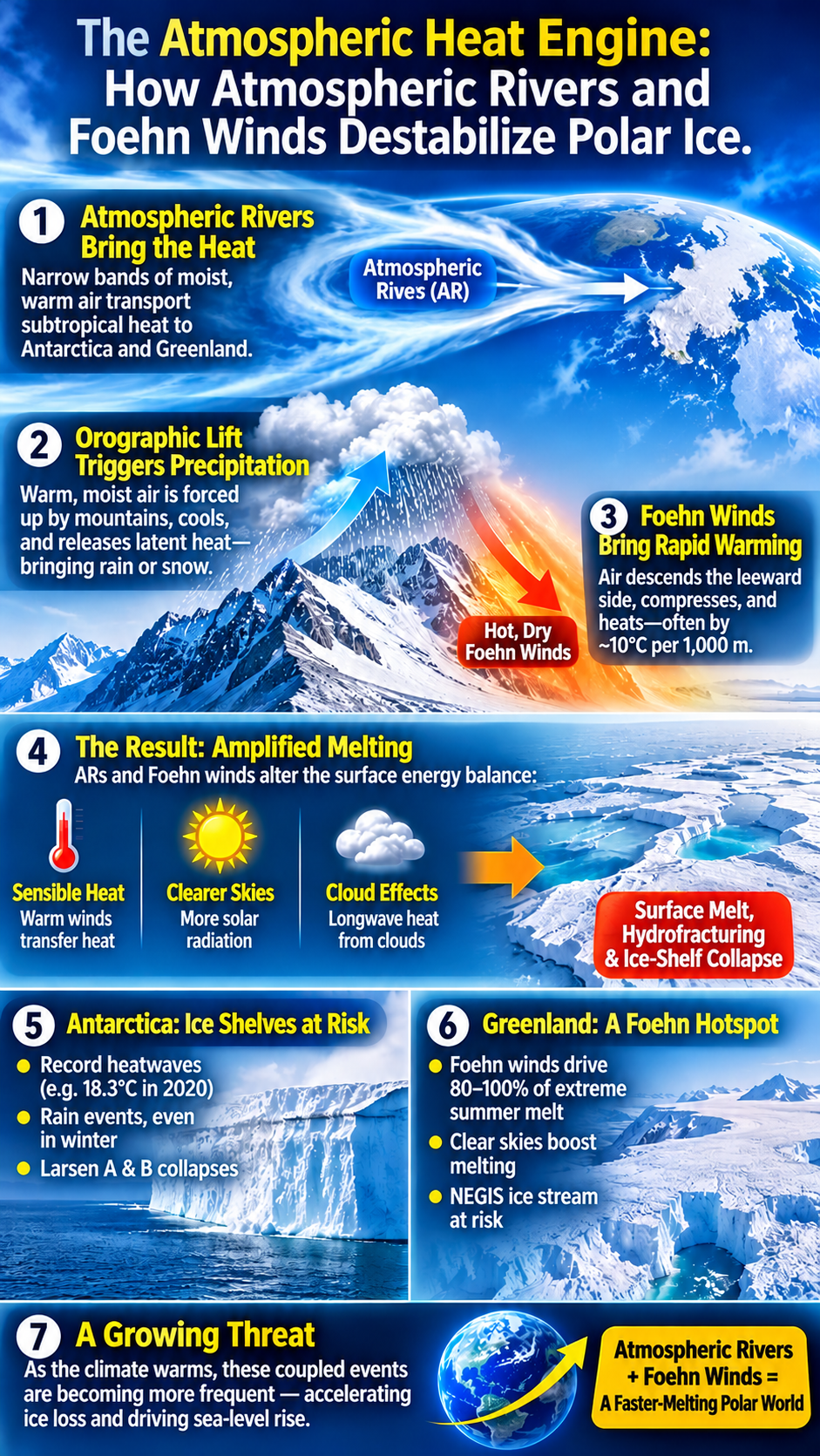
🌎❄️ ATMOSPHERIC RIVERS AND FOEHN WINDS: FEEDBACK COUPLING ACCELERATING POLAR ICE LOSS
There’s nothing more exciting to a climatologist than discovering emerging feedback coupling in real-time.
And that’s exactly what we’re observing in the polar climate system.
🔥 TWO ATMOSPHERIC FORCES. ONE AMPLIFYING CLIMATE RESPONSE.
Atmospheric Rivers act as aerial conveyor belts, transporting enormous quantities of warm air and moisture into Antarctica and Greenland.
When these moisture-rich air masses encounter mountain barriers and massive ice-sheet topography, they trigger powerful Foehn winds.
The result? A coupled atmospheric heat engine.
🌊 HOW THE FEEDBACK COUPLING WORKS:
1️⃣ ATMOSPHERIC RIVERS
Transport subtropical heat and moisture directly into polar regions.
2️⃣ OROGRAPHIC LIFT
Mountains force warm, moisture-rich air upward, producing precipitation and releasing latent heat.
3️⃣ FOEHN WINDS
Descending air compresses and warms, sometimes increasing temperatures by approximately 10°C per 1,000 meters of descent.
4️⃣ AMPLIFIED MELTING
Powerful winds transfer sensible heat, cloud clearance increases incoming solar radiation, and cloud spillover increases downward infrared radiation.
5️⃣ ICE-SHEET DESTABILIZATION
Surface melting produces meltwater ponds, hydrofracturing, ice-shelf weakening, and accelerated ice loss.
⚠️ ANTARCTICA: THE WARNING SIGNS
🌡️ 18.3°C (64.9°F) Antarctic Peninsula temperature record in 2020.
🔥 March 2022: East Antarctic temperature anomalies approached 40°C above normal.
💧 Atmospheric rivers can deliver liquid precipitation, even during the Antarctic winter.
🧊 Larsen A and Larsen B demonstrate the consequences of ice-shelf destabilization and hydrofracturing.
⚠️ GREENLAND: ANOTHER FEEDBACK HOTSPOT
Foehn winds are associated with approximately 80–100% of extreme summer melt events in parts of Northeast Greenland.
🌧️ Atmospheric rivers are increasingly delivering liquid rain, heat, and moisture to Greenland, shifting precipitation from snow toward rain. Research shows that Greenland’s rainfall and rain-on-snow events have increased dramatically, particularly over the past four decades. Atmospheric rivers can increase the local probability of rainfall by 10 to nearly 40 times. Foehn winds then amplify the warming and melting, creating a powerful feedback coupling that accelerates ice loss and threatens the stability of the Greenland Ice Sheet.
The Northeast Greenland Ice Stream (NEGIS) is an important region to watch as atmospheric and oceanic forces interact with ice-sheet dynamics.
🌍 THE BIGGER PICTURE: FEEDBACK COUPLING
This is what makes the discovery so important.
We’re not looking at isolated weather events. We’re examining interconnected physical processes that amplify one another:
Atmospheric warming → Moisture transport → Foehn warming → Cloud and radiation changes → Surface melting → Albedo changes → Ice-sheet destabilization → Sea-level rise.
One atmospheric event can initiate multiple interacting feedbacks.
And those feedbacks connect the atmosphere, cryosphere, oceans, and global climate system.
🔬 THE CLIMATE SCIENCE CHALLENGE
Understanding individual feedbacks is no longer enough.
We must understand how they couple, amplify, and redistribute energy across the entire Earth system.
That’s where the next generation of climate research is headed.
The atmospheric heat engine is operating at both poles.
The ice isn’t just melting. The system is changing.
🌎 JUST LOOK OUT YOUR WINDOW. THEN LOOK AT THE POLES.
#ClimateScience #AtmosphericRivers #FoehnWinds #Antarctica #Greenland #ClimateFeedbacks #IceSheetCollapse #SeaLevelRise #ClimateAcceleration
Introduction: Atmospheric Rivers Bring Heat to the Frozen Continents
Atmospheric rivers (ARs) act as aerial conveyor belts, transporting enormous quantities of heat and moisture from subtropical and mid-latitude regions directly into the polar atmosphere. These narrow, concentrated corridors of water vapor can deliver extraordinary amounts of atmospheric energy to Antarctica and Greenland.
Although atmospheric rivers make landfall at individual Antarctic locations only a few days per year, their influence on ice-sheet mass balance is disproportionately large. They have a dual effect: delivering substantial snowfall while simultaneously introducing extreme heat, liquid precipitation, and atmospheric conditions that accelerate surface melting.
When atmospheric rivers interact with mountainous terrain, they can also generate powerful Foehn winds. This combination creates an atmospheric heat-transfer mechanism capable of producing rapid temperature increases, extensive surface melting, and destabilization of vulnerable ice shelves.
The critical issue is not simply how much snow or rain falls. It is how atmospheric heat, moisture, cloud cover, wind, and surface energy interact to change the stability of the polar ice system.
1. Atmospheric Rivers: Triggering Extreme Melting and Ice-Shelf Instability
Atmospheric rivers influence Antarctic ice stability through several interconnected mechanisms.
Unprecedented Heatwaves
Atmospheric rivers have been major contributors to some of Antarctica’s most extraordinary temperature events.
- February 2020: Atmospheric river conditions contributed to the Antarctic Peninsula temperature record of 18.3°C (64.9°F), recorded at Esperanza Station.
- March 2022: An extraordinary atmospheric circulation event transported heat and moisture into East Antarctica, producing temperature anomalies approaching 40°C above seasonal averages in parts of the continent.
These events demonstrate how atmospheric circulation can transport enormous quantities of heat into regions normally dominated by extreme cold.
Ice-Shelf Instability and Hydrofracturing
Atmospheric rivers can produce the combination of warm air, liquid precipitation, surface melting, and persistent meltwater accumulation that threatens ice-shelf stability.
Meltwater collects in surface depressions and crevasses. Because water is substantially denser than ice, its weight creates pressure within fractures, forcing them deeper into the ice. This process, known as hydrofracturing, can propagate fractures through an ice shelf and contribute to its structural collapse.
The Larsen A Ice Shelf collapsed in 1995, followed by the much larger Larsen B collapse in 2002. Surface meltwater and hydrofracturing were important mechanisms in these collapses.
Atmospheric warming, Foehn winds, and changing precipitation patterns are important contributors to the melt conditions that destabilize these ice shelves.
Liquid Rain and Albedo Reduction
Atmospheric rivers can transport enough heat into Antarctica to produce liquid precipitation, even in environments where snowfall normally dominates.
Researchers have documented atmospheric river conditions associated with supercooled liquid precipitation in West Antarctica.
Rain falling onto snow and ice changes the surface structure and can create darker, wetter surfaces. When meltwater subsequently refreezes or changes the snowpack, the resulting surface conditions can reduce reflectivity.
This is an important feedback mechanism:
Reduced albedo → Greater solar absorption → More surface warming → More melting.
The result is a surface that becomes increasingly vulnerable to additional atmospheric heating.
2. Can Atmospheric Rivers Produce Rainfall in Antarctica?
Absolutely. Atmospheric rivers routinely produce rainfall around the world and are among the principal drivers of extreme precipitation and flooding.
Antarctica is no exception.
Although most Antarctic precipitation falls as snow, atmospheric rivers can transport sufficient heat and moisture to raise local temperatures above freezing, allowing precipitation to fall as rain rather than snow.
This is particularly important along the Antarctic Peninsula and the coastal margins of the ice sheet, where atmospheric circulation and topography create localized temperature extremes.
Documented Antarctic atmospheric river events include:
July 2023: Deep-Winter Rainfall
An intense atmospheric river affected the Antarctic Peninsula during the austral winter.
Temperatures reached approximately +2.7°C (36.9°F), creating conditions favorable for liquid precipitation during a period when temperatures would normally remain well below freezing.
The event demonstrated that atmospheric rivers can produce significant warm-season anomalies even during the Antarctic winter.
March 2022: East Antarctic Heatwave
An exceptionally powerful atmospheric circulation event transported heat into East Antarctica, producing temperature anomalies approaching 40°C above normal in some locations.
The event demonstrated the capacity of atmospheric circulation to rapidly redistribute heat across the Antarctic continent, creating conditions favorable for anomalous melting and liquid precipitation near coastal regions.
2020: Amundsen Sea Embayment
Research examining extreme atmospheric river storms over West Antarctica identified substantial liquid precipitation associated with two atmospheric river events in 2020.
Estimates included as much as 30 mm of rainfall during summer and 9 mm during winter over vulnerable ice-shelf regions.
The Amundsen Sea Embayment is particularly important because it includes the Thwaites Glacier system, one of the most consequential regions for future global sea-level rise.
These events establish an important point: Antarctica is not insulated from the hydrological extremes occurring elsewhere on Earth. Atmospheric rivers are transporting heat and moisture directly into the polar environment.
3. Foehn Winds and Atmospheric Rivers: A Coupled Atmospheric Heat Engine
The interaction between atmospheric rivers and Foehn winds creates a powerful mechanism for transferring atmospheric heat to Antarctic ice.
When an atmospheric river encounters the steep coastal mountains of the Antarctic Peninsula, the topography forces warm, moisture-rich air upward. This produces orographic precipitation and changes the thermodynamic properties of the air mass.
As air crosses the mountain barrier and descends on the opposite side, it undergoes adiabatic compression and warming, generating powerful Foehn winds.
Together, these processes create a compound melting mechanism.
The atmospheric sequence:
[1. AR Intrusion] → [2. Orographic Lift] → [3. Foehn Descent] → [4. Compound Melting]
- Atmospheric river intrusion: Warm, moisture-rich air approaches the mountains.
- Orographic lift: Rising air cools, condenses, and produces rain or snow.
- Foehn descent: Air descends the leeward slopes, compresses, and warms.
- Compound melting: Turbulent heat transfer, cloud changes, and solar radiation accelerate ice-surface melting.
3.1 The Trigger: Orographic Lift and Latent Heat
When an atmospheric river approaches a mountain barrier such as the Antarctic Peninsula, the topography forces the moisture-rich air upward.
As the air rises, it expands and cools. Water vapor condenses into clouds and precipitation, releasing latent heat into the atmosphere.
This release of latent heat changes the thermodynamic structure of the air mass and contributes to the atmospheric energy available during the event.
The windward slopes receive substantial precipitation, while the air continuing across the mountain barrier becomes progressively drier.
3.2 The Acceleration: Adiabatic Foehn Warming
Once the air crosses the mountain ridge, it descends along the leeward slopes.
As atmospheric pressure increases during descent, the air compresses and warms.
Unsaturated descending air warms at approximately 9.8°C per 1,000 meters of descent, although actual Foehn warming depends on the initial atmospheric profile, moisture loss, mixing, and terrain.
The resulting Foehn winds can produce extraordinary localized temperature increases.
The atmospheric river supplies the large-scale moisture transport and warm-air intrusion. The mountain barrier transforms the airflow, producing localized downslope warming and powerful winds.
This is an important distinction: atmospheric rivers transport the heat and moisture, while Foehn dynamics concentrate and redistribute that energy across vulnerable ice surfaces.
3.3 The Coupling Effect: Amplified Surface Energy Balance
When atmospheric rivers and Foehn winds interact over vulnerable ice shelves, they can substantially alter the surface energy balance through three mechanisms.
1. Sensible Heat Flux: Atmospheric Turbulence
Foehn winds act like enormous atmospheric hair dryers.
Strong winds transport warm air directly across the ice surface. Atmospheric turbulence increases the exchange of sensible heat between the air and the ice.
This process can rapidly increase surface temperatures and accelerate melting.
2. The Cloud-Clearance Paradox: Increased Solar Radiation
As air descends the leeward side of a mountain, warming and drying promote cloud evaporation.
This can create a Foehn gap, producing relatively clear skies over the ice shelf.
During the Antarctic summer, reduced cloud cover allows greater incoming shortwave solar radiation to reach the surface.
The result is an additional source of energy for melting precisely when the atmosphere is already delivering unusually warm conditions.
3. Cloud Spillover: Increased Downward Longwave Radiation
Not all atmospheric river moisture remains on the windward side of the mountains.
Some moisture crosses the mountain barrier, producing clouds over the leeward ice shelf.
These clouds can increase downward longwave radiation, reducing the amount of infrared energy escaping from the surface.
This mechanism is particularly important during periods of limited sunlight and the Antarctic winter.
The interaction between cloud clearance and cloud spillover means that atmospheric rivers and Foehn winds can affect the ice shelf through different radiative mechanisms, depending on local atmospheric conditions.
4. Direct Impacts on Antarctic Ice Shelves
The combined effects of atmospheric rivers and Foehn winds are particularly consequential for Antarctic ice shelves.
Surface Meltwater and Hydrofracturing
Foehn-driven warming can produce extensive surface meltwater accumulation.
Water collects in depressions, melt ponds, and existing crevasses. As water penetrates fractures, its weight increases pressure within the ice, potentially propagating fractures through the shelf.
This process can weaken the structural integrity of an ice shelf and contribute to rapid disintegration.
The Larsen A and Larsen B collapses demonstrate the consequences of sustained surface melting and hydrofracturing.
Larsen C also remains an important monitoring target because of its vulnerability to changing atmospheric and oceanic conditions.
Sea-Ice Removal and Ocean Exposure
Strong offshore Foehn winds can push protective sea ice away from coastal regions.
This exposes ice shelves and coastal waters to increased ocean-wave activity.
The resulting exposure can increase wave-induced flexure and mechanical stress along vulnerable ice-shelf margins.
The interaction between atmospheric forcing, surface melting, and ocean conditions creates multiple pathways for destabilization.
The critical point is that ice-shelf stability depends on more than temperature alone. It depends on the combined atmospheric, oceanic, and mechanical energy acting on the ice.
5. Antarctica vs. Greenland: Two Polar Systems, One Atmospheric Mechanism
The coupling of atmospheric rivers and Foehn winds operates in both Antarctica and Greenland.
The underlying physics is similar, but the geography, topography, and seasonal timing create important differences.
Antarctica’s coupling is strongly influenced by isolated coastal mountain barriers, particularly the Antarctic Peninsula.
Greenland’s coupling is influenced by the enormous topographic dome of the Greenland Ice Sheet itself.
The Core Mechanism Comparison
| Feature | Antarctica | Greenland |
|---|---|---|
| Primary region | Antarctic Peninsula / Larsen Ice Shelf | Northeast Greenland / NEGIS |
| Atmospheric river entry | Primarily western coastal approaches | Northwest Greenland |
| Topographic barrier | Steep coastal mountains, locally approaching 2,000 m | Massive central ice-sheet dome |
| Leeward impact | Eastern Antarctic Peninsula ice shelves | Northeast Greenland outlet glaciers |
| Primary melt season | Austral summer, December–February | Boreal summer, June–August |
| Major radiative influence | Cloud spillover and Foehn-driven cloud clearance | Foehn-driven cloud clearance and solar absorption |
5.1 Greenland’s Atmospheric Dynamic: Crossing the Ice-Sheet Divide
Research on Northeast Greenland demonstrates how atmospheric river events affecting one side of the ice sheet can influence melting on the opposite side.
The process operates through several interconnected stages.
1. Northwest Atmospheric River Intrusion
An atmospheric river transports subtropical moisture and warm air into northwestern Greenland.
The incoming air mass carries substantial atmospheric energy into the polar environment.
2. The Great Lift: Crossing the Ice-Sheet Dome
The air encounters the enormous western slope of the Greenland Ice Sheet.
As it rises over the ice-sheet dome, it cools and loses moisture through precipitation.
Condensation releases latent heat into the atmosphere, while the remaining air mass continues across the ice sheet.
3. The Northeast Foehn Effect
As the air descends toward northeastern Greenland, it compresses and warms.
This produces powerful Foehn conditions that can raise local temperatures by 5.5°C to 11°C or more within hours.
The resulting warming can trigger intense surface melting along vulnerable outlet glaciers and ice-stream margins.
5.2 Greenland’s Extreme Melt Events
Research examining Northeast Greenland has identified an especially strong relationship between Foehn conditions, atmospheric rivers, and extreme summer melting.
Reported findings include:
- Foehn conditions associated with approximately 80–100% of extreme, greater-than-99th-percentile summer melt events in the studied region.
- Atmospheric rivers associated with approximately 50–75% of these events.
- Strong atmospheric river–Foehn episodes occurring only about 1% of the time but contributing disproportionately to regional summer melt.
These percentages describe particular research regions, event definitions, and observation periods. They should not be interpreted as universal values for the entire Greenland Ice Sheet.
5.3 The Role of Clear Skies and Albedo Feedback
Greenland’s large-scale topography creates extensive areas where descending air becomes warm and dry.
These conditions promote Foehn gaps and cloud clearance.
During summer, the resulting increase in incoming solar radiation accelerates surface melting.
As snow and ice melt, surface reflectivity can decline. Darker surfaces absorb more incoming solar energy, creating an additional positive feedback:
Foehn warming → Cloud clearance → Increased solar absorption → Surface melting → Reduced albedo → Additional warming.
This feedback is particularly important along lower-elevation outlet glaciers, where temperatures are already closer to the melting point.
5.4 Frequency vs. Impact
The significance of atmospheric river–Foehn coupling is not determined solely by how frequently these events occur.
In Greenland, relatively infrequent events can produce a disproportionate amount of regional summer melting.
Research estimates indicate that a small number of these concentrated atmospheric episodes can account for approximately 5–10% of summer melt across the studied region.
This illustrates an important climate-system principle: infrequent extreme events can exert an outsized influence on annual ice-sheet mass balance.
6. Future Risks: Accelerating Polar Ice Loss and Global Sea-Level Rise
Both Antarctica and Greenland are experiencing atmospheric and oceanic changes that increase the importance of atmospheric river–Foehn interactions.
As the atmosphere warms, it can hold more water vapor. This increases the potential moisture transport associated with atmospheric rivers and intensifies the hydrological consequences of some extreme weather events.
The resulting atmospheric energy redistribution has several important consequences:
- More opportunities for anomalous liquid precipitation over polar ice.
- Increased potential for surface meltwater accumulation.
- Greater exposure to hydrofracturing and ice-shelf destabilization.
- Changes in cloud cover and surface radiation.
- More frequent or intense episodes of localized Foehn warming in susceptible regions.
- Increased interaction between atmospheric melting and ocean-driven ice loss.
Greenland: Northeast Greenland Ice Stream (NEGIS)
The Northeast Greenland Ice Stream is particularly important because it transports substantial quantities of ice toward the ocean.
Its stability depends on the condition of its upstream ice, outlet glaciers, grounding zones, and surrounding ice shelves.
Increased surface melting and changes in ice discharge can contribute to destabilization.
The critical concern is the interaction between atmospheric melting, ocean-driven basal melting, and the structural dynamics of the ice stream.
Antarctica: Ice-Shelf Destabilization
Antarctica faces an additional challenge.
Its large floating ice shelves buttress the continental ice sheet, slowing the movement of grounded ice toward the ocean.
When ice shelves thin, fracture, or collapse, this restraining effect weakens.
The resulting acceleration of grounded glacier flow increases the contribution of land-based ice to global sea-level rise.
The atmospheric river–Foehn combination is therefore important not simply because it melts surface ice, but because it can contribute to changes in the structural stability of the larger ice-sheet system.
7. The Larger Climate-System Connection
Atmospheric rivers and Foehn winds illustrate how climate-system components interact rather than operate independently.
An atmospheric river transports heat and moisture. Mountain topography transforms the airflow. Foehn winds redistribute heat. Cloud changes alter radiation. Surface melting reduces albedo. Meltwater contributes to hydrofracturing. Ice-shelf weakening can accelerate grounded glacier discharge.
The sequence is interconnected:
Atmospheric warming → Increased moisture transport → Atmospheric river intrusion → Foehn warming → Cloud and radiation changes → Surface melting → Hydrofracturing → Ice-shelf destabilization → Accelerated ice discharge → Sea-level rise.
This is an example of coupled climate feedbacks, in which one atmospheric event can initiate a chain of physical responses across multiple Earth systems.
The implications extend beyond Antarctica and Greenland.
The polar ice sheets are connected to the global climate system through atmospheric circulation, ocean heat transport, freshwater discharge, and changes in global sea level.
The important question is no longer simply whether atmospheric rivers can bring rain to Antarctica or Greenland.
They can.
The larger issue is how the increasing interaction of atmospheric heat, moisture, wind, radiation, ocean energy, and ice-sheet dynamics is changing the stability of Earth’s polar regions.
Atmospheric rivers deliver the heat. Foehn winds concentrate it. Coupled climate feedbacks amplify its consequences.