Introduction
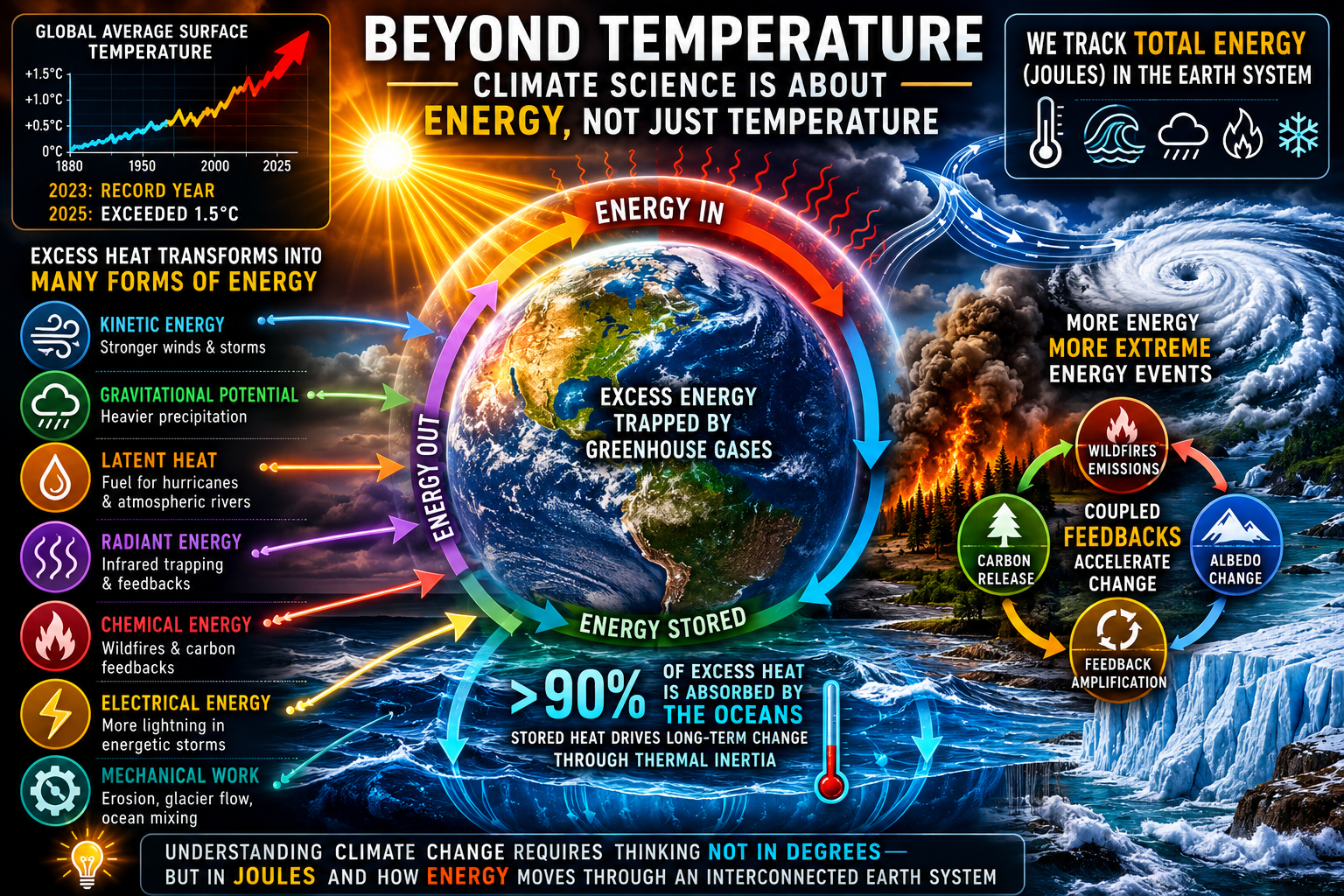
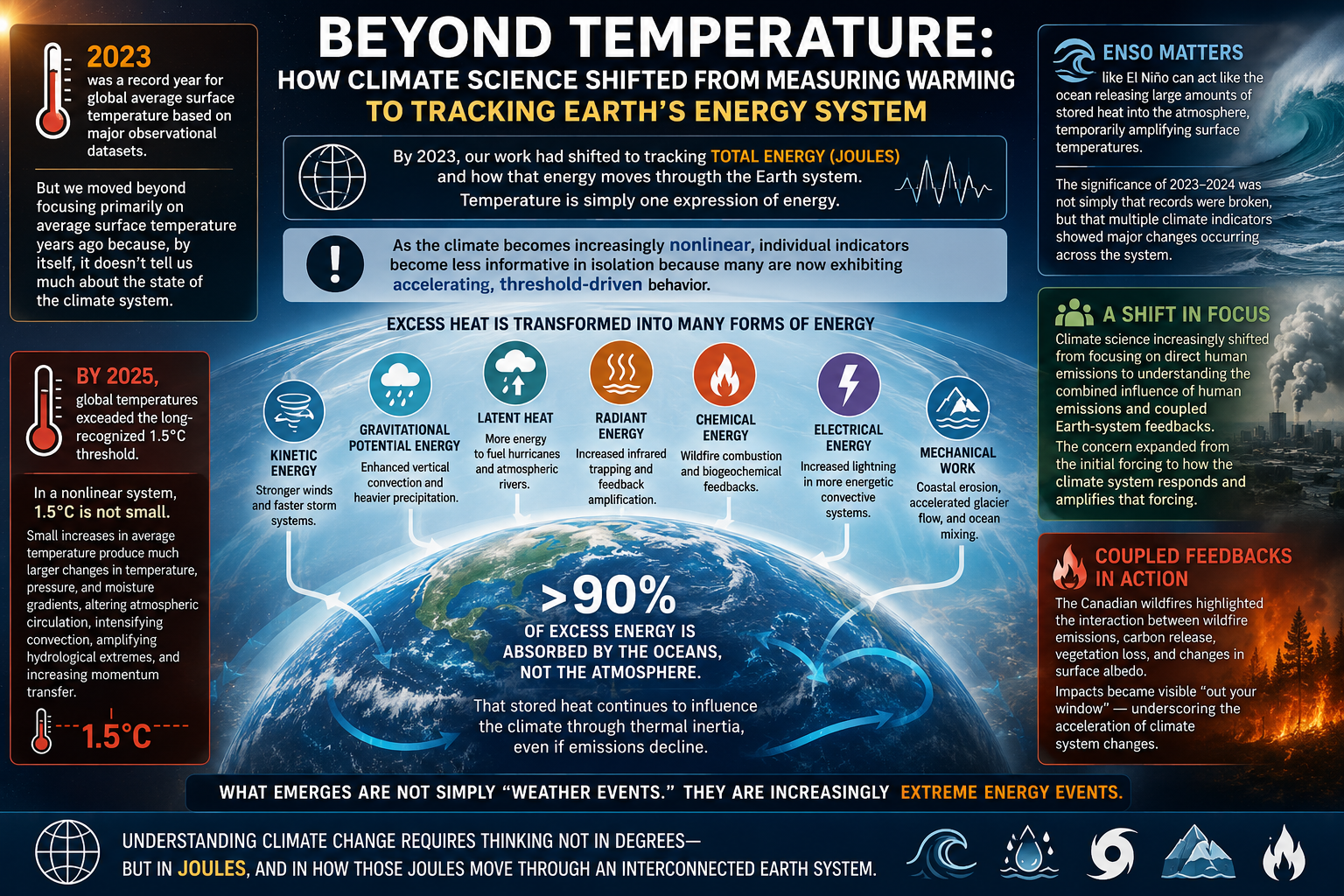
2023 was a record year for global average surface temperature according to the major observational datasets. However, climate science moved beyond focusing primarily on annual temperature records years ago because, by itself, average surface temperature provides only a limited view of the state of the climate system.
Temperature is an important indicator, but it is only one expression of energy. A changing climate is fundamentally an energy problem: how much energy is entering the Earth system, how much is leaving, and how that excess energy is redistributed among the atmosphere, oceans, cryosphere, and biosphere.
By 2023, climate analysis had increasingly shifted toward tracking total energy accumulation (measured in joules) and understanding how that energy moves through the Earth system. As the climate becomes more nonlinear, individual indicators become less informative when viewed in isolation because many components of the system are beginning to exhibit accelerating and threshold-driven behavior.
Global Warming Is Only the Beginning
The phrase “global warming” is often misunderstood. While it accurately describes rising average surface temperatures, it can understate the broader transformation occurring within the climate system.
The central issue is not simply that the planet is warmer. The issue is that greenhouse gases have created a persistent energy imbalance, causing the Earth system to accumulate and redistribute additional thermal energy.
Global warming is the beginning of climate change—not its endpoint.
Once excess heat is trapped by greenhouse gases, it does not remain as a simple increase in temperature. That energy is transformed into multiple forms throughout the Earth system:
- Kinetic energy — contributing to stronger winds, changing atmospheric circulation, and more energetic storm systems.
- Gravitational potential energy — increasing atmospheric instability, vertical convection, and the potential for heavier precipitation events.
- Latent heat — providing additional energy for hurricanes, atmospheric rivers, and extreme rainfall.
- Radiant energy — increasing infrared energy retention and amplifying greenhouse feedbacks.
- Chemical energy — influencing wildfire combustion, carbon cycling, and ecosystem feedbacks.
- Electrical energy — contributing to increased lightning activity within more energetic convective systems.
- Mechanical work — accelerating coastal erosion, glacier movement, ocean mixing, and other physical processes.
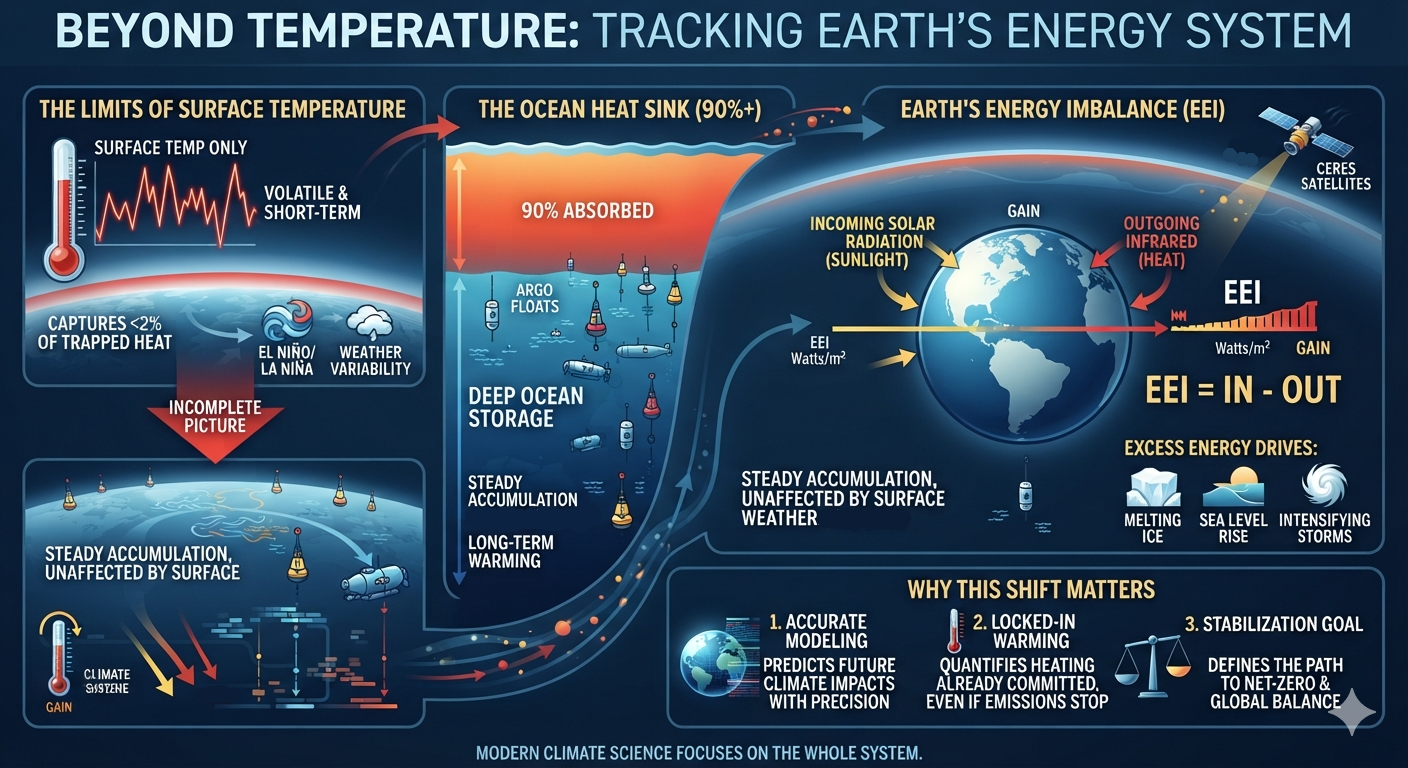
More than 90% of the excess heat trapped by greenhouse gases is absorbed by the oceans. This stored energy creates long-term consequences because the oceans have enormous thermal inertia. Even if atmospheric emissions decline, previously accumulated heat continues to influence climate behavior.
The Limits of Temperature Alone
Climate modeling is not focused primarily on average surface temperature. Surface temperature is one indicator, but it represents only a small part of the broader Earth system.
The significance of 2023–2024 was not simply that temperature records were broken. It was that multiple climate indicators showed simultaneous changes across the system.
The El Niño–Southern Oscillation (ENSO) cycle is an important example. During El Niño events, the ocean can release large amounts of stored heat into the atmosphere, temporarily amplifying surface temperatures. But the larger scientific question is how that additional energy interacts with other components of the climate system.
This period represented an important shift in climate analysis: moving beyond studying direct human emissions alone and toward understanding the combined influence of human forcing and coupled Earth-system feedbacks.
The focus expanded from:
“How much carbon dioxide are humans adding?”
to:
“How does the Earth system respond once that additional energy begins interacting with interconnected feedback mechanisms?”
From Climate Change to Climate Acceleration
One of the clearest examples of coupled feedbacks emerged during the Canadian wildfires. These events demonstrated the interaction between wildfire emissions, carbon release, vegetation loss, and changes in surface albedo.
When forests burn, they release stored carbon while also reducing the ability of ecosystems to absorb future carbon. Darkened landscapes can absorb more solar energy, creating additional warming effects. These processes interact rather than operate independently.
The result is a climate system where impacts can become increasingly visible at local and regional scales—effectively becoming observable “out your window.”
This does not mean that every individual weather event is caused by climate change alone. Rather, it reflects a growing understanding that a warmer, more energetic climate changes the background conditions in which extreme events develop.
Crossing Thresholds in a Nonlinear System
By 2025, global temperatures exceeded the long-recognized 1.5°C threshold. To a casual observer, a 1.5°C increase may appear small. In a nonlinear system, however, small changes in average conditions can produce much larger changes in physical processes.
Additional warming alters:
- temperature gradients,
- pressure differences,
- atmospheric moisture capacity,
- ocean circulation,
- convection patterns,
- and energy transfer throughout the climate system.
The result is not simply more “warm weather.” It is a more energetic system capable of producing increasingly extreme energy events.
Extreme storms, atmospheric rivers, marine heatwaves, wildfire outbreaks, and precipitation extremes are not merely isolated weather anomalies. They are manifestations of energy moving through an increasingly altered Earth system.
Understanding Climate Change in Terms of Energy
The future of climate science requires looking beyond a single number on a thermometer.
Temperature tells us what the system is expressing.
Energy tells us what is driving the system.
To understand climate change, we must think not only in degrees Celsius, but in joules—and in how those joules move through an interconnected planetary system.
The central question is no longer simply:
“How much has the planet warmed?”
The deeper question is:
“Where is the energy going, how is it being transformed, and what feedbacks are being activated as the Earth system responds?”