by Daniel Brouse
December 4, 2025
Cold weather brought to you by global warming.
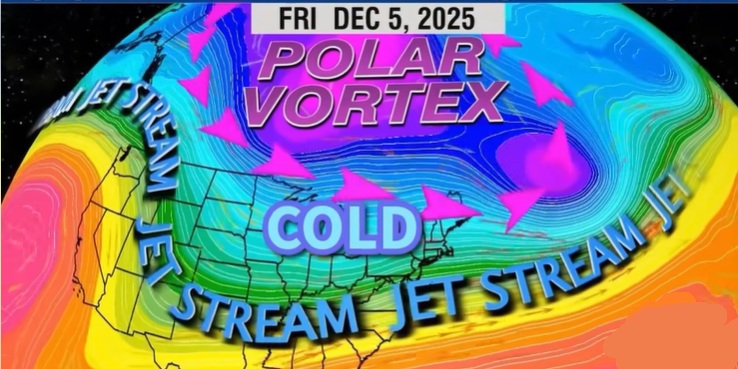
Over the next several days, the Northeastern United States will experience unusually cold temperatures delivered by what meteorologists call the Siberian Express — a mass of frigid Arctic air plunging southward into North America. While this may feel like a contradiction to global warming, it is in fact one of the clearest signatures of a destabilizing climate system. The very forces warming the planet overall are also helping unleash more extreme cold spells in the mid-latitudes.
At the heart of this counterintuitive pattern are two major disruptions: the weakening of the AMOC (Atlantic Meridional Overturning Circulation) and the increasing waviness and instability of the jet stream. These changes are direct consequences of unprecedented ocean heating and rapid Arctic amplification.
What Is the “Siberian Express”?
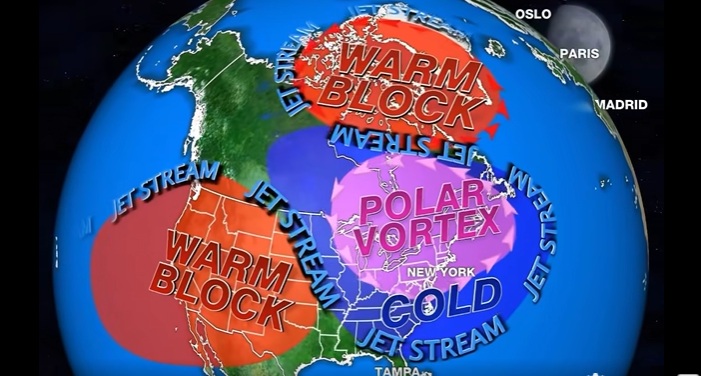
The “Siberian Express” refers to a weather pattern in which extremely cold, dense Arctic air is displaced from its usual position near the pole and funneled southward into North America. Despite the name, this air mass often forms in the Canadian Arctic, where strong high-pressure systems develop over extensive snow and ice. In this case, however, the cold air does originate in Russia and is being held north by a blocking high positioned between Russia and Canada. After sweeping over the Northwestern United States, the jet stream then dips sharply, steering the frigid air directly over Pennsylvania.
This displacement comes from:
- A weakened or disrupted polar vortex
- A deeply dipping jet stream
- A “cross-polar flow” pattern that bridges Asia, the Arctic, and North America
The jet stream acts like an atmospheric conveyor belt. When it becomes wavier and slower, it can scoop up Arctic air and drive it far south into the continental United States, delivering the kind of bitter cold typically confined to the high latitudes.
The blue and purple regions commonly shown on temperature anomaly maps reflect areas experiencing temperatures far below average during these events.
Why Global Warming Is Causing More Extreme Cold Bursts
At first glance, “global warming causes cold” seems paradoxical. But in a nonlinear climate system, warming does not simply raise all temperatures evenly—it disrupts circulation patterns that have stabilized Earth’s climate for thousands of years.
1. The Arctic Is Warming 3–4 Times Faster Than the Global Average
This process, called polar amplification, reduces the temperature contrast between the Arctic and the mid-latitudes — the very contrast that powers a strong, stable jet stream.
2. A Weaker Temperature Gradient Means a Weaker Jet Stream
With less difference between Arctic cold and mid-latitude warmth, the jet stream slows, becomes wavier, and meanders. These waves can dip deeply southward, dragging Arctic air with them.
3. A Disrupted Polar Vortex Spills Cold Air South
When the stratospheric polar vortex weakens or splits, cold air that was once confined to the Arctic is free to plunge into regions unaccustomed to such extremes.
Ocean Heating, AMOC Slowdown, and the Breakdown of Planetary Circulation
More than 90% of the excess heat trapped by greenhouse gases is absorbed by the oceans. This enormous thermal load is now reshaping planetary circulation systems, setting the stage for weather extremes of all kinds — including sudden, intense cold outbreaks.
Key destabilizing impacts of ocean warming:
- Weakening of the AMOC, which normally helps distribute heat from the tropics to the North Atlantic
- Slowing, stretching, and increased waviness of the jet stream, allowing Arctic air to spill south
- Persistent heat domes and atmospheric blocking patterns, which can trap cold air in place for days or weeks
- Amplification of storms, including more powerful nor’easters fueled by warm Atlantic waters
These shifts introduce chaotic behavior into global weather patterns—creating an atmosphere that oscillates between extremes: historic droughts one season, record floods the next, blistering heat followed by abnormal cold.
Cold Is Not a Contradiction — It’s a Symptom
The same climate forces that bring deadly heat waves, supercharged rainfall, intensifying hurricanes, and historic wildfires are also responsible for destabilizing winter.
Extreme cold events in a warming world are not only possible; they are increasingly expected.
The Siberian Express hitting the Northeast is not a sign that global warming has paused. It is evidence that the planetary circulation systems that once regulated our seasons are breaking down — and extremes of all kinds are becoming the new normal.
* Our probabilistic, ensemble-based climate model — which incorporates complex socio-economic and ecological feedback loops within a dynamic, nonlinear system — projects that global temperatures are becoming unsustainable this century. This far exceeds earlier estimates of a 4°C rise over the next thousand years, highlighting a dramatic acceleration in global warming. We are now entering a phase of compound, cascading collapse, where climate, ecological, and societal systems destabilize through interlinked, self-reinforcing feedback loops.
What Can I Do?
The single most important action you can take to help address the climate crisis is simple: stop burning fossil fuels. There are numerous actions you can take to contribute to saving the planet. Each person bears the responsibility to minimize pollution, discontinue the use of fossil fuels, reduce consumption, and foster a culture of love and care. The Butterfly Effect illustrates that a small change in one area can lead to significant alterations in conditions anywhere on the globe. Hence, the frequently heard statement that a fluttering butterfly in China can cause a hurricane in the Atlantic. Be a butterfly and affect the world.
Tipping points and feedback loops drive the acceleration of climate change. When one tipping point is breached and triggers others, the cascading collapse is known as the Domino Effect.
The Human Induced Climate Change Experiment