By Daniel Brouse and Sidd Mukherjee
Membrane Institute — Independent Climate and Physics Research
November 19, 2026
Introduction: More Than an El Niño
NOAA’s Climate Prediction Center confirmed in November 2026 that the 2026–2027 El Niño has reached its highest intensity classification: Very Strong, commonly referred to as a Super El Niño.
Although “Super El Niño” is a commonly used meteorological designation rather than a formal World Meteorological Organization classification, the measured ocean temperatures establish the exceptional intensity of this event.
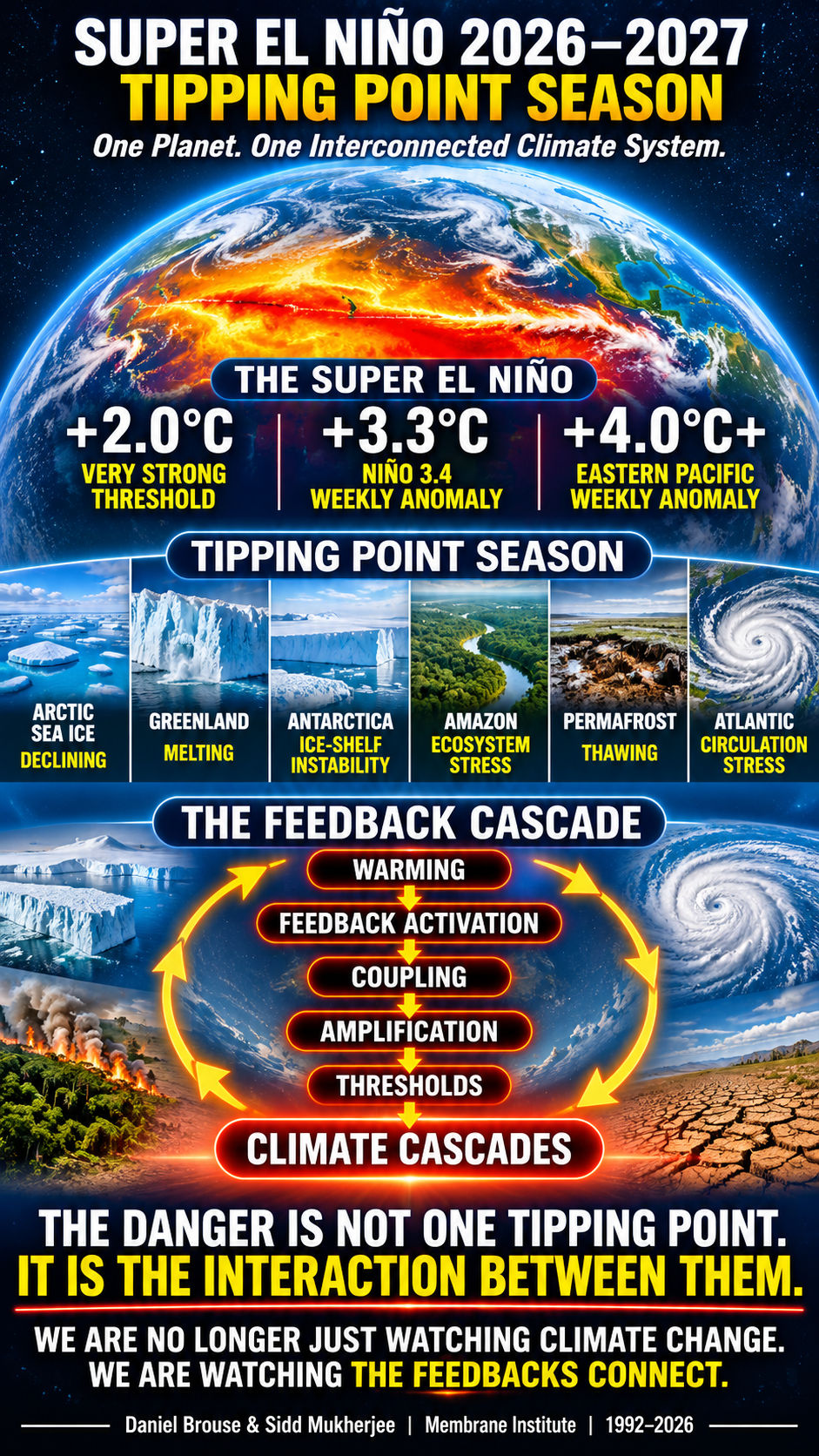
The three-month average sea surface temperature anomaly in the Niño 3.4 monitoring region has exceeded the +2.0°C (3.6°F) threshold associated with very strong El Niño conditions. Weekly sea surface temperature anomalies in portions of the eastern equatorial Pacific, particularly the Niño 3 region, have exceeded +4.0°C. Meanwhile, weekly anomalies across the broader central-eastern Niño 3.4 region have hovered around +3.3°C.
These measurements are important. But their greatest significance extends beyond the Pacific Ocean.
We are entering another critical phase of what we have identified as Tipping Point Season.
The 2026–2027 Super El Niño is developing within an Earth system already experiencing substantial accumulated energy, widespread warming, declining cryospheric stability, and increasingly interconnected climate feedbacks.
The question is no longer simply how much additional warming an El Niño will produce.
It is how that additional energy moves through the planetary climate system, which feedbacks it activates, and how those feedbacks interact with already destabilizing climate systems.
1. Tipping Point Season: The Larger Context
In our September 2026 paper, Tipping Point Season: Climate Change Hunting Manual, we identified 2023–2024 as the first observable tipping point season.
During that period, global temperatures exceeded the 1.5°C threshold for an extended period while nine major climate tipping systems exhibited observable destabilization:
- Greenland Ice Sheet
- West Antarctic Ice Sheet
- East Antarctic Subglacial Basins
- East Antarctic Ice Sheet
- Arctic Winter Sea Ice
- Amazon Rainforest
- Boreal Permafrost
- Labrador–Irminger Seas / Subpolar Gyre convection
- Atlantic Meridional Overturning Circulation (AMOC)
That period coincided with El Niño.
The important distinction is that El Niño does not cause anthropogenic climate change. It is a natural component of the climate system that redistributes accumulated ocean heat toward the atmosphere and surface.
However, the background conditions in which El Niño develops have changed dramatically.
The oceans have accumulated enormous quantities of additional energy. The cryosphere is losing reflective ice and snow. Atmospheric moisture and circulation patterns are changing. Terrestrial ecosystems are experiencing increasing heat and moisture stress.
Consequently, the same natural climate oscillation now operates within a substantially warmer and more energy-loaded planetary system.
Our concern is not simply another record-breaking temperature year.
It is the increasing interaction between climate systems already under stress.
2. The Super El Niño as an Earth-System Energy Redistribution Event
More than 90% of the excess heat accumulating in the climate system is stored in the oceans.
El Niño periodically redistributes some of this accumulated energy, particularly through changes in tropical Pacific ocean circulation, convection, and atmospheric circulation.
The exceptionally strong 2026–2027 event represents another major redistribution of that energy.
Its consequences extend well beyond the Pacific.
Ocean temperature anomalies alter atmospheric convection. Atmospheric circulation transports energy and moisture across continents and ocean basins. Changes in winds influence ocean upwelling, surface temperatures, precipitation, and storm development.
These processes interact with existing climate feedbacks.
The developing Pacific El Niño and Atlantic Niña configuration is particularly important because it illustrates how separate ocean basins can become connected through atmospheric circulation.
The sequence is:
PACIFIC WARMING
→ ATMOSPHERIC REROUTING
→ ATLANTIC COOLING
→ CHANGES IN OCEAN CIRCULATION
→ REGIONAL WEATHER AND HYDROCLIMATIC CONSEQUENCES
This is not a single atmospheric current traveling around the planet. It is a network of coupled oceanic and atmospheric responses operating across different geographic and temporal scales.
The significance is the connection itself.
One ocean changes. The atmosphere responds. Another ocean changes. Regional circulation patterns adjust. Feedbacks propagate.
One planet. One interconnected climate system.
3. The 1.5°C Tripwire and the Proliferation of Feedbacks
The 1.5°C threshold is frequently discussed as though it represents a simple temperature limit.
It does not.
In our research, we describe 1.5°C as a planetary tripwire because increasing global temperatures raise the probability of activating major climate tipping mechanisms.
The significance is not the difference between 1.4°C and 1.5°C. It is the increasing probability that interconnected climate systems will cross thresholds beyond which changes become self-reinforcing.
The 2026–2027 Super El Niño is expected to add substantial temporary warming to an already elevated global temperature baseline.
That additional warming compounds existing stresses on:
- Arctic and Antarctic sea ice
- Greenland and Antarctic ice sheets
- Mountain glaciers and permafrost
- Atlantic and Pacific ocean circulation
- Amazon rainforest stability
- Global coral reef ecosystems
- Atmospheric circulation and precipitation patterns
These systems do not operate independently.
Ice loss reduces planetary albedo. Permafrost thaw releases stored carbon. Forest degradation weakens carbon sinks. Greenland meltwater changes North Atlantic freshwater conditions. Ocean warming influences circulation and atmospheric energy exchange.
Each process changes the conditions under which other feedback mechanisms operate.
The resulting system is nonlinear.
Warming → Feedback Activation → Coupling → Amplification → Thresholds → Cascades
This is the central distinction between conventional linear warming projections and our Nonlinear Climate Acceleration Hypothesis.
4. Comingling Tipping Points: The Emerging Planetary Network
The most important development during Tipping Point Season is not necessarily the activation of any single tipping point.
It is the increasing evidence of interactions between multiple tipping systems.
Consider the connections:
Polar Ice and Ocean Circulation
Arctic sea ice loss reduces albedo and amplifies regional warming. Greenland ice loss introduces freshwater into the North Atlantic. Changes in ocean temperature, salinity, and stratification interact with Atlantic circulation.
Glaciers, Permafrost, and Mountain Stability
Rising temperatures accelerate glacier retreat and permafrost thaw. Frozen ground loses structural strength. Mountain slopes destabilize, increasing the likelihood of cascading failures involving ice, rock, water, and sediment.
Amazon Dieback and Carbon Feedbacks
Heat, drought, and changing rainfall patterns stress rainforest ecosystems. Forest degradation reduces carbon storage and can disrupt regional precipitation. These changes increase pressure on other climate-sensitive systems.
Coral Reefs and Recovery Windows
Repeated marine heatwaves produce bleaching and mortality. As the interval between major heat events decreases, ecosystems have less time to recover before the next disturbance.
Atmospheric Rivers, Foehn Winds, and Greenland
Atmospheric rivers transport heat and moisture toward Greenland. Topography can transform these systems into powerful foehn winds. Rainfall, warm air, surface melting, and declining albedo reinforce ice loss and freshwater discharge.
These are not isolated climate stories.
They are interconnected processes involving the redistribution of energy throughout the Earth system.
The Super El Niño adds another major disturbance to this already interconnected network.
5. The Second Derivative of the Climate Problem
One of the central concepts in our research is that climate change must be evaluated not only by the magnitude of warming, but also by the changing rate and acceleration of its consequences.
A temperature increase is a first-order observation.
An increasing rate of change is acceleration.
But when the interactions between climate feedbacks themselves begin strengthening, the problem becomes more complicated.
We describe this as the second derivative of the problem: the emergence of increasingly consequential interactions between destabilizing systems.
The concern is that one climate disturbance increasingly becomes the starting point for another.
Ice loss changes albedo. Atmospheric warming increases moisture. Permafrost thaw destabilizes landscapes and releases carbon. Ocean circulation changes redistribute heat and freshwater. Ecosystem degradation weakens natural carbon sinks.
The feedbacks begin reinforcing one another.
The result is not simply more warming.
It is a climate system undergoing increasingly complex and potentially accelerating structural change.
The 2026–2027 Super El Niño provides an important opportunity to observe these interactions as they unfold.
6. What We Are Watching During Tipping Point Season
The immediate scientific priority is to monitor how the additional ocean-atmosphere energy associated with this Super El Niño interacts with existing climate-system vulnerabilities.
Among the most important indicators are:
- Ocean Heat Content: Continued accumulation and redistribution of excess ocean energy.
- Sea Ice and Albedo: Changes in reflective surface area and the resulting amplification of warming.
- Greenland and Antarctic Ice: Surface melting, basal melting, ice-shelf weakening, freshwater discharge, and grounding-line retreat.
- Atmospheric Circulation: Changes in planetary wave patterns, jet streams, atmospheric rivers, and regional circulation.
- Ocean Circulation: Interactions between Pacific and Atlantic temperature anomalies, freshwater input, and North Atlantic circulation.
- Permafrost and Mountain Stability: Increasing thaw, landscape destabilization, and associated carbon release.
- Terrestrial Ecosystems: Forest stress, drought, fire, changing rainfall, and declining carbon-sink capacity.
- Marine Ecosystems: Repeated coral bleaching, ocean heat stress, and diminishing recovery periods.
These indicators must be evaluated together.
Examining each one independently risks overlooking the most consequential development: the coupling and amplification of feedbacks across the planetary system.
Conclusion: We Are Not Watching One Tipping Point
The 2026–2027 Super El Niño is not simply another powerful El Niño event.
It is developing during a period when multiple climate systems are already experiencing destabilization, when the 1.5°C tripwire has been crossed in recent global annual temperature assessments, and when interactions between oceanic, atmospheric, cryospheric, and terrestrial systems are becoming increasingly important.
Our research has consistently emphasized that the greatest climate danger lies not in any single feedback mechanism or tipping point.
It lies in their interactions.
The Super El Niño provides another powerful example of how accumulated planetary energy can be redistributed through the climate system, influencing conditions across multiple interconnected regions.
The central scientific question is therefore not simply whether this El Niño produces another record-breaking global temperature.
It is whether the additional energy accelerates existing feedbacks, strengthens connections between destabilizing systems, and pushes additional climate components toward critical thresholds.
We are no longer simply hunting for individual tipping points. We are watching the connections between them.
Tipping points come together. Feedbacks proliferate. Interactions strengthen. Acceleration emerges.
That is the significance of Tipping Point Season.
One planet. One interconnected climate system. And a growing network of feedbacks that must be understood together.
Daniel Brouse — Climatologist and Economist
Sidd Mukherjee — Physicist
Related research: Tipping Point Season: Climate Change Hunting Manual
https://www.kingarthur.com/global_warming/Tipping-Point-Season.html