by Daniel Brouse and Sidd Mukherjee
Emerging Feedback Coupling: Overwintering Wildfires, Carbon Release, Methane Emissions, Albedo Reduction, and Permafrost Degradation
Simplified Overview
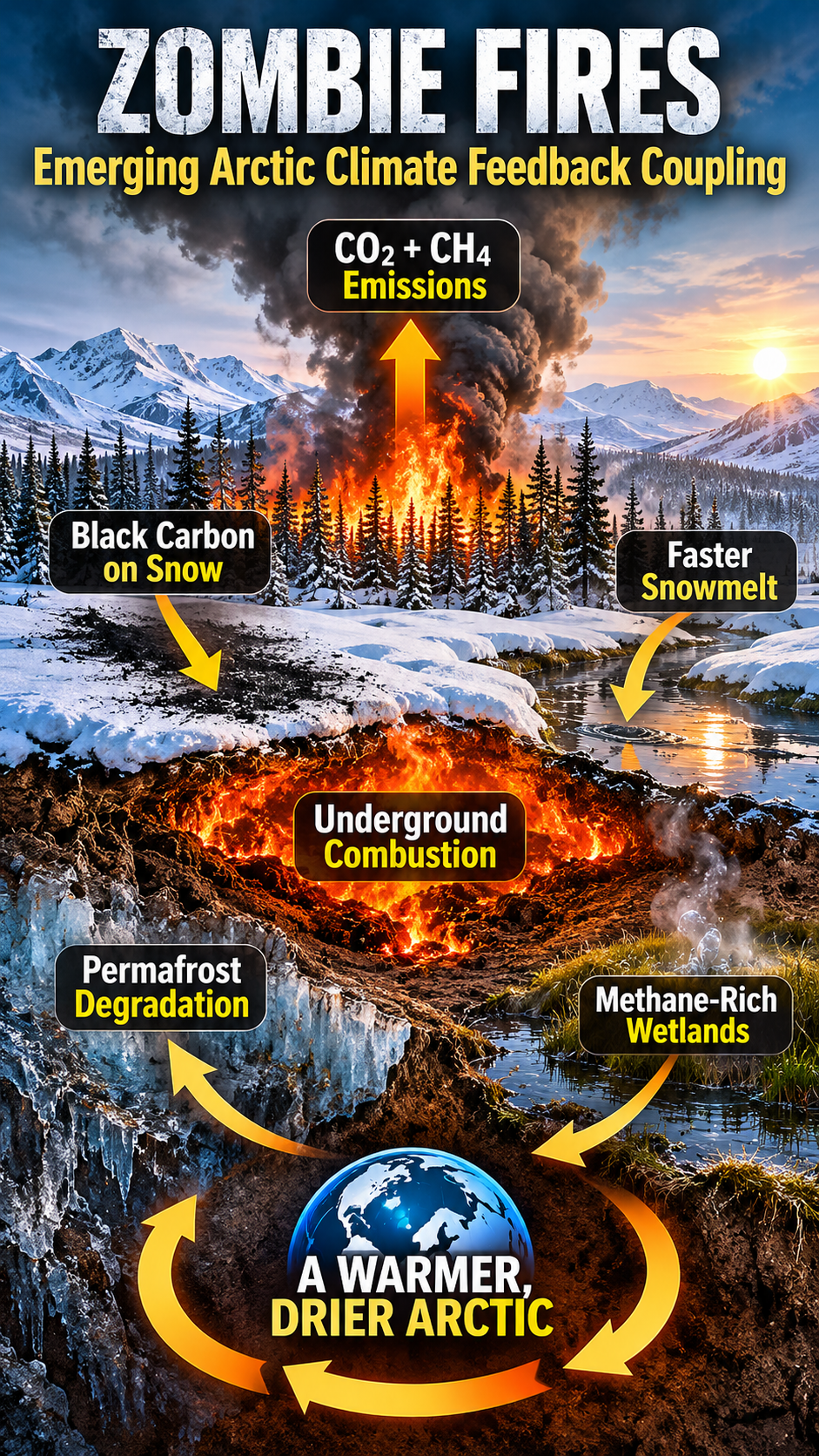
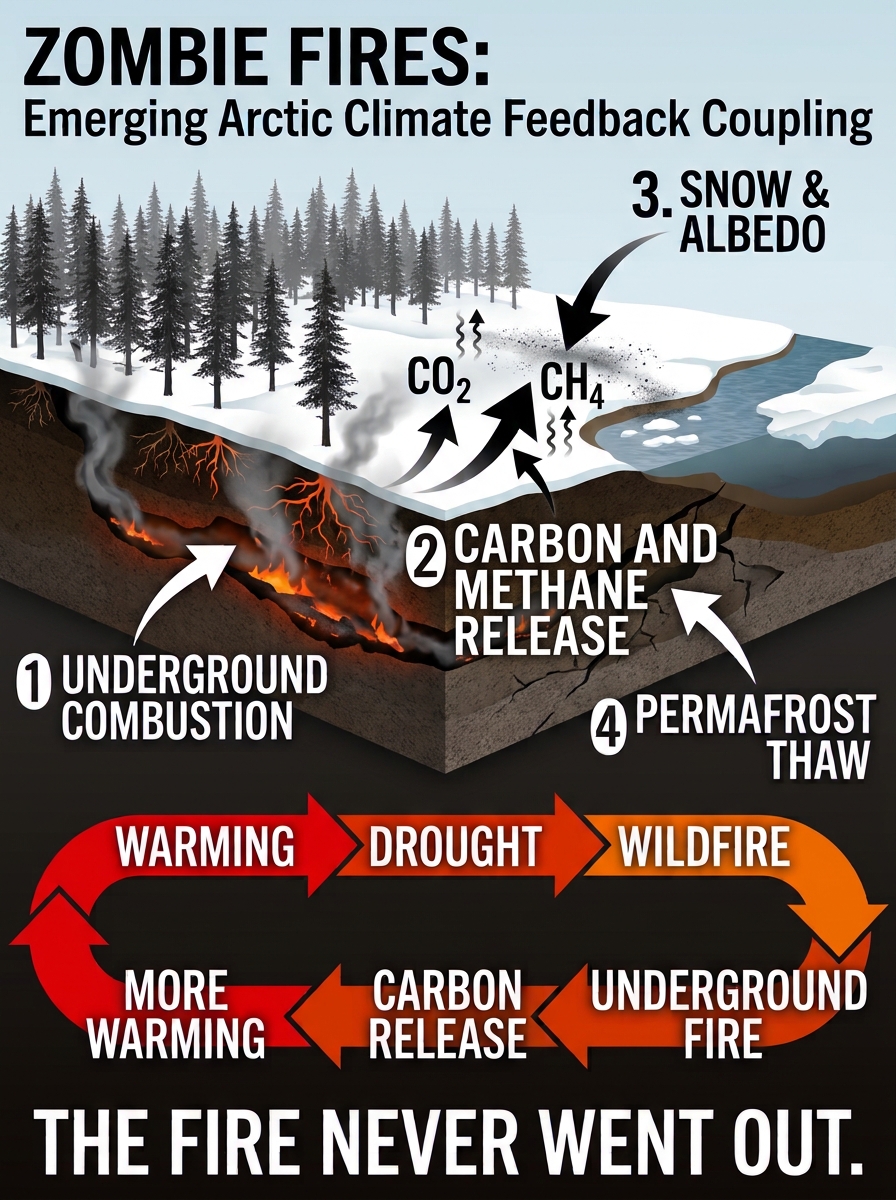
🔥 ZOMBIE FIRES: Emerging Arctic Climate Feedback Coupling
Wildfires don’t always end when the flames disappear. In Arctic and boreal regions, fires can continue smoldering underground through the winter, hidden beneath snow and ice, only to reemerge in spring.
These zombie fires connect multiple climate feedback mechanisms:
🔥 Underground combustion releases stored carbon, including CO₂ and CH₄.
🌫️ Black carbon deposition darkens snow and ice, reducing reflectivity and accelerating melting.
🧊 Permafrost degradation exposes ancient organic carbon to decomposition.
💨 Methane-producing wetlands develop in suitable waterlogged, oxygen-poor conditions, adding another source of greenhouse gas emissions.
The result is an interconnected feedback network: warming and drought promote wildfire; underground combustion, carbon release, albedo reduction, and permafrost thaw intensify warming; and those changes increase the conditions favoring future fires.
The fire never went out. The feedbacks keep burning.
#ZombieFires #ClimateFeedbacks #ArcticWarming #Permafrost #Methane #ClimateScience #ClimateChange
Introduction
“Zombie fires”—also known as holdover or overwintering fires—are wildfires that survive winter by smoldering underground in carbon-rich peat, organic soils, and root systems before reemerging at the surface the following spring. These persistent fires represent an emerging positive climate feedback mechanism in Arctic and subarctic boreal forests.
As global temperatures rise, increasingly severe heatwaves, prolonged droughts, and declining soil moisture create conditions favorable to larger and more intense wildfires. Some of these fires penetrate deep into organic soils, where they continue smoldering beneath winter snow cover. Their persistence extends wildfire activity beyond the conventional fire season, allowing combustion to continue for months.
The resulting carbon emissions, methane release, black carbon deposition, snow and ice degradation, and permafrost thaw establish interconnected feedback pathways. These mechanisms reinforce one another, intensifying warming and changing the environmental conditions that determine future wildfire activity.
An especially important component is methane (CH₄), which enters this feedback network through both incomplete underground combustion and microbial decomposition of thawing organic matter. These pathways connect wildfire persistence to the Arctic methane cycle, expanding the climate consequences beyond conventional wildfire carbon emissions.
This feedback network operates through five interconnected climate mechanisms.
1. The Carbon Bomb: Greenhouse Gas Emissions
Arctic and subarctic boreal forests, peatlands, and organic soils contain enormous quantities of carbon accumulated over thousands of years. These ecosystems function as major terrestrial carbon reservoirs, storing organic matter that would otherwise contribute to atmospheric greenhouse gas concentrations.
Zombie fires threaten these long-established carbon reserves.
- Deep Underground Combustion: Unlike conventional surface wildfires, which primarily consume vegetation and surface organic matter, zombie fires can penetrate deep into carbon-rich peat deposits and interconnected root systems. They continue consuming these underground fuel sources long after surface flames disappear.
- Sustained Greenhouse Gas Emissions: Prolonged subterranean combustion releases carbon dioxide (CO₂), methane (CH₄), carbon monoxide (CO), and other combustion products. Methane emissions are particularly relevant during incomplete combustion and oxygen-limited smoldering.
- Carbon Sink Degradation: Repeated burning destroys accumulated organic matter and damages the ability of boreal forests and peatlands to store carbon, potentially transforming long-term carbon reservoirs into net sources of atmospheric emissions.
The Feedback Loop:
Underground combustion → CO₂ + CH₄ emissions → Increased atmospheric greenhouse forcing → Arctic warming → Soil drying → Increased wildfire susceptibility → More underground combustion.
The result is a self-reinforcing cycle in which warming increases fire activity, and fire activity adds further greenhouse gases to the atmosphere.
2. Methane Amplification: The Permafrost–Wetland Connection
Methane introduces an additional and particularly important feedback pathway connecting underground fires, permafrost degradation, and northern wetland ecosystems.
Methane is a potent greenhouse gas with a substantially greater warming influence per unit mass than CO₂ over commonly used assessment periods. Although it remains in the atmosphere for a much shorter time, additional methane emissions intensify near-term warming.
Zombie fires contribute to this pathway through two distinct mechanisms.
- Direct Combustion Emissions: Smoldering peat and organic matter release methane when combustion is incomplete. The quantity depends on fuel composition, temperature, moisture, and oxygen availability.
- Thaw-Driven Methane Production: Wildfire damage to insulating vegetation and organic soil layers exposes permafrost to additional heat. As frozen organic matter thaws, microorganisms decompose previously preserved carbon.
- Anaerobic Methane Production: In waterlogged, oxygen-poor soils and newly formed wetlands, microbial decomposition produces methane through methanogenesis. This creates an additional source of atmospheric greenhouse gas emissions.
- Changing Wetland Hydrology: Permafrost degradation alters ground stability, drainage, and water-table levels. Thermokarst collapse and newly inundated areas can create favorable conditions for methane production, while better-drained, oxygen-rich soils generally favor CO₂ production over methane.
- Methane–Warming Reinforcement: Additional atmospheric methane increases greenhouse forcing, contributing to further Arctic warming, permafrost degradation, and changes in ecosystem hydrology.
The Feedback Loop:
Wildfire → Loss of insulating organic layers → Permafrost thaw → Thawing organic carbon → Anaerobic microbial decomposition → Methane production → Increased atmospheric greenhouse forcing → Additional warming → Further permafrost degradation.
This pathway is particularly important because it connects wildfire-induced landscape changes to microbial processes that continue producing greenhouse gases even after the original fire has disappeared.
The critical distinction: Permafrost thaw does not automatically produce methane. Wetness, water-table depth, oxygen availability, soil temperature, and vegetation determine whether thawed carbon is released predominantly as CO₂ or CH₄. Both pathways contribute to climate warming, but wetland formation and waterlogged conditions can substantially increase methane emissions. PubMed+2
3. Albedo Reduction: The Black Carbon Effect
Zombie fires amplify regional warming through changes in surface reflectivity, known as albedo. Snow and ice normally reflect a substantial portion of incoming solar radiation. Black carbon deposition reduces that reflectivity and increases solar energy absorption.
- Early Spring Reemergence: Because zombie fires survive winter underground, they can reignite at the surface during early spring, sometimes while extensive snow cover remains.
- Black Carbon Deposition: Smoke from these fires contains black carbon (soot), which can travel through the atmosphere and settle on surrounding snow and ice.
- Accelerated Snowmelt: Darkened snow absorbs more incoming solar radiation than clean snow, accelerating melting and exposing darker underlying soil and vegetation.
- Extended Seasonal Warming: Earlier snow disappearance reduces surface reflectivity and increases regional heat absorption, contributing to longer periods of exposed, combustible terrain.
The Feedback Loop:
Zombie fires → Black carbon emissions → Snow and ice darkening → Reduced albedo → Increased solar absorption → Accelerated snowmelt → Greater surface warming → Increased fire susceptibility.
This mechanism couples wildfire activity directly to the Arctic albedo feedback, amplifying the effects of regional warming.
4. Permafrost Degradation: Unlocking Ancient Carbon and Methane
Permafrost is ground that remains frozen for at least two consecutive years. Across Arctic and subarctic landscapes, it preserves enormous quantities of ancient organic carbon that accumulated under cold conditions.
Rising temperatures and increasingly severe wildfires are destabilizing this frozen carbon reservoir.
- Loss of Insulation: Wildfires consume surface vegetation and organic soil layers that normally insulate underlying permafrost from summer heat. Underground smoldering can further damage these protective layers.
- Accelerated Thaw: The loss of insulating organic material increases ground exposure to heat, accelerating permafrost degradation and destabilizing previously frozen terrain.
- Ancient Carbon Release: As permafrost thaws, microorganisms decompose previously frozen organic matter, releasing additional carbon dioxide and methane.
- Methane-Producing Wetlands: Ground collapse and thermokarst formation can create waterlogged depressions and expanding wetlands. Under oxygen-poor conditions, microbial decomposition produces methane, creating an additional greenhouse gas feedback.
- Changing Soil Moisture: Altered drainage can produce both wetter and drier landscapes. Wet, oxygen-poor conditions favor methane production, while dry, oxygen-rich conditions generally favor CO₂ production and increase the susceptibility of organic soils to burning.
The Feedback Loop:
Wildfire → Loss of insulating organic layers → Permafrost degradation → Thawing ancient carbon → CO₂ + CH₄ emissions → Increased atmospheric warming → Further permafrost degradation.
The methane pathway adds another dimension: permafrost degradation changes not only the amount of carbon released but also the form in which it enters the atmosphere.
5. Emerging Feedback Coupling: The Zombie Fire Network
Zombie fires do not operate as an isolated climate feedback. They connect multiple warming mechanisms into an interconnected system in which atmospheric, terrestrial, cryospheric, and biological processes reinforce one another.
The principal pathways include:
| Feedback pathway | Process | Climate impact |
|---|---|---|
| Carbon emissions | Underground combustion releases stored carbon | Increased greenhouse gas forcing |
| Direct methane emissions | Incomplete combustion releases CH₄ | Additional atmospheric warming |
| Methane production | Thawing organic matter decomposes under anaerobic conditions | Additional CH₄ emissions |
| Albedo reduction | Black carbon darkens snow and ice | Increased solar absorption |
| Snowmelt acceleration | Reduced reflectivity advances seasonal melting | Longer periods of surface warming |
| Permafrost degradation | Fire removes insulating organic layers | Thaw and additional carbon release |
| Wetland transformation | Thermokarst and changing water tables alter microbial activity | Increased methane production in suitable conditions |
| Soil moisture depletion | Heat, drought, and vegetation loss dry susceptible terrain | Increased fire susceptibility |
| Fire persistence | Underground combustion survives winter | Extended combustion and earlier seasonal reemergence |
These pathways interact rather than operate independently. Carbon emissions intensify atmospheric warming, while albedo reduction increases surface energy absorption. Permafrost degradation releases additional greenhouse gases, and changing hydrology can create methane-producing wetlands.
The resulting system creates multiple reinforcing pathways:
Carbon pathway:
Wildfire → Underground combustion → CO₂ emissions → Atmospheric warming → Permafrost degradation → Additional carbon release.
Methane pathway:
Permafrost thaw → Changing hydrology → Waterlogged organic soils → Anaerobic decomposition → CH₄ emissions → Increased greenhouse forcing → Additional warming.
Albedo pathway:
Zombie fires → Black carbon → Snow darkening → Albedo reduction → Increased solar absorption → Arctic warming.
Terrestrial pathway:
Arctic warming → Soil drying → Increased fire susceptibility → More zombie fires.
The convergence of these pathways represents emerging cross-system feedback coupling: multiple environmental processes interacting to amplify the same underlying warming trend.
The Zombie Fire Cycle: From Summer Wildfire to Spring Resurrection
| Phase | Process | Climate consequence |
|---|---|---|
| 1. Trigger | Rising temperatures, heatwaves, and drought dry vegetation and organic soils. | Increased wildfire frequency and intensity. |
| 2. Deep Combustion | Fires penetrate carbon-rich peat and underground root systems. | Destruction of long-stored carbon and sustained CO₂ and CH₄ emissions. |
| 3. Overwintering | Underground fires continue smoldering beneath winter snow cover. | Combustion persists beyond the conventional fire season. |
| 4. Resurrection | Fires reemerge at the surface during the following spring. | Earlier wildfire activity and additional black carbon emissions. |
| 5. Permafrost Degradation | Fire-damaged vegetation and organic layers expose frozen ground to additional heat. | Accelerated thaw and release of previously frozen carbon. |
| 6. Methane Amplification | Thaw-related changes in hydrology create waterlogged, oxygen-poor environments in some locations. | Increased microbial methane production and atmospheric greenhouse forcing. |
| 7. Recurrence | Warming, drought, and changing landscape conditions increase fire vulnerability. | Reinforcement of future wildfires and overwintering fires. |
Monitoring and Suppression: Detecting Fires Before They Resurface
As overwintering fires become an increasingly important concern in northern ecosystems, detecting underground combustion before spring reemergence is essential.
Traditional wildfire surveillance focuses primarily on visible surface flames and active fire seasons. Zombie fires require a different approach.
Advanced monitoring technologies, including wintertime infrared surveillance, thermal anomaly detection, and satellite-based observations, can help identify persistent underground combustion beneath snow-covered landscapes.
Combining thermal observations with ground-based measurements, soil moisture monitoring, and atmospheric greenhouse gas measurements can improve the identification of vulnerable peatlands and help distinguish direct fire emissions from methane released through wetland and permafrost processes.
Early detection is particularly important because preventing an overwintering fire from reemerging can limit additional carbon emissions, protect vulnerable ecosystems, and reduce the likelihood of another season of persistent underground combustion.
Conclusion: An Emerging Arctic Climate Amplifier
Zombie fires demonstrate how climate warming can transform conventional wildfire activity into a persistent, interconnected climate feedback system.
These fires do more than consume vegetation. They penetrate ancient carbon reservoirs, release greenhouse gases, deposit black carbon on reflective snow and ice, damage the insulating layers protecting permafrost, and extend combustion beyond the normal wildfire season.
The addition of methane substantially expands this feedback network. Direct methane emissions from incomplete combustion combine with methane production from thawing, waterlogged organic soils. These mechanisms connect wildfire activity to microbial carbon decomposition, wetland transformation, and the broader Arctic methane cycle.
The resulting feedbacks connect the carbon cycle, methane cycle, atmospheric warming, surface albedo, soil moisture, and permafrost degradation.
Warming → Drought → Wildfire → Underground Combustion → CO₂ + CH₄ Emissions → Albedo Reduction → Permafrost Degradation → Methane Production → Additional Warming.
What begins as a wildfire can become a year-round source of combustion and a catalyst for multiple interacting climate feedbacks.
Zombie fires are not simply wildfires that refuse to die. They are an emerging component of the broader Arctic climate feedback network, where combustion, carbon release, methane production, and cryosphere degradation reinforce one another.
Additional scientific references
These are particularly useful additions to your existing sources list:
1. Zhu et al. (2026), Science: Decadal doubling of Siberian methane emissions due to warming-induced fires and methanogenesis. Documents increasing Siberian methane emissions and distinguishes fire-related emissions in eastern Siberia from wetland-related emissions in western Siberia. PubMed
2. Dynamics of methane flux in permafrost-affected wetlands (2025): Environmental Pollution. Examines the influence of permafrost continuity, water-table depth, and vegetation on methane emissions. ScienceDirect
3. Cui et al. (2024): Wetland hydrological dynamics and methane emissions. Examines how changing hydrology influences methane production and transport. Nature
4. Schuur et al. (2022): Permafrost and Climate Change: Carbon Cycle Feedbacks From the Warming Arctic. Comprehensive review of permafrost carbon release and CO₂/CH₄ feedbacks.
Note:
The most important observation is the explicit connection between four previously distinct climate feedback domains:
- Terrestrial carbon release: Underground peat combustion, vegetation loss, and permafrost thaw release long-stored organic carbon.
- Atmospheric greenhouse gas accumulation: CO₂ and CH₄ emissions intensify atmospheric greenhouse forcing and accelerate warming.
- Cryosphere degradation and albedo reduction: Black carbon deposition darkens snow and ice, reducing reflectivity and accelerating snowmelt.
- Methane-producing wetland transformation: Permafrost thaw, thermokarst formation, and changing hydrology create waterlogged, oxygen-poor environments that promote microbial methane production.
ZOMBIE FIRE–OVERWINTERING COMBUSTION FEEDBACK: Arctic + boreal warming → increased heatwaves + drought → drying vegetation + carbon-rich peat soils → wildfire → deep underground smoldering in peat + organic root systems → combustion persists beneath winter snow cover → sustained release of stored organic carbon as CO₂ + CH₄ + other combustion products → increased atmospheric greenhouse forcing → further warming → increased fire susceptibility → recurring overwintering fires ↺
ZOMBIE FIRE–SNOW–ALBEDO CROSS-LINK: Overwintering wildfire → spring surface reemergence → smoke + black carbon emissions → soot deposition on snow + ice → reduced surface reflectivity → increased absorption of incoming solar radiation → accelerated snowmelt + earlier exposure of darker land surfaces → additional regional warming → increased wildfire susceptibility ↺
ZOMBIE FIRE–PERMAFROST–CARBON–METHANE COUPLING: Arctic warming + wildfire → underground peat combustion + loss of insulating vegetation and organic soil layers → altered ground thermal properties → deeper seasonal thaw + permafrost degradation → exposure of previously frozen organic carbon to microbial decomposition → aerobic decomposition → additional CO₂ emissions + anaerobic decomposition in waterlogged, oxygen-poor soils and wetlands → CH₄ production → increased atmospheric greenhouse forcing → further warming + permafrost thaw → increased fire susceptibility in vulnerable landscapes ↺
ZOMBIE FIRE–SYSTEM-WIDE FEEDBACK COUPLING: Atmospheric warming + drought → wildfire → underground combustion → persistent CO₂ + CH₄ emissions + black carbon deposition → reduced snow + ice albedo + accelerated permafrost degradation → thawing ancient organic carbon → microbial decomposition + methane-producing wetland formation in suitable conditions → additional CO₂ + CH₄ emissions → increased atmospheric greenhouse forcing + surface warming → vegetation stress + soil moisture depletion → increased wildfire activity → additional overwintering fires and carbon release ↺