by Daniel Brouse
Climate Change Is Altering the Conditions That Destabilize Slopes
CONNELLSVILLE, PENNSYLVANIA — OCTOBER 17, 2026
A woman was killed when a falling rock pinned her and her husband while they were bicycling on the Great Allegheny Passage near Connellsville, Pennsylvania. Her husband was seriously injured and airlifted to a hospital. The Pennsylvania Department of Conservation and Natural Resources is investigating the fatal landslide.
This tragedy illustrates a geological hazard that climate change can make more dangerous: the progressive destabilization of rock faces and slopes.
Earthquakes, erosion, gravity, rainfall, and natural weathering have always caused rockfalls. But climate change is altering the background conditions under which these processes operate. Warming, changing precipitation, shifting freeze–thaw patterns, and changing water movement can interact with existing geological weaknesses, contributing to slope instability.
The critical question is not whether climate change created the rocks or the hillside. It is whether changing climate conditions are accelerating the processes that cause rock to break loose.
Pennsylvania Weather: The Conditions Before the Collapse
Historical weather records for Connellsville document a substantial temperature swing during the days preceding the October 17 rockfall.
The recorded sequence was:
| Date | Reported temperature |
|---|---|
| October 13 | High of 82°F |
| October 14 | High of 77°F |
| October 15 | High of 68°F |
| October 16 | High of 77°F |
| October 17 | Low of 36°F |
Historical hourly observations also show rain during October 16 and into the early hours of October 17, followed by much cooler conditions.
The reported October 13 high of 82°F and October 17 morning temperature near 36°F represent a temperature difference of approximately 46°F over four days.
These observations provide a concrete starting point for investigating the environmental conditions preceding the collapse.
The sequence of warming, rainfall, and cooling deserves examination because temperature changes can stress fractured rock, while infiltrating water can alter the forces holding rock masses together.
The weather sequence is documented. Its contribution to the rockfall remains a question for geological investigation.
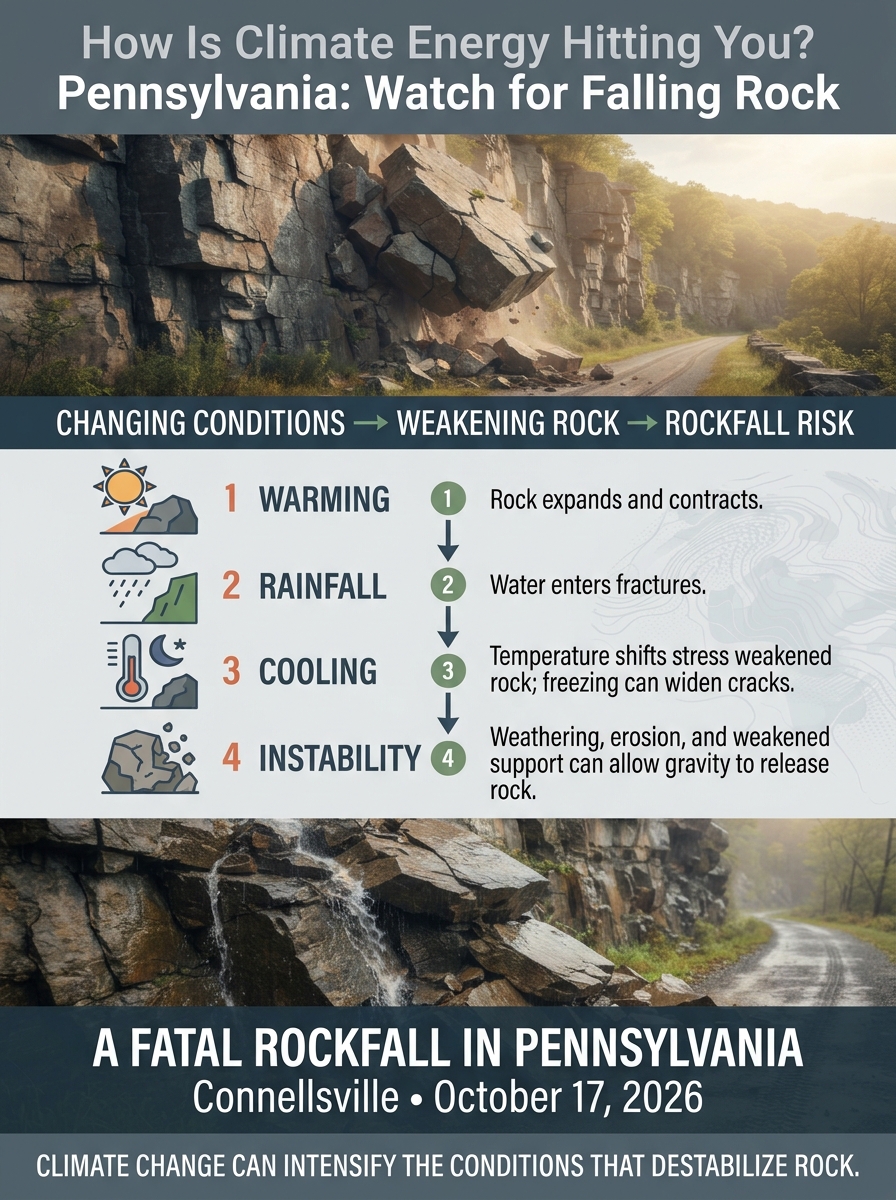
Four Ways Climate and Weather Can Destabilize Pennsylvania Rock Faces
1. Thermal Expansion and Contraction: Repeated Stress on Fractured Rock
Rock expands as it heats and contracts as it cools. Different minerals respond differently to temperature changes, producing internal stresses that can contribute to cracking and progressive deterioration.
Repeated heating and cooling can gradually weaken susceptible rock, particularly where fractures and joints already exist. This process is known as thermal fatigue.
The Connellsville weather record shows a substantial change in air temperature between October 13 and October 17. Even though the temperature log at the nearest weather station recorded a low of 36°F, microclimates along deep, shaded cliff faces can behave differently.
A large air-temperature swing does not prove that thermal stress triggered this particular collapse. Nevertheless, the mechanism is established and relevant to evaluating the stability of exposed, fractured rock.
2. Freeze–Thaw Weathering: Water Can Widen Existing Fractures
Water enters cracks in rock. When it freezes, ice can exert pressure that widens fractures, particularly where water is confined. Repeated freezing and thawing can progressively loosen blocks until gravity causes them to fall.
The Connellsville-area records show temperatures approaching or reaching the freezing point in the broader period around the incident. The October 17 morning readings include temperatures near a daily low of 36°F.
Climate change modifies the conditions under which freeze–thaw weathering occurs. Warmer winters can reduce freezing in some locations, while changing seasonal temperature patterns can alter when freezing and thawing occur in others.
The local consequences depend on rock type, moisture, exposure, and the frequency and duration of freezing.
3. Rainfall and Water Pressure: Destabilizing Slopes From Within
Rainfall is a major trigger of landslides and slope failures.
Water infiltrating fractured rock and surrounding soil can increase pore-water pressure, reduce the effective forces resisting movement, and weaken susceptible slopes. Runoff can also erode material supporting a rock face, leaving overhanging or poorly supported blocks.
Historical hourly observations for Connellsville show rain during October 16 and into the early hours of October 17. This makes the timing and amount of precipitation important subjects for the investigation.
Climate change is increasing heavy precipitation in many regions, including parts of the eastern United States. A warmer atmosphere can hold more water vapor, contributing to heavier precipitation when atmospheric conditions support rainfall.
Where rainfall intensifies, climate change can increase the conditions that lead to slope failure. Whether it did so in this incident requires a local climate and geological assessment.
4. Vegetation, Roots, and Long-Term Weathering
Plant roots can enter existing rock fractures and gradually widen them. Vegetation can also stabilize soil, reduce erosion, and alter water movement through a slope. Its overall effect depends on the terrain and the type and distribution of vegetation.
Changes in temperature, growing seasons, drought, and precipitation can alter these interactions over time.
A rock face can weaken through years of weathering before a particular combination of rainfall, temperature changes, erosion, or other disturbances contributes to a sudden failure.
The Climate Connection: From Individual Hazards to Accelerating Change
Climate change does not have to create a new geological hazard to make existing hazards more dangerous.
The relevant distinction is between the underlying geological structure and the environmental conditions that influence its stability.
A fractured rock face may remain in place for decades. Changes in temperature, water infiltration, erosion, or the removal of supporting material can gradually alter its stability. Eventually, a relatively small additional disturbance may be sufficient to trigger a collapse.
Where warming or changing precipitation increases a known destabilizing process, the resulting hazard can become more severe.
The same principle applies to infrastructure, roads, railways, hiking trails, and communities built beneath steep slopes.
Global Case Studies: The Scale of Slope Instability
Western North Carolina — September 2024
Hurricane Helene produced extreme rainfall across parts of the southern Appalachians. The U.S. Geological Survey initially identified more than 2,200 landslides associated with the event, with subsequent mapping identifying additional failures.
The landslides damaged roads and other infrastructure and isolated communities.
Helene illustrates how extreme rainfall interacting with susceptible terrain can produce widespread slope failures. Determining the contribution of climate change to the storm and its associated landslides requires separate attribution analysis.
New Zealand — February 2023
Cyclone Gabrielle triggered hundreds of thousands of landslides across affected parts of New Zealand. Government assessments have reported different totals depending on geographic coverage and mapping scope, with estimates exceeding 300,000 and broader national summaries reporting more than 800,000.
The event demonstrates how severe rainfall can produce extensive landsliding across a large region.
The physical mechanism is well established: rainfall infiltrates susceptible terrain, increases water pressure, and can reduce the forces resisting slope movement. The event’s scale alone does not determine the proportion attributable to climate change.
European Alps — Warming, Permafrost Thaw, and Rockfall
Research in the European Alps has documented the destabilizing effects of permafrost thaw and changing glacier conditions. Warm periods can increase concern about rockfall where ice within fractures contributes to rock-mass stability.
The Intergovernmental Panel on Climate Change identifies glacier retreat and permafrost thaw as important drivers of changing mountain hazards.
These processes show how climate change can affect the physical structure of terrain, not simply the weather experienced at the surface.
Himalayas — Multiple Interacting Hazards
The Himalayan region faces risks from intense rainfall, landslides, glacier retreat, permafrost degradation, and glacial-lake outburst floods.
These hazards can interact, producing cascades in which slope failures contribute to debris flows, river blockages, and downstream flooding.
What Pennsylvania Should Do Now
The Connellsville tragedy warrants more than a general discussion of climate change. It calls for a thorough investigation of the failed slope and the conditions preceding its collapse.
Investigators should examine:
- The failure surface, rock type, fracture patterns, and evidence of previous movement.
- Recent rainfall, drainage, and the possibility of water infiltration into the slope.
- Temperature records and the potential effects of heating, cooling, and localized freezing.
- Evidence of erosion, vegetation-related changes, or the loss of material supporting the rock face.
- Long-term local climate records to determine whether relevant temperature or precipitation patterns have changed.
- Similar slopes along the Great Allegheny Passage and other Pennsylvania trails, particularly where rock faces overhang public routes.
Trail managers and transportation authorities should evaluate unstable slopes using current geological assessments and weather-related risk factors rather than relying exclusively on historical conditions.
A hazard that has remained stable for decades is not necessarily guaranteed to remain stable under changing environmental conditions.
Conclusion: Climate Change Can Alter the Conditions That Cause Rockfalls
The fatal rockfall near Connellsville occurred after a documented sequence of warm weather, rainfall, and cooling. That sequence merits examination because temperature changes and water infiltration can contribute to the deterioration and destabilization of fractured rock.
The underlying mechanisms are real, and climate change is altering temperature and precipitation patterns in ways that can increase geological hazards in susceptible locations.
Pennsylvania faces a combination of geological conditions, but the fundamental lesson is the same: rockfalls are not simply events involving gravity. They are often the final stage of a longer process involving fractures, water, weathering, erosion, and changing environmental conditions.
Climate change does not have to create a geological hazard to increase the conditions under which it occurs.
The appropriate response is neither to attribute every rockfall to climate change nor to ignore the climate connection. It is to investigate the evidence, identify the mechanisms at work, and incorporate changing environmental conditions into public safety planning.
How is climate energy hitting you? Sometimes its consequences unfold gradually. Sometimes they emerge as sudden, localized disasters.
Understanding how climate, weather, and geology interact is essential to recognizing and reducing the risks ahead.