How Coupled Climate Feedbacks Are Accelerating Earth-System Change
By Daniel Brouse
Simplified Introduction to:
🌎 TIPPING POINT SEASON
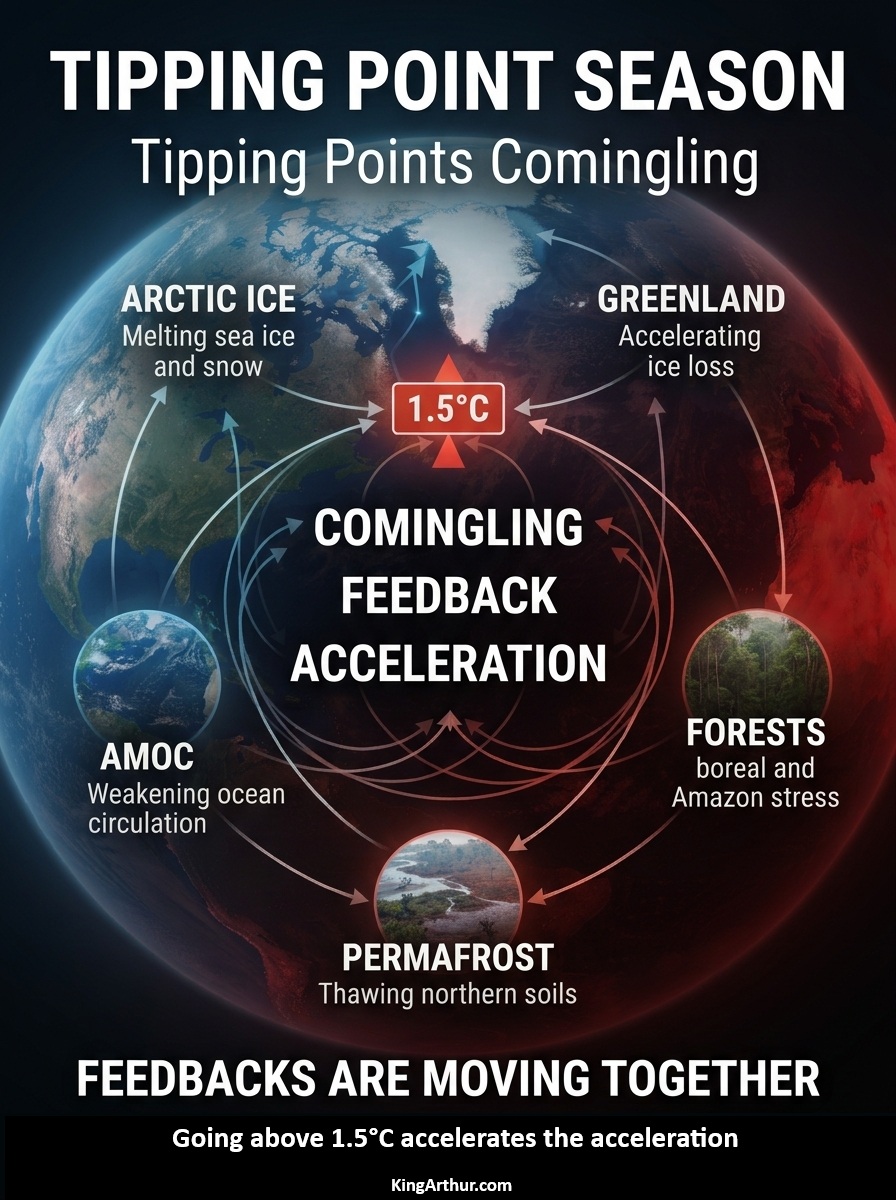
Tipping points are not necessarily isolated events waiting to happen one at a time.
Several have already begun moving together.
Ice loss changes albedo. Arctic warming alters atmospheric circulation. Greenland melt adds freshwater to the North Atlantic. Permafrost thaws and releases greenhouse gases. Forests are stressed by heat, drought, and fire. Ocean and atmospheric systems respond.
The important question is no longer simply: When will a tipping point occur?
It is: What happens when multiple tipping elements begin interacting with one another?
Tipping points come together. Feedbacks proliferate. Interactions strengthen. And acceleration emerges.
The climate system begins to change faster and in more complex ways than its individual pieces can be understood in isolation.
That is the idea behind the paper:
Tipping Point Season: Comingling Tipping Points and Proliferating Feedbacks
How Coupled Climate Feedbacks Are Accelerating Earth-System Change
The greatest danger may not be one tipping point suddenly toppling.
It may be several moving together.
🌡️ 1.5°C is not a magical switch.
It is a tripwire into a climate system where more interconnected components are being pushed toward critical states.
Tipping Point Season has begun.
Comingling Tipping Points
The climate system has entered a new phase. The significance of the first sustained period in which global temperatures repeatedly exceeded 1.5°C above the pre-industrial baseline during 2023–2024 is not simply the number itself, but what is happening around that number. Across the planet, multiple components of the Earth system are simultaneously experiencing unprecedented or rapidly intensifying stress. Polar ice is disappearing, Arctic amplification is accelerating, permafrost is thawing, ocean heat content continues to rise, extreme marine heatwaves are becoming more consequential, and tropical forests are being stressed by increasing heat and drought. These are not isolated phenomena. They are interacting.
The central climate question is therefore changing. It is no longer sufficient to ask when an individual tipping point will be crossed. We must ask whether multiple tipping elements are already beginning to influence one another strongly enough to create a self-reinforcing cascade. The evidence increasingly indicates that they are. This is the comingling tipping points: a condition in which multiple vulnerable Earth-system components are changing simultaneously, altering the boundary conditions experienced by other components and strengthening feedbacks between them. The result is feedback proliferation. One change creates another, that change alters another part of the system, and the resulting response feeds back into the original disturbance. The climate system begins to behave less like a collection of separate components and more like a tightly coupled network. As coupling increases, the rate of change can increase with it.
1.5°C Is Not a Switch. It Is a Tripwire.
The 1.5°C threshold should not be imagined as a magical switch that suddenly activates every climate feedback. Climate feedbacks have always existed. What changes as warming increases is their strength, frequency, geographic extent, persistence, and interaction with other feedbacks. At approximately 1.5°C of global warming, numerous tipping elements become increasingly vulnerable, including Greenland ice-sheet instability, West Antarctic ice-sheet instability, Arctic sea-ice loss, permafrost thaw, boreal forest degradation, Amazon rainforest degradation, AMOC weakening, coral-reef collapse, and mountain-glacier loss.
These systems are connected through the atmosphere, oceans, cryosphere, biosphere, and hydrological cycle, and that connectivity matters. A warmer Arctic changes atmospheric temperature gradients; changing gradients alter circulation; circulation changes precipitation, drought, storm tracks, and heat transport; those changes affect forests, soils, glaciers, snowpack, and oceans. Ice loss changes albedo and freshwater delivery, while freshwater changes ocean density and circulation. Forest degradation changes carbon uptake and atmospheric moisture recycling, while permafrost thaw releases additional greenhouse gases. Each response changes the conditions under which the others operate. This is not theoretical coupling. It is the physical architecture of the climate system.
The El Niño Accelerator
ENSO provides another mechanism by which an already-warmed climate system can experience rapid additional warming. During El Niño, heat stored in the tropical Pacific is redistributed toward the atmosphere and higher latitudes, producing a temporary but potentially enormous pulse of global surface warming. A major 2026–2027 El Niño would therefore not be occurring in the climate system of the twentieth century; it would be occurring on top of a much warmer baseline.
That distinction is crucial because the same El Niño forcing applied to a cooler climate and a highly warmed climate does not necessarily produce the same system response. Background conditions have changed, and a strong El Niño can push global temperatures substantially above the 1.5°C level and potentially toward or beyond 1.6°C for extended periods. The danger is not that El Niño creates anthropogenic warming. Rather, an exceptionally warm baseline combined with a powerful natural climate oscillation can push already-stressed tipping elements closer to critical states simultaneously. A climate pulse can therefore become a trigger.
From Individual Tipping Points to Comingling Tipping Points
Consider the sequence already emerging across the polar climate system: polar amplification → weakened equator-to-pole temperature gradient → altered atmospheric circulation → accelerated Arctic and Greenland ice loss. That initial sequence immediately activates multiple feedbacks.
The ice–albedo feedback begins when ice loss exposes darker ocean and land surfaces. Those surfaces absorb more solar energy, producing additional regional warming and further ice loss: ice loss → darker ocean and land surfaces → greater solar absorption → additional warming → additional ice loss ↺. The Arctic consequently changes from a highly reflective surface toward a darker, increasingly heat-absorbing system.
At the same time, a melt–elevation feedback can develop as an ice sheet loses mass and elevation. Lower ice-sheet surfaces are exposed to warmer atmospheric conditions, increasing surface melting and producing further elevation loss: ice loss → lower ice-sheet elevation → exposure to warmer air → increased surface melting → additional elevation loss ↺. Arctic warming also alters the vertical temperature structure of the lower atmosphere, contributing to a lapse-rate feedback in which changes in the vertical temperature gradient can reduce atmospheric cooling efficiency near the surface and promote additional warming: Arctic warming → altered lapse rate → reduced atmospheric cooling efficiency near the surface → additional near-surface warming → additional ice and snow loss ↺.
These are not three independent feedbacks operating in isolation. They interact. The resulting cryospheric response can then connect to the ocean through accelerated Greenland melt and increased freshwater input into the North Atlantic. Freshwater can reduce salinity and density, contributing to AMOC weakening. Ocean circulation then connects back to the atmosphere through altered North Atlantic heat transport, pressure fields, and storm tracks. Atmospheric circulation can consequently reorganize, increasing jet-stream waviness and creating conditions favorable to persistent blocking.
The resulting sequence can extend into slower-moving Rossby waves, persistent blocking and omega blocks, prolonged heat domes, drought, stalled atmospheric rivers, and extreme precipitation. The consequence is hydroclimatic whiplash, in which the same atmospheric circulation regime can produce drought in one region and catastrophic flooding in another, sometimes in rapid succession. The components are no longer simply responding independently to global warming; they are modifying one another’s operating environment.
Feedback Proliferation
Once multiple tipping elements become coupled, the number of potential feedback pathways increases dramatically. A single change can propagate through several systems simultaneously. Consider the sequence: polar amplification → atmospheric circulation change → ice loss → albedo reduction → additional warming → Greenland melt → freshwater input → ocean circulation disruption → atmospheric circulation change → precipitation redistribution → drought and flood extremes → ecosystem stress → carbon-cycle disruption → additional greenhouse forcing → additional warming.
Now introduce permafrost. Warming → permafrost thaw → microbial decomposition → CO₂ + CH₄ release → additional greenhouse forcing → additional warming ↺. Add boreal forests: warming + drought + wildfire → forest degradation → reduced carbon uptake + carbon release → additional warming ↺. Add the Amazon: warming + drought + fire → reduced evapotranspiration → disrupted rainfall recycling → greater drought stress → forest degradation → carbon release → additional warming ↺. Add Antarctica: ocean warming → ice-shelf weakening → accelerated West Antarctic ice loss → sea-level rise → coastal and cryospheric stress.
The system is now operating as a network of interacting positive feedbacks. This is why the phrase feedback proliferation is more useful than simply listing individual feedbacks. The critical issue is not the existence of one feedback, but the rapidly expanding number of ways in which feedbacks can connect.
The Feedbacks Are Accelerating
Acceleration is particularly important because a climate system experiencing a given external forcing does not necessarily produce a constant rate of response. If feedbacks strengthen as warming increases, the response itself can accelerate. This creates a fundamental distinction between a linear response—forcing → proportional response—and a coupled nonlinear response in which forcing → response → feedback → stronger response → stronger feedback → acceleration.
This acceleration is increasingly visible in observations. Ocean heat has accumulated to extraordinary levels, marine heatwaves are becoming more intense and persistent, Arctic warming is occurring at multiple times the global average rate, Greenland is losing ice mass, Antarctica is losing ice mass, permafrost is thawing, extreme precipitation is intensifying as a warmer atmosphere carries more moisture, heat extremes are becoming more severe, and drought and wildfire are degrading major carbon-storing ecosystems.
These are not simply independent records of a warming planet. They are evidence of a planet whose internal responses are becoming increasingly consequential. The critical observation is not merely that each indicator is changing, but that multiple indicators are changing simultaneously across interconnected subsystems, with some changes occurring at accelerating rates. That is a signature of a system becoming increasingly nonlinear.
Water Vapor: The Fastest Amplifier
The water-vapor feedback demonstrates how rapidly a positive feedback can operate. Water vapor is the most abundant greenhouse gas in Earth’s atmosphere and provides one of the strongest and fastest positive feedbacks in the climate system. The Clausius–Clapeyron relationship indicates that the atmosphere can hold approximately 7% more water vapor for every 1°C of warming, assuming relative humidity remains broadly similar.
The sequence is straightforward: warming → increased atmospheric moisture → stronger greenhouse trapping → additional warming ↺. Water vapor does not provide the original forcing; it amplifies it. This feedback operates rapidly, on timescales ranging from days to weeks, and affects the entire atmospheric system. A warmer atmosphere also means that when moisture is transported into storm systems, more water can potentially be released as extreme precipitation. The same thermodynamic process that increases atmospheric heat retention can therefore contribute to more intense precipitation extremes, allowing one feedback to influence multiple hazards.
Ice–Albedo: The Arctic Heat Engine
The cryosphere provides another rapidly reinforcing feedback. Snow and ice reflect incoming solar radiation, while dark ocean and land surfaces absorb it. As Arctic ice disappears, the sequence becomes ice loss → reduced albedo → increased solar absorption → regional warming → additional ice loss ↺.
The Arctic is therefore not simply responding to global warming; it is increasingly participating in the amplification of regional warming. This is particularly important because Arctic amplification alters the temperature contrast between the poles and lower latitudes. That contrast is one of the fundamental drivers of atmospheric circulation, meaning that changes in the polar temperature structure can propagate outward into the mid-latitude atmosphere. The feedback does not stop at the Arctic. It travels.
Permafrost: The Carbon Feedback
Permafrost represents a slower but potentially persistent feedback. Frozen northern soils contain enormous quantities of organic carbon accumulated over thousands of years. When those soils thaw, microorganisms gain access to previously frozen organic matter. Depending on environmental conditions, decomposition releases carbon dioxide and methane.
The sequence is therefore warming → thaw → decomposition → greenhouse-gas release → additional warming ↺. Unlike water vapor, this feedback can continue long after the initial warming event, making it a potential bridge between short-term climate acceleration and long-term carbon-cycle destabilization.
Boreal Forests: From Carbon Sink to Carbon Stress
Boreal forests are increasingly exposed to compound stress from heat, drought, insects, disease, and wildfire, with these stresses capable of interacting rather than simply occurring independently. A forest weakened by drought becomes more vulnerable to fire, fire releases stored carbon, and the loss of forest cover reduces future carbon uptake. The resulting feedback is warming → drought + fire → forest degradation → reduced carbon uptake + carbon release → additional atmospheric warming ↺.
The significance lies in the possibility of a transition from a carbon-absorbing ecosystem toward one that increasingly contributes carbon to the atmosphere. That transition would not be instantaneous, nor would it occur uniformly across the boreal zone, but the direction of the feedback is clear: increasing climate stress can progressively weaken an important carbon sink.
Amazon: The Rainfall-Recycling Feedback
The Amazon provides an even more tightly coupled example because the forest does not merely receive rainfall; it helps generate and recycle it. Through evapotranspiration, vegetation transfers enormous quantities of water back into the atmosphere. Repeated drought and heat stress can weaken this mechanism, creating a potentially dangerous feedback: warming → drought → forest stress → reduced evapotranspiration → reduced rainfall recycling → greater drought → forest degradation → carbon release ↺.
The forest therefore becomes both a victim and a participant in the warming process. The more the ecosystem is degraded, the more its ability to sustain the hydrological processes on which it depends can be compromised, while the carbon released through degradation and fire can add further greenhouse forcing.
The Comingling Cascade
When these systems are considered together, the emerging picture is fundamentally different from a simple list of tipping points. It can be represented as a connected cascade:
POLAR AMPLIFICATION → ARCTIC ICE LOSS → ICE–ALBEDO AMPLIFICATION → GREENLAND ICE LOSS → FRESHWATER INPUT → AMOC STRESS → ATMOSPHERIC CIRCULATION REORGANIZATION → JET-STREAM WAVINESS + PERSISTENT BLOCKING → HEAT DOMES + DROUGHT + STALLED ATMOSPHERIC RIVERS → HYDROCLIMATIC WHIPLASH → AGRICULTURAL + INFRASTRUCTURE + ECOSYSTEM + PUBLIC-HEALTH STRESS → PERMAFROST THAW → CO₂ + CH₄ RELEASE → ADDITIONAL GREENHOUSE FORCING → BOREAL FOREST DEGRADATION → CARBON LOSS + WILDFIRE → AMAZON DROUGHT + FOREST DEGRADATION → ADDITIONAL CARBON RELEASE → ADDITIONAL WARMING → FEEDBACK INTO THE ENTIRE SYSTEM.
This is no longer adequately described as a series of isolated tipping points. It is a tipping cascade, and the cascade is capable of feeding back into itself.
The Speed of the System Is Changing
This may be the most important implication. The climate system is not simply moving toward a warmer equilibrium; it is increasingly exhibiting faster transitions between states. Heat accumulates, ice responds, water vapor amplifies, atmospheric circulation reorganizes, extreme precipitation intensifies, drought stresses ecosystems, wildfire releases carbon, permafrost thaws, and ocean circulation responds. Each process operates on a different timescale, but those timescales overlap, and that overlap creates opportunities for comingling.
A slow process such as ice-sheet destabilization can interact with a faster process such as atmospheric circulation. A seasonal event such as El Niño can temporarily push a slower-moving tipping element toward a threshold. A wildfire can rapidly convert a carbon sink into a carbon source, while a marine heatwave can stress an ecosystem already weakened by long-term warming. The climate system therefore contains multiple clocks, and as warming increases, those clocks increasingly begin to interact.
A New Way of Thinking About 1.5°C
The importance of 1.5°C is therefore not that crossing it suddenly turns the climate system into something entirely different. Its importance is that it places an increasing number of interconnected systems into a zone of elevated vulnerability. The relevant question is not simply whether we crossed 1.5°C, but how many systems are now being pushed toward critical states, how strongly those systems are interacting, whether their feedbacks are strengthening, and whether the rate of change is increasing.
Most importantly, we must ask whether we are beginning to see the Earth system respond to itself.
There is growing evidence that the answer is yes. Human emissions remain the primary driver of contemporary global warming, but the climate system does not remain passive after that forcing occurs. It responds. That response creates feedback. Feedback creates amplification. Amplification changes the conditions experienced by other systems. Those systems respond, and their responses feed back again.
That is the central danger of comingling tipping points.
From Tipping Points to Tipping Point Season
The old conceptual model was relatively simple: human emissions → warming → impacts. The emerging model is more complicated: human emissions → warming → tipping-element stress → feedback activation → system interaction → amplification → additional warming and disruption → additional feedback activation.
The Earth system is becoming an active participant in the trajectory we have initiated. This does not mean that climate change has become independent of human emissions. It means that the consequences of those emissions are increasingly being amplified by the physical and biological systems they have destabilized.
That is why the distinction between climate forcing and climate response is becoming increasingly important. We are no longer dealing solely with the question of how much additional warming humans will cause. We must also contend with how much additional change the warming already imposed can generate through Earth-system feedbacks.
That is the beginning of Tipping Point Season: not a season defined by one spectacular threshold, but a season defined by comingling—multiple tipping elements, multiple feedbacks, multiple timescales, multiple cascading pathways, and an increasingly observable acceleration in the response of the Earth system.
The greatest danger may therefore not be that one tipping point suddenly topples, but that several have already begun moving together. Tipping points are beginning to come together, feedbacks are proliferating, interactions are strengthening, and acceleration is emerging across interconnected Earth-system components. The climate system is consequently beginning to change faster and in more complex ways than its individual pieces can be understood in isolation.
That is the climate challenge we now face: not simply tipping points, not simply feedbacks, but tipping points comingling and feedbacks accelerating one another.