Tonight’s homework assignment: How much land do I need for my own shit? (AKA The Eat n’ Poop Experiment)
Both literally and figuratively.
This is an experiment I’ve been working on for years. And when you actually try to do it—when you have to think about where your food comes from, where your water comes from, and what happens to everything that comes out of you—you gain a very different perspective.
And yes, sometimes the experiment even comes down to a question like: Do I eat the worm, or don’t I?
Food and water are big problems.
But getting rid of what comes out of you can be an even bigger problem.
I’ve been meeting quite a few other people who are “doing it”—trying to become more self-sufficient, reduce their dependence on centralized systems, and figure out what is actually required to sustain a human being.
So I thought a good test for me would be to reevaluate the whole concept at two scales:
Macro. And micro.
Tonight is micro night.
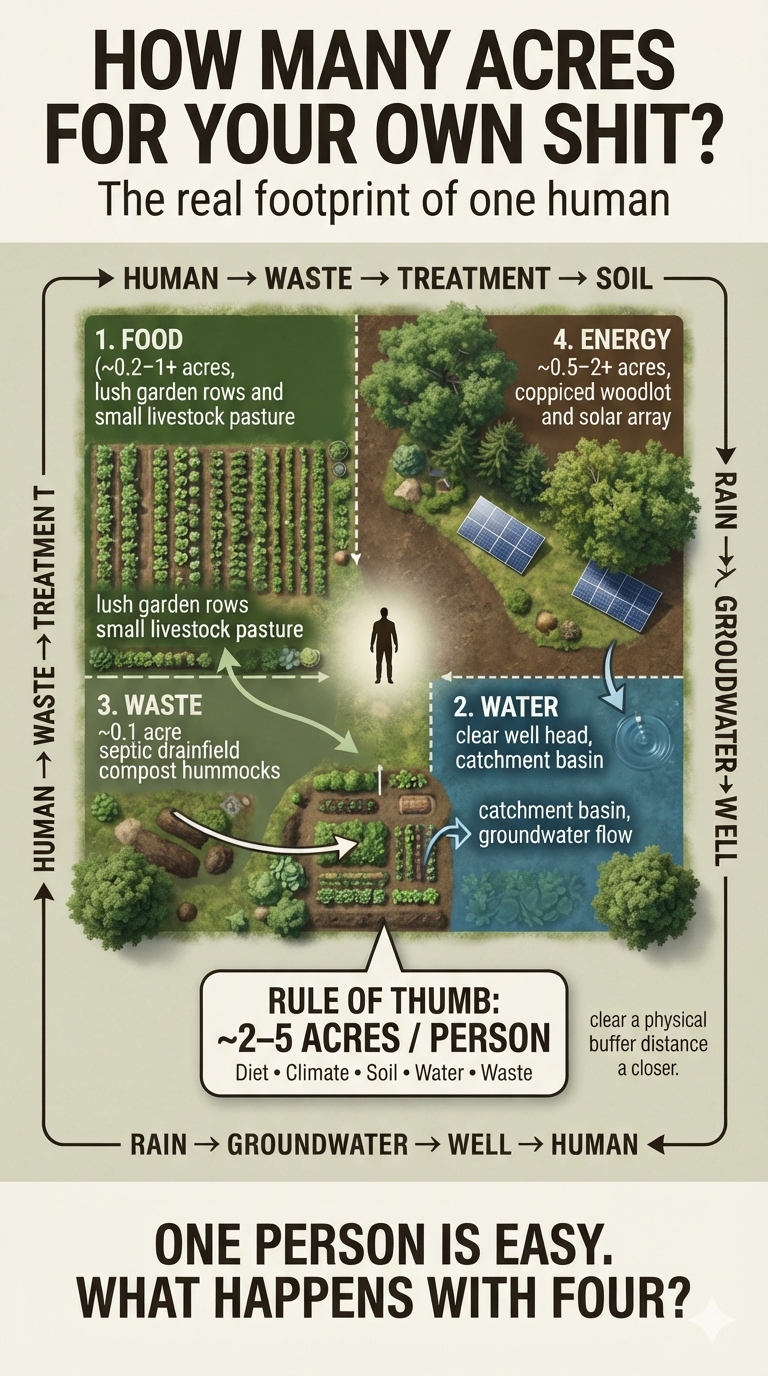
How many acres do you need for your own shit?
A commonly cited homesteading rule of thumb is roughly 2–5 acres per person for a fairly self-sufficient setup—but that’s not a universal number. It depends enormously on your diet, soil, climate, water supply, livestock, energy needs, and how much of your waste you can safely recycle.
And that’s where it gets interesting.
Food production:
You might be able to produce a substantial amount of plant food on a fraction of an acre. Add grains, livestock, dairy, or meat, and the land requirement can increase dramatically.
Water:
You need a reliable source of potable water—and potentially enough watershed, recharge area, storage, or infrastructure to keep that supply reliable.
Waste:
This is the part people tend to overlook.
Your sewage system doesn’t just need a place to put sewage. It needs soil, treatment capacity, separation from groundwater and drinking-water sources, and enough suitable land for the system to function safely.
In Pennsylvania, for example, wastewater land-treatment systems can require significant separation distances from private drinking-water wells. That means the geometry of the property can matter almost as much as the number of acres.
And then there’s the really interesting question:
What if the waste isn’t actually waste?
Humanure, composting systems, graywater, nutrient cycling, orchards, biomass…
At the right scale—and with proper treatment—some things we call “waste” become inputs into another system.
So tonight I’m starting at the smallest possible unit:
One human.
How much land does one human actually need to provide food, water, and a safe place to put—or recycle—everything that comes out of them?
How many acres do you need for your own shit?
Then we’ll scale it up.
Because four people don’t necessarily require four times the land. And four people sharing a watershed, a food system, and a waste-treatment system creates an entirely different problem.
Tonight: micro.
Next: macro.
MACRO
Tonight’s homework assignment: How much land do we need for all our shit?
AKA: The “Who Will Fend for Themselves?” Experiment
Last night was micro: How much land do I need for just me?
Tonight is macro: How much land do we need for me, my family, and company?
In two different experiments—one in New Zealand and one in Pennsylvania—families have been trying to find the answer.
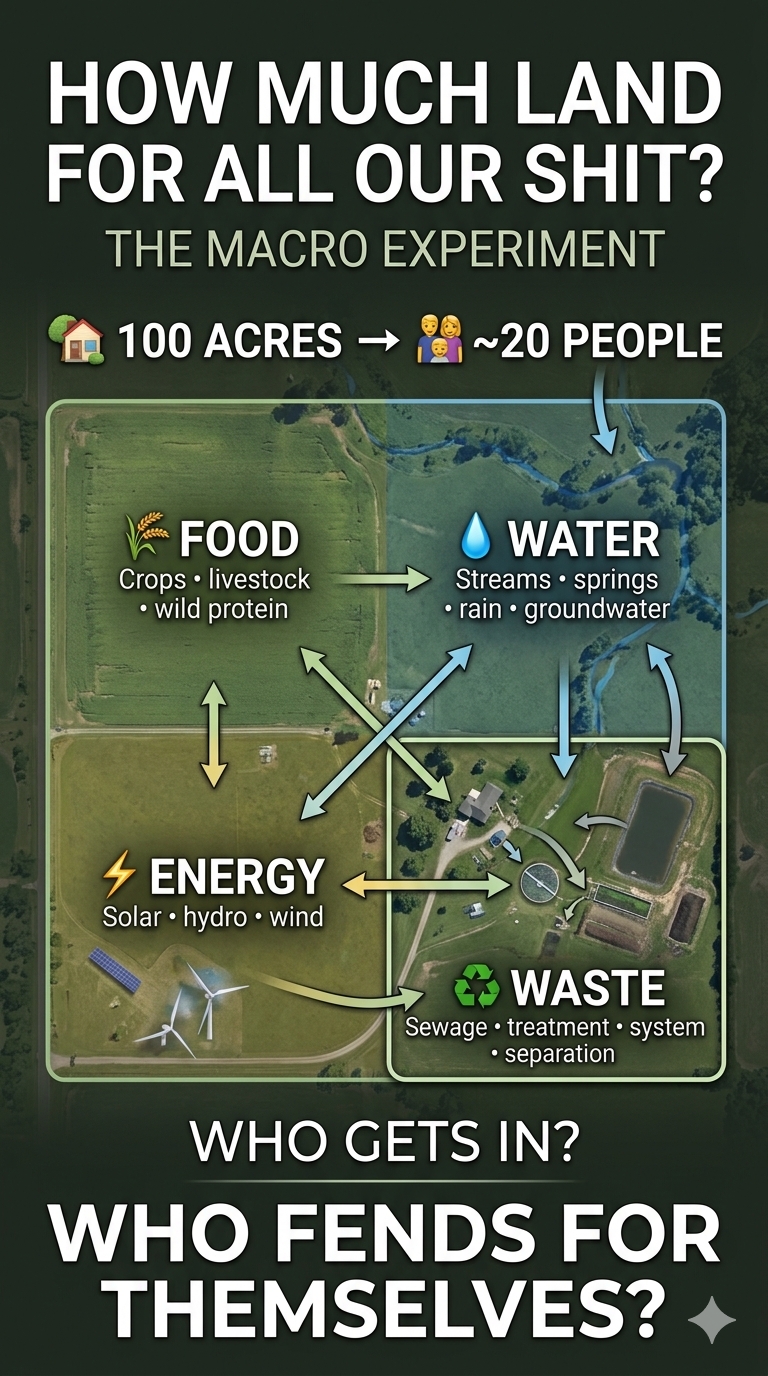
Interestingly, both case studies arrived at a remarkably similar result: if you can optimize the use of roughly 100 acres, you can support about 20 people, although toward the lower end of what we would consider a modern standard of living.
And that’s when the bigger problem became evident.
As part of our long-term planning, we had to determine who would be allowed to come live with us in a crisis such as climate change.
There were eight of us. We figured our parents would need to be among the first to come. That added six, bringing us to 14. Then we started adding siblings, their partners, and their children. We quickly exceeded 25.
So the real question became:
Who gets invited?
And who is left to fend for themselves?
That sounds like an abstract thought experiment when you have plenty of land, food, water, and energy. It becomes a very different question when those resources have a hard limit. And as climate change accelerates—and the number of grandchildren continues to grow—these questions are no longer really about “future generations.”
They are about our own descendants.
They are the people who may actually have to confront the new realities we are leaving them.
That’s the part of the experiment I find hardest to calculate.
Not how many people the land can sustain.
But who gets to be one of them.
Notes
In New Zealand, Ganantchian Claire said:
Human waste is a very easy “problem “. Composting is super easy, safe, and valuable. Water of course depends where you are. Stream, or roof water are easy gravity fed, groundwater requires energy to bring it up. Food, acreage… as you say, depends entirely on your soil and climate. My opinion is a cow or a couple of goats are the easiest quickest way to get food security as milk covers all your needs. My experience is plants are great, but unreliable as crops can be devastated in a flash by pests or weather events. To avoid starvation, I would never give up my milking cow. One could actually survive with no land at all just walking a cow along the roadsides. A bit extreme, but why not?
In Pennsylvania, USA, I replied:
Nice! Thanks. “Real food” is the hardest thing in my environment as well, especially in the winter. When I say real food, I mean exactly what you said—food security. Eating vegetation is not something I can do for any extended period, and winter makes that particularly difficult.
Though your winters get cooler, I assume they aren’t quite as extreme as Pennsylvania’s, are they?
This becomes particularly relevant when we get to the “macro” experiment.
You also raise another important point with your example of “walking a cow along the roadsides.” In our experiment, we set it up as a game. One of the rules is that you can’t use other people’s land.
That, too, depends on where you live—and on what is considered public property versus private property. Ultimately, I think this is a debate that is likely to intensify as climate migration itself intensifies.
As for waste management, this also appears to be heavily dependent upon location.
In Pennsylvania, the largest long-term problem is waste management, followed by food, then water. But if you don’t manage waste properly, water quickly becomes your biggest problem. Contamination of drinking-water supplies from inadequate or poorly located waste management has been a long-term issue.
Traditionally, you needed at least 10 acres if you could not “perc” your lot.
Collecting rainwater isn’t necessarily a viable solution either. There simply isn’t enough precipitation in many locations across the continental U.S. And in several states, there are legal restrictions on collecting or impeding the flow of water unless you specifically own the water rights.
That’s what makes this experiment so interesting.
The answer isn’t just “How much land do I need?”
It’s where is the land, what can it produce, where does the water come from, and where does the poo go?
How many acres do you have available and how many people do you think you could sustain?
Ganantchian replied:
Interesting conversation. It highlights one of the biggest obstacles to self sufficiency is regulations.
We have 100 acres of land. 25 acres retired to native bush and wetlands, 50 acres very steep of very poor quality soil, 25 acres of which have been planted in poplars. And 25 acres of gently slopping with average quality soil.
I reckon we would comfortably feed 20 people in a localised system ie no fossil fuels or synthetic fertilisers use. Because of the poor inherent quality of our soil, manure from animals and us is the most valuable resource. If composted properly, it is safe to use around fruit and nut trees, which we have planted over 100 over the farm.
Our climate is very mild and with usually good rainfall although we do get drought. Rainwater is vital for drinking as I drunk water from our creek as an experiment and got quite sick  Although it’s fine when boiled.
But again, the biggest hurdle is having to pay land rates. Which at the moment the livery horses cover. They do take up 90% of our grazing land… so currently the farm can only sustain 1 or 2 people… All because we are forced to fund Growth in the region, new roads, infrastructure for cars which I loathe, airport extensions which I vowed to never use again…
Hence it is very difficult to prepare for the unfolding multi crisis while the authorities are impeding our progress.
I responded:
Yes, very interesting indeed. Our macro experiment was intended to demonstrate how many people we could sustain on similar acreage. The result was almost identical.
Two families of four acquired 135 acres. About 35 acres were “public rights of way,” and another 20 acres were steep slopes and other unlivable acreage. Some of those 35 acres consisted of three streams, so potable water wasn’t a problem. One of the streams originated from a spring on the property and tested safe for drinking.
We had a cattle and chicken farmer adjoining the property. We exchanged our tillable acreage, about 65 acres, for him to grow feedstock in exchange for him raising a couple of cows and some chickens for us. There were also fish, small game, deer, and other protein sources. That left us about 15 acres for vegetables.
We did not fully develop and complete the land-management plan because it was not economical at the time. However, we did a thorough plan for being able to survive the winters. Solar panels offered the best and cheapest energy source. Small hydroelectric systems installed in the streams could add additional wattage. In addition, a small windmill could pump water up the steep slope to a small reservoir, which could be used as a “battery” for hydropower when the sun wasn’t shining.
Sewage ended up being the limiting factor.
Without sewage, we could sustain about 38 people. With sewage, that number dropped to about 25. The three streams were great for eating and drinking, but they limited where we could build sewage treatment systems without having rainwater runoff contaminate the drinking water and food sources.
The end result was a self-sustaining property of roughly 100 acres that could provide enough food, water, and energy for 20–25 people.
That is when the bigger problem became evident.
As part of our long-term plan, we had to determine who would be allowed to come live with us in a crisis such as climate change. There were eight of us. We thought our parents would need to be the first to be saved. That was an additional six, bringing the total to 14. If all of our siblings, their mates, and kids were included, we quickly exceeded 25.
So that became the bigger issue.
Who would be on the list of people invited versus the list of people to fend for themselves?
As climate change accelerates and the number of grandchildren grows, these questions are no longer about future generations. They are about our own descendants being forced to confront the new realities they will inherit.
She asked:
did you give up?
Yes, I equally feel that I only can provide for close loved ones. It might become different if our local community wakes up. But so far, most of my neighbors think the crisis is a distant worry for the next generation. I’m more than happy to open my gardens to as many people as possible. As long as they are on the same page, and putting in the hard yards.
People seem to think we have time. But the systems you are describing take years to put into place. 50 years ago is when humanity should have gone down that track.
Now… we barely have time to prepare for our small family groups…
Makes me ponder if I’ve done it in the right place as the local population (walking distance) is about 2000 people. 99% of whom rely entirely on being fed by supermarkets and takeaways…
I replied:
No, we didn’t give up. We achieved the goals of the study.
I was the climatologist, economist, and estate planner, as well as the land-management executive. What became obvious was that the physics, science, and logic of a crisis weren’t going to be the real problem.
The security of the infrastructure from outside threats—and the internal trust required to manage the “financial trust fund”—were going to be the larger crisis within the crisis.
One would hope that a crisis would bring us—humanity—together.
Unfortunately, the opposite appears to be true.
Fear and greed are inherent problems that get amplified in a crisis.
That was probably the most important thing we learned from the experiment.