by Daniel Brouse
Rerouting the Walker Circulation: The Pacific El Niño–Atlantic Niña Atmospheric Bridge
The unusual co-occurrence of a Pacific El Niño and an Atlantic Niña illustrates how strongly connected Earth’s climate system is. Although the Pacific and Atlantic are separate ocean basins, the atmosphere links them through planetary-scale circulation patterns.
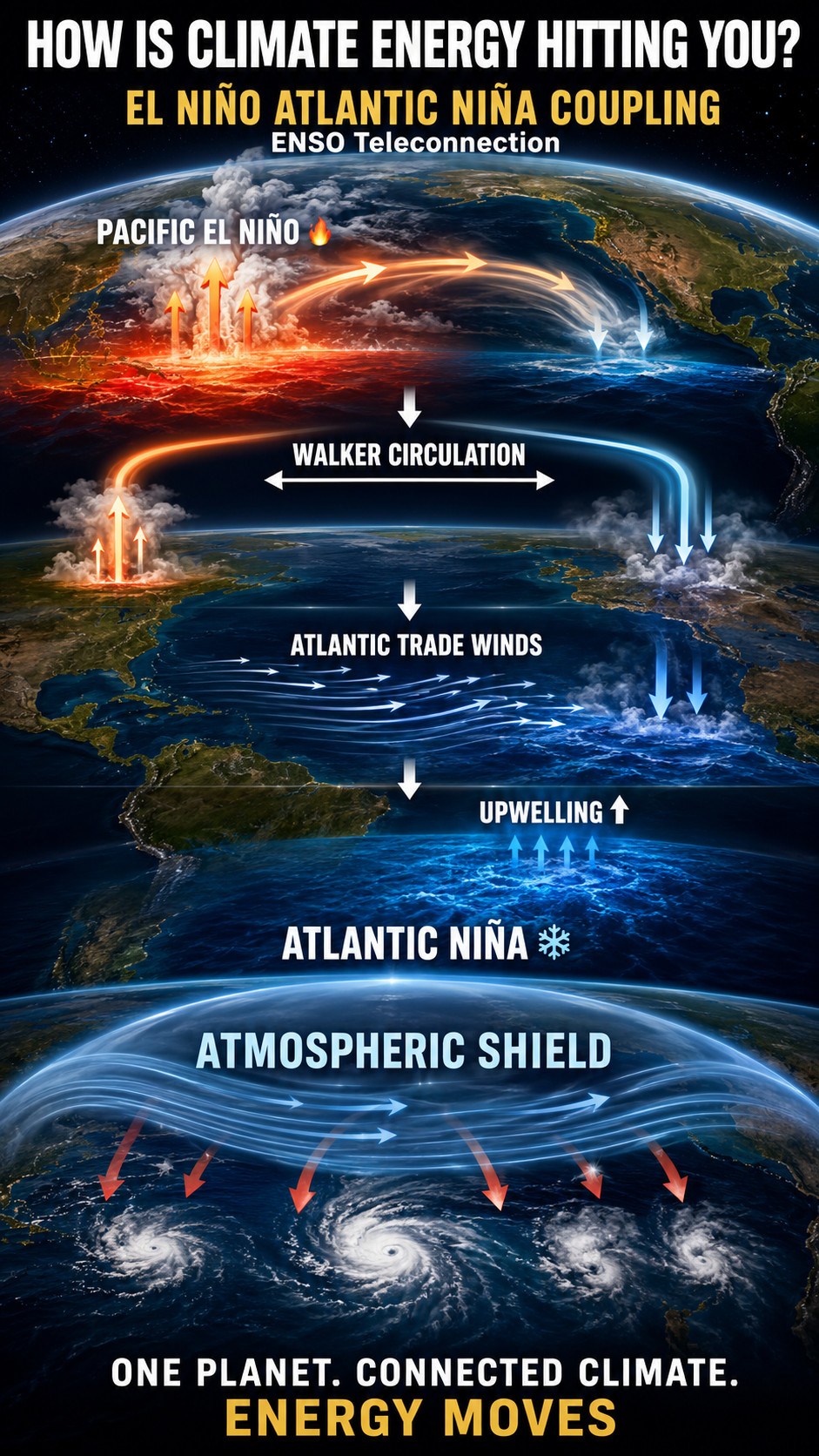
One of the most important connections is the Walker circulation—a vast east-west circulation of rising and sinking air across the tropics. When El Niño warms the central and eastern tropical Pacific, it reorganizes convection, atmospheric pressure, and wind patterns across the tropics. Those changes can extend into the Atlantic, altering the trade winds and ocean circulation there.
The result is a remarkable sequence of interconnected processes: Pacific warming → atmospheric rerouting → Atlantic pressure changes → stronger trade winds → enhanced upwelling → Atlantic cooling.
1. Rerouting the Walker Circulation
Walker circulation / ENSO Teleconnection:
The Walker circulation is a large-scale tropical atmospheric circulation that links changes in convection, pressure, winds, and ocean–atmosphere heat exchange across the Pacific and beyond. During El Niño, changes in Pacific sea-surface temperatures reorganize this circulation, creating atmospheric teleconnections that can extend into the Atlantic.
Pacific warming:
During El Niño, unusually warm surface waters develop across the central and eastern tropical Pacific. The additional oceanic heat increases evaporation and fuels stronger deep atmospheric convection.
Shifted convection:
As warm, moisture-rich air rises over the anomalously warm Pacific, the center of tropical convection shifts eastward. This changes the pattern of rising and sinking air that defines the Walker circulation, redistributing atmospheric energy and altering pressure and wind patterns across the tropics.
Atlantic subsidence:
The reorganized tropical circulation can produce compensating regions of sinking, relatively dry air over parts of the tropical Atlantic and Caribbean. This subsidence suppresses cloud formation and deep convection and can contribute to higher surface pressure.
The atmospheric bridge:
The Pacific warming does not directly “cause” the Atlantic to cool. Instead, ENSO reorganizes the atmospheric circulation, and that planetary-scale response can alter Atlantic pressure, winds, evaporation, and ocean circulation—providing the atmospheric bridge between the two ocean basins.
2. The Planetary Teleconnection: From the Pacific to the Atlantic and Beyond
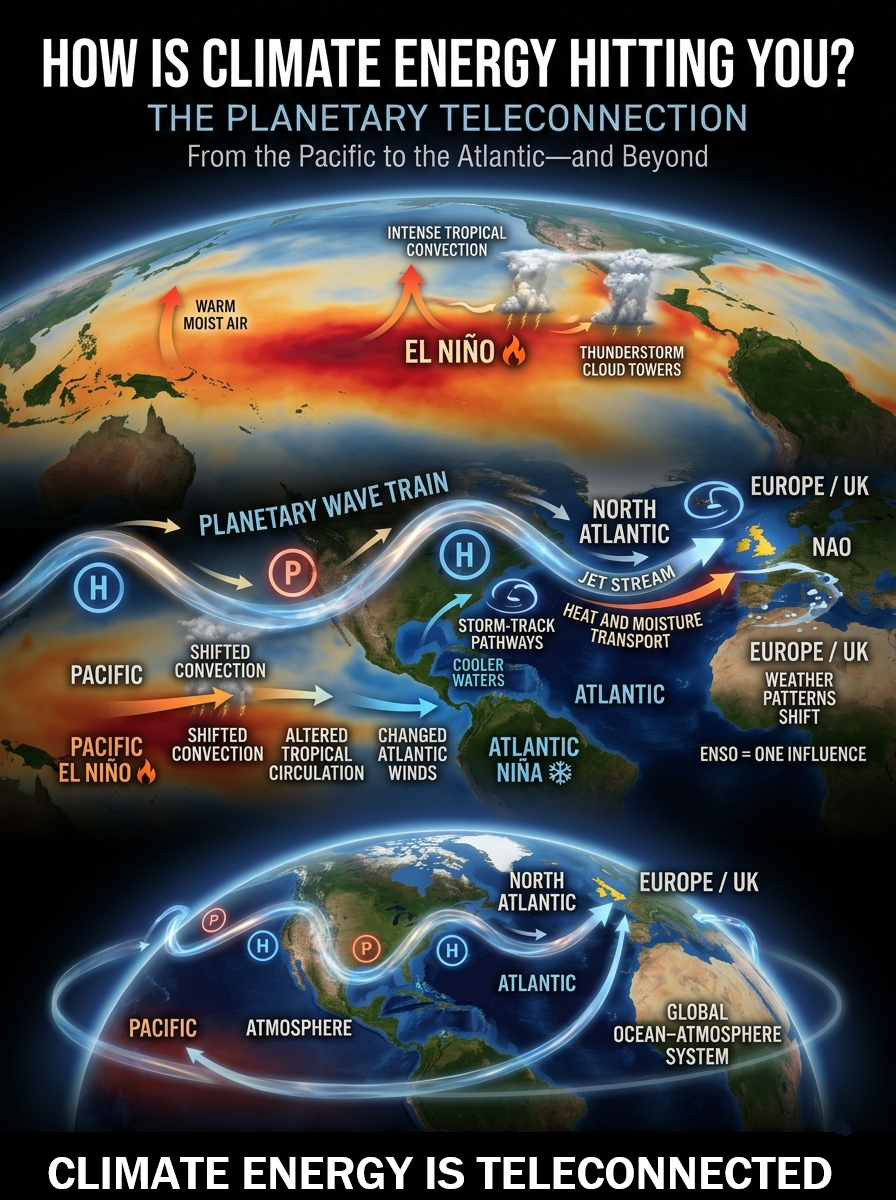
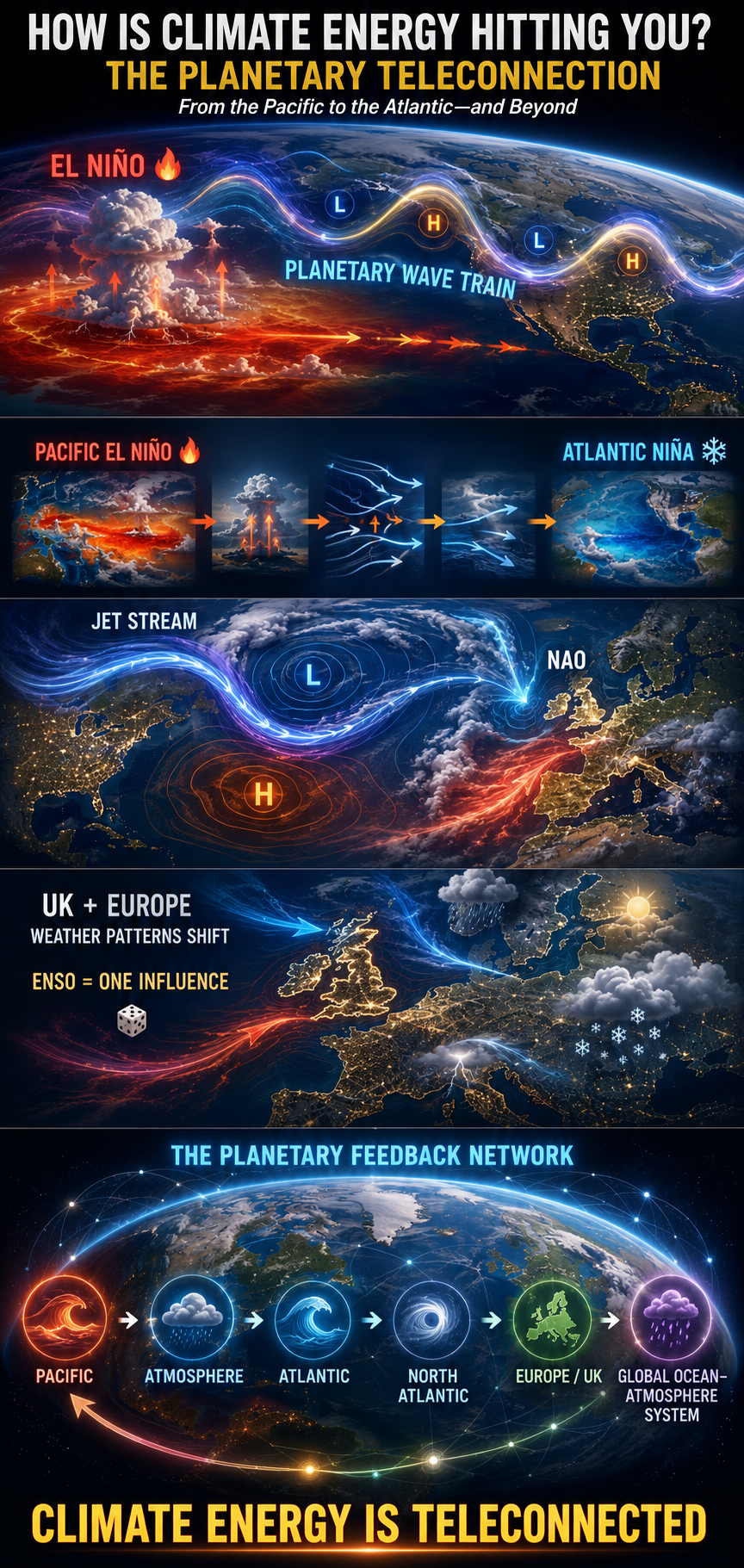
The ENSO teleconnection does not stop at the Atlantic. The atmospheric disturbance generated by El Niño can propagate across the tropics and into the extratropics, linking the Pacific to the Atlantic, North Atlantic, Europe, and the United Kingdom through a network of atmospheric circulation patterns.
As tropical convection shifts over the Pacific, it alters the distribution of atmospheric heating. These changes can generate large-scale Rossby waves that propagate through the atmosphere, modifying the position and strength of the jet streams, storm tracks, and persistent pressure systems far from the original Pacific anomaly.
Pacific → Atlantic
The first major connection is the tropical Atlantic.
Pacific El Niño
↓
Shifted tropical convection
↓
Walker circulation response
↓
Changes in tropical pressure and winds
↓
Atlantic trade-wind response
↓
Ocean circulation and sea-surface temperature changes
This atmospheric bridge helps explain how a warming anomaly in the Pacific can coincide with cooling in the tropical Atlantic.
Atlantic → North Atlantic → Europe
The teleconnection can extend farther north.
Changes in tropical heating and atmospheric wave patterns can influence the North Atlantic jet stream and pressure fields, including variations associated with the North Atlantic Oscillation (NAO). These changes can alter the path of Atlantic storms and the transport of heat and moisture toward Europe.
The United Kingdom sits downstream of this North Atlantic circulation and can therefore experience changes in the probability of particular weather regimes—even though the original oceanic disturbance began thousands of miles away in the tropical Pacific.
The relationship is probabilistic, not deterministic. ENSO is one influence among many, and the eventual European response depends on the season, the state of the North Atlantic, stratospheric conditions, and other interacting climate modes.
A Planetary Feedback Network
The important point is that this is not a simple one-way pipeline.
PACIFIC
🔥 El Niño
↓
ATMOSPHERE
Walker circulation + planetary waves
↓
ATLANTIC
Trade winds + ocean response
↓
NORTH ATLANTIC
Jet stream + NAO
↓
EUROPE / UK
Weather-pattern response
↓
GLOBAL OCEAN–ATMOSPHERE SYSTEM
↓
PACIFIC
The final connection back toward the Pacific should not be interpreted as a single atmospheric current literally traveling around the planet. Instead, it represents coupled feedbacks within the global climate system. Changes in one ocean basin alter atmospheric circulation; those atmospheric changes affect other ocean basins and land surfaces; and those changes can subsequently feed back into the global circulation system.
ENSO is therefore not simply a Pacific phenomenon.
It is a planetary-scale disturbance that can reorganize atmospheric and oceanic conditions across multiple basins and continents.
One ocean warms.
The atmosphere responds.
The response travels.
The planet adjusts.
3. Amplification of Atlantic Trade Winds
Pressure gradients:
The redistribution of rising and sinking air modifies sea-level pressure across the tropical Atlantic. A stronger pressure gradient can develop along the equatorial Atlantic.
Stronger easterly winds:
The resulting pressure gradient can strengthen the Atlantic trade winds. These persistent easterlies are critical because they directly interact with the ocean surface.
The atmosphere has effectively rerouted part of the Pacific’s excess energy through a planetary-scale circulation response, creating conditions that can cool a distant ocean basin.
4. Wind-Driven Ocean Upwelling
Surface-water displacement:
Stronger easterly trade winds push warm surface waters westward across the equatorial Atlantic and alter the distribution of ocean heat.
Cold water rises:
As surface waters are displaced, deeper, colder water can rise toward the surface through equatorial upwelling. This water is typically cooler and richer in nutrients than the surface layer.
The Atlantic Niña emerges:
When the resulting cooling is sufficiently strong and persistent, tropical Atlantic sea-surface temperatures can fall substantially below normal, producing the characteristic cold anomaly known as an Atlantic Niña.
The Atlantic cooling is therefore not an isolated ocean event. It can be part of a larger coupled atmosphere–ocean response initiated thousands of miles away in the Pacific.
The Atmospheric Shield: A Planetary Teleconnection Comes Full Circle
When a Pacific El Niño and an Atlantic Niña occur together, their effects can reinforce one another over the tropical Atlantic. But the hurricane response is only one part of a much larger planetary circulation story.
The sequence begins thousands of miles away:
Pacific El Niño
↓
Rerouted Walker circulation
↓
Planetary atmospheric teleconnection
↓
Atlantic pressure + wind changes
↓
Stronger trade winds
↓
Enhanced equatorial upwelling
↓
Atlantic Niña / cooler tropical Atlantic
The resulting Atlantic conditions can then influence tropical cyclone development.
El Niño tends to increase vertical wind shear, disrupting the organization of developing tropical cyclones. At the same time, cooler tropical Atlantic waters reduce the oceanic heat available to support deep convection and storm intensification.
Together, these effects can create an atmospheric shield over the Atlantic hurricane-development region:
ATLANTIC NIÑA
❄️ Cooler ocean
↓
Less convective energy
EL NIÑO
🔥 Pacific warming
↓
Stronger vertical wind shear
Combined effect
↓
Less favorable conditions for Atlantic tropical cyclones
This does not mean an Atlantic hurricane season becomes impossible. Tropical cyclone activity depends on many interacting factors, including sea-surface temperatures, atmospheric moisture, vertical wind shear, African easterly waves, upper-level circulation, and broader Atlantic climate conditions.
One Planetary System
The deeper significance is the connection itself.
A thermal anomaly in the Pacific can reorganize tropical convection. That atmospheric reorganization can propagate through the global circulation system, altering pressure and winds over the Atlantic. Those winds can change ocean upwelling and sea-surface temperatures. The resulting ocean anomaly can then modify atmospheric moisture, convection, and storm development.
The signal can extend even farther through the North Atlantic jet stream and atmospheric wave patterns, influencing weather regimes across Europe and the United Kingdom.
This is not a single atmospheric current traveling around the planet. It is a coupled network of atmospheric and oceanic responses operating across different spatial and temporal scales.
What begins as:
PACIFIC WARMING 🔥
can become:
ATMOSPHERIC REROUTING
then:
ATLANTIC COOLING ❄️
and ultimately:
REGIONAL WEATHER + HYDROCLIMATIC CONSEQUENCES
The climate system is therefore not a collection of isolated ocean basins and weather systems.
Energy moves through the connections.
The atmosphere carries the signal.
The oceans respond.
Feedbacks propagate.
One planet. One interconnected climate system.
Public Access Version
Tonight’s homework assignment is about climate chaos.
The climate system is chaotic. I started out researching the odd ENSO coupling — Pacific El Niño + Atlantic Niña. Usually, the Pacific and Atlantic pretty much “do their own thing.”
But this year is different.
The climate system has been supercharged with energy, and that energy is manifesting in some strange and surprisingly interconnected ways.
How Is Climate Energy Hitting You?
Rerouting the Walker Circulation
This is a story about teleconnections.
That proverbial butterfly wing flapping in the Pacific…
flutters across the atmosphere…
affects the USA…
and messes with the Atlantic.
At some point during this homework assignment, I thought to myself:
“I wonder if this teleconnection is… planetary?”
Does it hit Rocky Rex in the UK? 🇬🇧
A: Yes. Yes, it does.
And if you keep following the atmospheric energy and the feedbacks, you discover something even more interesting:
It isn’t just a Pacific–Atlantic connection.
It’s a planetary teleconnected climate system, where disturbances propagate through the atmosphere and oceans, affecting distant regions—and feeding back into the system.
One ocean warms.
The atmosphere responds.
The response travels.
The planet adjusts.
Homework continues… 🌎