by Daniel Brouse
Density. Velocity. Gravity. Friction. Entrainment.
Climate change is often described in terms of temperature: another degree of warming, another heat record, another fraction of a degree above a historical baseline.
But temperature is only the beginning of the story.
The more consequential question is:
What happens when warming changes how much energy and mass are available to move—and how easily they can move?
The atmosphere, oceans, glaciers, snowpack, soils, mountains, and rivers are all components of a connected physical system. They store energy and mass. Under certain conditions, that stored energy can be released rapidly through wind, water, ice, avalanches, landslides, floods, and debris flows.
And once something starts moving, density, velocity, gravity, friction, and entrainment can interact to dramatically amplify the consequences.
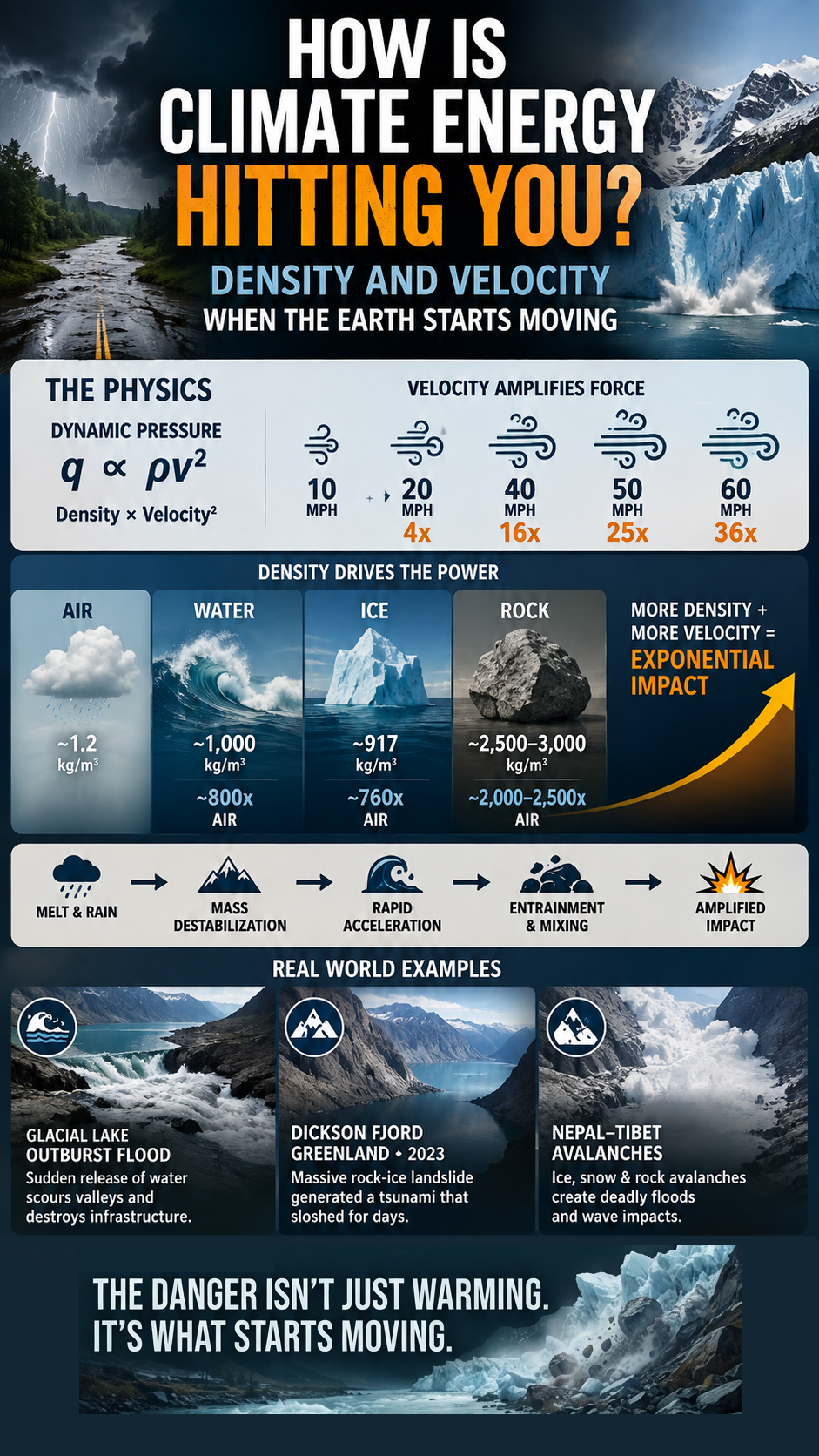
The Physics: Density × Velocity²
For fluid flow, dynamic pressure is proportional to density multiplied by the square of velocity:
q ∝ ρv²
More precisely, dynamic pressure is:
q = ½ρv²
This simple relationship explains why velocity is such a powerful amplifier.
For example:
- A 20 mph wind produces 4× the dynamic-pressure scale of a 10 mph wind.
- A 40 mph wind produces 16×.
- A 50 mph wind produces 25×.
- A 60 mph wind produces 36×.
Velocity is therefore not a linear amplifier.
Double the velocity → 4× the velocity-squared term.
Triple the velocity → 9×.
And this is before considering density.
Density: How Much Mass Is Moving?
Density determines how much mass is packed into a given volume.
Approximate densities illustrate the enormous difference:
- Air: ~1.2 kg/m³
- Water: ~1,000 kg/m³
- Ice: ~917 kg/m³
- Rock: ~2,500–3,000 kg/m³
Water is therefore roughly 800 times denser than air.
Ice is roughly 760 times denser than air.
Rock can be roughly 2,000–2,500 times denser than air.
At the same velocity, these differences matter enormously.
But there is an important distinction.
The simple ρv² relationship describes dynamic pressure in a moving fluid. It should not be applied mechanically as though a rock avalanche were simply “rock behaving like air or water.” Moving ice and rock involve additional physics—especially mass, momentum, gravitational potential energy, kinetic energy, friction, and collisions.
The underlying principle, however, remains powerful:
More mass moving faster carries more energy and momentum.
Gravity: The Energy Stored in Height
Gravity is one of the great energy reservoirs of the Earth system.
A glacier sitting high in a mountain valley contains enormous gravitational potential energy because of its mass and elevation.
So does a mountainside.
So does water stored behind a natural or artificial dam.
So does a glacial lake perched above a downstream valley.
Gravitational potential energy is commonly expressed as:
PE = mgh
where:
- m = mass
- g = gravitational acceleration
- h = elevation
When that stored energy is released, it can become kinetic energy:
KE = ½mv²
This creates another important connection between mass and velocity.
A small object moving rapidly can be destructive.
An enormous mass moving rapidly can be catastrophic.
And when the moving mass begins picking up additional material, the system can become even more powerful.
Friction: The Brake on the System
But gravity does not automatically make everything move.
Friction is the brake.
Friction resists movement between surfaces. It helps keep glaciers attached to their beds, soil on hillsides, rocks on mountains, and sediment within channels.
In simplified terms:
Gravity drives movement.
Friction resists movement.
The balance between those forces can determine whether a system remains stable—or begins to move.
This is particularly important in glaciers and steep mountain environments.
Meltwater: When the Brake Gets Wet
Under a glacier, meltwater can travel through cracks, crevasses, channels, and conduits until it reaches the glacier bed.
There it can increase water pressure between the ice and underlying rock.
That matters because increased water pressure can reduce the effective normal force pressing the glacier against its bed, potentially reducing basal friction and allowing the ice to slide more easily.
In other words, meltwater can do more than add water to the system.
It can reduce resistance to movement.
The simplified conceptual chain becomes:
Warming → melting → more meltwater → increased basal water pressure → reduced friction → enhanced sliding
But the actual relationship is complex. More meltwater does not automatically mean faster glacier movement. The effect depends on how water is distributed and drained beneath the glacier. Efficient drainage can relieve pressure, while poorly drained or rapidly delivered water can increase basal pressure.
The important point is that lubrication can alter the balance between driving force and resistance.
The same broader principle applies to unstable slopes.
Water infiltrating soil, fractured rock, snow, and ice can change pore-water pressure and reduce effective resistance to failure. A slope that was stable under one set of conditions can become unstable when water changes the mechanical balance.
So another pathway emerges:
More water → less effective resistance → greater potential for movement.
And once movement begins:
greater movement → greater velocity → greater kinetic energy.
Climate change can therefore influence not only how much energy enters a system, but under some circumstances how easily that stored energy can be released.
Entrainment: When Moving Material Picks Up More Material
There is another amplifier:
Entrainment.
Moving water can pick up sediment.
Floods can carry gravel and boulders.
Avalanches can incorporate snow, ice, trees, and rock.
Landslides can transform into debris flows as they mix with water and incorporate additional material.
A moving glacier can transport enormous quantities of sediment and rock.
This creates a potentially powerful feedback:
Movement → entrainment → more mass → greater momentum → greater destructive potential
The flow is no longer carrying only the material that initially started moving.
It is gathering additional mass along the way.
When Water Becomes a Weapon
Consider extreme rainfall.
Rain falls onto a landscape.
Some infiltrates.
Some becomes runoff.
As rainfall intensity increases, runoff can become increasingly rapid. Gravity accelerates water downslope. The moving water begins eroding soil and sediment and can pick up increasingly large particles.
Now the flow is carrying:
water + soil + gravel + rocks + trees + debris
The physical character of the event has changed.
It is no longer simply a flood.
It can become a debris flow or sediment-laden flood, capable of enormous erosion and impact.
This is why the consequences of extreme rainfall can be disproportionately larger than the increase in rainfall itself.
Glacial Lake Outburst Floods
The same principles operate in high mountain environments.
Glaciers can dam lakes.
Meltwater can increase lake volume.
Ice or rock can destabilize the surrounding terrain.
A sudden collapse, avalanche, or breach can release enormous quantities of water.
A glacial lake outburst flood, or GLOF, can rapidly send a pulse of water downstream.
As that water accelerates under gravity, it can scour the valley and entrain sediment, boulders, trees, and infrastructure debris.
The result can become a cascading process:
Stored water → sudden release → acceleration → erosion → entrainment → greater mass → amplified destruction
The original trigger may be relatively localized.
The resulting moving mass may not be.
When Glaciers and Mountains Collapse
The same energy cascade can occur when ice and rock themselves become unstable.
A glacier, ice shelf, frozen slope, or mountain face can store enormous gravitational potential energy.
When structural stability is lost, that energy can be released rapidly.
Ice, snow, rock, and debris accelerate downslope.
Collisions generate additional energy transfer.
Material can fracture and fragment.
Snow and rock can be entrained.
Water can be displaced.
And if the moving mass enters a lake, fjord, river, or ocean, it can transfer energy into the water and generate powerful waves.
The system can therefore move through multiple physical states:
Ice → collapse → acceleration → impact → water displacement → wave → downstream damage
This is not simply “melting.”
It is a mass-and-energy transfer through a connected Earth system.
Dickson Fjord: Greenland, 2023
The September 2023 event at Dickson Fjord in Greenland provides a remarkable illustration.
A massive rock-and-ice landslide entered the narrow fjord, displacing water and generating a tsunami-like wave. The confined geometry of the fjord allowed the resulting water motion to oscillate for days.
The event demonstrates how changes affecting ice, permafrost, and mountain stability can interact with water and topography to produce consequences far beyond the original failure.
The important lesson is the chain:
Mass failure → gravity → acceleration → water displacement → wave energy
One component of the Earth system triggers another.
Nepal–Tibet and the Himalayas
The high mountains of the Nepal–Tibet/Himalayan region provide another setting where these interactions can become particularly dangerous.
Here, glaciers, snowpack, steep rock faces, permafrost, glacial lakes, and rapidly flowing rivers exist within an extraordinarily steep landscape.
Ice and snow avalanches can incorporate rock.
Rock avalanches can interact with glaciers and snow.
Failures can enter lakes and displace water.
Floods can then transport the resulting debris downstream.
The potential cascade becomes:
Ice + snow + rock → avalanche → acceleration → water displacement → flood → debris entrainment
Again, the initiating event is only one part of the story.
The pathway of energy matters.
The Nonlinear Cascade
Put all of these components together and the system begins to look very different.
Climate warming
↓
More heat and altered precipitation
↓
Melt + intense rainfall
↓
More water available to move
↓
Changes in pore pressure and basal lubrication
↓
Potential reduction in friction / resistance
↓
Destabilization
↓
Gravity releases stored potential energy
↓
Acceleration
↓
Velocity² amplification
↓
Ice + water + snow + rock + sediment
↓
Entrainment adds mass
↓
Momentum and kinetic energy increase
↓
Water displacement / waves / debris flows
↓
Amplified physical impact
This is the central concept:
The climate system does not have to increase every variable dramatically to produce a dramatically larger consequence.
Several smaller changes can interact.
More water.
Less resistance.
Greater instability.
More available mass.
Higher velocity.
More entrainment.
Each can alter the conditions experienced by the next part of the chain.
This Is Not “Exponential” by Default
It is important to be precise.
The underlying physics does not mean that every climate impact is mathematically exponential.
The velocity-squared relationship is nonlinear.
Kinetic energy also scales with v².
Gravitational potential energy scales with mass and elevation.
Friction determines resistance to motion.
Water pressure can alter effective stress and friction.
Entrainment can increase the moving mass.
These nonlinear processes can interact and produce disproportionately large impacts relative to the initiating change.
The result can sometimes look exponential in its consequences even when no single component follows a simple exponential equation.
That distinction matters.
The physics is powerful enough without exaggerating it.
The Earth Is a Connected Energy System
This changes how we should think about climate risk.
The danger is not simply:
“The temperature went up.”
The more important question is:
“What did that additional energy change?”
Did it increase atmospheric moisture?
Did it intensify rainfall?
Did it accelerate runoff?
Did it increase meltwater?
Did it alter water pressure beneath a glacier?
Did it reduce effective resistance to sliding?
Did it destabilize frozen ground?
Did it weaken a slope?
Did it increase the amount of material available to an avalanche or debris flow?
Did a moving flood begin carrying rocks and trees?
Did a landslide enter a fjord or lake and displace water?
The climate signal can therefore propagate through a chain of physical processes.
Heat can become water.
Water can become motion.
Motion can become erosion.
Erosion can become entrainment.
Entrainment can become mass.
Mass moving under gravity becomes momentum and kinetic energy.
And that energy eventually reaches something we care about:
a road, a bridge, a home, a community, an ecosystem, or a coastline.
The Physics
The physics can be summarized in five words:
Density. Velocity. Gravity. Friction. Entrainment.
Density determines how much mass is contained in a moving volume.
Velocity can amplify fluid dynamic pressure and kinetic energy through the v² relationship.
Gravity provides a pathway for converting elevation into motion.
Friction normally acts as a brake—but water can sometimes reduce effective resistance through lubrication and changes in water pressure.
Entrainment can add more mass to a moving system as it travels.
Together, these processes create the possibility of cascading amplification.
The danger of climate change is therefore not measured only by the number on a thermometer.
It is also measured by what begins moving when the Earth system is pushed beyond its previous conditions.
The atmosphere moves.
The oceans move.
Water moves.
Glaciers move.
Mountains move.
Rock moves.
And when those systems begin interacting, energy can move from one component to another with astonishing speed.
The critical question is no longer simply:
How much warmer is the planet?
It is:
How much stored energy and mass are being made available to move—and what happens when the brakes come off?
That is how climate energy can hit you.
Footnote:
There was a video of what appeared to be large boulder rolling along the top of the entrainment and sometimes appearing to be bobbing up and down.
The bulk of the rock appears to have come through first, driven by the entrainment and water flow. That process essentially carved out a channel, which was then followed by an enormous mass of mud—up to three stories deep—that completely buried villages.
As for whether what we’re seeing is rock or ice, it was probably a combination of both. I heard one report describe the flow as being like “wet concrete,” which is actually a pretty good way to visualize the density and behavior of the material.
I also saw a video of a bridge collapse that really demonstrated the power of the flow. I was amazed by what looked like the “buoyancy” of the bridge. The entrainment was so dense and forceful that the bridge essentially “floated” on top of the moving mass, continued downstream, and then took out another bridge—which also appeared to “float” on top of the flow.
Both structures were ultimately carried downstream, taking out virtually anything and everything in their path. That is the kind of energy and momentum you get when water, sediment, rock, ice, and debris become one extremely dense, moving mass.
q = ½ρv²
If you’re interested in the physics, I wrote it out in detail. I thought you might be particularly interested in the lubrication/friction component, especially since you’ve been describing what appears to be that process in some of your comments. Under the right conditions, meltwater can reduce friction beneath the ice, contributing to what is known as basal sliding (or basal slip).
I’ve also seen footage showing substantial water flowing out from beneath the glacier, which makes the basal-flow question particularly interesting. There was also a glacial lake at the bottom of the system and a hydroelectric plant downstream—well, there was one before the event—leading me to believe there is substantial glacial meltwater.
Another factor is the thawing permafrost and peat that had been helping stabilize the rock and sediment. Add the unseasonably warm conditions and significant precipitation in the preceding days, and you have multiple processes acting together: meltwater infiltration, increasing water pressure, reduced basal friction, thawing ground, and gravity-driven ice and rock movement.
That’s why I’m hesitant to characterize what happened as simply an “ice collapse” or a “rockslide.” It appears to have involved a coupled ice-rock-water system. The ice-water mixture at the top of the fall may have been predominantly ice, but by the time that mass traveled roughly a kilometer downhill under an acceleration of about 32 ft/s², much of the ice would likely have melted or fragmented. As it accelerated, it was also entraining water, rock, sediment, and debris, rapidly changing the composition and behavior of the flow. Once the material began moving, the entrainment produced an extremely dense and mobile flow like “wet concrete.” When you see these villages buried under that material, it almost looks like the ground has turned into solidifying concrete or quicksand—an incredibly dense, water-saturated mass that can engulf and bury structures… and people in minutes. The rescue teams are reaching for people almost like they’re conducting an ice rescue—crawling on their bellies across the surface because the material is so unstable. It gives me a whole new perspective on the physics of climate change.