by Daniel Brouse
Changing Atmospheric Moisture Transport, Precipitation Intensity, and the Redistribution of Water
Abstract
Climate warming is altering the atmospheric hydrologic cycle in ways that extend beyond changes in average precipitation. This paper examines the hypothesis that warming is increasing atmospheric moisture residence time and transport distance while simultaneously intensifying precipitation and, in some regions, producing more spatially concentrated and temporally episodic rainfall. The resulting hydrologic regime may be characterized by heavier precipitation events, longer intervening dry periods, declining snowpack, and increasing disparities in water availability.
Evidence from atmospheric moisture-tracking, precipitation observations, climate modeling, and snowpack records supports substantial portions of this hypothesis. A 2026 analysis of 35 years of atmospheric reanalysis data found statistically significant increases in moisture-transport distance and residence time across portions of the southwestern United States and southern Great Plains. In some watersheds, moisture traveled approximately 50–80 km farther and remained in the atmosphere 2–4 hours longer than in earlier decades.
At the same time, heavy precipitation has increased across the contiguous United States since the 1950s, particularly in the Northeast and Midwest. Other research indicates that warming can increase precipitation intensity while reducing the size or duration of individual precipitation systems in some seasons and regions. Meanwhile, observations across the western United States show longer and more variable dry periods and substantial declines in snowpack.
The evidence therefore supports a modified version of the proposed hypothesis: warming is not generally causing atmospheric moisture to travel shorter distances before precipitation. Instead, warming is increasing atmospheric moisture residence time and transport distance while altering the timing, intensity, duration, and spatial distribution of precipitation. The resulting combination can produce a more episodic hydrologic cycle in which extreme precipitation and flooding coexist with longer dry intervals, drought, earlier snowmelt, and declining water-storage capacity.
1. Introduction
The hydrologic cycle is often described in terms of precipitation totals: how much rain or snow falls over a particular location during a given period. This approach, while useful, can obscure an important characteristic of the climate system—the distribution of precipitation in space and time.
Two regions could receive identical annual precipitation while experiencing radically different hydrologic conditions. One might receive moderate precipitation distributed throughout the year. The other might experience prolonged dry periods punctuated by a few exceptionally intense storms.
The consequences are very different.
The first regime promotes relatively consistent soil moisture, groundwater recharge, snow accumulation, and streamflow. The second can produce the seemingly contradictory combination of flooding and drought: intense storms generate rapid runoff and flooding, while the longer intervals between storms allow soils and vegetation to dry and reduce groundwater and snowpack storage.
This raises a fundamental question:
Is climate warming changing not merely how much precipitation occurs, but how atmospheric moisture is transported and how precipitation is distributed across time and space?
The hypothesis examined here is:
Climate warming is altering the atmospheric hydrologic cycle by increasing atmospheric moisture residence time and transport distance while simultaneously increasing precipitation intensity and, in some regions, reducing the spatial extent and duration of individual precipitation events. This may produce a more episodic hydrologic cycle characterized by heavier flooding when precipitation occurs, longer intervening dry periods, declining snowpack, and greater spatial disparities in water availability.
Recent research provides an unusually strong opportunity to test this hypothesis because scientists can now combine decades of atmospheric reanalysis with Lagrangian moisture tracking, precipitation observations, radar data, climate models, and long-term snowpack records.
2. Atmospheric Moisture Is Traveling Farther
One of the most direct tests of the hypothesis is whether scientists can actually measure changes in the distance atmospheric moisture travels before becoming precipitation.
Until recently, this was difficult to quantify over sufficiently long periods. Modern atmospheric reanalysis and moisture-tracking techniques now make it possible.
A 2026 study published in Geophysical Research Letters analyzed 35 years of reanalysis data and tracked atmospheric moisture contributing to precipitation across watersheds in the contiguous United States. The study found statistically significant trends in both the length scale of moisture recycling and the atmospheric residence time of water vapor across portions of the Southwest and southern Great Plains.
In some regions, moisture now travels approximately:
- 50–80 km farther before precipitation
- 2–4 hours longer in the atmosphere
than it did approximately 35 years earlier.
This is an important result because it directly confirms that moisture transport distance can be measured over decades and that measurable changes are occurring.
The study also found a shift in moisture sources. On average, evaporation from terrestrial surfaces has decreased while the contribution from oceanic evaporation has increased in the examined regions. The researchers concluded that moisture over land is traveling farther and remaining in the atmosphere longer before precipitation.
This result is consistent with earlier theoretical work on atmospheric water-vapor residence time. A major review in Nature Reviews Earth & Environment found that the global mean residence time of atmospheric water vapor is approximately 8–10 days, although the median is shorter because residence times have a highly skewed distribution. The review concluded that anthropogenic warming is expected to increase atmospheric water-vapor residence time by approximately 3–6% per °C of warming, thereby increasing the distance moisture travels between evaporation and precipitation.
Result
The first component of the hypothesis is strongly supported.
Atmospheric moisture is not generally traveling a shorter distance before precipitation. Evidence instead indicates that, in important regions, warming is increasing moisture residence time and transport distance.
3. Why a Warmer Atmosphere Changes Moisture Transport
The physical mechanism is straightforward.
A warmer atmosphere can contain more water vapor. The Clausius–Clapeyron relationship indicates that the saturation vapor pressure of air increases by approximately 7% per °C of warming near Earth’s surface.
But atmospheric moisture does not simply remain where it evaporates.
It is transported by atmospheric circulation. As moisture remains available for longer periods before precipitation, it can be carried farther from its original source.
This creates an important distinction between moisture-source distance and precipitation footprint.
A storm can receive moisture from farther away while simultaneously depositing a large portion of that moisture over a relatively small geographic area.
Consequently:
Longer moisture transport does not necessarily mean broader precipitation.
This distinction resolves an apparent contradiction in the original hypothesis.
4. Increasing Precipitation Intensity
The second major component of the hypothesis concerns precipitation intensity.
Here the observational evidence is strong.
The U.S. Environmental Protection Agency reports that heavy precipitation events have become more frequent across the contiguous United States since the 1950s, with particularly strong increases in the Northeast and Midwest. The EPA also concludes that human-caused warming has contributed to the increase.
The physical mechanism is again related to atmospheric moisture.
When additional water vapor is available to a storm, precipitation intensity can increase substantially. Consequently, precipitation totals averaged over a month or year can conceal a major change in event intensity.
For example, suppose a region historically receives 40 inches of precipitation annually.
That 40 inches could theoretically occur as:
40 inches ÷ 365 days = relatively frequent moderate precipitation
or instead as:
long dry intervals + several extremely heavy storms.
The annual total might be similar while the hydrologic consequences are dramatically different.
The second regime produces more runoff, erosion, flash flooding, infrastructure stress, and potentially less effective groundwater recharge.
5. Evidence for More Spatially Concentrated Precipitation
The hypothesis becomes more complicated when spatial extent is considered.
Research does not support a universal rule that precipitation systems are always becoming smaller.
Instead, the response varies according to storm type, season, geography, and atmospheric circulation.
A modeling study examining precipitation characteristics over the contiguous United States found that warming can increase precipitation intensity while reducing storm size. In its simulations, summertime storms became more intense but smaller, while winter storms also tended toward reduced spatial extent and, in some cases, fewer and shorter-duration events.
Other research reaches a more nuanced conclusion.
A study of precipitation-event spatial extent using high-resolution regional climate models found that the response depends upon the size of the precipitation system. Larger systems can become more frequent and larger, while smaller systems can decrease in number.
This means the most defensible conclusion is not:
All storms are becoming smaller.
Rather:
Warming is changing the relationship between precipitation intensity, spatial extent, storm organization, and duration. Some precipitation regimes are becoming more intense and spatially concentrated even as other large-scale systems may expand.
That distinction is essential.
6. Shorter Storms Can Produce Longer Dry Intervals
The temporal component of the hypothesis may be even more important than storm size.
A study of precipitation characteristics under warming found that, in model simulations, increasing precipitation intensity was accompanied by changes in storm frequency, size, and duration. In particular, summertime precipitation systems became more intense and smaller, while winter systems also showed reductions in size and, in some cases, duration and frequency.
Meanwhile, observations provide direct evidence of increasing dry intervals in parts of the United States.
A USGS-supported study examined daily precipitation records from 337 long-term weather stations across the western United States from 1976–2019. It found reduced annual precipitation across much of the region, increasing precipitation variability, and increasing duration of dry intervals. The mean dry interval increased approximately 0.6 days per decade, while the longest dry interval increased approximately 2.4 days per decade.
This is precisely the type of change expected from a more episodic hydrologic cycle.
The atmosphere does not necessarily become uniformly drier.
Instead, precipitation can become less evenly distributed.
7. The Emerging Pattern: Flooding and Drought
The combined evidence suggests that the most important change may not be a simple shift toward “more rain” or “less rain.”
It may be a shift toward greater hydrologic variability.
A simplified conceptual model is:
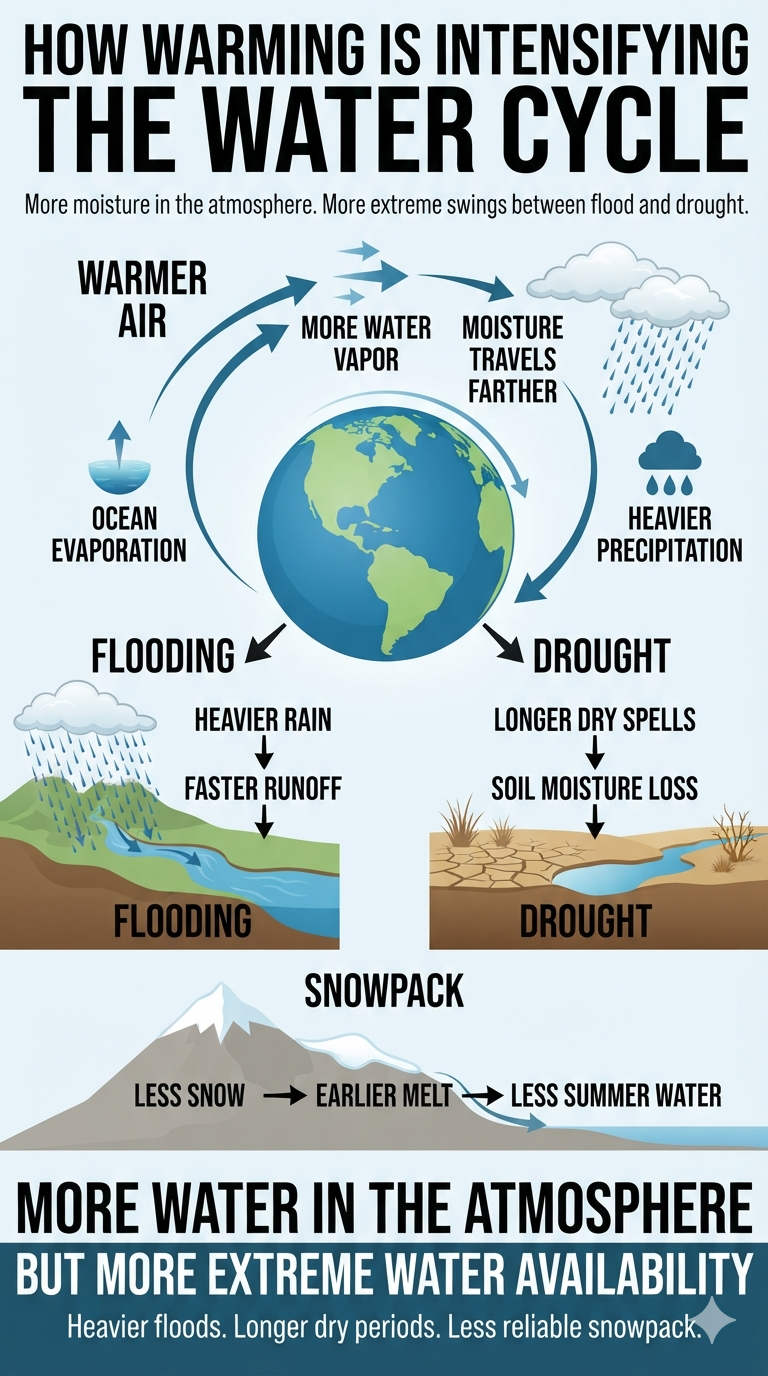
Warming → Greater atmospheric moisture capacity → Longer moisture residence time → Longer moisture transport pathways → Greater moisture availability to precipitation systems → More intense precipitation → Greater runoff and flood potential
Meanwhile:
Longer intervals between precipitation events → Greater evapotranspiration and soil-moisture loss → Longer dry periods → Drought stress
Greater runoff and flood potential
This produces an apparent paradox:
More water falling during individual storms can coexist with less water available between storms.
The distinction is between precipitation flux and water storage.
A very intense storm can move enormous quantities of water through a watershed without necessarily increasing long-term water availability proportionally.
If rainfall arrives faster than soil infiltration capacity, a larger fraction can become surface runoff. That water rapidly enters streams and rivers rather than being retained in soils or replenishing groundwater.
Thus:
More precipitation ≠ more available water.
8. Snowpack: The Natural Water Reservoir Is Shrinking
Snowpack introduces another critical component.
Mountain snowpack functions as a natural seasonal reservoir, storing winter precipitation and releasing it gradually during spring and summer.
As temperatures rise, precipitation increasingly falls as rain rather than snow in marginal snow zones. Existing snow also melts earlier.
NOAA reports that average spring snowpack across the western United States declined by approximately 20% between 1955 and 2020.
The significance extends beyond skiing or mountain ecology.
Snowpack controls the timing of water delivery to downstream watersheds.
A precipitation regime that shifts from:
winter snow → spring melt → summer runoff
toward:
winter rain → immediate runoff
loses part of the natural storage function of the mountain snowpack.
This creates a second form of hydrologic episodicity.
Instead of storing water for future months, precipitation is increasingly capable of moving rapidly through the watershed.
9. A Changing Geography of Water
The 2026 moisture-transport research adds another dimension to the problem.
If the source of precipitation changes, the hydrologic security of a region can become increasingly dependent upon atmospheric processes occurring far beyond its borders.
The study found that portions of the United States are receiving moisture that has traveled farther through the atmosphere and that a greater share of the moisture is associated with oceanic rather than terrestrial sources.
This means the traditional concept of a watershed may be insufficient for understanding future water security.
A watershed describes where water flows after it reaches the surface.
Atmospheric moisture tracking describes where that water came from before it arrived.
The two systems are connected:
Ocean → atmosphere → atmospheric transport → precipitation → watershed → river/groundwater → ocean
Climate change can alter both the atmospheric and terrestrial portions of this cycle.
Consequently, two regions receiving similar annual precipitation totals may have substantially different water-security risks depending on:
- moisture-source location,
- atmospheric transport distance,
- residence time,
- precipitation intensity,
- storm footprint,
- dry-period duration,
- snowpack,
- evapotranspiration,
- soil infiltration,
- groundwater recharge,
- and runoff.
10. Evaluation of the Hypothesis
The evidence can now be evaluated component by component.
| Hypothesis component | Evidence | Assessment |
|---|---|---|
| Atmospheric moisture residence time is increasing | Theory + observations | Supported |
| Moisture transport distance is increasing | 35-year U.S. moisture-tracking study | Supported regionally |
| Oceanic moisture contribution is increasing in some U.S. regions | 2026 moisture-tracking study | Supported regionally |
| Heavy precipitation is increasing | Long-term U.S. observations | Strongly supported |
| Precipitation intensity is increasing with warming | Observational/model evidence | Strongly supported |
| Precipitation spatial extent is decreasing | Modeling/observational evidence | Partially supported; highly regional |
| Precipitation duration is decreasing | Model evidence | Partially supported; storm-dependent |
| Dry intervals are increasing | Western U.S. observations | Supported regionally |
| Snowpack is declining | Long-term observations | Strongly supported in western U.S. |
| Water availability is becoming more spatially variable | Multiple lines of evidence | Supported |
The hypothesis therefore survives testing, but with an important modification.
The evidence does not support a universal reduction in moisture transport distance. It supports the opposite.
Nor does it establish that every precipitation event is becoming smaller or shorter.
Instead, the evidence supports a broader and more physically consistent hypothesis:
Anthropogenic warming is increasing atmospheric moisture availability and, in many regions, atmospheric moisture residence time and transport distance. At the same time, warming is increasing precipitation intensity and altering storm size, duration, frequency, and spatial organization. These changes can increase precipitation variability, producing heavier precipitation and flooding in some periods while lengthening dry intervals, reducing snowpack, and increasing water scarcity in others.
11. Implications for Flood Risk
This distinction has major implications for flood-risk assessment.
Traditional infrastructure design often relies heavily on historical precipitation statistics.
But if precipitation characteristics are changing, the historical distribution may no longer be stationary.
A watershed can experience:
longer dry periods
followed by
more intense rainfall
followed by
rapid runoff and flooding.
The flood hazard is therefore not necessarily proportional to annual precipitation.
Two watersheds receiving identical annual precipitation could have radically different flood risk if one receives its precipitation in fewer, more intense events.
This is particularly important for:
- dams,
- spillways,
- stormwater systems,
- culverts,
- bridges,
- retaining structures,
- drainage systems,
- floodplain management,
- agricultural planning,
- and reservoir operations.
The relevant engineering question increasingly becomes not simply:
How much precipitation does this watershed receive?
but:
How quickly can the atmosphere deliver precipitation to this watershed, how intensely does it fall, how spatially concentrated is it, and how rapidly can the watershed absorb or discharge it?
12. Implications for Water Management
The findings also suggest that water-management strategies based primarily on annual precipitation totals may become increasingly inadequate.
A reservoir can compensate for some variability by storing water, but natural storage systems such as snowpack and soil moisture cannot necessarily be replaced easily.
The loss of snowpack is particularly consequential because it changes the timing of water availability.
A warmer climate can therefore produce the following sequence:
More atmospheric water
→ more intense precipitation
→ more rapid runoff
→ greater flood risk
while simultaneously:
less snow storage
→ earlier runoff
→ lower summer streamflow
→ greater water scarcity
This is not contradictory.
It is the signature of a hydrologic system in which water moves through the system more rapidly and less predictably.
13. Conclusions
The hypothesis that climate warming is fundamentally altering atmospheric moisture transport and precipitation distribution is supported by multiple independent lines of evidence.
The strongest new evidence comes from atmospheric moisture tracking. A 35-year analysis of U.S. watersheds demonstrates that, in portions of the Southwest and southern Great Plains, atmospheric moisture is traveling farther and remaining airborne longer before precipitation. In some regions, the increase reaches approximately 50–80 km in transport distance and 2–4 hours in atmospheric residence time.
At the surface, heavy precipitation events have increased across the United States since the 1950s. Research further indicates that warming can alter precipitation-event size and duration, with some precipitation systems becoming more intense but spatially smaller and/or shorter-lived.
At the same time, observations from the western United States show increasing precipitation variability and longer dry intervals, while spring snowpack has declined substantially.
Taken together, these observations point toward a fundamental change in the structure of the hydrologic cycle.
The critical change may not be simply:
more precipitation vs. less precipitation.
It may instead be:
more variability → greater intensity → longer dry intervals → less natural storage → greater spatial and temporal disparities in water availability.
The atmosphere can transport moisture farther while precipitation becomes more concentrated when and where atmospheric conditions trigger rainfall. Consequently, longer moisture pathways and more localized precipitation are not contradictory processes.
The emerging picture is of a hydrologic cycle increasingly characterized by greater atmospheric moisture mobility, more intense precipitation events, altered storm dimensions, longer dry intervals, declining snow storage, and greater separation between flood and drought conditions.
This represents a shift from thinking about climate change primarily as a change in precipitation quantity toward understanding it as a change in water-cycle dynamics.
The most important future research should therefore integrate four previously separated measurements:
- Where atmospheric moisture originates
- How far and how long it travels
- How precipitation is distributed spatially and temporally when it arrives
- How efficiently the resulting water is retained as snow, soil moisture, groundwater, and reservoir storage
That integrated framework could provide a much more complete measure of whether climate change is producing an increasingly episodic hydrologic cycle—one in which water arrives in larger pulses but becomes less reliably available between those pulses.
Key References
- Aerenson, T. et al. (2026). Precipitation Over the Contiguous United States Is Coming From Farther Away Than in the Past. Geophysical Research Letters.
- Gimeno et al. (2021). The residence time of water vapour in the atmosphere. Nature Reviews Earth & Environment.
- U.S. Environmental Protection Agency. Extreme Precipitation.
- Chang et al. (2016). Changes in Spatio-temporal Precipitation Patterns in Changing Climate Conditions.
- Matte, Christensen & Ozturk (2022). Spatial extent of precipitation events: when big is getting bigger. Climate Dynamics.
- Zhang et al. (2021). Five decades of observed daily precipitation reveal longer and more variable drought events across much of the western United States. Geophysical Research Letters.
- NOAA Climate.gov. Large declines in snowpack across the U.S. West.
The central finding is stronger than the original hypothesis in one respect: the evidence now indicates that warming is not simply redistributing precipitation closer to its moisture source. The atmosphere is carrying moisture farther, while the precipitation system can nevertheless deliver that moisture in increasingly intense, episodic pulses. That distinction may be the key to understanding why flooding and drought can intensify within the same changing hydrologic system.